














































Why you should not wait to act after a dog bite
Official records begin quickly. A dog that bites a person is generally reported to local animal control or the health department and held for a rabies observation period. The resulting records identify the dog and its owner and show its vaccination status, and insurers look at them first.
The dog’s history can be requested. Animal control agencies keep files on earlier bites and complaints, and Illinois law has a process for declaring a dog dangerous. Those records speak to the owner’s awareness, which can matter even though the Animal Control Act does not require it.
Video is not kept for long. Many home cameras store footage only with a paid plan, and businesses near parks and streets record over older files. A request made in the first days has the best chance.
The injury is evidence. A wound looks different after a week. Photographs and clinic notes from the early days show how serious it was.
Illinois gives you two years from the date of the attack to file most personal injury suits, including dog bite suits. If the defendant is a local government, the Tort Immunity Act generally requires suit within one year. Do not wait to gather evidence, and talk to a lawyer about the deadline that applies to you.
How does the Illinois Animal Control Act work?
Section 16 of the Animal Control Act makes the owner liable in civil damages for the full amount of the injury when a dog, without provocation, attacks or injures a person who is peaceably conducting himself or herself in any place where the person may lawfully be. Because it covers an attack or an injury, it is not limited to bites, which can matter when a dog knocks someone down.
The statute puts the focus on two questions. Were you lawfully where you were, and did you provoke the dog? An invited guest, a mail carrier and a person walking on a public sidewalk are lawfully present. Someone who entered a fenced yard uninvited may not be.
Illinois applies modified comparative fault. Your compensation is reduced by your percentage of fault, and if you are found more than 50 percent at fault, you cannot recover. That is why insurers lean on provocation and trespass arguments.
Who can actually be held responsible?
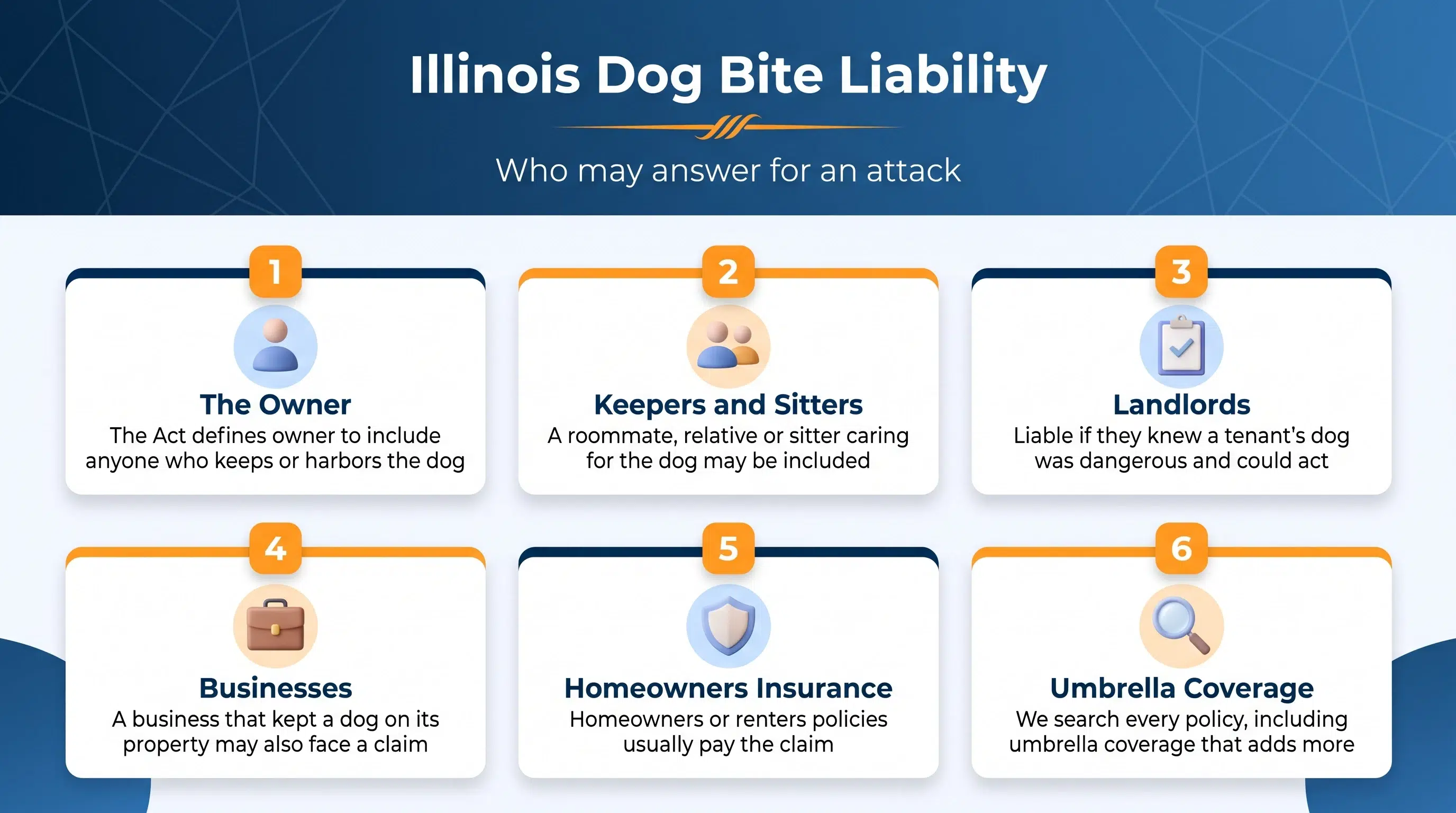
The owner is the first person to look at, and the Act defines owner to include a person who keeps or harbors the dog. That can cover a roommate, a relative or a sitter who had the dog in their care when the attack happened.
A landlord or property manager may be responsible if they knew a tenant’s dog was dangerous and had the ability to deal with it but did not. A business that kept a dog on its property may also face a claim.
Homeowners or renters insurance usually pays the claim. Some policies exclude certain breeds or limit dog coverage, and an umbrella policy may add more. We search for every policy that could apply.
What situations lead to dog attacks?
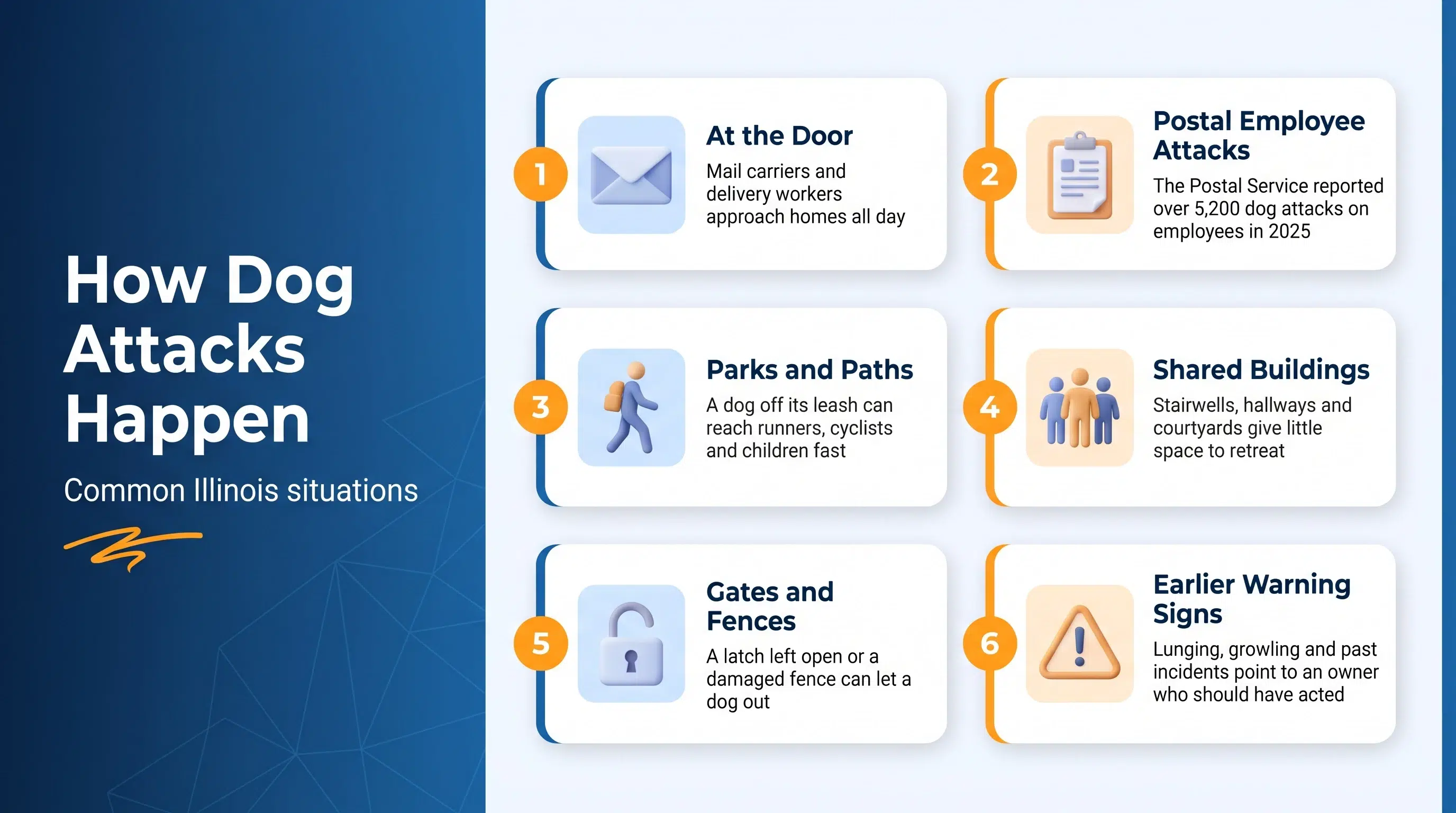
Most attacks start in ordinary circumstances that an owner could have controlled. Some of the common ones are:
- At the door: Mail carriers, delivery workers and meter readers approach homes all day. The U.S. Postal Service reported more than 5,200 dog attacks on its employees in 2025, including 260 in Illinois and 43 in Chicago.
- In public places: Parks, paths and sidewalks put dogs near runners, cyclists and children, and a dog off its leash can be on someone in moments.
- In shared buildings: Stairwells, hallways and courtyards in multi-unit buildings give a person little space to retreat.
- Through gates and fences: A latch left open or a damaged fence can let a dog reach the street.
- After earlier warning signs: Lunging, growling and past incidents point to an owner who should have acted.
How do dog bite injuries differ from other personal injury cases?
The American Veterinary Medical Association (AVMA) estimates that about 4.5 million people are bitten by dogs each year in the United States, and about 800,000 of them need medical care.
A bite can reach tendons, nerves and joints even when the surface wound looks modest. If the dog’s rabies vaccination cannot be verified, doctors may recommend preventive shots. Bacteria from a dog’s mouth can also cause infections that need antibiotics or further procedures.
Scars on the face and hands can be permanent, and children may carry fear for a long time. Medical records that start on the day of the attack and follow your recovery give the claim its structure.
How is an Illinois dog bite case valued?
Value rests on the injuries, the care they require and how the attack has changed your life and your work. The main parts are:
- Medical expenses: Emergency care, wound treatment, rabies prevention, follow-up and surgery, along with future care such as scar revision or counseling.
- Lost income: Pay missed during recovery and any lasting effect on how much you can earn.
- Non-economic damages: Pain, distress, disfigurement and fear of dogs. Illinois does not cap these in an ordinary dog bite case, but they must be supported by evidence.
- Shared fault: Your share of responsibility reduces the award, and over 50 percent bars recovery.
- Medical liens: Providers and health plans may seek repayment from the recovery. We work to reduce those balances before the case closes.
If you would like to know what your claim could be worth, schedule a free consultation and we will review it with you.
What should you do in the days after a dog bite?
See a doctor the same day. Move away from the dog and have the wound examined, even if it seems minor. Early treatment lowers infection risk and creates a record linking the injury to the attack.
Report it and identify the owner. Contact local animal control or the police, and obtain the owner’s name and address if you can. Ask whether the dog’s rabies shots are current.
Document the scene and your injuries. Photograph the wounds as they heal, save torn clothing and note nearby cameras. Write down what you remember while it is fresh, including why you were at that location.
Be cautious with the insurer. You do not have to give the owner’s insurance company a recorded statement, and casual remarks can be used to argue provocation.
Speak with a lawyer first. The consultation is free, and we handle the insurance company so you can concentrate on getting better.
Related pages: dog bite attorneys in Chicago, Illinois personal injury lawyers, slip and fall accident lawyers, and wrongful death lawyers.