







































Why you should not wait after an Illinois scooter or e-bike crash
The device may be gone. A rental scooter or bike is typically collected, repaired and rented again within days, taking the best evidence of a brake or throttle problem with it. If you own the device, do not fix it, sell it or send it back to the manufacturer before it has been inspected.
Ride data expires. Rental apps usually record when a trip started, the route and the speed. Some personal e-bikes and fitness apps keep similar data. It can show you were riding lawfully, but companies do not retain it forever, and a preservation letter sent early makes a difference.
No report, no record. Police generally write up a crash with a car. A fall from a pothole or a sudden mechanical failure may never be reported. Report it anyway, get the number, and write down your account soon after.
Video and injuries fade. Business cameras and public cameras overwrite their footage within days or weeks, and bruising and road rash heal. Early photographs and prompt medical records preserve what the crash did to you.
Illinois generally gives injured people two years to file a personal injury lawsuit. Claims against a local government over a road defect usually must be filed within one year, and a claim involving a Chicago Transit Authority bus carries a six-month notice requirement. The practical deadline can be much shorter than two years.
Who may owe you compensation in an Illinois scooter or e-bike case?
A driver is the main defendant in most serious cases. CPSC reviewed deaths from 2017 through 2024 and found motor vehicles in 140 of 206 e-scooter deaths and 170 of 310 e-bike deaths. Other parties can be added depending on the cause.
A rental company may be responsible when a poorly maintained scooter or bike fails. CPSC identified brake problems in 40 of the 189 e-scooter incidents it investigated. Rental apps require riders to accept terms that include waivers and arbitration clauses, but those terms do not always hold, particularly where the company’s own negligence caused the injury. A manufacturer or seller may answer for a defective brake or an overheating battery. A city, village or other local government can be responsible for a dangerous road, though the Tort Immunity Act gives public bodies defenses and short deadlines.
Insurance determines what can actually be collected. The at-fault driver’s liability policy is the first source, with a state minimum of $25,000 per person. Because every Illinois auto policy must include uninsured motorist coverage, your own policy may also help. Whether it extends to someone on a scooter or e-bike depends on its wording, so each policy needs a careful read.
Where do Illinois scooter and e-bike crashes happen?
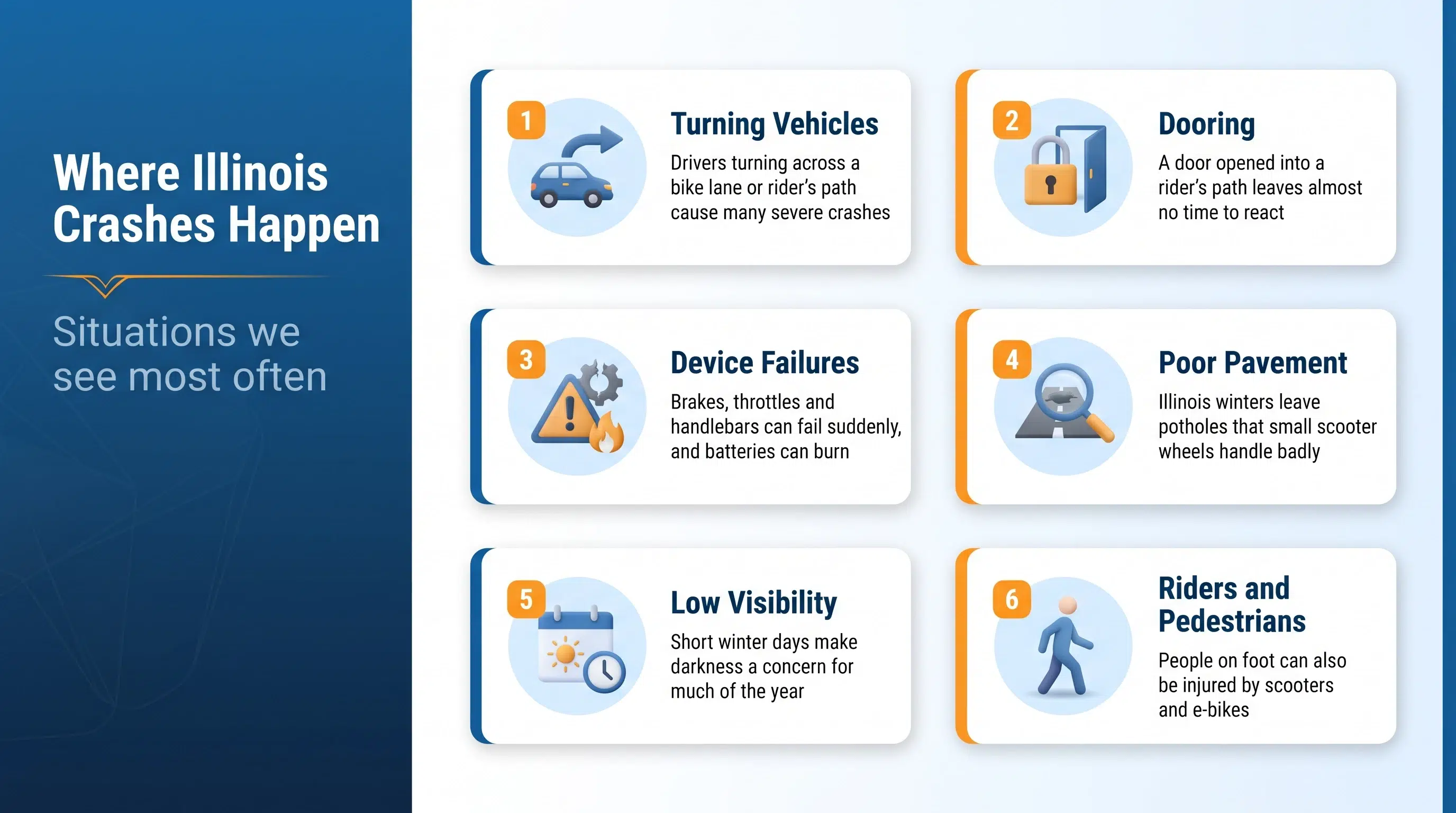
Riders are easy to overlook, and Illinois streets give drivers many chances to do it. The situations we see most often:
- Turning vehicles: A driver turning across a bike lane or a rider’s path at an intersection or driveway is behind many severe crashes. E-bikes often travel faster than the driver expects.
- Dooring: A door opened into a rider’s path in a lane beside parked cars leaves almost no time to react.
- Device failures: Brakes, throttles and handlebars can fail suddenly, and lithium-ion batteries can overheat and burn.
- Poor pavement: Illinois winters leave potholes and broken pavement behind, and small scooter wheels handle those badly.
- Low visibility: CPSC found that about one in five injured e-scooter riders in 2024 said it was dark or hard to see. Short winter days make this a concern for much of the year.
- Riders striking pedestrians: People on foot can be injured by scooters and e-bikes, and those claims may involve the rider’s insurance or the rental company.
What do Illinois law and the new 2027 statewide rules say?
Illinois is changing its rules, so which set applies depends on the date of the crash.
Before January 1, 2027
Under current law, a low-speed electric scooter is a two- or three-wheeled device under 100 pounds with handlebars and a floorboard. It may be used only where a municipality, park district or similar authority has authorized it. Riders must be at least 18, only one person may ride, the scooter may not be used on highways posted above 35 mph, and it is not allowed on state highways. This comes from Public Act 103-0899, in the Vehicle Code at 625 ILCS 5/11-1518. Cities, including Chicago, have run their own programs under local authorization.
Low-speed electric bicycles, defined in 625 ILCS 5/1-140.10 as pedal bicycles with motors under 750 watts, fall into three classes. Class 1 stops assisting at 20 mph, Class 2 can run on the motor alone, and Class 3 stops assisting at 28 mph. Class 3 riders must be 16 or older. Low-speed e-bikes may not be ridden on sidewalks, and Illinois has no statewide helmet law for e-bike or e-scooter riders, though some cities and park districts set their own rules.
Beginning January 1, 2027
Public Act 104-0854 (Senate Bill 3484), approved August 26, 2026, sets one statewide framework. An “electric micromobility device” (an e-scooter, electric skateboard or electric unicycle) may be operated only by someone 16 or older. These devices may use roads, bike lanes and bike paths, but not sidewalks, interstates, or highways posted above 35 mph unless there is a designated bike lane. A device capable of more than 28 mph may not be used on public highways, bike lanes or bike paths. For e-bikes, Class 1 and Class 2 riders must be at least 15, and Class 3 riders at least 16. An e-bike with a motor over 750 watts is treated as a motor driven cycle, which requires a driver’s license and insurance, and a title for those bought new from 2027. The law also limits how cities and home rule units can regulate these devices on their own.
Breaking a rule does not automatically defeat a claim. In Illinois, a rider found more than 50% at fault is barred from recovering, and below that line the recovery is reduced by the rider’s share. That makes it important to show whether a violation, if there was one, actually caused the crash.
How do these injuries compare with other injury cases?
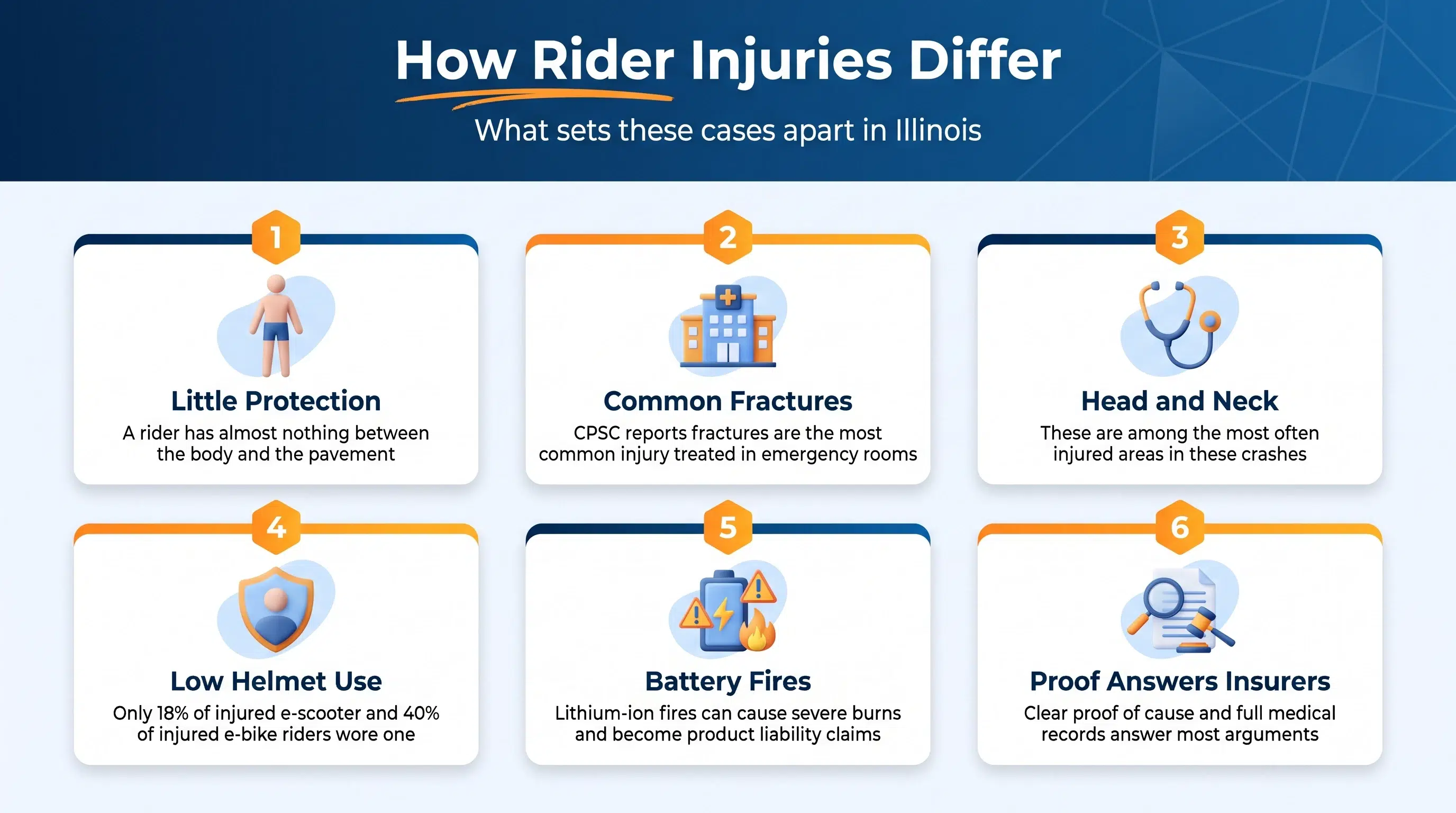
A scooter or e-bike rider has almost no protection in a crash, and the upright position makes it easy to be thrown forward. CPSC reports that fractures are the most common injuries treated in emergency rooms for these crashes, with the head and neck among the most often injured areas.
Helmets are used less than they should be. In CPSC’s 2024 follow-up study, 18% of injured e-scooter riders and 40% of injured e-bike riders wore one. Insurers may argue that a missing helmet worsened a head injury, even though Illinois has no statewide helmet requirement. That argument does not erase a driver’s fault, and its weight varies with the injury and the proof.
Not every injury comes from the impact. Battery fires can cause severe burns, and those cases are product liability claims rather than traffic cases. The best answer to nearly every insurer argument is the same: solid proof of what caused the crash and complete medical records from the first visit.
What is an Illinois scooter or e-bike claim worth?
The value turns on the severity of the injury, the care needed, and the effect on your life and work. The usual components:
- Medical expenses: Emergency treatment, imaging, surgery and rehabilitation are proven with records and itemized bills. Future care, such as hardware removal after a fracture repair, is estimated with the treating doctors.
- Lost income: This is the pay missed while recovering. For someone who depends on an e-bike for work or commuting, an injury can cost both the income and the way to earn it.
- Non-economic damages: Pain, emotional distress, scarring and lost activities count toward value. Illinois does not cap these in an ordinary injury case, and their weight depends on how well they are documented.
- Shared fault: Compensation is reduced by the rider’s percentage of fault and barred above 50%, which explains why insurers dwell on speed and helmet use.
- Available insurance: The Illinois minimum liability limit is $25,000 per person. Uninsured motorist coverage, a rental company claim or a product liability claim may add other sources.
- Medical liens: Hospitals, lien-based providers and health insurers may claim repayment from a recovery. GoSuits negotiates these balances before the case closes, so that more of the money reaches our client.
To learn what your claim may be worth, set up a free consultation. We will review what happened and explain your options.
What to do in the first days after a crash
See a doctor right away. Walking away from a crash does not mean you are uninjured. Concussions and some fractures can take hours to appear, and a same-day visit documents the connection to the crash.
Report the crash and keep the ride record. If a vehicle was involved, call the police and obtain the report number. On a rental, screenshot the ride receipt and report the crash in the app in a brief, factual way. Get the driver’s name, plate number and insurance information if possible.
Leave the device untouched. Do not repair or discard your own scooter or e-bike, and do not send it back to the maker. For a rental, photograph it from several angles before it is collected, including brakes, tires and visible damage. Keep your helmet and damaged gear.
Document where it happened. Photograph the pavement, the intersection and whatever contributed, such as a pothole, a parked car or a blocked bike lane. Collect witness names and numbers, and note nearby businesses with cameras.
Speak with us before the adjuster. The driver’s insurer or the rental company may call quickly and ask for a recorded statement. You are not required to give one. Schedule a free consultation first, and we will handle the calls while you focus on getting better.
Related pages: Chicago pedestrian injury lawyers, Chicago rideshare accident lawyers, car accident lawyers, product liability lawyers, wrongful death lawyers, Illinois personal injury lawyers and our Chicago personal injury team.