In Illinois, a wrongful death lawsuit is not filed by the grieving family members in their own names. Under the Illinois Wrongful Death Act, the action must be brought by and in the name of the deceased person’s personal representative, such as an executor, an administrator, or a court-appointed special administrator [1]. The money recovered is for the exclusive benefit of the surviving spouse and next of kin [1]. A judge, not the representative, divides the recovery among those beneficiaries in proportion to each person’s dependency on the person who died [4]. Who qualifies, how the split is decided, and how the deadline works all depend on the facts, so family members should speak with a lawyer promptly.
Legal Snapshot
-
Legal Topic: Who may bring an Illinois wrongful death action and who receives the recovery
-
Jurisdiction: Illinois state law, with federal law noted only where a federal defendant is involved
-
Case Stage: Pre-suit and early filing (appointing a representative, identifying beneficiaries)
-
Primary Legal Issue: Standing to sue (personal representative) and distribution of proceeds (spouse and next of kin)
-
Primary Authority: Illinois Wrongful Death Act, 740 ILCS 180/1 et seq.; Illinois Survival Act, 755 ILCS 5/27-6
-
Date Legal Authority Last Reviewed: November 11, 2026 (research review; attorney review pending)
What Does “Wrongful Death” Mean in Illinois?
A death is “wrongful” under Illinois law when it is caused by a wrongful act, neglect, or default that would have entitled the injured person to sue and recover damages had the person lived [1]. The Act applies even if the circumstances also amount to a felony [1]. This is a civil claim for money damages. It is separate from any criminal case, and this article does not address criminal proceedings.
The liable party can be a person, a company, or a corporation that would have been liable if the death had not occurred [1]. Common fact patterns include vehicle crashes, unsafe premises, defective products, and workplace incidents, though each carries its own rules.
What Does Illinois Law Say About Who Can File?
The Wrongful Death Act requires that every action be brought by and in the names of the personal representatives of the deceased person [3]. A spouse, child, or parent generally cannot file the wrongful death claim in his or her own name. Instead, someone must first be appointed to act for the person who died.
There are two recognized routes to becoming the plaintiff:
-
Representative of the estate. If the probate court appoints a representative of the decedent’s estate, that representative is the plaintiff [6]. The decedent’s will may name an executor. If there is no will, the court may appoint an administrator.
-
Special administrator. If the wrongful death claim is the only thing the person who died left behind, and no probate estate has been opened, Section 2.1 of the Illinois Wrongful Death Act offers a simpler option. Someone entitled to share in the recovery can ask the court to appoint a special administrator to bring the lawsuit, after giving whatever notice the court requires [2]. Illinois courts have recognized that a properly appointed special administrator can hire a lawyer and pursue the wrongful death claim [11].
The person appointed is a fiduciary, which means they must act for the benefit of the family members entitled to the money. Under the Illinois Wrongful Death Act, the recovery belongs to the surviving spouse and next of kin, not to the representative, and the court distributes it even when the case settles (740 ILCS 180/2). A settlement is therefore not the representative’s private decision.
What Legal Rules Apply?
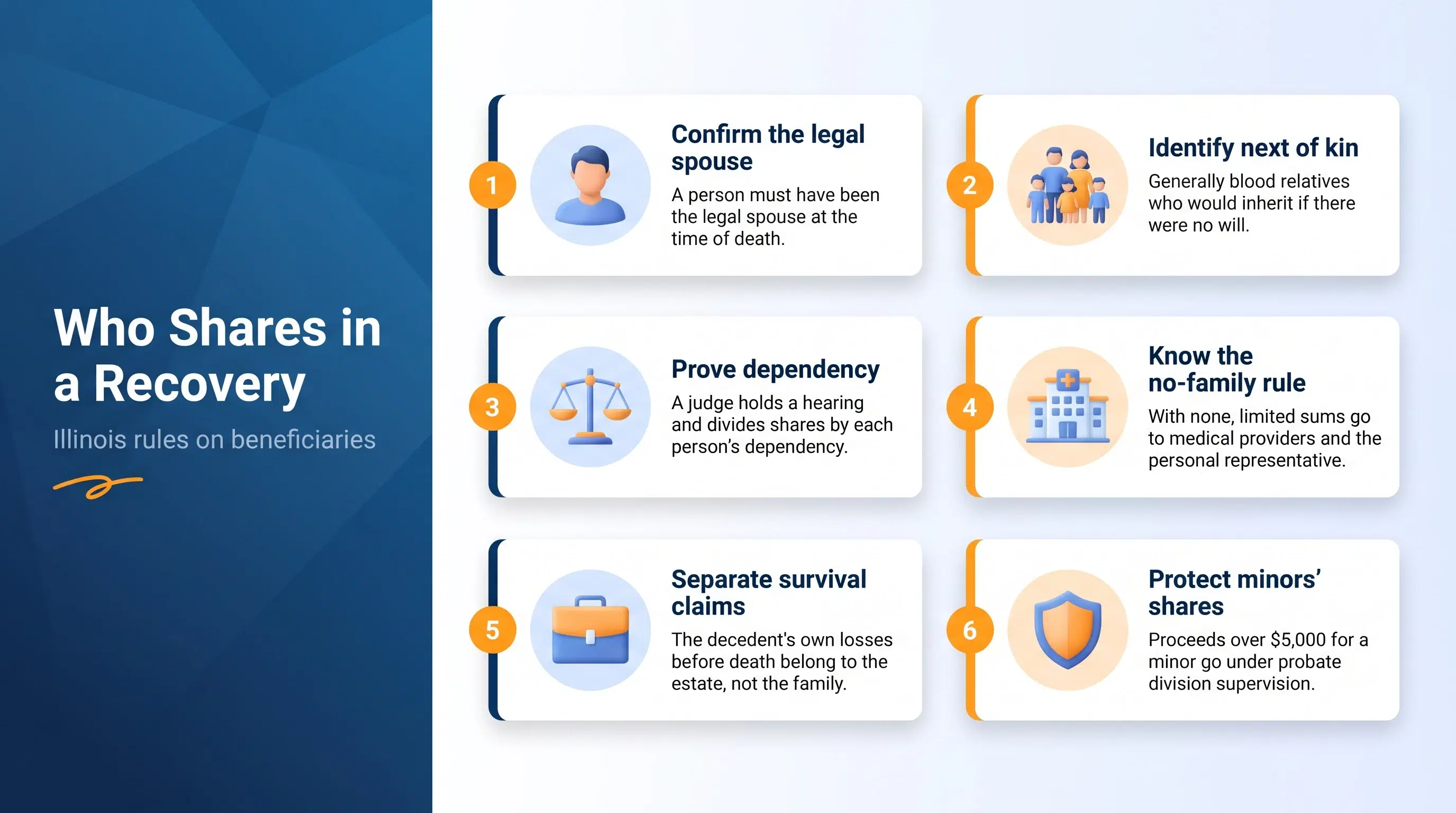
Who counts as the surviving spouse and next of kin?
The Act names two groups of beneficiaries: the surviving spouse and the next of kin [3]. Some general points are widely described by Illinois practitioners:
-
A person must have been the legal spouse at the time of death.
-
“Next of kin” generally means blood relatives who would inherit if the decedent died without a will (Morris v. William L. Dawson Nursing Center, Inc., 187 Ill. 2d 494 (1999)).
-
The Act treats an adopting parent and an adopted child like a natural parent and natural child [4].
-
When the decedent leaves surviving children, parents and siblings generally do not qualify as next of kin (755 ILCS 5/2-1).
How is the money divided?
The court that heard the case decides how the money is divided. If the case ends in a settlement instead of a trial, the circuit court divides it. Each surviving spouse and next of kin receives a share based on how much they depended on the person who died, compared with everyone else who depended on that person [4]. A judge holds a hearing to decide how dependent each person was [6]. This formula comes from 740 ILCS 180/2(b)
“Dependency” is not limited to money. Under Illinois pattern jury instructions, when the person who died leaves direct-line relatives, such as children or parents, the law presumes those relatives suffered a substantial loss from the death [5]. Because the judge weighs the evidence at the distribution hearing, the person with the closest relationship does not automatically get the largest share. How the money is divided depends on what each person can prove.
What if there is no spouse or next of kin?
If the person who died left no surviving spouse or next of kin entitled to recover, the law allows only limited payments to certain people[1]. These include whoever provided hospital care and medical care for the final illness or injury, and the personal representative for the costs of handling the estate and the lawsuit. Under 740 ILCS 180/2(c), hospital and medical payments are each capped at $450, and the total is capped at $900 plus a reasonable attorney’s fee.
Wrongful death versus survival claims
Illinois treats the family’s losses separately from the losses of the person who died. Under the Survival Act, 755 ILCS 5/27-6, a claim for personal injury generally continues after the injured person’s death, with limited exceptions [8]. That claim belongs to the estate. The table below compares the two.
|
Question |
Wrongful Death Act (740 ILCS 180) |
Survival Act (755 ILCS 5/27-6) |
|---|---|---|
|
Whose losses? |
The surviving spouse and next of kin |
The decedent’s own losses before death |
|
Who files? |
Personal representative or special administrator |
Representative of the estate |
|
Who receives the money? |
Spouse and next of kin, divided by the court by dependency |
The estate, passing under the will or intestacy rules |
|
Typical damages |
Pecuniary loss, grief, sorrow, and mental suffering |
Pre-death medical bills, lost wages, conscious pain and suffering |
The two claims are often pleaded together when the person survived for a period after the injury. Since a 2023 amendment, both the Survival Act and the Wrongful Death Act refer to punitive damages “when applicable” [8]. Punitive damages are not available in medical malpractice or legal malpractice cases, or in claims against the State or a local government. An attorney should review if punitive damages are available in a given case [1].

How Does This Apply to a Real Case?
Hypothetical example (not a GoSuits case). A married father of two minor children is struck in a rear-end collision in stop-and-go traffic on the Kennedy Expressway and dies two weeks later. He had no will, and his own parents are living. Because no family member can sue in his or her own name, the surviving spouse petitions the Circuit Court of Cook County, where civil cases are filed at the Richard J. Daley Center, to be appointed as representative or special administrator. Once appointed, she files the wrongful death action on behalf of herself and the children, and, if the facts support it, a survival claim for the two weeks of treatment and suffering.
If the case resolves, the court holds a dependency hearing. Under the rules above, the spouse and the minor children would be the likely focus of the distribution. His parents generally would not share, because under Illinois law the spouse and children inherit ahead of parents (Morris v. William L. Dawson Nursing Center, Inc., 187 Ill. 2d 494 (1999)). Because the children are minors, if the spouse was appointed special administrator, any amount over $5,000 that goes to a child must be handled under the supervision of the probate division, after the court approves expenses and fees, if the circuit court has a probate division [2].
What Evidence Can Matter?
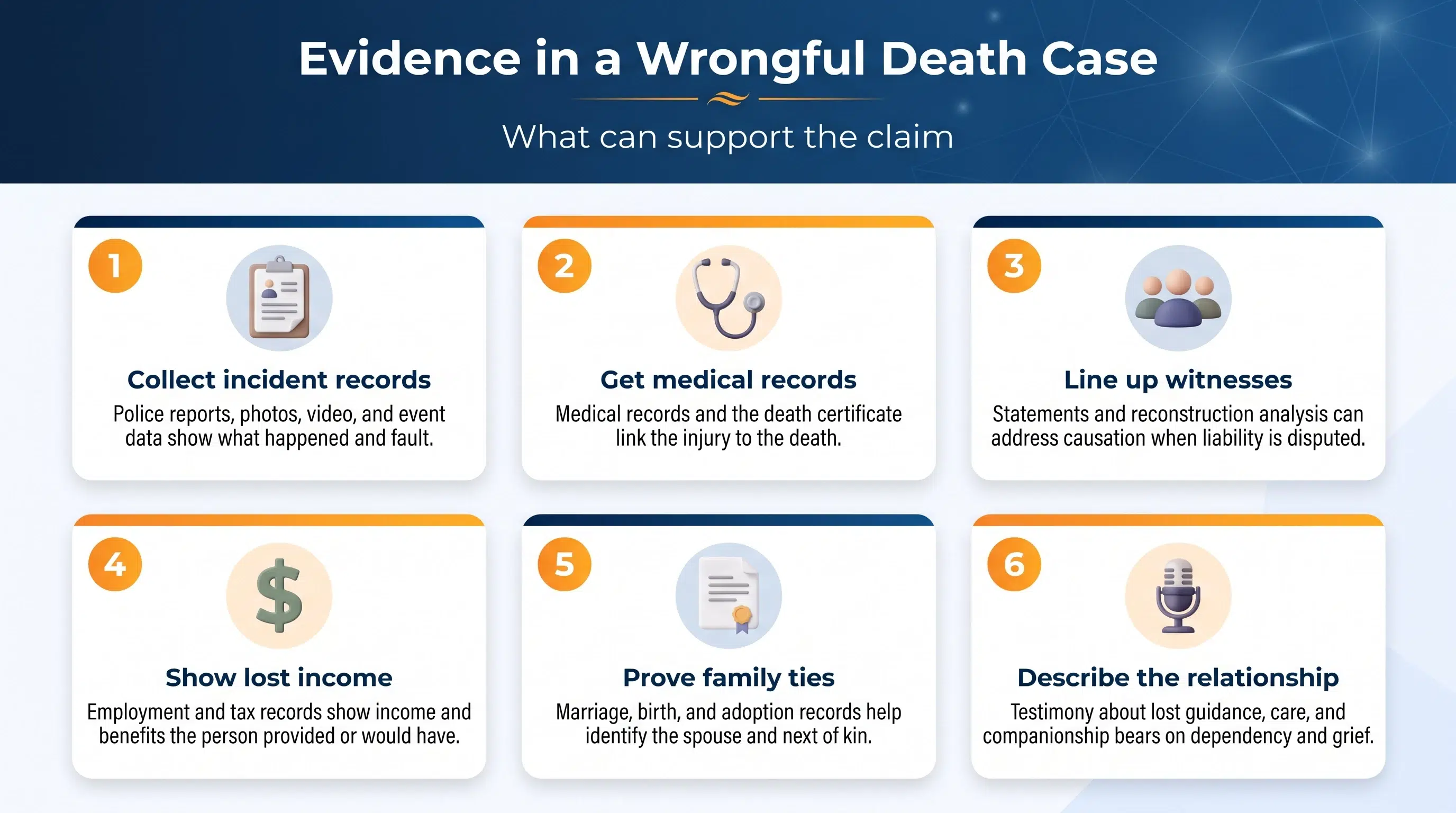
A wrongful death case has two evidence tracks. One proves that someone’s wrongful act caused the death. The other proves what the family lost. Evidence is not self-proving, and each item has to be tied to the legal elements.
-
Police and incident reports, photographs, video, and event data: establish what happened and who may be at fault.
-
Medical records and the death certificate: connect the injury to the death and support any survival claim for pre-death suffering.
-
Witness statements and reconstruction analysis: can address causation when liability is disputed.
-
Employment and tax records: show the income and benefits the decedent customarily provided and was likely to provide.
-
Family relationship records: marriage, birth, and adoption records help identify the spouse and next of kin.
-
Testimony about the relationship: shows the guidance, care, and companionship lost, which bears on dependency and on grief damages.
What Damages or Remedies May Be Available?
In a wrongful death action, a jury may award what it considers fair and just compensation for the family’s losses from the death, including damages for grief, sorrow, and mental suffering, and punitive damages when applicable [1]. llinois pattern jury instructions describe these losses as including the money, goods, and services the person who died provided or would likely have provided, along with the loss of their companionship and guidance in certain relationships [5]. The instructions note that next of kin may recover for grief, sorrow, and mental suffering when the death occurred on or after May 31, 2007.
A survival claim can add medical expenses and lost wages from before the death, along with the pain and suffering the person experienced while alive. Funeral and burial expenses may also be part of a claim, depending on who paid them and the applicable statute, such as the Illinois Family Expense Act (750 ILCS 65/15). What can be recovered depends on the facts and on Illinois law, and no outcome or amount can be promised.
What If the Other Party Disputes Liability?
A defendant may argue that it was not negligent, that its conduct did not cause the death, or that the person who died or a beneficiary shared fault. Under the Illinois Wrongful Death Act, a beneficiary’s own negligence reduces that beneficiary’s share of the recovery, and a beneficiary whose fault is more than 50 percent of the cause of the death cannot recover at all (740 ILCS 180/2). A defendant may also challenge who is entitled to share in the recovery, which is why the dependency hearing and the identification of beneficiaries matter early in the case.
What If Insurance Is Involved?
Many wrongful death recoveries come from liability insurance, and policy limits can affect what is realistically collectible. Uninsured and underinsured motorist coverage may also matter in vehicle cases (215 ILCS 5/143a and 143a-2). Health insurers, hospitals, and other lienholders may assert claims against a recovery, so the gross settlement and the amount that reaches each beneficiary can differ. Families should avoid signing releases or giving recorded statements to an insurer without legal advice.
How Long Do I Have to Act?
The general rule is that a wrongful death action must be filed within two years after the death [3].The clock generally runs from the date of death, not the date of the underlying injury or crash. Illinois law contains exceptions and related deadlines:
-
Violent intentional conduct and certain listed crimes. Subsection (e) of the Act extends the deadline to five years after the death if the death resulted from violent intentional conduct, or to one year after the criminal case ends if the defendant is charged with certain listed homicide offenses. The extension applies only against the person who allegedly committed the act or was charged, not against any other person or entity [3].
-
Minor beneficiaries. If a person entitled to benefits was under 18 when the cause of action accrued, that person may bring the action within two years after turning 18 [3]. Because the claim is brought by a representative, an attorney should review how this applies in practice.
-
Federal defendants. A tort claim against the United States is barred unless it is presented in writing to the appropriate federal agency within two years after the claim accrues, or suit is begun within six months after a final denial is mailed [9]. This is a federal rule that applies separately from the Illinois Act [10].
-
Local government defendants.Under the Local Governmental and Governmental Employees Tort Immunity Act, most lawsuits against an Illinois local government or its employees must be filed within one year (745 ILCS 10/8-101)
Appointing a representative takes time, particularly when family members disagree about who should serve. Waiting to start that process can consume a meaningful part of the limitations period.

What Should I Do Next?
-
Write down the date of death and preserve records, photographs, and insurance paperwork.
-
Do not give recorded statements or sign releases for an insurer before speaking with a lawyer.
-
Gather documents showing family relationships and the decedent’s income and household contributions.
-
Talk with a lawyer about who should serve as personal representative or special administrator.
-
Calendar every possible deadline, including any government-entity notice period, and have a lawyer confirm them.
An Illinois wrongful death claim involves court appointments, competing beneficiaries, insurance issues, and strict deadlines. Our Chicago wrongful death team can review the circumstances, and our Illinois personal injury practice serves families across the state, including those in Naperville, Joliet, and Elgin. Cases are evaluated individually and no outcome is guaranteed. Wrongful death lawyers can explain how the Act applies to a particular family, and personal injury lawyers can also address any claim the decedent held before death. To discuss your situation, you can schedule a free consultation. You may also review the GoSuits Chicago personal injury page for background on our services.
This article provides general legal information about Illinois law and is not legal advice. It does not create an attorney-client relationship. Illinois statutes and court decisions change, and every case turns on its own facts. A licensed Illinois attorney should review the law and deadlines that apply to your situation.
References
-
740 ILCS 180 Wrongful Death Act, 2025 Illinois Compiled Statutes – Justia
-
740 ILCS 180 Wrongful Death Act, 2005 Illinois Code (historical compilation) – Justia
-
Illinois Pattern Jury Instructions, Civil, Section 31.00 Wrongful Death – Illinois Courts
-
Clear warning for attorneys in wrongful death cases – Illinois State Bar Association
-
28 U.S.C. 2401, Time for commencing action against United States – GovInfo