- What we know about the Palm Desert I-10 crash
- Why chain-reaction truck crashes are so destructive
- Where families can obtain official records and reports
- Civil legal pathways after a fatal interstate crash
- Insurance, evidence, and protecting your rights
- If the victim was working: workers’ compensation death benefits
- Safety context: national truck crash trends and I-10 traffic realities
- Why acting quickly matters after a fatal truck crash
- Commentary from Gosuits Los Angeles, California Personal Injury Attorney
- References
What we know about the Palm Desert I-10 crash
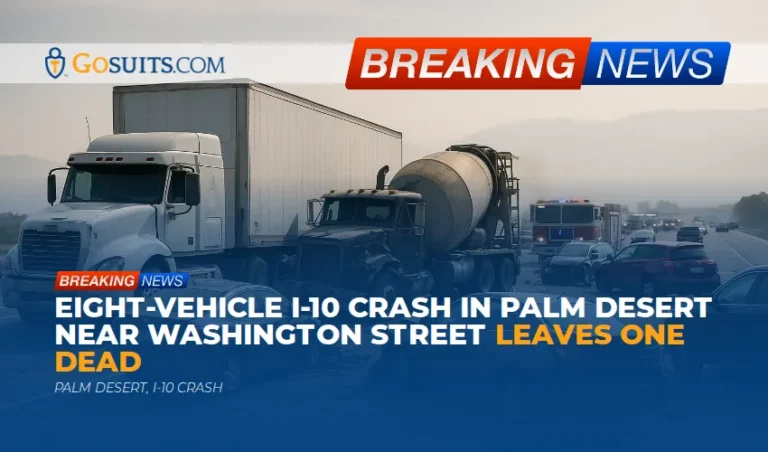
On the morning of April 14, 2026, an eight-vehicle, chain-reaction crash unfolded on Interstate 10 in Palm Desert, just west of the Washington Street on-ramp. According to publicly released information from the Riverside County Sheriff Coroner’s Bureau, 62-year-old George Mauricio of Yucca Valley was pronounced deceased at the scene. The coroner’s record lists the injury and death location as westbound I-10 approximately 0.03 miles west of the Washington Street on-ramp, with the time of injury recorded at 7:47 a.m. and the time of death at 8:10 a.m. The investigating agency is the California Highway Patrol, Indio Area [1].
Details reported contemporaneously indicate that a tractor-trailer traveling eastbound veered left for reasons not yet publicly determined, crossed the center median, and entered the westbound lanes, where it struck Mauricio’s cement mixer. The initial violent broadside impact reportedly left the trailer obstructing westbound travel lanes, where it was struck by additional vehicles, and other collisions occurred in the eastbound lanes as traffic reacted to the unfolding emergency. CHP Indio is leading the collision investigation.
Palm Desert residents know the I-10 corridor well. That stretch near Washington Street is a lifeline for morning commuters between Indio, La Quinta, Palm Desert, and Palm Springs, as well as for heavy truck traffic moving along the Coachella Valley. At that hour, traffic often includes a mix of local drivers, construction crews, and through-traffic bound for the Inland Empire and the Los Angeles Basin.
Why chain-reaction truck crashes are so destructive
Multi-vehicle collisions on high-speed interstates are uniquely dangerous. When a fully loaded tractor-trailer crosses a median into opposing traffic, it can unleash enormous kinetic energy. Secondary and tertiary crashes often follow within seconds as nearby drivers have little time or space to react. Debris fields, jackknifed trailers, and lane obstructions multiply the risks for everyone approaching the scene.
From a civil-injury perspective, scene complexity matters. Investigators and reconstruction experts may analyze:
- Pre-impact vehicle movements using roadway evidence, eyewitness accounts, dashcams, and nearby traffic cameras.
- Heavy-vehicle data such as engine control module (ECM) downloads, speed, braking, throttle position, and fault codes.
- Maintenance and load documentation including inspection reports and bills of lading to see if cargo shift, mechanical failure, or braking issues played a role.
- Median and roadway design to evaluate whether vehicle containment or barrier performance had relevance to crash severity.
In the Coachella Valley, spring can bring heavier-than-usual freeway volumes due to seasonal events. Mix that with regional delivery trucks, interstate semis, and commuter traffic and it becomes clear why any loss of control by a large rig can ripple into a devastating chain of impacts.
Where families can obtain official records and reports
Families affected by fatal crashes typically need a combination of records for insurance claims, employer paperwork, and potential civil actions. For this incident, the following agencies and documents are most relevant:
- Riverside County Sheriff-Coroner: The Coroner’s Bureau records identity, location, and time of death and maintains official records connected to the decedent. The coroner’s press release for this case confirms the decedent’s identity and the precise location near the Washington Street on-ramp in Palm Desert [1].
- California Highway Patrol – Collision Report: Since CHP Indio is the investigating agency, the official collision report is a foundational record for claims. CHP explains how to request a traffic collision report on its public portal, including eligibility requirements and request methods [2].
- Autopsy and death certificate: Depending on the family’s needs and the status of the investigation, the coroner can advise on how to request additional records. Requests often require proof of relationship and may be subject to investigative holds.
- Employer records: If the decedent was on-duty, families may need wage statements, job description, and workers’ compensation carrier information for death benefit claims.
Practical note: request the CHP collision report as soon as you’re eligible. These reports often include measurements, diagrams, involved-party statements, witness details, and listed evidence. They are essential for insurance and civil claims, especially in complex multi-vehicle scenes.
Civil legal pathways after a fatal interstate crash
Each crash is fact-specific, but certain legal frameworks commonly apply in California after a fatal collision on I-10:
- Negligence and vicarious liability: If a commercial driver’s negligence caused the crash, their motor carrier employer may face vicarious liability for actions within the course and scope of employment. Additional direct-liability claims can arise if evidence shows negligent hiring, retention, training, supervision, dispatching, or maintenance.
- Wrongful death and survival claims: California law allows certain family members to bring a wrongful death action to recover losses such as financial support, household services, and loss of companionship. A companion survival action can pursue claims the decedent could have brought had they lived (e.g., medical expenses before passing).
- Third-party liability beyond the driver: Depending on the evidence, claims may extend to a truck’s maintenance contractor, a loading company if improper cargo securement contributed to loss of control, or other drivers if their conduct exacerbated the chain reaction.
- Comparative fault and multi-vehicle apportionment: California applies comparative fault principles, which can impact how a jury or insurers apportion responsibility across multiple parties in a chain-reaction crash. Thorough reconstruction is key.
Time limits matter. California’s general statute of limitations for actions arising from wrongful death based on negligence is two years [3]. However, shorter timelines can apply in certain scenarios, such as government-entity involvement under the Government Claims Act. Because deadlines vary and evidence can be lost quickly, it is crucial to clarify all potential time bars early.

How specialized civil claims intersect with complex trucking cases
Commercial trucking cases can involve federal and state safety rules, including service-hour compliance, vehicle maintenance mandates, and load-securement standards. When ECM data, telematics, and internal safety audits are preserved promptly, they can help establish or refute liability. Families and injured survivors should consider sending preservation letters to keep key records, including:
- Vehicle event data and ECM downloads.
- Driver qualification file, duty logs or ELD data, dispatch records, and trip planning materials.
- Maintenance, inspection, and repair records.
- Load and route documentation.
- Company safety policies, training records, and internal post-collision reviews.
To understand typical risk factors in heavy-vehicle collisions on Southern California freeways, you may find this overview helpful: Common Truck Crash Causes on Los Angeles Highways.
Insurance, evidence, and protecting your rights
Multi-vehicle freeway crashes often trigger competing insurance claims and rapid-fire inquiries from adjusters and company representatives. A few practical points:
- Consult a trusted attorney before speaking with insurers: Statements can be used against you later. In the immediate aftermath, it is easy to misspeak, speculate, or accept a partial narrative that harms your rights down the line. An early consultation helps keep communications consistent and strategic.
- Preserve documentation: Save photos, dashcam footage, tow and repair invoices, medical billing, and any communications with employers or carriers. For fatalities, maintain funeral and burial receipts as well as proof of financial support the decedent provided.
- Track impacted dependents and household services: In wrongful death matters, careful documentation of the decedent’s contributions to the household, both financial and non-financial, is essential for establishing damages.
- Independent evaluation: Complex scenes sometimes produce conflicting accounts. Independent scene review, including site inspections and 3D mapping, can clarify impact sequences and who is truly at fault.
Our region’s families deserve a fair and accurate accounting, not a rush to judgment. Decisions made in the first weeks after a fatal crash often shape the rest of the case.
How attorney involvement supports complex, multi-party cases
When multiple insurers are involved, policy disputes, coverage stacking, and priority-of-payment questions can delay or diminish recovery. Seasoned counsel can help ensure that the right coverages respond in the right order and that all liable parties are identified and preserved for claims. In the background, preservation demands and expert alignments must happen quickly so critical evidence does not disappear.
If the victim was working: workers’ compensation death benefits
When a person is fatally injured while performing work duties, California workers’ compensation death benefits may be available to eligible dependents. For qualifying claims, benefits can include reasonable burial expenses and a statutory death benefit amount that depends on the number of total and partial dependents, with current benefit tiers set by law. California’s Division of Workers’ Compensation provides public guidance on how death benefits work and the ranges that apply by date of injury and level of dependency [4].
In practice, families often pursue parallel claims when a third party caused the fatal crash. For example, if a commercial driver or another entity caused a collision that killed a worker who was on duty, eligible dependents may obtain workers’ compensation death benefits and also assert a third-party wrongful death claim. Each route has different rules, timelines, and potential recoveries, and they can intersect through subrogation and credit rights. Coordinating these pathways strategically is important.
Safety context: national truck crash trends and I-10 traffic realities
High-speed corridors such as I-10 through the Coachella Valley carry a heavy mix of passenger vehicles and commercial trucks. Nationally, preliminary data indicated a small year-over-year decrease in overall traffic fatalities during 2023, yet fatality levels remained elevated compared to pre-pandemic baselines [5]. Large-truck crash data remain a focal point for roadway safety stakeholders; federal publications track trends in fatalities and injury crashes involving large trucks and buses, shedding light on multi-factor causes and risk mitigation approaches [6].
Local drivers know that I-10 sees frequent lane closures, seasonal event surges, early-morning work convoys, and heavy freight movement. Even modest disruptions or sudden obstructions can quickly propagate into a chain reaction. That is why lane discipline, adequate following distance, and avoiding distraction are so crucial along that stretch. And when a heavy vehicle crosses a median, there is often almost no margin for error for oncoming traffic.

Why acting quickly matters after a fatal truck crash
What should happen next
- Request essential records: Obtain the CHP collision report when available and ask the Riverside County Sheriff-Coroner about what additional records can be released and when. Compile employer and insurance documentation, especially if the decedent was on duty.
- Secure evidence now: Heavy-vehicle ECM data, dashcam video, event logs, and maintenance records can be overwritten or lost. Rapid preservation efforts protect your ability to learn what really happened.
- Coordinate benefits and claims: Align potential workers’ compensation death benefits with any third-party wrongful death and survival claims so no rights are inadvertently waived and deadlines are observed.
- Be cautious with insurers: Before giving any recorded statement or signing medical or record releases, seek guidance. Early choices can shape fault determinations and settlement posture.
Why now
Evidence fades fast on interstates. Skid marks vanish, debris gets cleared, and witnesses become harder to reach. For families already grappling with loss, a clear plan grounded in timely records, preserved evidence, and thoughtful claim coordination can prevent avoidable disputes and protect long-term security.
Commentary from Gosuits Los Angeles, California Personal Injury Attorney
Our hearts are with the family, friends, and co-workers of the driver who died on I-10 near Washington Street. This piece is offered for education and general information.
From what is publicly known, this was a sudden and violent chain-reaction event initiated by a large rig crossing into oncoming lanes on a busy stretch of freeway. When a heavy vehicle enters opposing traffic, secondary impacts often follow, and fault can become complex. That is why immediate preservation of commercial records and roadway evidence is so important.
We often see insurers and large companies move quickly to shape the narrative of a crash. Families may be pressed to provide statements before they have the full picture or are asked to sign authorizations that are broader than necessary. Without guidance, crucial evidence can slip away and technical questions about heavy-vehicle data, service-hour compliance, maintenance, and loading can go unexamined.
A timely, no-cost consultation can help clarify the process, set preservation priorities, and coordinate parallel claims such as workers’ compensation death benefits and civil wrongful death actions. It is a step that can level the playing field and ensure that decisions made in the first weeks safeguard the family’s long-term interests.
Practice-area insight for Southern California readers
Families often have questions about who can bring a case and where to start. Within the body of this article (outside of this commentary), you will find references to personal injury lawyers and to two practice areas that frequently intersect with cases like this: truck accident lawyers and wrongful death lawyers. These phrases reflect common categories of civil claims and insurance disputes that may arise after a multi-vehicle interstate crash in our region. It is always wise to consult before engaging with any insurance representative.
Helpful claim-related language you may encounter
- Personal injury lawyers: Broad category covering civil claims after injury or death due to negligence. Families often search for this phrase when looking for education and representation.
- Los Angeles personal injury lawyers: Localized phrasing that aligns with many SoCal-based resources serving readers across the region.
- Truck accident lawyers: Focused on the standards, records, and technical evidence that are unique to commercial-vehicle collisions.
- truck accident lawyers in Los Angeles: A localized form of the same concept for readers seeking regional context and resources.
- Wrongful death lawyers: Address loss-of-life claims brought by eligible family members, including financial support and non-economic harms unique to wrongful death cases.
- wrongful death lawyers in Los Angeles: Localized phrasing that can help families find educational materials aligned with California law.
None of these phrases should be interpreted as a guarantee of any particular outcome. They are simply common descriptors tied to the types of civil claims and resources that often come into play after catastrophic freeway events.
Navigating resources and agencies
To recap the most important records for a fatal crash on I-10 in Palm Desert: the Riverside County Sheriff-Coroner press release confirms identity, time, and location details [1], and CHP’s official collision report process is explained on a public-facing California Highway Patrol page [2]. For families dealing with a work-related fatality, the California Division of Workers’ Compensation provides state-issued guidance on burial benefits and dependency-based death benefit amounts [4]. And for a statewide view of safety trends, NHTSA and FMCSA publish data and reports that help frame truck-involved crash risk and prevention [5] [6].

A closing thought for our Coachella Valley community
The I-10 corridor ties our valley to the Inland Empire and the Los Angeles Basin. Crashes like this reverberate through families, job sites, and neighborhoods from Indio to Palm Springs. Slowing down near work zones, leaving space around large trucks, and staying alert can help us all. When tragedy strikes, accurate records, preserved evidence, and careful claim coordination can provide clarity and accountability.
References
- 2026-02860 Coroner’s Release – Riverside County Sheriff-Coroner
- Traffic Collision Report Request – California Highway Patrol
- California Code of Civil Procedure § 335.1 – California Legislature
- Workers’ Compensation Benefits and Death Benefits – CA Division of Workers’ Compensation
- Early Estimate of Motor Vehicle Traffic Fatalities for 2023 – NHTSA
- Large Truck and Bus Crash Facts – FMCSA