- What Is Influencer False Advertising?
- What Do FTC Disclosure Rules Require of Influencers?
- Are Filters and Cosmetic Enhancements Deceptive?
- Who Can Actually Be Sued: The Influencer, the Brand, or the Agency?
- What Penalties Can Violators Face?
- Can a Consumer File a Civil Lawsuit?
- How Do State Laws Apply in California, Texas, and Illinois?
- What If the Product Actually Caused Physical Harm?
- Perspectives of Both Plaintiffs and Defendants
- What Should You Do If You Were Misled by an Influencer Ad?
- How GoSuits Can Help
- References
What Is Influencer False Advertising?
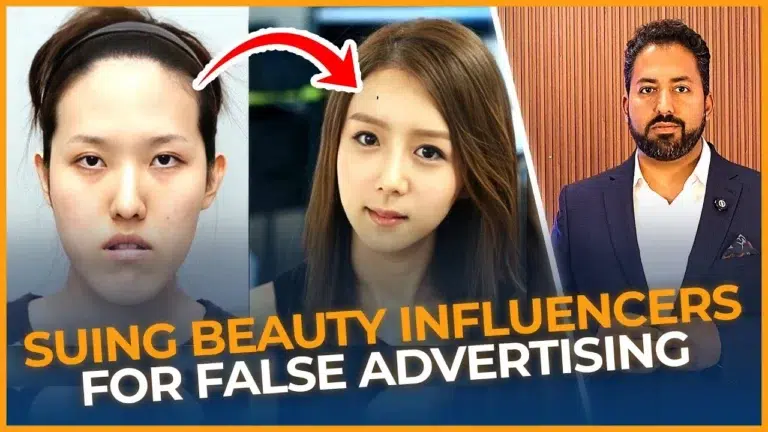
You scroll through your feed and see a glowing “before and after.” A beauty influencer shows you dramatically clearer skin, a more sculpted jaw, and a radiant complexion all credited to a $100 serum. You buy it. The results never come. Worse, the influencer was using filters, had cosmetic procedures, and was paid by the brand without making that clear. Now you’re asking: was that illegal, and can you do something about it?
This is a question millions of consumers in Los Angeles, Irvine, Chicago, and Dallas are asking especially as the influencer marketing industry has grown to an estimated $21.1 billion globally as of 2023 [1]. Influencer false advertising refers to a paid endorser typically a social media personality promoting a product using claims, images, or demonstrations that misrepresent what the product can actually do. When the person’s own altered appearance (through digital filters, surgical procedures, or other enhancements) is used to demonstrate the product’s results, regulators and courts are increasingly treating this as a deceptive act.
This article focuses solely on civil law. It explores when consumers injured or deceived by misleading product endorsements may have grounds for a civil claim, what federal and state laws apply, who can be held liable, and what steps may help you if you find yourself in this situation. If you believe you have been injured, working with personal injury lawyers who understand the interplay between consumer protection law and product liability is important.
What Do FTC Disclosure Rules Require of Influencers?
The Federal Trade Commission (FTC) is the primary federal agency overseeing advertising truth in the United States. Under Section 5 of the Federal Trade Commission Act, 15 U.S.C. § 45, unfair or deceptive acts or practices in commerce are declared unlawful [2]. The FTC has translated this broad authority into detailed guidance specifically for influencer marketing through its Guides Concerning the Use of Endorsements and Testimonials in Advertising, codified at 16 C.F.R. Part 255 [3].
The Guides were significantly updated in 2023 (effective August 22, 2023) and reflect a far stricter approach to online endorsements. Under the revised Guides [3]:
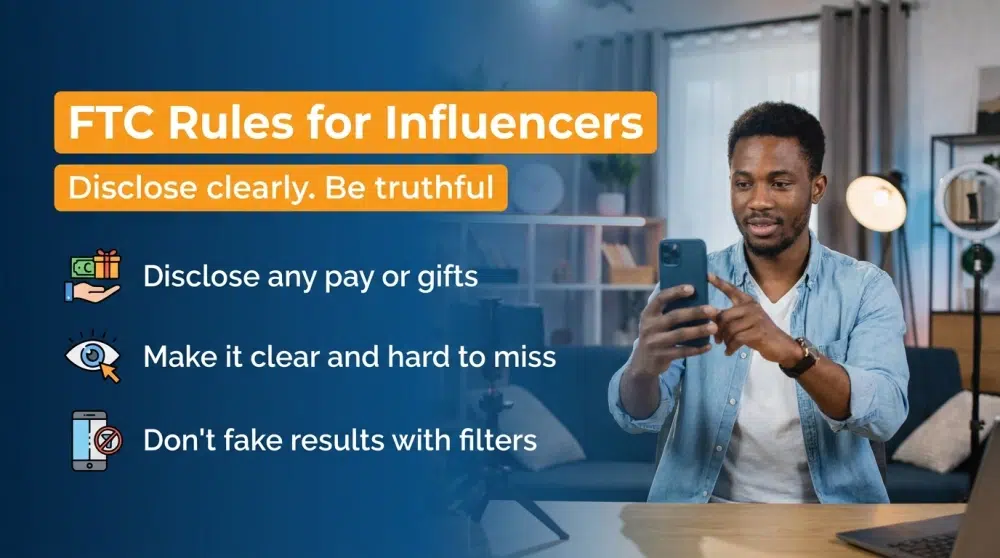
- Disclosure is mandatory whenever there is a “material connection” between the endorser and the brand such as payment, free products, or a business relationship.
- Disclosures must be clear and conspicuous – not buried in hashtags, not placed below lengthy captions, and not buried among other links.
- Consumer endorsements must reflect the genuine experience of the endorser. If the results shown are not what a typical consumer can expect, that must be clearly stated.
- Altered depictions used to sell a product may constitute deception. The FTC’s guidance specifically addresses the use of digitally altered photos or appearance enhancements to imply a product’s effect on the endorser’s complexion, body, or appearance.
A critical addition in the 2023 update is that liability no longer falls exclusively on the brand. The revised Guides expand responsibility to the influencer personally and to any advertising agency or intermediary that set up the campaign. This means an influencer who uses filters to simulate a product’s results without disclosing either the filter or the paid relationship is operating in territory the FTC treats as potentially deceptive advertising [3].
What does this mean practically? If you are among the injured or deceived consumers in Los Angeles, Irvine, Chicago, or Dallas, the federal regulatory framework now provides a stronger factual foundation for civil claims that was not as clearly established before 2023.
Are Filters and Cosmetic Enhancements Deceptive When Used to Promote a Product?
This is the nuanced heart of the matter. Under the law, filters are legal. Cosmetic surgery is legal. An influencer’s personal decisions about their own appearance are their own. The legal question is much narrower: Was the altered appearance used to represent what the product does?
The FTC’s Endorsement Guides use a specific example of an endorser’s complexion in an acne treatment advertisement. If the face shown is not the face the product produced whether because of a filter, prior cosmetic work, professional lighting, or image editing and the ad implies the result came from the product, that crosses into deceptive territory under the Guides [3]. The standard under Section 5 of the FTC Act asks whether a representation would be likely to mislead a reasonable consumer acting reasonably under the circumstances [4].
Courts applying this standard have held that false advertising need not be an outright lie, it includes half-truths and misleading demonstrations. In Sterling Drug, Inc. v. Federal Trade Commission, 741 F.2d 1146 (9th Cir. 1984), the Ninth Circuit affirmed that advertising need only have the capacity to deceive (not actually deceive), to violate Section 5 [5]. When an influencer’s smoothed-out, surgically altered face appears in a “before-and-after” for a serum, the capacity to deceive a reasonable viewer into thinking the product caused those results is exactly what regulators and civil plaintiffs focus on.
For consumers in the broader Los Angeles and Southern California market which is one of the most influencer-dense markets in the country, this distinction matters enormously. Many product campaigns originate or are distributed from studios, talent agencies, and marketing firms based in Los Angeles, making California consumer protection law particularly relevant.
Who Can Actually Be Sued: The Influencer, the Brand, or the Agency?
One of the most common misconceptions is that only the brand can be held responsible for false advertising. Following the FTC’s 2023 update, the legal landscape has shifted. In a civil lawsuit for deceptive advertising or product liability, multiple parties may potentially be held liable [3]:
- The influencer – If the influencer personally made false or misleading representations about the product’s results, used filters or cosmetic enhancements to simulate the product’s effect without disclosure, or failed to disclose the paid relationship.
- The brand or manufacturer – The company selling the product has a legal obligation to monitor its influencer campaigns. Under the revised Endorsement Guides, “we didn’t know the influencer used filters” is no longer a viable defense. Brands have an affirmative duty to review how their products are being represented [3].
- The talent agency or marketing firm – Any agency that structured, facilitated, or managed the paid campaign may also be held liable for the deceptive content that emerged from the arrangement they set up.
From a civil litigation perspective, this creates the possibility of multiple defendants in a single lawsuit. A consumer injured in Los Angeles who bought a product based on a filtered, surgically enhanced “before-and-after” video could potentially bring claims against the brand (for the underlying product defect or false advertising), the influencer (for the deceptive endorsement), and the agency (for setting up the campaign). Each defendant would likely have their own legal team, insurance, and defenses which is one reason why having skilled product liability lawyers and personal injury attorneys in your corner matters.
You can explore how our Los Angeles personal injury team approaches cases involving multiple parties and layered liability through our knowledge-base article on navigating product liability claims.
What Penalties Can Violators Face Under the FTC Framework?
The FTC framework operates primarily through regulatory enforcement, meaning the FTC itself brings actions, not individual consumers. However, those enforcement actions have significant consequences that can affect the landscape for civil claims:
- Per-violation civil penalties of up to $51,744 per post can be assessed for knowing violations of FTC rules, as adjusted for inflation under the Federal Civil Penalties Inflation Adjustment Act Improvements Act [6]. This applies when a party knew or should have known their conduct was unlawful.
- Cease-and-desist orders may be issued, prohibiting future deceptive advertising.
- Consent orders require companies and influencers to change their practices, and violations of those orders carry additional penalties.
- Injunctive relief and restitution to consumers may be part of a settlement or judgment.
An important distinction: FTC enforcement is regulatory. A private consumer in Dallas, Irvine, or Chicago cannot directly sue someone for an FTC violation. However, FTC findings and enforcement records can serve as powerful supporting evidence in a parallel civil lawsuit under state consumer protection statutes. They also establish a public record that the conduct was recognized as deceptive which matters when you’re trying to prove the “deceptive” element of a consumer fraud claim.
Can a Consumer File a Civil Lawsuit for Influencer False Advertising?
The short answer is: it depends on the facts and your jurisdiction. Consumers generally cannot sue under the FTC Act directly, the Act does not provide a private right of action [7]. However, that does not mean you have no civil options. There are several legal theories under which a consumer may bring a private lawsuit:
Can You Sue Under State Consumer Protection Laws?
Every state has some form of consumer protection law, and these statutes typically do allow private lawsuits. California’s Consumers Legal Remedies Act (CLRA) and the Unfair Competition Law (UCL), Business & Professions Code §§ 17200 et seq., are among the broadest in the country. They allow individuals to sue over “unfair, unlawful, or fraudulent” business acts, a category that courts have interpreted to include false advertising [8]. A California appellate court applied this framework in People v. Overstock.com, Inc., 219 Cal. Rptr. 3d 65 (Cal. Ct. App. 2017), affirming that businesses engaging in false advertising violate these statutes [9].
Can You Assert a Fraud Claim?
A civil fraud claim requires showing: (1) a false representation of a material fact; (2) the defendant’s knowledge of its falsity; (3) intent to induce reliance; (4) actual reliance by the plaintiff; and (5) resulting damage [10]. In the context of influencer advertising, the false representation is the implication that the product caused the results shown. Proving the influencer or brand knew the representation was false (e.g., knew the filters were hiding the real results) is often the challenging element but not impossible when communication records, contracts, and content guidelines are obtained in discovery.
Can You Sue for Product Liability if the Product Caused Physical Harm?
This is where civil claims become most compelling, particularly for personal injury clients. If a product say, a serum, a supplement, or a topical treatment, actually caused physical harm (skin reactions, chemical burns, allergic responses, or other injuries), a product liability claim may arise independently of any false advertising issue. You don’t have to prove deception to bring a product liability claim; you need to show the product was defective in design, manufacturing, or that the risks were inadequately disclosed. The false advertising by an influencer may then be relevant to show how you came to purchase the product in the first place supporting the element of reliance.
For consumers in Los Angeles who may have been harmed by a product promoted through misleading influencer content, speaking with product liability lawyers in Los Angeles who understand both the consumer protection and personal injury dimensions of these cases is an important first step. The influencer marketing legal issues involved are layered a single case may involve the product’s safety, the truthfulness of the advertising, and the physical injuries caused and those layers require careful evaluation.
How Do State Laws Apply in California, Texas, and Illinois?

California
California offers some of the strongest consumer protection frameworks in the country. Beyond the UCL and CLRA, the False Advertising Law, Business & Professions Code § 17500, specifically prohibits untrue or misleading advertising. The FTC Act’s standards are often incorporated by reference into California enforcement actions. California courts have also recognized that misleading before-and-after comparisons in advertising may constitute actionable false advertising [8]. Los Angeles consumers and those in surrounding areas, including Orange County residents served through Irvine, benefit from these robust state protections.
Texas
In Texas, the Texas Deceptive Trade Practices Act (DTPA), Tex. Bus. & Com. Code §§ 17.41 et seq., provides a private cause of action for consumers harmed by false, misleading, or deceptive trade practices [11]. A consumer in Dallas who purchased a product based on misleading influencer content may bring a DTPA claim. The DTPA allows consumers to recover actual damages, and in some cases may support additional damages of up to three times the economic damages if the conduct was committed knowingly. The DTPA also allows recovery of attorney’s fees, which can make otherwise small individual claims viable when there is clear deceptive conduct.
Illinois
Illinois consumers are protected by the Illinois Consumer Fraud and Deceptive Business Practices Act, 815 ILCS 505/1 et seq. [12]. This statute provides a private right of action for deceptive acts or practices, including false advertising. A consumer in Chicago who suffered harm from a product purchased based on a filtered influencer endorsement could invoke this statute. Illinois courts have broadly construed the Act to cover misleading visual representations in advertising, not only false written statements.
Because of the geographic breadth of influencer campaigns, a single Instagram or TikTok post reaches consumers across all these states simultaneously, a consumer protection lawyer may need to evaluate which state’s laws produce the most favorable framework based on where the consumer purchased the product, where the harm occurred, and where the defendants are located.
What If the Product Actually Caused Physical Harm?
If the product did not just fail to work but actually injured you, the legal options expand significantly. Physical injury from a falsely advertised product can support claims under multiple legal theories simultaneously:
- Product liability – If the product was defective or dangerous when used as directed, manufacturers, distributors, and sellers may all be liable. California, Texas, and Illinois each recognize strict liability in product liability cases, meaning a plaintiff does not need to prove negligence only that the product was defective and caused harm [13].
- Negligence – If the brand or influencer failed to exercise reasonable care in how they represented or distributed the product, a negligence claim may be possible.
- Misrepresentation / Fraud – If you purchased the product based on a fraudulent demonstration and suffered harm, the deception itself may form part of your damages claim.
- Consumer protection statute claims – As discussed above, state DTPA, UCL, and Illinois Consumer Fraud Act claims may provide additional avenues with lower burdens and the possibility of attorney fee recovery.
For consumers who are injured in this way, injury claims can involve economic damages (the cost of the product, medical expenses, lost wages if applicable), as well as non-economic damages for pain, suffering, and emotional distress. If the influencer’s content was part of a campaign that induced thousands of consumers to purchase a harmful product, class action considerations may also come into play, though class actions have their own procedural requirements and complexities.
If you or someone you know was injured by a product promoted through deceptive influencer advertising, reaching out to personal injury lawyers is a practical next step, not to guarantee any outcome, but to understand what your options actually are under the law as it stands today.
Perspectives of Both Plaintiffs and Defendants in These Cases
The Plaintiff’s Perspective
From the consumer’s side, the challenge in influencer false advertising cases is proving the specific elements of each claim. Key questions include: Did you reasonably rely on the influencer’s content in making your purchase decision? Can you document that the representation was false at the time it was made? Was the influencer using filters or cosmetic enhancements to simulate the product’s effect, and can that be proven? What damages did you actually suffer? Courts look carefully at causation, the false advertising must have caused your harm, not merely preceded it.
Plaintiffs often face the practical challenge that individual damages in a single consumer case may be modest, making solo litigation less economically practical. This is where class actions, regulatory findings (such as an FTC enforcement action), and contingency-fee arrangements with experienced personal injury attorneys can shift the calculus.
The Defendant’s Perspective
Defendants, whether the influencer, the brand, or the agency will typically raise several defenses. They may argue: the consumer did not actually rely on the specific representation; the representation was puffery (an exaggerated promotional claim that no reasonable person takes literally); the product was not actually defective; the disclosed results were typical for some users; or the consumer assumed risk by purchasing a cosmetic product. Brand defendants may also argue they did not have knowledge of the influencer’s use of filters and therefore lacked the scienter required for fraud claims, though the 2023 FTC update has weakened this argument considerably by creating an affirmative monitoring duty [3].
What Should You Do If You Were Misled by an Influencer Ad?
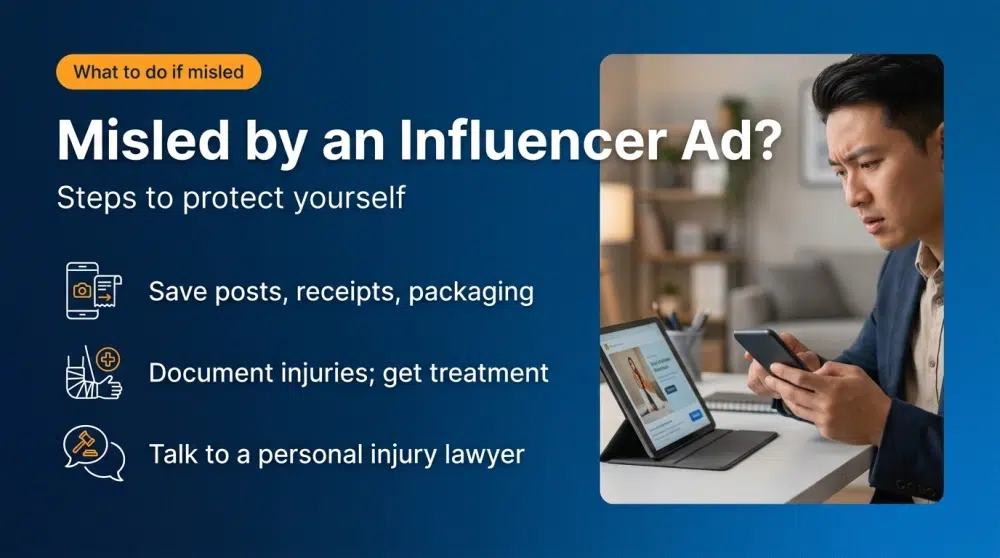
If you believe you purchased a product based on deceptive influencer advertising especially if you suffered physical harm, here are practical, non-legal steps you can begin today, combined with reasons to involve a personal injury attorney early:
- Preserve the evidence – Screenshot or screen-record the influencer’s original post, story, or video. Save your purchase receipts. Document the product packaging, lot number, and any visible claims on the label.
- Document your harm – If you suffered a physical reaction or injury, photograph it, seek medical attention, and keep all records of treatment and related costs.
- Report to the FTC – You can file a consumer report at ReportFraud.ftc.gov. This helps build a record and may contribute to a broader enforcement investigation.
- Do not post publicly about a potential lawsuit – Social media posts can be used against you in litigation.
- Speak with a personal injury attorney – An attorney can evaluate the strength of your claims, identify all potentially liable parties, and advise you on the statutes of limitations that apply in your state. Missing a deadline can permanently close the door on your claim.
Under California law, the general statute of limitations for personal injury claims is two years from the date of injury under Code of Civil Procedure § 335.1, though the discovery rule may affect when the clock starts. Texas provides a two-year statute of limitations under the DTPA and for personal injury claims. Illinois has a two-year statute of limitations for personal injury and a three-year period for fraud claims under the Consumer Fraud Act. These deadlines are firm, they do not delay in consulting counsel.
If you are injured, accident injury attorneys can help you evaluate all of your options under both personal injury law and consumer protection law, and can do so in a free consultation without any upfront cost to you.

How GoSuits Helps Clients Navigate Product Liability and Consumer Protection Claims
At GoSuits, we understand that being deceived by a misleading advertisement especially one that leads to physical harm is more than a financial inconvenience. It can mean real damage to your health, your finances, and your sense of trust. This is especially true when the products involved are marketed as health or beauty solutions, and the deception is built into the very images used to sell them.
GoSuits serves clients across California, Texas, and Illinois, including Los Angeles, Irvine, Chicago, and Dallas. Our attorneys handle product liability claims, consumer injury matters, and personal injury cases with a combined 30 years of experience across our team. We have handled cases through trial, which is a meaningful difference: a firm that has tried cases holds a different position at the negotiating table than one that settles everything to avoid the courtroom. When you consult with us, you speak directly with a designated attorney, not a case manager or intake coordinator. Every client has unfettered access to the attorney handling their case from start to finish.
What makes GoSuits different is also how we work. We use proprietary technology built specifically for our practice, not off-the-shelf case management software, but custom-built tools that allow our attorneys to move faster, stay better organized, and build stronger case files. This means your case benefits from a more thorough investigation, earlier identification of key evidence, and more efficient preparation. Technology drives our process; attorneys drive your case. Our prior cases reflect this approach across a range of practice areas, and our results speak for themselves in terms of what clients have recovered.
If you believe you were injured by a product promoted through deceptive influencer advertising whether in Los Angeles, Irvine, Chicago, or Dallas, a free consultation with our team costs you nothing. You can learn about your rights, the applicable laws in your state, and what evidence would be needed to support a claim, without any obligation. To connect with our team, schedule a free consultation today.
Our attorneys bring trial experience across product liability, personal injury claims, and consumer harm cases. You can also learn more about our firm’s approach and values at our about us page, and see the full range of what we handle at our practice areas page.
GoSuits handles personal injury lawyers matters throughout Los Angeles, Irvine, Chicago, and Dallas. We serve clients in Pasadena, El Monte, Norwalk, Naperville, Plano, Carrollton, and communities across our four-city footprint. If you’ve been injured, don’t wait! Statutes of limitations are strict, and early action protects your options. Speaking with product liability lawyers in Los Angeles is a concrete step you can take today.
References
- FTC Report on Influencer Marketing – Federal Trade Commission
- 15 U.S. Code § 45 – Unfair Methods of Competition Unlawful – LII / Cornell Law School
- 16 CFR Part 255 – Guides Concerning Use of Endorsements and Testimonials in Advertising – LII / Cornell Law School
- Federal Trade Commission Act – FTC.gov
- Sterling Drug, Inc. v. Federal Trade Commission, 741 F.2d 1146 (9th Cir. 1984) – CourtListener
- Civil Penalty Adjustments – Federal Trade Commission
- 15 U.S. Code § 41 – Federal Trade Commission Act – LII / Cornell Law School
- California Business and Professions Code § 17500 – California Legislative Information
- People v. Overstock.com, Inc., 219 Cal. Rptr. 3d 65 (Cal. Ct. App. 2017) – CourtListener
- Fraud – Legal Information Institute / Cornell Law School
- Texas Business and Commerce Code Chapter 17 – Texas DTPA – Texas Legislature Online
- 815 ILCS 505 – Illinois Consumer Fraud and Deceptive Business Practices Act – Illinois General Assembly
- Products Liability – Legal Information Institute / Cornell Law School