After a pedestrian accident in California, the priorities are medical care, safety and documentation. Call 911, accept an evaluation even if you feel mostly fine, and ask police to create a report. California law generally requires drivers to yield to pedestrians in marked crosswalks and in unmarked crosswalks at intersections, and drivers must use due care around pedestrians elsewhere on the road [1][2]. Fault can still be shared, and a pedestrian’s own share of fault reduces recovery instead of automatically barring it [8]. In California, most injury lawsuits must be filed within two years, but claims against a public entity can have a six-month claim deadline [4][5].Legal Snapshot
-
Legal Topic: Pedestrian injury claims against drivers and, in some cases, public entities, under California civil law
-
Case Stage: Immediately after the collision through early claim investigation
-
Primary Legal Issue: Who was at fault, and how right-of-way and shared-fault rules affect recovery
-
Primary Authority: California Vehicle Code sections 21950 and 21954; Code of Civil Procedure section 335.1; Government Code section 911.2; Insurance Code section 11580.2; Li v. Yellow Cab Co. (1975) 13 Cal.3d 804
-
Date Legal Authority Last Reviewed: November 18, 2026 (research review; licensed attorney verification pending)
What Does a Pedestrian Accident Claim Mean?
A pedestrian accident claim is a civil claim for money damages after a person on foot is struck or injured because of someone else’s negligence. In most cases, the other party is a driver, but a vehicle owner, an employer, a rideshare or commercial operator, or a public entity may also be involved depending on the facts.
This article covers civil claims only. A traffic citation or criminal charge against a driver is a separate proceeding from an injured person’s civil case. Because every collision is different, nothing here is individualized legal advice, and an injured person should speak with a licensed attorney about their own situation.
What Does California Law Say?
California state law governs these claims. The Vehicle Code sets the road rules, the Code of Civil Procedure sets filing deadlines, the Government Code controls claims against public entities, and the Insurance Code governs uninsured motorist coverage. Federal law rarely controls an ordinary pedestrian claim unless a federal vehicle or agency is involved, which requires separate analysis.
The core rules are:
-
Crosswalk right-of-way: Vehicle Code section 21950(a) requires a driver to yield to a pedestrian crossing within a marked crosswalk or within an unmarked crosswalk at an intersection. Subdivision (c) requires a driver approaching a pedestrian in a crosswalk to use all due care and slow down or take other needed action [1].
-
Pedestrian duty of care: The same section says it does not relieve a pedestrian of the duty to use due care, and a pedestrian may not suddenly leave a curb into the path of a vehicle so close that it is an immediate hazard [1].
-
Outside a crosswalk: Under section 21954(a), a pedestrian crossing at any point other than a marked or unmarked crosswalk must yield to vehicles so near as to be an immediate hazard, but section 21954(b) states that this does not relieve the driver of the duty to exercise due care for pedestrians on the roadway [2].
-
Unmarked crosswalks: Unmarked crosswalks: A crosswalk can exist at an intersection without painted lines. The Vehicle Code defines “crosswalk” in section 275 [9].
-
Recent amendments: Recent amendments: Assembly Bill 2147 (effective January 1, 2023) amended several pedestrian provisions, including the rules on crossing outside a crosswalk.
What Legal Rules Apply?
A pedestrian claim is usually a negligence claim: the injured person must show the defendant owed a duty of care, breached it, and caused the injury and resulting losses. California Vehicle Code provisions help define that duty, and a violation of a traffic statute can support a presumption of negligence under Evidence Code section 669 in some circumstances [12].
California applies pure comparative negligence. In Li v. Yellow Cab Co., the California Supreme Court replaced the all-or-nothing contributory negligence rule with a rule that reduces damages in proportion to the injured person’s share of fault [8]. A pedestrian found partly at fault may still recover, but the award is reduced by that percentage.
Criminal-law duties of the driver also matter to the story. Vehicle Code section 20001 requires a driver involved in an injury accident to stop immediately and comply with the information and aid requirements in sections 20003 and 20004 [3]. A driver who flees creates both a criminal issue and an insurance problem for the injured person, discussed below.
What Should I Do Right After the Collision?
The steps below describe common practical priorities, not legal advice for any one situation.
-
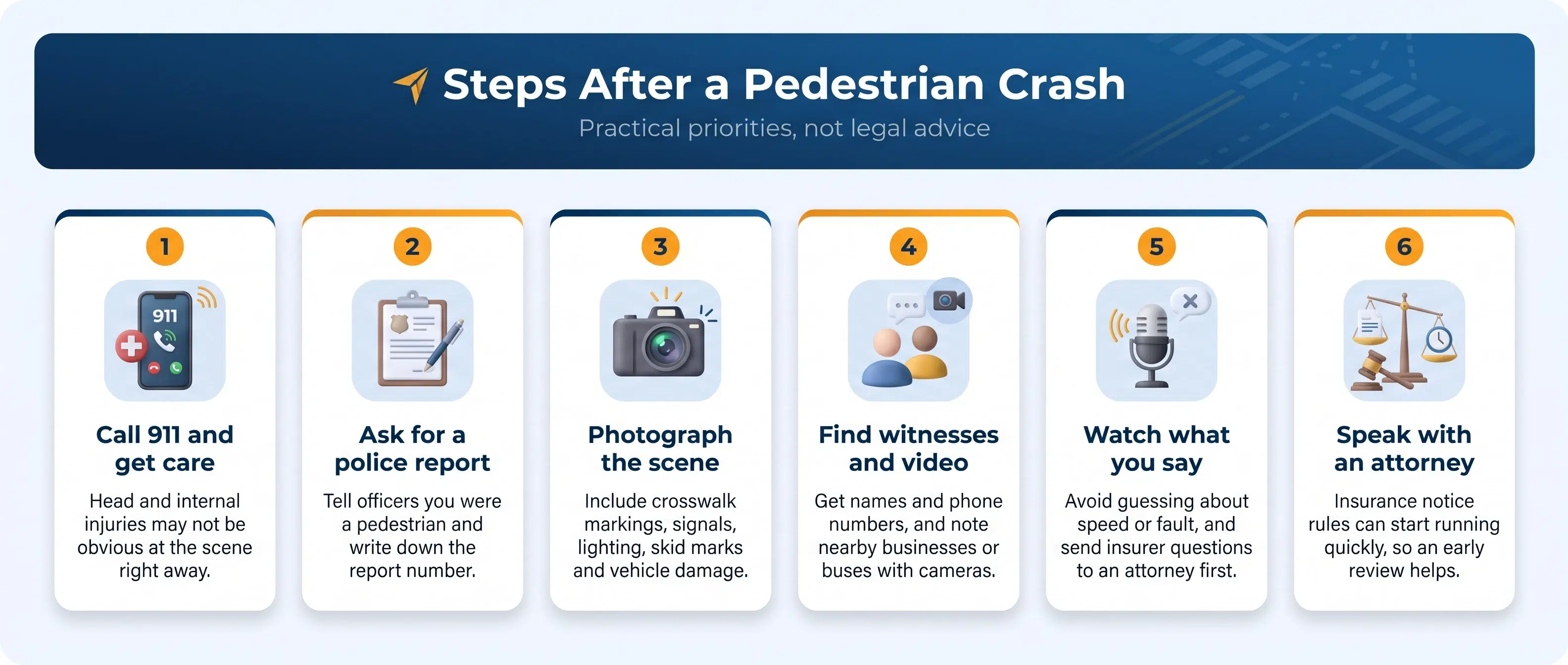
Call 911 and get medical attention. Some injuries, including head and internal injuries, may not be obvious at the scene. Medical records also create an early, neutral record of what was hurt.
-
Stay at a safe location. If you can, move out of traffic lanes. Roads such as Wilshire Boulevard in Los Angeles or Pacific Coast Highway after dark can be dangerous for anyone standing in the road.
-
Ask for a police report. Make sure officers know you were a pedestrian and note the report number.
-
Collect driver and vehicle information. Name, license plate, insurance details and a description of the vehicle matter, especially if the driver leaves.
-
Photograph the scene. Capture the crosswalk markings, signals, signs, lighting, skid marks, vehicle damage and your injuries.
-
Identify witnesses and cameras. Get names and phone numbers, and note nearby businesses, buses or homes that may have video.
-
Be careful with statements. Avoid guessing about speed, distance or fault, and avoid apologizing. Direct questions from the other driver’s insurer to an attorney before giving a recorded statement.
-
Follow your treatment plan. Keep every appointment, prescription and bill.
-
Keep a simple journal. Record pain levels, missed work and daily activities you cannot do.
-
Speak with a licensed attorney early. Deadlines and insurance notice rules can start running quickly.
How Does This Apply to a Real Case?
Hypothetical example (not an actual GoSuits case): A pedestrian is walking through a marked crosswalk in downtown Los Angeles when a driver making a left turn does not stop. Section 21950 places the primary duty to yield on the driver, but the driver’s insurer argues the pedestrian entered late against the signal. The case may turn on signal timing, video, and witness accounts, and any fault assigned to the pedestrian would reduce, not erase, the recovery [1][8].
Hypothetical example (not an actual GoSuits case): A person crosses mid-block on a dark, multi-lane boulevard in the San Fernando Valley and is struck. Section 21954 required the pedestrian to yield to vehicles that were an immediate hazard, but the driver still owed due care, such as keeping a lookout and driving at a safe speed [2]. Whether the driver could have avoided the collision becomes the central question.
Hypothetical example (not an actual GoSuits case): A driver strikes a pedestrian on a busy San Diego arterial and drives away. The injured person may need to rely on their own uninsured motorist coverage, which carries strict reporting steps [6].
What Evidence Can Matter?
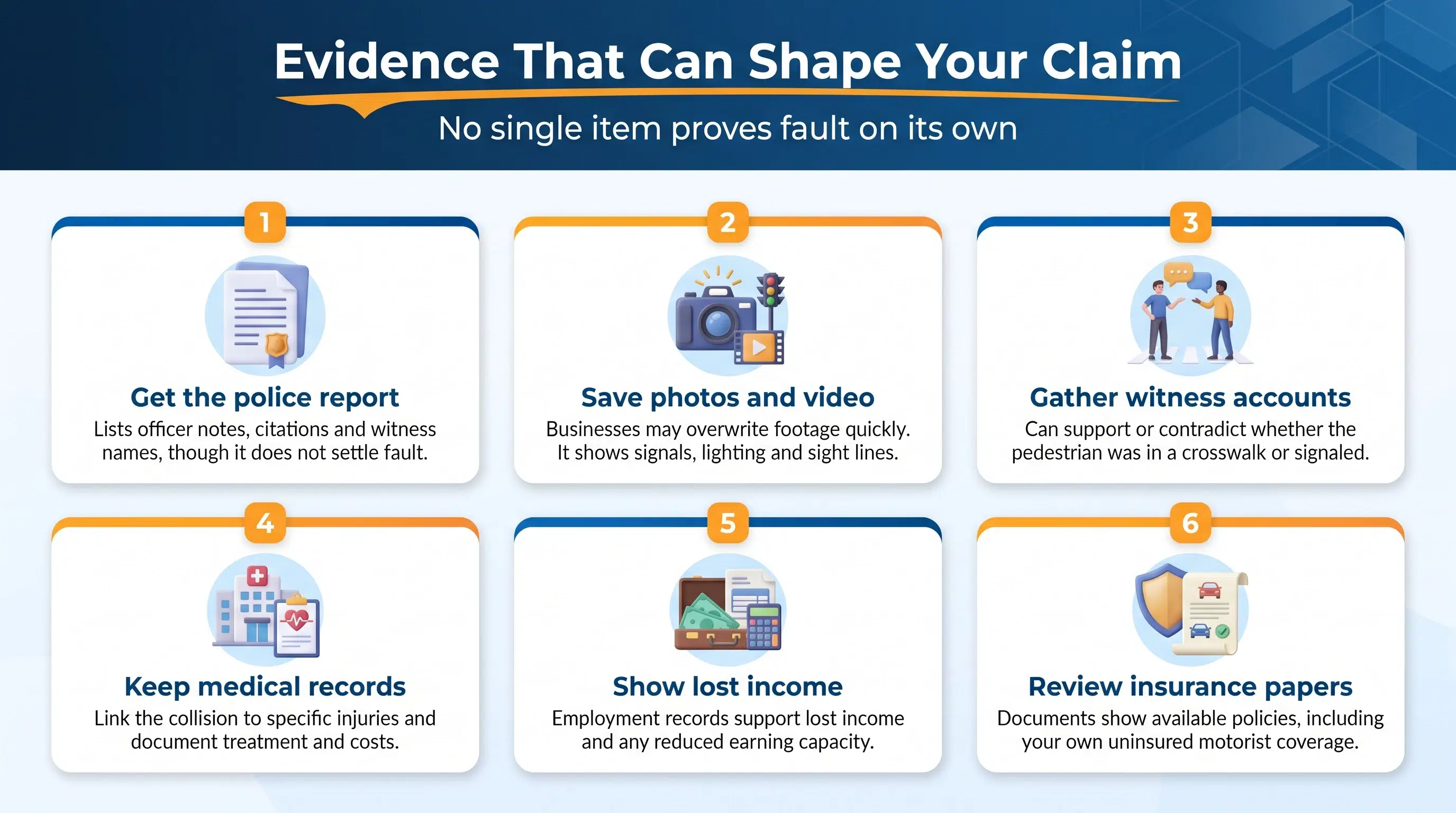
No single item of evidence automatically proves liability, but these categories often shape how fault is evaluated:
|
Evidence |
Why it may matter |
|---|---|
|
Police report |
Records the officer’s observations, citations, witness names and driver information, though it is not the final word on fault. |
|
Photos and video |
Show crosswalk markings, signal phases, lighting, sight lines and vehicle positions. Businesses may overwrite footage quickly. |
|
Witness statements |
Can support or contradict each side’s version of whether the pedestrian was in a crosswalk or had a signal. |
|
Medical records and bills |
Link the collision to specific injuries and document treatment and costs. |
|
Employment records |
Support lost income and any reduced earning capacity. |
|
Vehicle data and phone records |
May show speed, braking and driver distraction, usually obtained through formal discovery in litigation. |
|
Scene or reconstruction analysis |
May help explain stopping distance, visibility and impact angles in contested cases. |
|
Insurance documents |
Identify the available policies, including your own uninsured motorist coverage. |
What Damages or Remedies May Be Available?
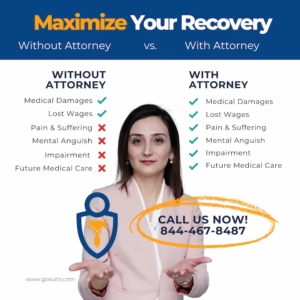
Recoverable damages depend on California law and the facts of the case, and no outcome is guaranteed. Categories commonly claimed in pedestrian injury cases include:
-
Past and future medical expenses
-
Lost income and loss of earning capacity
-
Physical pain and mental suffering
-
Physical impairment and disfigurement
-
Property damage, such as a damaged phone, glasses or clothing
-
In limited circumstances involving malice, oppression, or fraud, punitive damages under Civil Code section 3294
If a pedestrian dies, certain family members or representatives may bring a wrongful death claim under Code of Civil Procedure section 377.60 [11]. Families in that situation may want to speak with wrongful death lawyers about who may bring the claim and which damages the law allows. Health insurers, medical providers, and other payers may also assert reimbursement or lien rights that affect the net amount an injured person keeps.
What If the Other Party Disputes Liability?
Disputes are common, and the usual defense is shared fault: the pedestrian was outside a crosswalk, crossed against a signal, was distracted, or stepped suddenly into traffic. Those arguments invoke Vehicle Code sections 21950(b) and 21954(a) [1][2].
The injured person’s response is typically that the driver still owed due care under sections 21950(c) and 21954(b), and that a reasonably careful driver would have slowed, kept a lookout or stopped. Under pure comparative negligence, a jury or insurer assigns percentages of fault, and the final recovery is reduced by the pedestrian’s percentage [8]. If a lawsuit is filed, it would proceed in the superior court of the appropriate county, such as the Los Angeles County Superior Court, where cases are heard at courthouses including the Stanley Mosk Courthouse.
What If Insurance Is Involved?
Insurance is often the main practical source of recovery. California requires drivers to carry minimum liability limits of $30,000 per person, $60,000 per accident for bodily injury, and $15,000 for property damage on policies issued or renewed on or after January 1, 2025, under Vehicle Code section 16056 as amended by SB 1107 [7]. Serious pedestrian injuries can exceed those minimums, which makes it important to identify every available policy.
Uninsured motorist (UM) coverage under Insurance Code section 11580.2 may apply to a pedestrian under their own auto policy, or a resident relative’s policy, if the driver is uninsured or unidentified [6]. For an unidentified hit-and-run vehicle, the statute requires physical contact, a police report within 24 hours, and a sworn statement to the insurer within 30 days (Ins. Code § 11580.2(b)) [6]. Settling with a responsible party without your insurer’s written consent can also affect UM rights (Ins. Code § 11580.2(c)(3)).
Insurance adjusters may contact an injured person quickly. Early recorded statements and quick settlement offers can be difficult to undo, so many people choose to have an attorney communicate with the insurer.
How Long Do I Have to Act?
Several deadlines may apply at once. These are general descriptions, and each must be confirmed for the specific facts.
|
Claim type |
General deadline |
Authority |
|---|---|---|
|
Personal injury lawsuit against a private party |
Two years from the date of injury |
Code Civ. Proc. section 335.1 [4] |
|
Wrongful death lawsuit |
Generally two years from the date of death |
|
|
Written claim to a public entity for injury or death |
Six months after the cause of action accrues |
Gov. Code section 911.2 [5] |
|
Property damage lawsuit |
Three years |
Code Civ. Proc. section 338 [10] |
|
UM claim involving an unidentified vehicle |
Police report within 24 hours and sworn statement within 30 days; separate two-year requirement |
Ins. Code section 11580.2 [6] |
The six-month government claim rule matters when a city, county, state agency, school district, or transit agency may share responsibility, for example a collision involving a government vehicle or a dangerous roadway or sidewalk condition (Gov. Code § 835). Exceptions, including tolling for minors, can change these dates, so the safest approach is to have an attorney calculate the deadline as early as possible.
What If the Driver Left the Scene?
Leaving the scene of an injury collision is a crime under Vehicle Code section 20001, and the duty applies regardless of who caused the crash [3]. For the injured person, the immediate concerns are different: report the crash right away, preserve any video, canvass for witnesses, and notify your own insurer promptly. A hit-and-run is one situation where the short UM reporting windows described above can decide whether coverage is available. Anyone injured in a hit-and-run should speak with one of the personal injury lawyers who handle California pedestrian claims before those windows close.
Related California Personal Injury Resources
For an overview of how GoSuits approaches injury claims statewide, see our California personal injury team. Injured pedestrians who want a lawyer’s review of liability, evidence and insurance coverage can work with pedestrian accident lawyers, and families coping with a fatal collision may need wrongful death representation as well.
Talk With a GoSuits Attorney
A pedestrian claim can involve contested fault, medical evidence, several insurance policies and short legal deadlines. If you or a family member was hurt as a pedestrian in California, a GoSuits attorney can review what happened and explain your options. You can schedule a free consultation to discuss your situation. Past results do not guarantee a similar outcome, and this article is general information, not legal advice or an attorney-client relationship.
References
-
California Vehicle Code section 21950 – Justia California Code
-
California Vehicle Code section 21954 – Justia California Code
-
California Vehicle Code section 20001 – California Legislative Information
-
California Code of Civil Procedure section 335.1 – California Legislative Information
-
California Government Code section 911.2 – California Legislative Information
-
California Insurance Code section 11580.2 – California Legislative Information
-
California Vehicle Code section 16056 – California Legislative Information
-
California Vehicle Code section 275 – California Legislative Information
-
California Code of Civil Procedure section 338 – California Legislative Information
-
California Code of Civil Procedure section 377.60 – California Legislative Information
-
California Evidence Code section 669 – California Legislative Information