
Medical liens can reduce your settlement check by tens of thousands of dollars before you receive a single dollar. In a Texas personal injury case, four categories of lienholders routinely assert claims against your recovery: the treating hospital under the Texas Hospital Lien Act, healthcare providers who treated you under a Letter of Protection, your employer’s health plan under ERISA, and federal programs such as Medicare or Medicaid. Each category operates under different legal rules, and each can be challenged or negotiated before your settlement funds are distributed. Understanding the rules that govern each lien type is the first step toward protecting your net recovery.
Legal Snapshot
- Legal Topic: Medical Lien Reduction Before Settlement Disbursement
- Case Stage: Post-Settlement / Pre-Distribution
- Primary Legal Issues: Statutory hospital liens; Letter of Protection balances; ERISA subrogation and preemption; Medicare Secondary Payer reimbursement; made-whole doctrine; common fund doctrine
- Primary Authorities: Tex. Prop. Code Ch. 55; Tex. Civ. Prac. & Rem. Code Ch. 140; 29 U.S.C. §§ 1132, 1144; 42 U.S.C. § 1395y; 42 C.F.R. § 411.37 [AUTHORITY TO VERIFY]
- Date Legal Authority Last Reviewed: July 2025
- How do medical liens get paid out of a Texas settlement?
- Can a hospital take money from my personal injury settlement in Texas?
- What is a Letter of Protection and how does it affect my recovery?
- Does my employer’s health plan have to be paid back from my settlement?
- How does Medicare get reimbursed from a Texas personal injury settlement?
- Can I reduce a hospital lien in Texas before I settle my case?
- What is the made-whole doctrine in Texas lien cases?
- What is the common fund doctrine and does it apply to my ERISA plan?
- How do I find out how much my health insurer is claiming from my settlement?
- Will liens wipe out my entire settlement?
The Four Categories of Medical Liens in Texas Personal Injury Cases
Before any settlement funds reach you as the injured party, your attorney is required to identify and resolve outstanding liens on your recovery. Texas personal injury cases typically involve some combination of these four categories:
| Category | Who Holds the Lien | Governing Law | Key Characteristic |
|---|---|---|---|
| Statutory Hospital Lien | Licensed hospital or emergency service provider | Tex. Prop. Code Ch. 55 | Must be filed; subject to specific statutory limits |
| Letter of Protection Balance | Treating physician or specialist | Contract; Texas common law | Deferred payment agreement; billed rates may exceed customary reimbursement |
| ERISA Health Plan Reimbursement | Employer group health plan | 29 U.S.C. §§ 1132, 1144; plan document | Federal preemption limits state law; plan text controls |
| Medicare / Medicaid Reimbursement | Federal or state government program | 42 U.S.C. § 1395y (Medicare); state Medicaid statutes | Mandatory reimbursement; statutory reduction procedures available |
Each category requires a separate legal analysis. A personal injury lawyers review of every category before settlement is essential to avoid overpaying or leaving reduction opportunities on the table.
Statutory Hospital Liens Under Texas Property Code Chapter 55
When a hospital in Dallas, Plano, Carrollton, or anywhere in Texas provides emergency or inpatient care to an accident victim, it may perfect a lien against that person’s personal injury claim. This right arises under Chapter 55 of the Texas Property Code, which authorizes certain healthcare providers to assert a lien on a patient’s cause of action or settlement. [1]
How a Hospital Lien Is Perfected
A hospital lien under Chapter 55 is not automatic. To be valid, the hospital must file the lien with the county clerk of the county where the services were provided and, separately, with the county where the accident occurred. The filing must occur before any settlement is reached or judgment rendered. If a hospital fails to timely file, the lien may be unenforceable against your recovery.
What the Lien Covers
The lien attaches to the “cause of action” and any resulting settlement or judgment. However, Chapter 55 limits the hospital’s recovery to a reasonable and regular rate for the services rendered. This statutory language gives injured parties a basis to contest inflated charges. Courts have held that a hospital may not collect through a lien an amount that exceeds what it would reasonably accept from a health insurer for the same services.
Strategies for Reducing a Hospital Lien
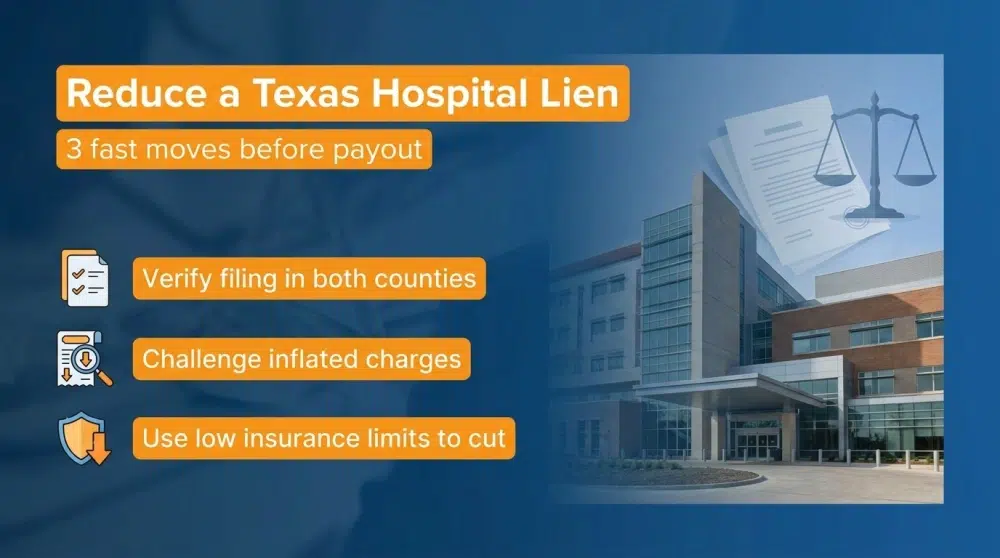
- Verify proper filing. Confirm that the lien was filed in both the correct county of services and the county of the accident, and that it was filed before settlement. A procedurally defective lien may be unenforceable.
- Challenge the “reasonable rate.” Compare the billed amount to the contractual rates the hospital accepts from major insurers for the same procedures. If the billed rate far exceeds what any insurer pays, that disparity supports a reduction argument.
- Invoke the made-whole doctrine. Texas courts have recognized that a subrogee or lienholder should not recover from a settlement that does not fully compensate the injured party for all losses. Whether this doctrine applies to hospital liens as a matter of Texas common law requires careful legal analysis specific to the facts of each case.
- Negotiate directly with the hospital. Hospitals routinely accept reduced lien amounts, particularly where the settlement value is constrained by the at-fault driver’s policy limits or where liability is disputed.
An injured person is taken to a Parkland-affiliated hospital in Dallas after a rear-end collision on I-635. The hospital files a Chapter 55 lien asserting $85,000 for emergency and inpatient services. The at-fault driver carried only $30,000 in liability coverage. The hospital’s actual Medicare rate for those services was approximately $22,000. Because the settlement grossly undercompensates the victim and the hospital’s billed rate far exceeds customary reimbursement, there are strong grounds to negotiate the lien substantially below the $85,000 face amount. This type of analysis is conducted on a case-by-case basis and outcomes vary.
Letter of Protection Balances: What They Are and How They Are Audited
A Letter of Protection (LOP) is a written agreement between your attorney, you, and a treating physician or specialist. Under the LOP, the provider agrees to treat you now and defer payment until your personal injury case resolves, at which point the provider is paid from the settlement proceeds before you receive your net recovery.
Why LOP Balances Can Be Disputed
Providers who treat patients under LOPs typically bill at their full charge-master or standard rates rather than the discounted rates they accept from health insurers. This means the amount the provider claims in the settlement may be significantly higher than what the same treatment would cost if billed through a health plan. Texas courts and practitioners commonly refer to this as the “billed vs. paid” gap.
In personal injury cases, courts may distinguish between the amount a provider billed and the amount that represents the reasonable value of the services. Texas Rule of Civil Evidence 803(6) and related case law on admissibility of medical billing evidence are relevant to this analysis. [2] Whether LOP charges are limited to a reasonable and customary rate or whether the full contracted rate is enforceable has been an evolving area of Texas law.
Auditing LOP Charges Before Distribution
Before any LOP balance is paid from settlement proceeds, an attorney should:
- Obtain an itemized billing ledger with CPT codes and ICD-10 diagnosis codes for every service billed.
- Compare charges to Medicare allowable rates and major commercial insurer rates for the same geographic region.
- Remove any charges unrelated to the accident injury from the claimed lien amount.
- Verify that every billed service was actually provided and is supported by medical records.
- Negotiate a reduction consistent with prevailing reimbursement rates, especially where the gross settlement does not fully compensate all damages.
LOP providers retain leverage because they agreed to defer payment, but they also understood the contingent nature of recovery when they signed the agreement. Reasonable reduction requests that reflect the gap between billed and customary rates are often accepted rather than litigated.
ERISA Health Plan Reimbursement: Federal Rules That Override State Law
If your medical bills were paid by your employer’s group health plan, that plan likely contains a subrogation or reimbursement provision requiring you to pay back the plan from your settlement. These rights are governed by the Employee Retirement Income Security Act of 1974 (ERISA), a federal statute that can significantly limit the protections that Texas law would otherwise offer injured claimants. [3]
Understanding ERISA liens is critical for Dallas personal injury cases. Our companion knowledge-base article ERISA Liens and Your Personal Injury Settlement covers the federal framework in depth, including the made-whole and common fund doctrines. The key principles for lien reduction purposes are summarized below.
Self-Funded vs. Insured Plans: Why It Matters
The most important threshold question in any ERISA lien analysis is whether the plan is self-funded or fully insured.
- Self-funded plans (where the employer pays claims from its own assets) are broadly protected by ERISA preemption under 29 U.S.C. § 1144. State laws limiting subrogation generally do not apply. Plan document language controls almost entirely.
- Fully insured plans (where the employer purchases a group insurance policy) are subject to state insurance regulation through ERISA’s savings clause. Texas Civil Practice and Remedies Code Chapter 140 may limit the amount such a plan can recover from your settlement. [4]

The Made-Whole Doctrine and ERISA
The made-whole doctrine is an equitable principle providing that a subrogee should not recover from the insured’s settlement unless the insured has first been fully compensated for all losses. In the ERISA context, the U.S. Supreme Court held in U.S. Airways, Inc. v. McCutchen, 569 U.S. 88 (2013), that clear plan language trumps the made-whole doctrine. If the plan expressly disclaims make-whole and requires first-dollar reimbursement, courts generally enforce that language for self-funded ERISA plans. However, if the plan is silent on the issue, equitable gap-filling may allow a reduction argument. [5]
The Common Fund Doctrine and ERISA Attorney Fee Apportionment
The common fund doctrine requires a beneficiary of a fund created through another’s efforts to share proportionally in the cost of creating that fund. In the ERISA context, McCutchen recognized that if the plan is silent on attorney’s fees, a court may apply the common fund doctrine to reduce the plan’s recovery by a proportionate share of the attorney fees and costs necessary to obtain the settlement. Plans with clear anti-assignment and no-reduction language can disclaim this doctrine, but plans that are silent often cannot. [5]
Texas CPRC Chapter 140 and Insured Health Plans
For cases involving fully insured health plans in Texas, Chapter 140 of the Texas Civil Practice and Remedies Code addresses limits on health benefit plan recovery from personal injury settlements. The statute provides formula-based caps and fee apportionment protections that do not apply to self-funded ERISA plans protected by federal preemption. [4]

Documents You Need to Audit an ERISA Lien
Before conceding any ERISA plan’s reimbursement claim, obtain the following from the plan administrator:
- Complete plan document and Summary Plan Description with all amendments effective on the date of injury
- Specific subrogation and reimbursement provisions, including definitions of “third-party recovery” and fee apportionment language
- Funding disclosure confirming whether the plan is self-funded or insured (and any stop-loss arrangements)
- The most recent Form 5500 filing or confirmation of exemption
- Identification of all authorized fiduciaries and recovery vendors
- Itemized payment ledger with CPT/ICD codes to remove non-injury charges
Failure to timely furnish plan documents can expose the administrator to statutory penalties under 29 U.S.C. § 1132(c)(1) and weakens the plan’s negotiating position. [3]
Medicare and Medicaid Reimbursement: Federal Programs With Mandatory Rights
Medicare and Medicaid are not ERISA plans and operate under separate statutory frameworks. Their reimbursement rights are among the strongest in personal injury cases and cannot be waived or reduced without following specific federal or state procedures.
Medicare Secondary Payer Act
The Medicare Secondary Payer Act (MSP), 42 U.S.C. § 1395y, makes Medicare a secondary payer when a primary plan (such as liability insurance) is or was expected to pay for the same injury-related medical treatment. When Medicare pays for injury-related care and the beneficiary recovers from a third party, Medicare has a right to reimbursement from those proceeds. [6]
The amount Medicare can recover is not simply the full amount it paid. Federal regulations at 42 C.F.R. § 411.37 provide a formula for reducing Medicare’s reimbursement when the settlement does not fully compensate the beneficiary for all damages. This reduction accounts for the attorney fee and procurement costs necessary to obtain the recovery. [AUTHORITY TO VERIFY confirm current regulatory text and any updates] The Centers for Medicare and Medicaid Services issues a conditional payment letter before settlement and a final demand letter after, which must be addressed before funds are distributed.
Medicaid Liens
Texas Medicaid recovery rights arise under both federal and state law. The Texas Health and Human Services Commission tracks Medicaid payments made on behalf of injured recipients and asserts liens against their recoveries. Federal law limits the amount Medicaid can recover by requiring that any reduction account for the proportion of attorney fees and costs. The U.S. Supreme Court’s decision in Wos v. E.M.A., 568 U.S. 627 (2013), limited a state’s ability to create an irrebuttable presumption allocating a fixed percentage of every settlement to medical costs for Medicaid reimbursement purposes, reinforcing the proportionality principle. [7]
Coordinating Medicare, Medicaid, and ERISA Claims
When a settlement involves multiple lienholders, including both a government health program and an ERISA plan, the order of priority matters. Federal Medicare law generally takes priority over ERISA plan reimbursement claims. All liens must be resolved and documented before the net proceeds are distributed to the client, and failing to address Medicare liens can expose both the attorney and the client to personal liability under the MSP.
Worked Hypothetical: Lien Reduction Before Distribution in a Dallas Truck Crash Case
Scenario: A driver sustains a fractured spine after an 18-wheeler runs a red light on I-30 in Dallas. The driver is taken to a major medical center, undergoes surgery, and is treated by several specialists during a two-week hospitalization and six months of outpatient rehabilitation. A $750,000 combined settlement is reached with the trucking company and its insurer.
| Lien Category | Initial Claim | After Reduction | Basis for Reduction |
|---|---|---|---|
| Hospital Lien (Ch. 55) | $180,000 | $65,000 | Billed rate far exceeds Medicare rate; “reasonable rate” challenge |
| LOP Specialist Balances | $95,000 | $52,000 | Charges reduced to customary reimbursement rates; non-injury items removed |
| ERISA Plan (Self-Funded) | $88,000 | $60,000 | Common fund fee reduction applied (plan silent on fees); non-injury charges removed |
| Medicare (MSP) | $42,000 | $25,000 | Procurement cost and attorney fee reduction under 42 C.F.R. § 411.37 |
| Total Liens Before Reduction | $405,000 | ||
| Total Liens After Reduction | $202,000 | ||
| Approximate Savings | $203,000 |
These figures are illustrative only. Actual results depend on the plan documents, the specific services billed, the governing law, and negotiated outcomes. The example shows why lien negotiation is often the single most impactful step in maximizing the net amount an injured person actually receives.
The Made-Whole Doctrine in Texas: Does It Protect Your Settlement?
The made-whole doctrine provides that a subrogee (the insurer or lienholder seeking reimbursement) should not recover from the insured’s settlement unless the insured has first been fully compensated for all of their damages. Texas courts have recognized this equitable principle in the insurance subrogation context.
Whether and how the made-whole doctrine applies depends on several factors:
- The type of lien. Texas hospital liens under Chapter 55 are statutory, and whether the made-whole doctrine reduces them requires case-specific legal analysis.
- The ERISA plan text. As discussed above, clear plan language overrides the made-whole doctrine for self-funded ERISA plans under McCutchen. For insured plans, state law and plan terms interact.
- The extent of undercompensation. The doctrine is most powerful when the settlement represents only a small fraction of total damages, such as where a policy limit is exhausted well below the actual value of the claim.
Texas courts have not uniformly applied the made-whole doctrine to all lien types, and the doctrine’s scope continues to evolve. Relying on it requires analysis of each specific lien category. Personal injury lawyers in the Dallas area who regularly handle serious injury cases understand how to use this doctrine as part of a comprehensive lien reduction strategy.
The Common Fund Doctrine: Making Lienholders Share the Cost of Recovery
The common fund doctrine is a well-established principle of equity: a person who, at their own expense, creates or preserves a fund that benefits others may require those others to bear a fair share of the expenses. In personal injury cases, this means that if your attorney’s work created the settlement fund from which a lienholder benefits, that lienholder may be required to contribute proportionally to the attorney fees and costs that produced the fund.
Application to ERISA Plans
The Supreme Court in McCutchen confirmed that the common fund doctrine can fill gaps in ERISA plan terms. If the plan is silent about attorney fee apportionment, a court or the parties may require the plan to pay a proportionate share of fees as a condition of recovering from the fund. If the plan expressly disclaims fee sharing, courts generally enforce that disclaimer. [5]
Application to Texas Insured Plans Under CPRC Chapter 140
For insured health benefit plans subject to Texas Chapter 140, the statute incorporates proportional fee reductions as part of its reimbursement formula. This provides a statutory basis for reducing an insured health plan’s recovery by a share of the fees and costs incurred to obtain the settlement. [4]
Application to Hospital Liens
Whether the common fund doctrine applies to reduce a statutory hospital lien under Chapter 55 is a question of Texas common law that does not have a clearly settled answer applicable to every situation. The argument has been raised in negotiations and litigation with varying success, and specific facts and the applicable Texas case law will determine its viability in any given matter.
Practical Steps for Addressing Medical Liens Before Settlement Distribution
- Identify all potential lienholders early in the case. Send lien investigation letters to all treating providers and insurers as soon as litigation or a potential recovery becomes apparent, not just after settlement. Early identification prevents delays at distribution and gives more time to request documents and audit claims.
- Obtain complete lien documentation before settlement. For each lienholder category, get the governing documents, payment ledgers with procedure codes, and any applicable plan or statutory authority for the claimed amount.
- Audit every lien for non-injury charges. Remove charges for pre-existing conditions, unrelated care, and duplicate billing before evaluating the legitimate lien balance.
- Compare billed amounts to customary reimbursement rates. For hospital liens and LOP balances, the gap between billed rates and what insurers actually pay is often the strongest basis for reduction.
- Apply the correct legal framework to each lien type. Self-funded ERISA plans require federal law analysis; insured plans require review under Chapter 140; hospital liens require Chapter 55 analysis; Medicare requires MSP compliance.
- Request a draft settlement statement before signing the release. You are entitled to see the proposed disbursement before you release your claims. Review every line item and confirm you understand what each lien is and why the claimed amount is the amount stated.
- Keep settlement funds in trust until all liens are resolved. Do not distribute proceeds until every lienholder has provided a written confirmation of the agreed final amount or a release of lien. This protects against later claims and preserves certain legal defenses recognized in federal case law.

How Policy Limits and Liability Disputes Affect Lien Negotiations
Two of the strongest arguments for reducing any lien are limited policy coverage and disputed liability. When the at-fault driver carried only minimum liability insurance, the gross settlement may not cover even a fraction of the total damages. In such cases, lienholders often accept reduced payments rather than face the alternative of receiving nothing if the case fails or the client files for bankruptcy protection.
Similarly, when liability is genuinely contested, a proportionality argument becomes compelling: if the settlement reflects a discounted value due to liability risk, requiring the full lien payment out of a compromised recovery would effectively require the injured person to subsidize the lienholder’s risk even though the injured person bore the litigation burden alone.
In Dallas County cases, where serious crash claims often arise from stop-and-go traffic on I-35E, rear-end collisions on the Dallas North Tollway, or multi-vehicle accidents near the LBJ Freeway interchange, reconstructing liability and documenting coverage limits early in the case builds the foundation for a stronger lien negotiation position later.
Medical liens involve federal law, Texas statute, and plan-specific contract language that all interact differently depending on the facts of your case. Before your settlement funds are distributed, a GoSuits Dallas personal injury attorney can review the lien documentation, identify applicable reductions, and protect the net amount you receive.
Related Texas Personal Injury Resources
- Our detailed guide: ERISA Liens and Your Personal Injury Settlement
- Understanding disbursement: Texas Injury Settlement: What Do I Actually Net?
- Dallas Personal Injury Lawyers
- Dallas Car Accident Lawyers
- Dallas Wrongful Death Lawyers
- Dallas Truck Accident Lawyers
- Types of Damages Available in Texas Personal Injury Cases
- The Personal Injury Claims Process in Texas Courts
- GoSuits Prior Cases
- Our Attorneys
- About GoSuits
- Practice Areas
References and Legal Authorities
- Texas Property Code, Chapter 55 (Hospital Liens) – Texas Legislature Online
- Texas Rules of Evidence and Court Rules – Texas Courts Online
- 29 U.S.C. § 1132 (ERISA Civil Enforcement) – Legal Information Institute, Cornell Law School
- Texas Civil Practice and Remedies Code, Chapter 140 (Health Benefit Plan Recovery Limits) – Texas Legislature Online
- U.S. Airways, Inc. v. McCutchen, 569 U.S. 88 (2013) – Legal Information Institute, Cornell Law School
- 42 U.S.C. § 1395y (Medicare Secondary Payer Act) – Legal Information Institute, Cornell Law School
- Wos v. E.M.A., 568 U.S. 627 (2013) – Legal Information Institute, Cornell Law School
- ERISA Overview – U.S. Department of Labor, Employee Benefits Security Administration
- Medicare Secondary Payer Overview – Centers for Medicare & Medicaid Services
- 29 U.S.C. § 1144 (ERISA Preemption, Savings and Deemer Clauses) – Legal Information Institute, Cornell Law School
- Texas Court Rules and Legal Research Guides – State Law Library of Texas
- Texas Constitution and Statutes – Texas Legislature Online