
Texas law treats lost wages and lost earning capacity as two separate economic damages, and confusing them is one of the most costly mistakes an injured person can make. Lost wages cover income you already missed while you were out of work. Lost earning capacity addresses a different and often larger question: how has this injury changed what you can realistically earn for the rest of your working life? Proving that future shortfall requires medical evidence, vocational analysis of the Dallas labor market, and an economist’s projection discounted to present value. This article explains the legal distinction, the proof required under Texas law, and how each element is built from the ground up.
Legal Snapshot
- Legal Topic: Lost Wages vs. Lost Earning Capacity Texas Personal Injury Damages
- Case Stage: Pre-litigation through trial
- Primary Legal Issue: Proving economic damages past lost wages and future diminished earning capacity
- Primary Authority: Texas Civil Practice & Remedies Code § 16.003; Texas common law on earning capacity damages; Fed. R. Evid. 702; Jones & Laughlin Steel Corp. v. Pfeifer, 462 U.S. 523 (1983)
- Date Legal Authority Last Reviewed: July 2025
- Jurisdiction: Texas (Dallas / DFW Metro); see also California and Illinois sections below
What Do “Lost Wages” and “Lost Earning Capacity” Actually Mean Under Texas Law?
The distinction matters from the moment a claim is filed. Texas courts have long recognized that these are separate elements of economic damages, each requiring its own proof.
Lost wages (sometimes called past lost earnings) represent the income you did not receive between the date of injury and the date you returned to work, or reached maximum medical improvement if you have not fully returned. They are backward-looking and document a concrete financial gap: the salary, hourly pay, overtime, shift differentials, commissions, bonuses, and tips you would have earned but for the injury. For example, a Carrollton logistics coordinator injured in a rear-end collision on I-635 who misses twelve weeks of work has a lost-wages claim measured by what that job actually paid during those twelve weeks.
Lost earning capacity (also called diminished earning capacity or loss of future earning capacity) is forward-looking. It does not measure what you have lost so far; it measures the reduction in your power to earn income going forward. A serious spinal injury that limits a skilled carpenter to sedentary work creates an earning capacity gap that will compound over every remaining year of that carpenter’s work life, even if the carpenter returns to some form of employment. Texas courts focus on the plaintiff’s ability to earn, not merely prior earnings, which means evidence of age, education, prior career trajectory, certifications, and physical functional capacity all become relevant. personal injury lawyers at GoSuits handle both elements in every serious injury claim.
| Feature | Lost Wages | Lost Earning Capacity |
|---|---|---|
| Time orientation | Past (injury to MMI or return to work) | Future (injury forward through work-life expectancy) |
| What is measured | Specific income not received | Reduction in earning power |
| Key evidence | Pay stubs, W-2, employer letter, medical work notes | Medical restrictions, vocational analysis, economic projection |
| Expert typically needed | Often not required for simple claims | Vocational expert + forensic economist for substantial claims |
| Texas legal standard | Reasonable certainty of past loss | Reasonable probability of future reduction |
What Does Texas Law Require to Prove Each Element?
Texas courts do not require mathematical precision for future economic damages, but they do require evidence that makes the claimed loss more than speculation. The standard is reasonable probability, not certainty. At the same time, juries are not permitted to award amounts that rest on guesswork.
Proving Past Lost Wages
For wage loss already incurred, the required proof is relatively straightforward:
- Pay records: Recent pay stubs, W-2 forms, payroll summaries, and bank deposit statements showing actual earnings before the injury. For hourly workers in the DFW area, these records should capture overtime patterns, which can be significant in trades and logistics.
- Employer verification: A letter from HR or a supervisor confirming your position, rate of pay, typical hours, the dates you were absent, and that work was available to you during that period.
- Medical causation link: Treating physician notes and work-restriction letters connecting the injury to your inability to work during the claimed period.
- Variable compensation: If your income included commissions, bonuses, tips, or shift differentials, document historical averages over the prior one to three years. A Plano technology sales representative on commission will need quarterly commission statements to establish what a comparable period would have generated.
- Self-employment: Tax returns (Schedule C or Form 1120S), 1099-NEC and 1099-K forms, invoices, and business bank records showing net lost profits not just gross revenue during the disability period. IRS guidance on Form 1099-NEC confirms these as standard income documentation. [1]
Proving Lost Earning Capacity
The future element is more complex and almost always requires expert testimony for substantial claims. Three categories of proof work together:
- Medical foundation: Physician opinions on permanent or long-term restrictions, functional capacity evaluations, imaging, and prognosis for symptom progression. Without a clear medical narrative of what the plaintiff can and cannot do indefinitely, neither the vocational nor the economic analysis can stand.
- Vocational analysis: A vocational rehabilitation counselor or vocational expert performs a transferable skills analysis, a structured method for identifying what occupations remain accessible given the plaintiff’s education, training, work history, and injury-related limitations. The analyst then surveys the local labor market to determine which realistic job alternatives exist in Dallas-Fort Worth, what those jobs pay according to Bureau of Labor Statistics occupational data, and whether the plaintiff can access them considering ADA accommodations, transportation, and cognitive demands. [2]
- Economic projection: A forensic economist takes the vocational findings and projects the earnings shortfall, the gap between pre-injury expected earnings and post-injury realistic earnings over the plaintiff’s estimated remaining work-life expectancy. That projection is then discounted to present value, as required under Texas law and as explained by the U.S. Supreme Court in Jones & Laughlin Steel Corp. v. Pfeifer. [3]
How the Transferable Skills Analysis Works
The transferable skills analysis (TSA) is the bridge between a medical diagnosis and an economic number. A vocational expert identifies the skills a worker has developed in prior jobs say, customer service, data entry, light assembly, or driving and determines which of those skills transfer to other occupations the person can still perform given their restrictions.
The analysis typically uses the Department of Labor’s O*NET occupational database and the Dictionary of Occupational Titles to map physical demands of job families against the plaintiff’s functional limitations. [4] For a construction superintendent in the Dallas area whose spine injury prevents him from standing for more than thirty minutes or lifting more than fifteen pounds, the TSA might identify a range of light-duty alternatives estimating, permit coordination, safety inspection each carrying a significantly lower wage than the superintendent role. The resulting wage differential defines the capacity loss.
The vocational expert also evaluates the local labor market. A job that exists in theory but has no realistic openings in the DFW metro area, or requires a skill the plaintiff cannot acquire given their age and restrictions, is not a valid alternative. Courts have excluded vocational opinions that failed to account for local market conditions. The expert must also address ADA accommodations, whether an employer would reasonably provide modifications and whether those modifications actually allow the plaintiff to perform the essential functions.
How a Vocational Evaluator Establishes Labor Market Access in DFW
Dallas-Fort Worth is one of the largest labor markets in the country. A vocational evaluator working on a DFW case cannot simply import national wage averages; the local market has its own supply, demand, and employer concentration. The evaluator typically conducts a labor market survey contacting employers, reviewing job postings on regional platforms, and consulting BLS metropolitan area wage surveys for the Dallas-Plano-Irving MSA to confirm that identified job alternatives actually exist and are hiring. [2]
The evaluator also assesses job search barriers specific to the plaintiff’s situation: whether a felony record affects licensing, whether commute distances from the plaintiff’s residence in Garland or Carrollton are realistic given transportation limitations, and whether ergonomic accommodations are standard practice in the industries identified. This ground-level detail makes the opinion credible under reliability scrutiny. Under Federal Rule of Evidence 702, and its Texas state analog, expert testimony must be based on sufficient facts or data and a reliable methodology. [5] An opinion that simply lists job titles from a database without grounding them in actual DFW market conditions is vulnerable to exclusion.
How Equity, Commission, RSU, and Self-Employment Income Is Proven
Many injured workers in the Dallas technology corridor, financial services sector, and professional services industry earn compensation that goes far beyond base salary. Proving these components requires specific documentation.
Equity Compensation and RSUs
Restricted stock units (RSUs) and stock options are increasingly common for software engineers, financial analysts, and executives at DFW’s corporate headquarters. Because these awards vest over time and their value depends on market price, they require careful documentation: grant agreements, vesting schedules, company 409A valuations or current market prices, and historical grant patterns. A forensic economist projects the future vesting stream the plaintiff would have received under the pre-injury employment trajectory and discounts that stream. When the injury forces an employee out of a company before shares vest, that unvested equity represents a real component of earning capacity loss.
Commissions and Variable Bonuses
For commission-based roles sales representatives, insurance agents, mortgage brokers, the proof requires two to three years of commission statements, quota attainment records, and employer documentation of the commission structure. The historical average is the baseline; the economist then projects whether the plaintiff’s pre-injury trajectory (growing accounts, expanding territory, promotion toward management) would have increased that baseline over time.
Self-Employment and Business Ownership
A self-employed contractor, restaurant owner, or independent consultant proves lost earning capacity through objective business records: federal tax returns for three or more years (Schedule C, Form 1065, or Form 1120S), 1099-K and 1099-NEC income records, invoices, QuickBooks or similar accounting records, and business bank statements. The key figure is net income revenue minus legitimate business expenses not gross revenue. Seasonality and growth trends must be demonstrated; a roofing contractor whose business peaks in spring and summer requires annualized data to avoid distorting the loss calculation. Where the plaintiff hired replacement workers to keep the business running during recovery, those costs are documented separately, and any continuing revenue is credited to avoid double counting. [1]
For informal cash income, a common feature of restaurant tipping, day labor, and cash-based service businesses, the evaluator must rely on POS terminal reports, prior tax filings that reported tips, bank deposit patterns, and third-party corroboration. Courts are skeptical of undocumented cash income, and a credible audit trail is essential.
How an Economist Projects the Shortfall to Retirement Age
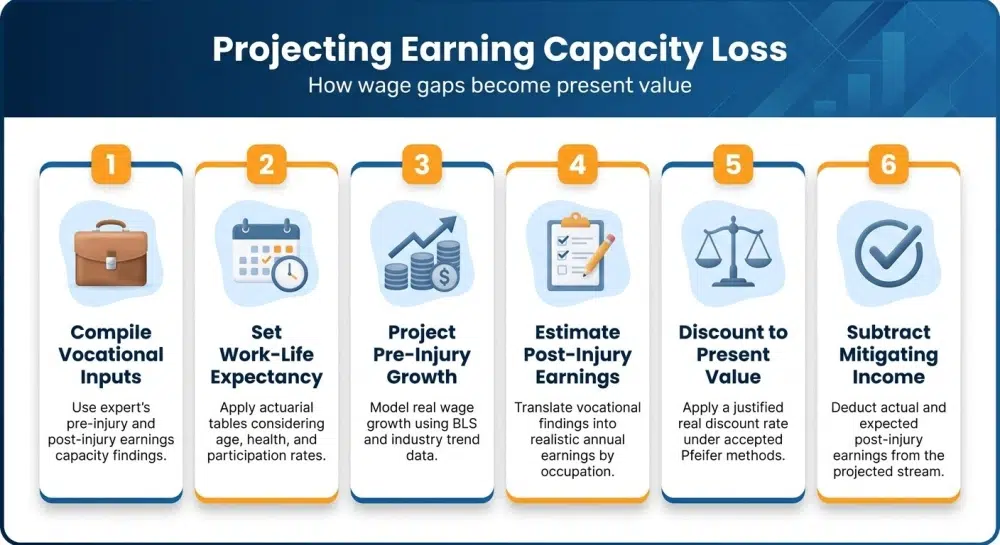
Once the vocational expert has established pre-injury earning capacity and post-injury realistic earning capacity, a forensic economist converts the annual shortfall into a single present-value lump sum. The methodology involves four steps.

Step 1. Establish the Work-Life Base Period
Using actuarial work-life expectancy tables, the economist estimates how many more years the plaintiff would likely have worked but for the injury. These tables account for mortality probability, labor force participation rates by age and education, and voluntary retirement patterns. For a 38-year-old plaintiff in good health prior to the injury, a work-life extending to age 65 or 67 is typical starting point, subject to adjustment for the plaintiff’s specific occupation and health history.
Step 2. Project Real Wage Growth
Wages are not static. A skilled worker promoted on a normal career trajectory earns more at 45 than at 35. The economist applies a real (inflation-adjusted) wage growth rate to project what the plaintiff’s pre-injury earnings would have been at each future year. Industry wage growth data from the Bureau of Labor Statistics and occupation-specific surveys inform this projection. [2]
Step 3. Discount to Present Value
A lump sum awarded today must be reduced because the plaintiff can invest and earn a return on that money. The Jones & Laughlin Steel Corp. v. Pfeifer decision established that courts must account for this time-value-of-money principle and explained accepted approaches to doing so. [3] One common method nets the projected real wage growth rate against a real discount rate, sometimes resulting in a “total offset” approach or a modest net discount. Experts are required to explain and justify the specific rate used; courts have excluded projections that rest on unsupported assumptions.
Step 4. Subtract Mitigating Income
The projection deducts the post-injury earnings the plaintiff realistically can generate. If the vocational analysis identifies realistic post-injury earnings of $55,000 annually and the pre-injury trajectory projected $90,000, the shortfall is $35,000 per year, which the economist then projects and discounts. Any actual post-injury earnings already received during the period from injury to trial may be applied against the past component of the claim.
| Step | What Is Done | Key Data Sources |
|---|---|---|
| 1. Work-life base | Estimate remaining working years using actuarial tables | Work-life expectancy tables; plaintiff age/health history |
| 2. Wage growth | Project pre-injury earnings at realistic growth rate | BLS occupational data; industry wage surveys |
| 3. Post-injury capacity | Project post-injury realistic earnings from vocational findings | Vocational report; BLS MSA wage data for DFW |
| 4. Discount to PV | Reduce future shortfall stream to a single lump sum in today’s dollars | Real interest rates; Pfeifer methodology; expert judgment |
| 5. Net loss | Subtract actual post-injury earnings and mitigating income | Post-injury pay records; vocational testimony |
What Evidence Should You Preserve Immediately
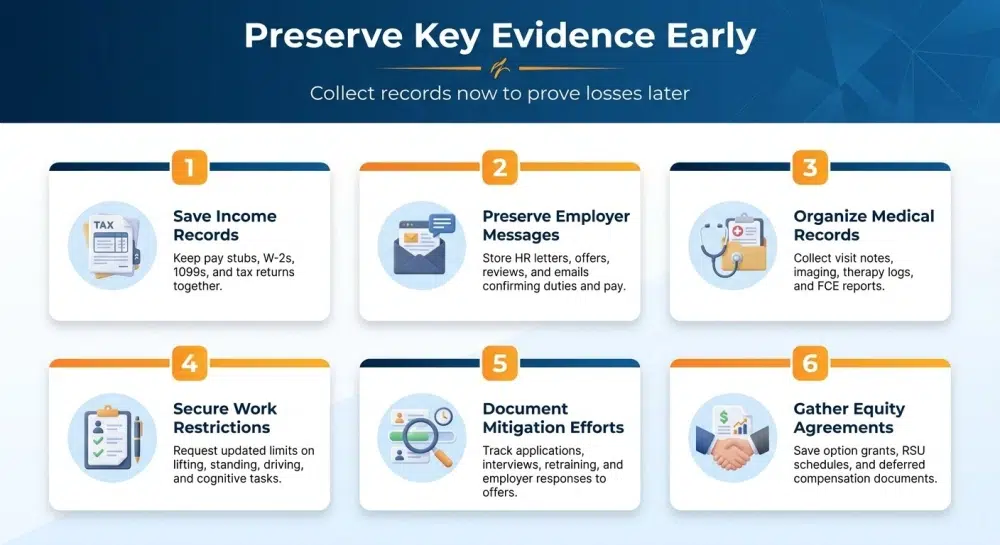
The strength of both wage and earning-capacity claims depends on the quality of evidence gathered early. Evidence lost in the first weeks after an injury cannot always be reconstructed. Work injury lawyers emphasize that documentation gathered while memories are fresh and records are accessible makes the difference in complex economic claims.
- Income records: Pay stubs, W-2s, 1099s, three to five years of tax returns, business bank statements.
- Employer communications: HR letters, offer letters, performance reviews, promotion documentation, and correspondence about job requirements.
- Medical records: Every physician visit note, imaging report, therapy log, and functional capacity evaluation from day one of treatment.
- Work restriction letters: Written physician-imposed limitations on lifting, standing, sitting, driving, and cognitive tasks, updated as restrictions evolve.
- Career records: Certifications, license records, continuing education records, professional association memberships, and any planned training programs that the injury interrupts.
- Mitigation records: Job applications, interview records, retraining program enrollment, and employer responses documenting that you are making reasonable efforts to return to productive work.
- Equity and compensation agreements: Stock option agreements, RSU grant letters, vesting schedules, partnership agreements, and any deferred compensation documents.
How Texas’s Modified Comparative Fault Rule Affects the Calculation
Texas uses a modified comparative fault system with a 51-percent bar. Under Texas Civil Practice and Remedies Code § 33.001 and related provisions, if a jury finds that the plaintiff was more than 50 percent responsible for the injury, the plaintiff recovers nothing. If the plaintiff is found 50 percent or less at fault, recovery is reduced proportionally by that percentage. [6]
This matters for earning capacity claims because defendants frequently argue that a plaintiff contributed to their own injury, failing to wear a seatbelt on the LBJ Freeway, for example, or disregarding posted warnings at a worksite. If the jury assigns the plaintiff 25 percent of the fault, the economic damages award, including lost earning capacity, is reduced by 25 percent. Careful presentation of liability evidence is therefore inseparable from the economic damages case.
Common Defense Challenges and How They Are Addressed
Defendants and their insurers routinely challenge earning-capacity claims in Texas litigation. Understanding these challenges helps explain why thorough preparation matters.
- Causation disputes: Arguing that the wage loss or capacity reduction stems from a preexisting condition (prior back problems, prior layoffs) rather than the defendant’s conduct. Medical records establishing baseline health before the injury, and expert opinions that differentiate new limitations from preexisting ones, counter this challenge.
- Failure to mitigate: Arguing that the plaintiff could have returned to work sooner, accepted light-duty assignments, or found comparable employment with reasonable effort. Mitigation logs, physician guidance on return-to-work timing, and vocational opinions on realistic job search timelines are the response.
- Speculative projections: Attacking the economist’s wage growth assumptions, discount rate, or work-life expectancy as unfounded. Using standard actuarial tables, BLS data, and documented career history and explaining each assumption clearly addresses this challenge. Federal Rule of Evidence 702 allows courts to exclude opinions that are not grounded in reliable methodology. [5]
- Alternative employment: Arguing that identified post-injury job alternatives pay more than the vocational expert acknowledged, reducing the shortfall. The vocational expert’s local market survey and documented wage verification are essential to defending the post-injury capacity figure.
- Underdocumented income: Especially for self-employed claimants and cash workers, defendants challenge income figures that lack IRS-corroborated records. Consistent tax filings and business accounting records are the only reliable foundation.
How the Statute of Limitations Applies in Texas, California, and Illinois
Filing deadlines are not flexible, and missing them generally bars the claim entirely.
- Texas: The general personal injury limitations period is two years from the date the cause of action accrues. Tex. Civ. Prac. & Rem. Code § 16.003. Wrongful death claims are also subject to a two-year period under the Texas Wrongful Death Act, Chapter 71. [6] Government entity claims may have shorter notice requirements under individual governmental immunity statutes and city charters.
- California: Two years for personal injury. Cal. Code Civ. Proc. § 335.1. Government claims generally require presentation of a claim within six months. [7]
- Illinois: Two years for personal injury. 735 ILCS 5/13-202. Wrongful death and survival action deadlines are governed by separate provisions. [8]
These deadlines run from the date of the incident in most cases, not from the date you understand the full extent of your injuries. Do not assume you have more time than the statute provides.
Tax Treatment of Wage and Earning-Capacity Awards
Damages for personal physical injuries are generally excluded from gross income under 26 U.S.C. § 104(a)(2). [9] This exclusion applies to compensatory damages for physical injury, including both lost wage and lost earning capacity components of a personal injury award. Punitive damages and interest are taxable. Allocation of settlement proceeds among different categories of damages, and the specific language of a settlement agreement, can affect whether the exclusion applies. Consulting a tax professional before finalizing any settlement is advisable.
How GoSuits Can Help
Demonstrating what an injury has permanently taken from your working life requires a coordinated team treating physicians who document restrictions clearly, vocational evaluators who know the Dallas labor market, and economists who can defend their projections under cross-examination. A lost earning capacity claim in a serious personal injury case is built through months of careful evidence gathering, expert collaboration, and strategic presentation.
If you were injured in the Dallas area whether in a collision on I-35E near downtown, in a workplace accident in Irving, or at a construction site in Carrollton and you believe the injury has changed your ability to work long-term, an early conversation with an attorney who handles these claims can help you understand what evidence needs to be preserved and what the timeline looks like. GoSuits personal injury attorneys can review your circumstances and explain your options. Schedule a free consultation.

Talk With a GoSuits Dallas Personal Injury Attorney
Lost earning capacity claims require early action evidence is time-sensitive and expert timelines are long. If a serious injury has changed your career path, speak with an attorney before the statute of limitations closes your options. GoSuits serves clients in Dallas, Fort Worth, Irving, Carrollton, Plano, and throughout Texas. Consultations are free and confidential.
Related Texas Personal Injury Resources
- Types of Damages Available in Texas Personal Injury Cases
- Dallas Personal Injury Lawyers
- Dallas Work Injury Lawyers
- Dallas Car Accident Lawyers
- Dallas Wrongful Death Lawyers
- Our Attorneys
- Prior Cases and Results
References and Legal Authorities
- IRS: About Form 1099-NEC – Internal Revenue Service
- BLS: Occupational Employment and Wage Statistics, Dallas-Plano-Irving MSA – U.S. Bureau of Labor Statistics
- Jones & Laughlin Steel Corp. v. Pfeifer, 462 U.S. 523 (1983) – Cornell Law School LII
- O*NET OnLine – U.S. Department of Labor / Employment and Training Administration
- Federal Rule of Evidence 702 – Expert Testimony – Cornell Law School LII
- Texas Civil Practice and Remedies Code Chapter 33 – Proportionate Responsibility – Texas Legislature
- California Code of Civil Procedure § 335.1 – Two-Year Limitation for Personal Injury – California Legislature
- 735 ILCS 5/13-202 – Illinois Personal Injury Limitations – Illinois General Assembly
- 26 U.S.C. § 104(a)(2) – Exclusion of Damages for Personal Physical Injuries – Cornell Law School LII
- Texas Civil Practice and Remedies Code § 16.003 – Two-Year Limitation Period – Texas Legislature
- Texas Civil Practice and Remedies Code Chapter 71 – Wrongful Death Act – Texas Legislature
- Texas Court Rules and Standards – Texas Judicial Branch
- Texas Court Rules Research Guide – Texas State Law Library
- Earning Capacity (Wex Legal Dictionary) – Cornell Law School LII
- IRS Publication 4345 – Settlements – Taxability – Internal Revenue Service