Under California law, a wrongful death claim produces a single, unified recovery. That recovery is not divided by the same percentages that would govern an inheritance. Instead, each eligible heir receives a share that reflects the personal loss that heir actually sustained as a result of the death. The court has authority to determine the respective rights of the heirs in any award, and when the heirs cannot agree among themselves, the court resolves the allocation. Understanding how California structures this process matters whether a family is evaluating a pre-trial settlement or preparing to present evidence at trial.
Legal Snapshot
- Legal Topic: California Wrongful Death Damage Allocation Among Heirs
- Case Stage: Pre-litigation through trial; applies to settlements and verdicts
- Primary Legal Issue: How a single California wrongful death recovery is apportioned among eligible heirs according to each heir’s individual loss
- Primary Authority: Cal. Code Civ. Proc. §§ 377.60, 377.61 (leginfo.legislature.ca.gov)
- Jurisdiction: State of California
- Date Legal Authority Last Reviewed: June 2025
What Is a California Wrongful Death Claim?
A wrongful death cause of action arises when a person dies as a result of another party’s wrongful act or neglect. California’s wrongful death statute is found in the Code of Civil Procedure, Article 6, at sections 377.60 through 377.62. The statute creates a claim that belongs to the surviving heirs, not to the decedent’s estate. This is a critical distinction: wrongful death damages compensate the survivors for what they lost when the decedent died, not the decedent for what the decedent suffered before death.
Those who qualify to bring or share in a wrongful death claim include the decedent’s surviving spouse or domestic partner, children, and issue of deceased children. If no issue survives, persons who would be entitled to the decedent’s property by intestate succession may also assert a claim. Certain other dependents, such as a putative spouse, stepchildren, or parents, may qualify if they were financially dependent on the decedent. [1]
What Does California Law Say About How Damages Are Calculated?
California Code of Civil Procedure section 377.61 states that in a wrongful death action, damages may be awarded that are “just” under all the circumstances, but “may not include damages recoverable under Section 377.34.” That exclusion is the key to understanding the boundary between wrongful death and the separate survival action.
Section 377.34 addresses damages that belong to the decedent’s estate through a survival action. Those include the decedent’s own pain, suffering, and disfigurement experienced before death. The wrongful death action covers a different set of losses: the harm to the survivors themselves. California courts and the personal injury lawyers who handle these cases treat the two actions as legally separate even when both arise from the same incident.
Section 377.61 also provides that “the court shall determine the respective rights in an award of the persons entitled to assert the cause of action.” [2] That language means the court retains final authority over how any award is divided. Heirs may agree on an allocation by stipulation, but if they disagree, the court steps in.
What Categories of Loss Are Recoverable in a Wrongful Death Claim?
California wrongful death damages are measured by each heir’s individual loss, not by a formula applied uniformly to all. The recoverable categories generally recognized under California law include:
Financial Support
Each heir who depended on the decedent financially may recover the value of future financial contributions the decedent would reasonably have provided. Courts consider the decedent’s age, health, earning capacity, and likelihood of continued support, as well as the age and circumstances of each heir. A dependent spouse and minor children typically have the strongest claims to economic support damages.
Loss of Gifts and Benefits
Beyond regular income, heirs may recover the value of gifts, household contributions, and other benefits the decedent customarily provided. This category captures the broader economic relationship between the decedent and each survivor.
Funeral and Burial Expenses
The reasonable cost of funeral and burial services is a recoverable item under California wrongful death law. These costs are typically straightforward to document.
Value of Household Services
If the decedent performed household work, childcare, home maintenance, or similar unpaid services for the family, the monetary value of those services is recoverable. An expert may testify about the replacement cost of those services.
Non-Economic Loss: Love, Companionship, Comfort, Care, and Moral Support
California allows each heir to recover for the loss of the decedent’s love, companionship, comfort, care, assistance, protection, and moral support. For a surviving spouse, this extends to the loss of consortium, which captures the loss of the marital relationship in its full sense. These are highly individual losses. A young child who loses a parent faces a different magnitude of non-economic harm than an adult child who lived independently from the decedent.
Personal injury lawyers handling wrongful death claims in Orange County commonly present detailed evidence about the decedent’s day-to-day role in each heir’s life, including testimony from family members, friends, and sometimes mental health professionals, to help the trier of fact understand what each heir lost personally.
What Is NOT Recoverable in a Wrongful Death Claim?
Two categories of loss are explicitly excluded from California wrongful death damages:
Grief and Sorrow as Such. The statute does not permit recovery for an heir’s own grief, emotional distress, or mental suffering caused by mourning the decedent. This limitation surprises many families. The non-economic damages are framed around what the heir lost from the relationship, not the heir’s emotional response to the death itself. The practical line is not always easy to draw, but California courts have consistently held that grief and sorrow are outside the statutory measure.
The Decedent’s Own Pre-Death Pain and Suffering. Damages for the physical pain, suffering, emotional distress, and disfigurement the decedent personally experienced before death belong to the survival action under section 377.34, not to the wrongful death action. If a person suffered serious injuries before dying from them, those pre-death damages are recovered through the estate, not through the wrongful death claim. Wrongful death lawyers who handle cases in Orange County and across Southern California frequently manage both a wrongful death claim and a survival action arising from the same incident, keeping the evidence and arguments for each legally distinct. [3]
How Does Allocation Work Among Multiple Heirs?
California treats the wrongful death claim as a single cause of action jointly held by all eligible heirs. A verdict or settlement produces one total amount. The heirs then allocate that amount among themselves based on each heir’s proportionate loss.
The allocation follows individual loss, not intestate succession shares. If a decedent is survived by a spouse and two adult children, the spouse does not automatically receive half and the children one-quarter each. Instead, the allocation reflects the magnitude of each heir’s personal economic and non-economic loss. A young spouse who depended financially on the decedent and shared decades of daily life will typically receive a larger allocation than an adult child who lived independently and saw the decedent infrequently.
Example Scenario
This is a hypothetical illustration for educational purposes only and does not represent any actual GoSuits case or a guaranteed outcome.
A driver is killed in a collision on the I-405 in Orange County. The decedent is survived by a spouse and two adult children from a prior relationship. A verdict is returned for $3 million. The spouse, who shared a household with the decedent and relied on the decedent’s income, may be allocated a substantially larger share because the financial and companionship losses are greater. The adult children may each receive a smaller share reflecting their separate households, less financial dependence, and more limited daily interaction with the decedent. The allocation must be supported by the evidence presented at trial or agreed upon by the parties in a written stipulation.
Disputes Between a Spouse and Adult Children
The most common allocation dispute in California wrongful death cases arises between a surviving spouse and adult children from a prior relationship. Each group may claim a significant share of the recovery. Courts resolve these disputes by examining the actual relationship each heir had with the decedent. Evidence that commonly matters includes:
- How often the adult children saw the decedent
- Whether the adult children received financial support from the decedent
- The nature and depth of the personal relationship
- The surviving spouse’s financial dependence on the decedent
- The decedent’s role in the spouse’s daily household
California courts applying wrongful death claims in cases tried at the Orange County Superior Court in Santa Ana have recognized that adult children can recover meaningful wrongful death damages even when they are financially independent, because the companionship, love, and moral support they lost has genuine value. At the same time, courts weigh the frequency and closeness of the relationship. An adult child who rarely visited the decedent will face a harder task establishing a large non-economic loss than one who maintained a close, active relationship.
When settlement is reached, the heirs are expected to agree on an allocation before the settlement can be distributed. If they cannot agree, the matter may need to go before the court for allocation. Wrongful death lawyers familiar with this process counsel heirs to try to reach agreement early, because litigation over allocation between co-plaintiffs can be costly and emotionally taxing.
When Court Approval Is Required
Settlements Involving Minor Heirs
If any heir is a minor, a court must approve both the settlement and the allocation of the minor heir’s share. This is called a minor’s compromise. The court reviews the settlement amount, the proposed allocation to the minor, and the reasonableness of attorney fees before approving the disbursement. The minor’s share is typically placed in a blocked account or structured settlement until the minor reaches adulthood. Cases filed in the Orange County Superior Court follow the local rules governing minor’s compromises, and the process requires a noticed petition supported by declarations. [4]
Allocation Disputes Among Adult Heirs
When adult heirs cannot agree on allocation, the court resolves it under section 377.61’s directive that the court “determine the respective rights in an award.” The court may hold an evidentiary hearing to receive testimony and documentary evidence about each heir’s relationship with the decedent and the magnitude of each heir’s loss.
How Structured Settlements Apply
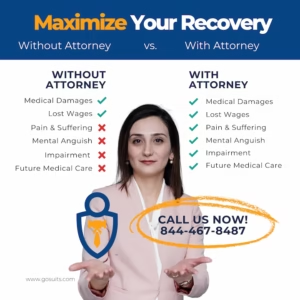
A wrongful death recovery need not be paid in a single lump sum. Defendants and their insurers frequently offer structured settlements, which spread payments over time through an annuity. Structured settlements can serve heirs who prefer a predictable long-term income stream over a large immediate payment that carries investment risk. They may also carry tax advantages under federal law because wrongful death compensatory damages are generally excluded from gross income.
When a wrongful death settlement is structured, the allocation question still applies: the structured payment stream must be divided among heirs in a manner that reflects each heir’s individual loss. A spouse receiving periodic income payments representing her financial support damages may be allocated a different structure than an adult child receiving a lump sum representing non-economic loss. The terms of the structure, including payment amounts, duration, and any remaining death benefit, are part of the allocation discussion.
When minor heirs are involved, structured settlements for minors require court approval as part of the minor’s compromise proceeding. The court evaluates whether the structure’s terms are in the minor’s best interest before approving the arrangement.
What Evidence Can Support an Allocation Claim?
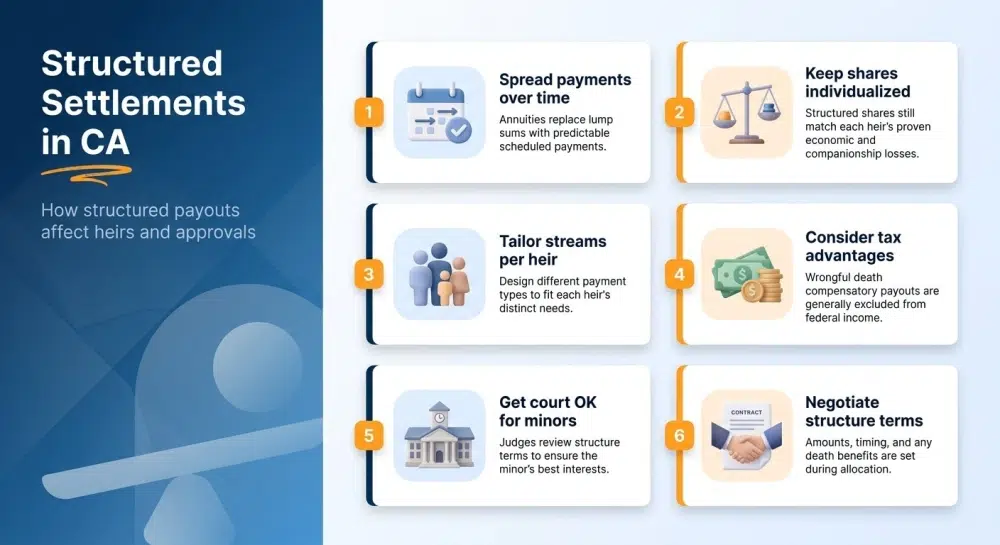
Each heir’s allocation is supported by evidence of that heir’s individual loss. Depending on the circumstances, evidence may include:
- Tax returns, pay stubs, and financial records showing the decedent’s income and contributions to each heir
- Bank records showing financial transfers from the decedent to heirs
- Testimony from family members about the frequency and nature of contact with the decedent
- Photographs, text messages, and communications reflecting the relationship
- Testimony from therapists, counselors, or psychologists about the impact of the loss on each heir
- Expert testimony from an economist or vocational expert on the value of lost financial support and household services
- Life expectancy tables used to project the duration of future losses
- Documentation of the decedent’s regular household contributions, such as home repairs, childcare, and elder care
The strength of a particular heir’s allocation claim turns significantly on the quality of this evidence. Heirs who maintain contemporaneous records of the decedent’s role in their lives are better positioned to support their allocation. Personal injury lawyers handling Irvine wrongful death claims regularly advise clients to preserve communications, photographs, and financial records from the outset.
How Long Do Heirs Have to File?
California’s statute of limitations for a wrongful death action is two years from the date of the decedent’s death. [5] Missing this deadline generally bars the claim entirely. Exceptions exist in limited circumstances, such as when a defendant fraudulently conceals facts relevant to the claim, or when the heir is a minor. Because deadlines are strictly enforced and the specific facts of a case can affect the applicable limitation period, the correct deadline in any individual matter requires legal verification and should not be assumed without consulting an attorney.
Separately, if any defendant is a government entity, a government tort claims act notice must typically be filed within six months of the incident before a lawsuit can proceed. This notice requirement is a threshold step, and failure to comply may permanently bar the claim regardless of the two-year limitation period.
Families in Orange County who have lost a loved one through another party’s negligence are encouraged not to delay. Evidence can disappear, witnesses move, and surveillance footage is often overwritten within days. Acting promptly allows a legal team to preserve the evidence that supports both liability and each heir’s individual loss.
What If Insurance Is Involved?
Wrongful death claims are almost always resolved through insurance. The at-fault party’s liability insurance provides the primary source of recovery. If the defendant’s coverage is insufficient to compensate all heirs fairly, the heirs’ own uninsured or underinsured motorist coverage may provide additional recovery. In crashes involving commercial vehicles on routes like the SR-73 Toll Road or the I-405, layered commercial insurance policies may provide higher limits than a personal auto policy.
The allocation question affects insurance negotiations as well as trials. When a defendant’s insurer agrees to pay a settlement amount, the heirs must agree on how to divide it before the insurer will release funds. The insurer typically will not participate in resolving internal disputes among heirs. That negotiation falls to the heirs and their legal representatives.
If any of the heirs is a minor, the insurer will generally require court approval of the settlement, including the minor’s allocated share, before releasing funds.
What Should You Do Next?
A wrongful death claim involves legal standing questions, factual investigation, medical and economic evidence, insurance negotiations, and potential litigation. The allocation of damages among heirs adds another layer of legal and personal complexity. Families dealing with the loss of a loved one while also facing these legal demands benefit from guidance that addresses both the liability case against the defendant and the fair representation of each heir’s individual interests.
A wrongful death claim can involve disputes about liability, insurance coverage, and the proper allocation of any recovery among surviving family members. If you have lost a family member due to another party’s negligence in Orange County or elsewhere in California, schedule a free consultation with a GoSuits attorney to review the circumstances and understand your options. There is no fee unless your case results in a recovery.
Related California Wrongful Death Resources
For additional information on related topics in California personal injury law, the following resources may be helpful:
- Wrongful Death Standing Under CCP § 377.60 – GoSuits Knowledge Base
- How Long Does It Take to Settle a Wrongful Death Lawsuit?
- How Do You Value Someone’s Life in a Wrongful Death Lawsuit?
- Lost Future Inheritance in Wrongful Death Claims
- What Are the Different Types of Personal Injury Damages?
Talk With a GoSuits Attorney
A wrongful death case involves questions of standing, evidence, liability, insurance coverage, and the allocation of any recovery among surviving family members. Each heir’s situation is different, and the recovery each person may be entitled to depends on the specific facts of the relationship and the loss involved. These cases carry strict filing deadlines, and early action to preserve evidence and assert legal rights can affect the outcome.
If your family is dealing with the loss of a loved one due to someone else’s negligence in Irvine, Newport Beach, Costa Mesa, Anaheim, or anywhere in Orange County, our Irvine personal injury team at GoSuits can review the facts of your situation and explain what options may be available. There is no fee unless your case results in a recovery. To speak with a GoSuits attorney, contact us here.
GoSuits serves injury victims throughout California. For information about our California practice areas, visit our Irvine personal injury lawyers page. Families who have suffered a fatal loss may also benefit from speaking with wrongful death lawyers in Irvine about their options under California law.
References
- Cal. Code Civ. Proc. § 377.60 – Wrongful Death Standing – California Legislative Information
- Cal. Code Civ. Proc. § 377.61 – Wrongful Death Damages – California Legislative Information
- Cal. Code Civ. Proc. § 377.34 – Survival Action Damages – California Legislative Information
- California Rules of Court – California Courts, Judicial Branch of California (courts.ca.gov)
- Cal. Code Civ. Proc. § 335.1 – Two-Year Limitation for Personal Injury and Wrongful Death – California Legislative Information
- Khosravan v. Chevron Corp., B307482 (Cal. Ct. App. 2d Dist. July 6, 2021) – CourtListener (discussing CCP § 377.60 and wrongful death standing)
- 26 U.S.C. § 104 – Exclusion of Compensation for Injuries or Sickness (Federal Tax Treatment of Wrongful Death Damages) – Cornell Law School Legal Information Institute
- United States Courts – Background on Federal Civil Procedure (uscourts.gov)
- Cal. Gov. Code § 945.6 – Government Tort Claims Statute of Limitations – California Legislative Information
- California Rules of Court, Rule 7.950 et seq. – Minor’s Compromise Petitions – California Courts (courts.ca.gov)