














































Which Naperville roads see the most car crashes?
We do not have a tidy ranking, and anyone who hands you one is guessing. What we can say is where the conditions for crashes are obvious.
Route 59 is a major north-south road, with a retail corridor running south from the I-88 interchange, and the cars on it are constantly braking for turn lanes and parking lot entrances. The I-88 interchange at Route 59 is a diverging diamond, which switches traffic to the left side of the road for a stretch. Drivers who are unfamiliar with it, or who are looking at a phone, can end up in the wrong lane. Rear-end and sideswipe collisions are the typical result of the slowdowns before and after.
Ogden Avenue (US 34) is a different problem. It runs through commercial strips with many driveways, so drivers pull out across lanes from shopping centers and restaurants. Left turns across oncoming traffic on Ogden and on 75th Street are a common way for an ordinary afternoon to become a T-bone collision. Out on 95th Street, on the Will County side of the city, speeds are higher, and a driver turning in or out of a side street has less room to misjudge a gap.
Closer to the center, the picture changes again. Downtown Naperville around Washington Street and the Riverwalk has pedestrians stepping off curbs, cars backing out of angle parking and drivers circling for a space. Those crashes are slower, but a pedestrian or cyclist can still be badly hurt. And twice a day, school traffic around the Naperville and Indian Prairie district campuses packs side streets with parents, buses and teenage drivers who are new behind the wheel.
Who is at fault, and does it matter if you share some of the blame?
Illinois is an at-fault state. The driver who caused the crash, and that driver’s liability insurer, is responsible for the harm. There is no no-fault system that makes your own insurer pay first regardless of who caused it.
Sharing blame does not always end a claim. Under 735 ILCS 5/2-1116, an injured person who is found to be more than 50 percent at fault cannot recover damages. If you are 50 percent at fault or less, you can recover, but your award is reduced by your percentage. A person 20 percent at fault on a claim worth $100,000 would collect $80,000. A person 51 percent at fault collects nothing.
That 50 percent line is why insurers argue about small things. A driver who said “I didn’t see him” at the scene, a missed turn signal, a speed estimate a little over the limit: each can be used to move a percentage point. We have written about how the rule works in our knowledge-base article on the Illinois 50 percent comparative fault rule.
Fault is usually proved by a mix of the crash report, photographs, vehicle damage patterns, witness accounts and, in a disputed case, video and the cars’ own recorded data. The earlier those are secured, the less room there is for argument.
What should you do in the days after a Naperville car crash?
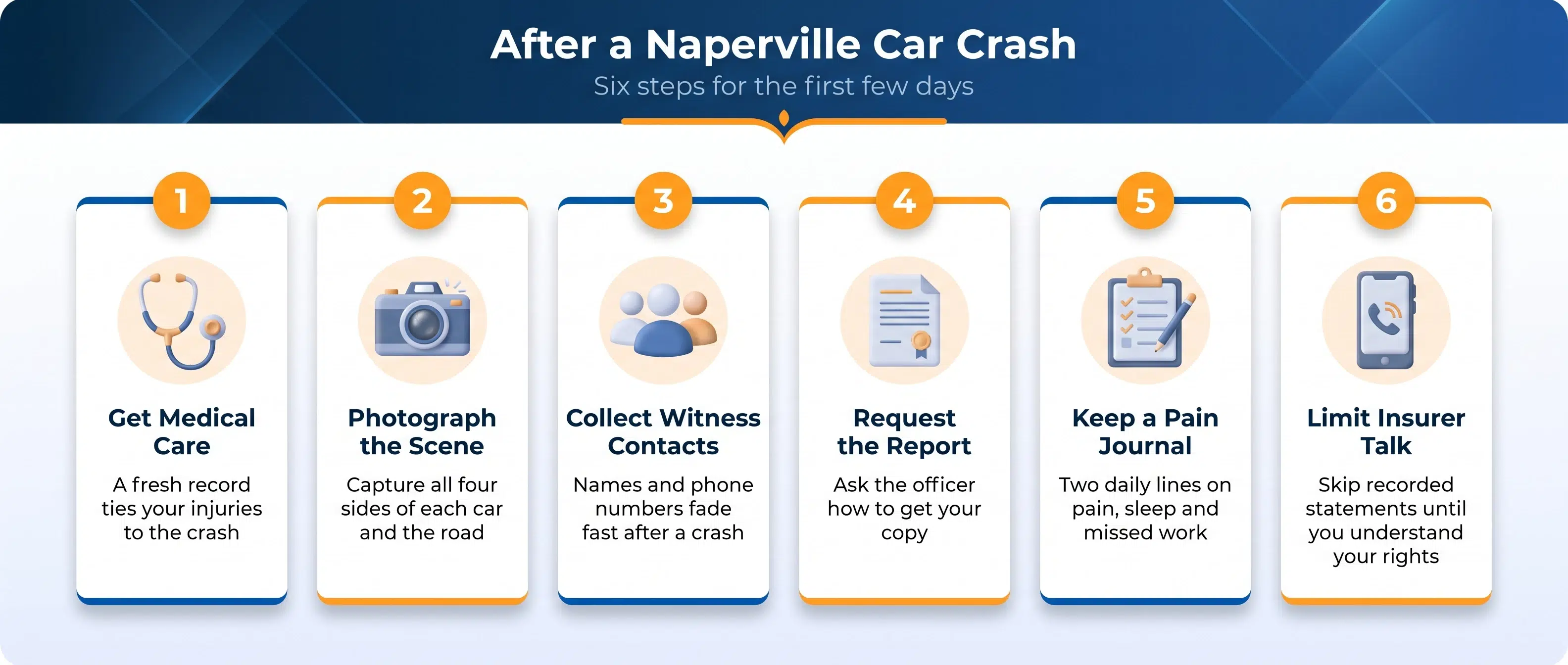
Get medical care, even if you feel mostly fine. Edward Hospital, at 801 South Washington Street, has an emergency department, and urgent care clinics are spread across Naperville. A visit records the injury when it is fresh, and it matters later if an adjuster says you were not really hurt.
Photograph everything you can before the cars are moved or repaired: all four sides of each vehicle, the road, skid marks, signals, and any visible injury. Get names and phone numbers of witnesses. Ask the responding officer how to get a copy of the report.
Keep a simple journal. Two lines a day on pain level, sleep, missed work and things you could not do is enough. Do not post about the crash online, and do not sign a medical release or accept an offer from the other driver’s insurer until you understand what you are giving up.
When your own insurer calls, report the crash and cooperate with your own policy. When the other driver’s insurer calls, you do not have to give a recorded statement, and the first call is usually where the adjuster is looking for exactly the kind of sentence that later reads as an admission.
Which insurance policy pays for your injuries?
Usually the first source is the at-fault driver’s liability coverage. It pays for your medical bills, lost income and pain and suffering, up to the policy limit. When the limit is low, or the driver has no insurance at all, your own policy may matter more than you expect.
Uninsured and underinsured motorist coverage on your own policy can fill part of the gap. Medical payments coverage, if you bought it, can pay bills quickly regardless of fault. If you were a passenger in a rideshare vehicle, the rideshare company’s coverage can come into play, and the rules depend on whether the app was on and whether a ride was in progress. If the other driver was working, an employer’s commercial policy may sit above their personal one.
We read every policy that might apply before any demand goes out, because the first limit you learn about is often not the last one.
What injuries show up after car crashes, and why do they change the claim?
Whiplash is the one most people have heard of, and it can take a day or two to show up as neck stiffness, headaches or pain between the shoulder blades. Concussions are easy to miss because there may be no visible mark; confusion, light sensitivity or trouble finding words in the days after a crash are reasons to be seen. Seat belts save lives and can also leave a bruised chest or a broken collarbone. Herniated discs, torn ligaments in the knee and fractures in the wrist from bracing against the wheel are common in rear-end and side-impact crashes.
Injuries matter to a claim in two ways. They drive the medical bills, and they determine how long recovery takes and whether anything is permanent. A claim should not be settled before you reach a stable point in treatment, because once you sign a release, you cannot go back for the surgery your doctor recommends three months later.
Psychological injuries count too. Anxiety about driving, sleep problems and flashbacks are real harm and can be documented by a treating provider.
How are car accident claims valued?
No formula produces the number, and online calculators that promise one should be treated with caution. Value comes from the facts of the case.
Medical expenses are the starting point, both what you have paid so far and what your doctors say you will need. Lost income comes next, including time off and any reduction in what you can earn later. Pain, limits on daily life and loss of enjoyment are real parts of the claim, and the strength of the evidence about them depends on how well they were documented. Property damage is handled separately and usually quickly.
Several things pull the number down: gaps in treatment, a delay in seeing a doctor, prior injuries to the same body part that the defense will call the real cause, and shared fault. Things that push it up include clear liability, consistent medical records, a treating doctor who will say plainly that the crash caused the injury, and a driver whose policy limits are high.
Net recovery matters as much as the gross figure. Beyond pursuing the settlement from the at-fault insurer, we negotiate with hospitals, ER groups and medical lien holders at the end of the case to reduce what you owe out of the award.
How do adjusters try to reduce what they pay?
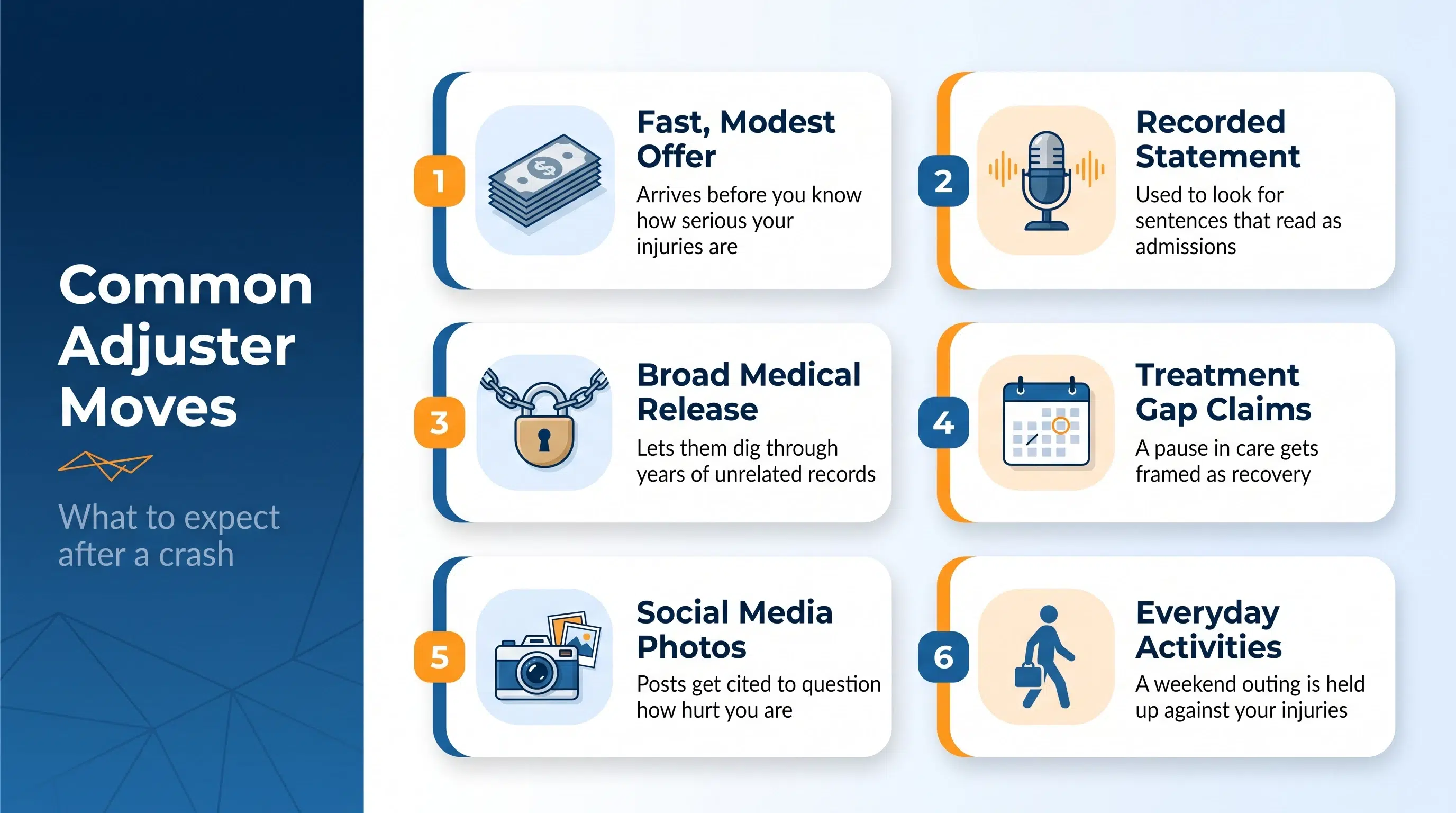
Adjusters are not villains, but they are paid to close claims for less. Common moves are a fast, modest offer before you know the extent of your injuries, a request for a recorded statement, a broad medical authorization that lets them dig through years of records, and a suggestion that a gap in your treatment means you got better. Some will point to social media photos, a vacation, or a weekend at a child’s soccer game.
A sound response is steady and boring. Provide what is needed, keep your answers short, and let your attorney deal with the rest. If you want a second set of eyes on an offer, our Chicago personal injury team can review it with you.
Where is a Naperville car accident case filed, and how long do you have?
Naperville sits in two counties. Most of the city is in DuPage County, and a southern portion is in Will County, so which court hears a lawsuit is not just a matter of the city name on the police report. Under 735 ILCS 5/2-101, a case can be filed in the county where a defendant lives or in the county where the crash happened. A crash on Route 59 may land in one county and the defendant may live in another, which gives us a choice that can affect the pace of the case and the jury pool.
In DuPage County, civil injury cases go to the Circuit Court of DuPage County, which is the 18th Judicial Circuit and sits in Wheaton. Will County cases go to the Circuit Court of Will County, the 12th Judicial Circuit, in Joliet.
The deadline to sue is two years from the date of the crash for most injury claims, under 735 ILCS 5/13-202. Claims against a city, a school district or another public body can carry shorter notice requirements, so if a government vehicle or a road defect was involved, tell us right away. The fastest way to protect your rights is to schedule a free consultation while the details are still fresh.
Which Naperville car accident cases do we take?
We take the car crash cases Naperville drivers most often face: rear-end collisions in the Route 59 slowdowns, T-bone crashes from left turns on Ogden Avenue and 75th Street, sideswipes near the I-88 interchange, and crashes with rideshare, delivery or company vehicles. Our Chicago-area car accident lawyers handle these claims from the first call through settlement or trial.
Car accident cases are one part of the work of our Chicago personal injury office. When a semi or another commercial truck is involved, our Chicago-area truck accident team works the case from the start.
