
There is no fixed timeline for a personal injury lawsuit in Illinois. A claim resolved through pre-suit negotiations may conclude sooner than a case that requires discovery, motions, trial, or an appeal. The length of the process depends on factors such as medical treatment, disputed liability, the number of parties, the evidence required, and the court’s schedule.
Waiting for a personal injury claim to move forward can be frustrating, especially while dealing with medical treatment, lost income, or uncertainty about the future. Having a clear understanding of the litigation process and the factors that influence a case timeline can help set realistic expectations as the claim progresses.
Key Takeaways
- Personal injury claims resolved before litigation may conclude sooner than cases requiring discovery, motions, trial, or an appeal.
- Filing a lawsuit generally extends the timeline because of court procedures, discovery, and scheduling.
- The two-year statute of limitations under 735 ILCS 5/13-202 continues to run during settlement negotiations.
- Cases involving disputed liability, multiple parties, or extensive medical treatment often take longer to resolve.
- Cases that proceed to trial typically require additional time beyond pretrial proceedings.
- Court scheduling may also affect how quickly a case progresses, as hearing dates, judicial assignments, and trial availability vary among Illinois circuit courts.
- Every case is different, and timeline estimates are general patterns rather than guarantees.

What is a realistic timeline for an Illinois personal injury case?
There is no fixed timeline for a personal injury case in Illinois. Some claims resolve through pre-suit settlement, while others take substantially longer because of ongoing medical treatment, disputed liability, multiple parties, discovery, trial, or an appeal.
The stages a case goes through and the issues that arise along the way often have the greatest impact on how long the process takes.
General Illinois Personal Injury Case Timeline
General Timeline Patterns for Illinois Personal Injury Cases |
||
|---|---|---|
| Case Type | General Timing Pattern | Main Factors |
| Claim Resolved Before Litigation | May Resolve Sooner Than a Filed Lawsuit | Medical Treatment, Liability, Documentation, and Negotiations |
| Filed Lawsuit with Limited Disputes | Often Requires Additional Months or Longer | Pleadings, Discovery, Motions, and Court Scheduling |
| Complex or Multi-Party Litigation | May Take Several Years | Serious Injuries, Multiple Defendants, Experts, and Extensive Discovery |
Note: These are broad process patterns, not statistical averages or predictions. Illinois does not impose a standard timetable for resolving personal injury cases, and the duration of any matter depends on its facts, procedural history, court schedule, and whether the parties reach a settlement.
Simple Cases With Clear Liability
Cases involving relatively minor injuries and clear fault often move through the claims process more quickly. When liability is not seriously disputed, and medical treatment is completed within a reasonable period, some claims may be resolved through settlement negotiations without a lawsuit ever being filed.
Even in these cases, the timeline depends on the progress of medical treatment and the parties’ ability to reach an agreed resolution.
Moderate Cases With Some Disputed Facts
A case may take longer when there are questions about liability, the extent of the injuries, or the value of the claim. Ongoing medical treatment, differing opinions about fault, or negotiations over damages can extend the process.
A claim may not be fully evaluated until enough medical information is available to better understand the long-term effects of the injuries.
Complex or Litigated Cases
Cases involving severe injuries, multiple defendants, expert witnesses, or significant disputes over liability often require substantially more time. In the most serious situations, including claims involving a fatal injury, a Chicago wrongful death attorney may also become involved, and the legal issues can further affect the litigation timeline.
If settlement negotiations do not resolve the claim, filing a lawsuit introduces additional procedural steps, including discovery, pretrial motions, and court scheduling. Should the case proceed to trial, the overall timeline may increase further depending on the complexity of the issues and the court’s calendar.
What are the stages of a personal injury case in Illinois?
Illinois personal injury cases may move through a similar sequence of stages, although not every case reaches each one. A case may resolve before filing, during discovery, through mediation or other negotiations, or through a trial and judgment.
Below is an overview of the stages that commonly shape the timeline of an Illinois personal injury case.
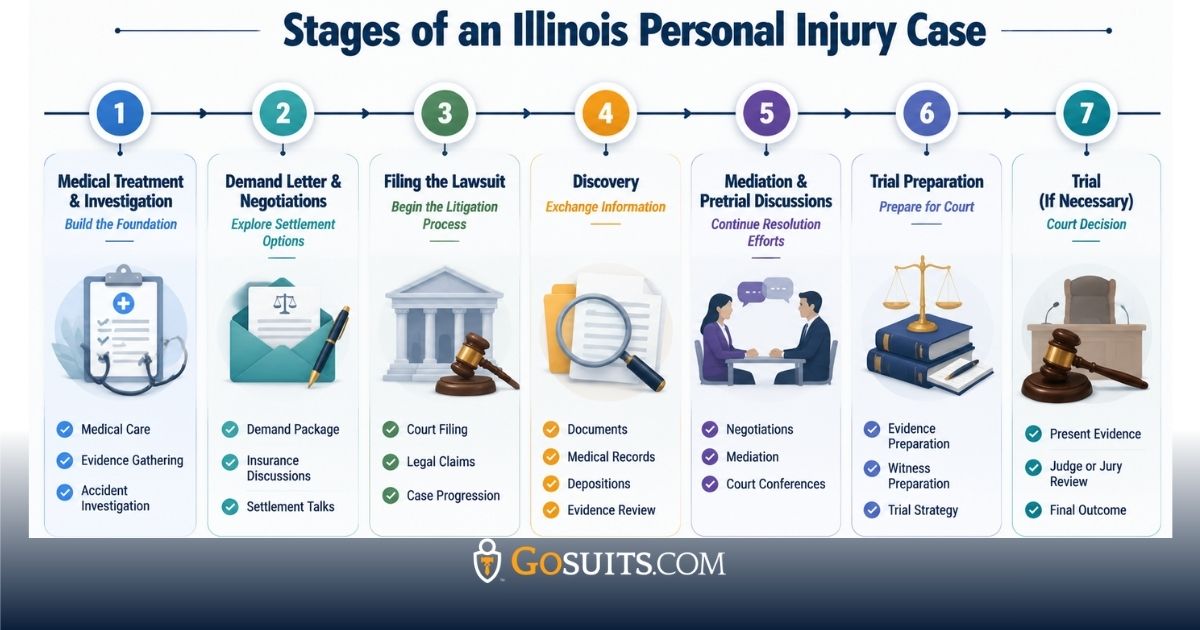
Medical Treatment and Case Investigation
The process typically begins with medical treatment and an investigation into how the accident occurred. For example, someone pursuing a claim after a motor vehicle collision may first work with a Chicago car accident attorney to gather police reports, medical records, witness statements, and other evidence before evaluating settlement options.
As treatment progresses, the full extent of an injury and any future medical needs may become clearer, which can affect how a claim is evaluated during settlement discussions.
However, if the applicable filing deadline is approaching, a lawsuit may be filed while treatment is still ongoing.
The timing of a demand or lawsuit should also account for the applicable filing deadline and the need to preserve evidence; treatment does not pause the statute of limitations.

Demand Letter and Settlement Negotiations
Once sufficient information is available, the injured person’s attorney may send a demand package to the insurance company describing the accident, the injuries, and the damages being claimed.
A personal injury claim may resolve through settlement negotiations at this stage without a lawsuit being filed. How long negotiations take depends on factors such as the evidence, any disputes over liability or damages, and whether the parties can reach an agreement.
Filing the Lawsuit
If settlement negotiations do not resolve the claim or the applicable filing deadline is approaching, a lawsuit may be filed in the appropriate Illinois circuit court. For many cases arising in the Chicago area, this may be the Cook County Circuit Court.
Filing a lawsuit does not necessarily mean the case will proceed to trial. Instead, it formally begins the litigation process and allows the parties to continue investigating the case, exchange information, file motions, and participate in additional settlement discussions while the matter moves through the court system.
Discovery
Discovery is the stage in which both sides exchange information and evidence, including written interrogatories, documents, medical records, depositions, and expert disclosures. Because this process often involves extensive fact gathering and coordination among multiple parties, it can become one of the longer stages of a litigated personal injury case.
Mediation, Pretrial Conferences, and Further Settlement Talks
Settlement discussions may continue throughout the litigation process. Some cases may resolve during or after discovery, while others continue toward trial when the parties cannot reach an agreement.
As discovery provides a clearer picture of the strengths and weaknesses of each side’s position, the parties may engage in additional negotiations.
Depending on the circumstances of the case and the court’s procedures, the parties may also participate in mediation or attend pretrial conferences to discuss the status of the litigation, address procedural issues, and explore the possibility of resolving the case before trial.
Trial (If Necessary)
If the parties cannot reach a settlement, the case may proceed to trial, where each side presents evidence and witnesses before a judge or jury. Trial preparation, court scheduling, and any post-trial motions can extend the overall timeline. A case may resolve before trial through negotiation, mediation, or another pretrial process. If no agreement is reached, a judge or jury may be required to decide the outcome.
What Illinois Court Rules Affect the Personal Injury Lawsuit Timeline?
Once a personal injury lawsuit is filed, the timeline is influenced not only by the facts of the case but also by the Illinois court rules governing civil litigation.
Two of the most important are Illinois Supreme Court Rule 218, which addresses case management, and Illinois Supreme Court Rule 213, which governs witness and discovery disclosures.
Under Illinois Supreme Court Rule 218, except as provided by an applicable local circuit-court rule approved by the Illinois Supreme Court, the court must hold a case-management conference within 35 days after the parties are at issue and no later than 182 days after the complaint is filed. At that conference, the court may establish deadlines for discovery, witness and expert disclosures, motions, settlement conferences, and trial preparation.
Illinois Supreme Court Rule 213 governs written interrogatories and the disclosure of lay, independent expert, and controlled expert witnesses. The information disclosed under the rule can limit the testimony later presented at trial, so witness identification and expert preparation can materially affect the litigation schedule.
Does the Illinois statute of limitations affect how long a case takes?

Illinois generally requires an action seeking damages for personal injury to be commenced within two years after the cause of action accrues under 735 ILCS 5/13-202. Different periods or tolling rules may apply depending on the defendant, the claimant’s age or legal disability, the type of claim, and other statutory circumstances.
Settlement negotiations do not pause or extend this filing deadline, so an attorney may file a lawsuit even while discussions with the insurance company are ongoing in order to preserve the injured person’s legal rights. In some cases, Illinois’s discovery rule may delay accrual until the injured person knew or reasonably should have known both that an injury existed and that it may have been wrongfully caused. The rule is fact-specific and does not automatically extend the deadline merely because the full extent of an injury was not immediately known.
Because the application of the discovery rule depends on the specific facts and applicable law, it is evaluated on a case-by-case basis.
Not every personal injury claim follows the same filing deadline. Claims involving certain public entities may be governed by different statutes and procedural requirements than the general two-year limitations period.
For example, lawsuits involving CTA bus and L train accidents may be subject to different statutory requirements than other personal injury claims. Identifying the correct deadline early in the process is important because missing the applicable filing period may prevent a lawsuit from moving forward regardless of the strength of the underlying claim.
What factors can make a personal injury case take longer or shorter?
No two personal injury cases follow exactly the same timeline. While some claims are resolved relatively quickly, others require additional investigation, medical evaluation, or court proceedings before they can be resolved.
Some of the most common factors that may influence how long an Illinois personal injury case takes include:
- Severity of the Injuries: More serious injuries often require additional medical evaluation and treatment before the full extent of damages can be assessed.
- Ongoing Medical Treatment: When treatment is still underway, it may be difficult to determine the long-term effects of an injury or estimate future medical needs, which can affect settlement discussions.
- Liability Disputes: Cases generally take longer when the parties disagree about how the accident occurred or who was responsible for the injuries.
- Multiple Defendants: Claims involving several individuals, businesses, or other potentially responsible parties often require additional investigation and coordination.
- Number of Insurance Policies: When more than one insurance policy or insurer may provide coverage, additional time may be needed to evaluate coverage issues and allocate responsibility.
- Discovery Complexity: Lawsuits involving extensive document production, depositions, or large amounts of evidence may require a longer discovery process.
- Expert Witnesses: Medical professionals, accident reconstruction specialists, economists, or other experts may be needed to evaluate important issues, adding additional time to the litigation process.
- Court Scheduling: Hearing availability, judicial assignments, scheduling orders, and trial calendars can affect how long litigation takes.
- Settlement Negotiations: Settlement discussions may occur before or after a lawsuit is filed and can affect the overall timeline. The amount of time required depends on factors such as the available evidence, the issues in dispute, and whether the parties are able to reach an agreement before trial becomes necessary.

Does Illinois comparative negligence affect case length?
Illinois’s modified comparative-fault rule under 735 ILCS 5/2-1116 can lengthen a case when the parties dispute how responsibility should be divided. Additional witness testimony, records, expert analysis, or depositions may be needed to evaluate each party’s conduct. An injured person who is 50% or less at fault may still recover damages reduced by that percentage; recovery is generally barred when the person is more than 50% at fault.
Frequently Asked Questions
Does filing a lawsuit mean my case is going to trial?
No. Filing a lawsuit formally begins the litigation process, but settlement discussions may continue during discovery, mediation, pretrial conferences, or other stages before trial.
Can I settle my case after a lawsuit has already been filed?
Yes. Settlement discussions can continue after a lawsuit is filed and may take place at any stage of the litigation process, including during discovery or shortly before trial.
What happens if the statute of limitations expires while settlement negotiations are ongoing?
Settlement negotiations do not extend the filing deadline. If the applicable statute of limitations expires before a lawsuit is filed, you may lose the right to pursue your claim.
Why can the timing of a Chicago personal injury case differ from other Illinois cases?
Timing may vary because local court procedures, judicial assignments, discovery schedules, motion practice, and trial availability differ from case to case. A filing in Cook County does not follow one guaranteed timetable.
Should I accept an early settlement offer to resolve my case faster?
An early offer may resolve the claim sooner, but accepting it usually ends the claim and may release further rights. The offer should be evaluated in light of the known injuries, anticipated treatment, available evidence, disputed liability, policy limits, and applicable deadlines.
Can ongoing medical treatment delay my personal injury case?
Potentially. When treatment is ongoing, it may take longer to assess the full impact of the injuries and estimate future medical needs, which can affect settlement discussions and case valuation.
What happens after discovery is finished?
After discovery, the parties may continue settlement negotiations, participate in mediation or pretrial conferences, address pretrial motions, or prepare for trial if the case cannot be resolved.