
- What Are the 2 Words You Should Never Say After an Accident?
- Why Does Saying “I’m Fine” Hurt Your Claim?
- Does Post-Accident Shock Affect How You Feel Right Away?
- Do You Have to Give a Recorded Statement to File an Insurance Claim?
- How Long Do You Have to File a Personal Injury Claim in California, Texas, and Illinois?
- What Is a Gap in Treatment and Why Does It Matter?
- Why Is Documentation So Critical After an Accident?
- What Should You Do Immediately After a Car Accident?
- How Does Saying “I’m Fine” Affect Both Plaintiffs and Defendants?
- Should You Say “I’m Sorry” After a Car Accident?
- What Are the Specific Rules in California?
- What Are the Specific Rules in Texas?
- What Are the Specific Rules in Illinois?
- What Does a Smarter Legal Strategy Look Like for Delayed Symptoms?
- Frequently Asked Questions
- How GoSuits Helps Injury Victims
- References & Resources
What Are the 2 Words You Should Never Say After an Accident?
The two words are: “I’m fine.”
They sound harmless. They feel natural. After a collision, when a stranger rushes over or a police officer asks how you are, your instinct may be to reassure everyone around you. But those two words can quietly become the most damaging sentence in your entire personal injury claim.
Insurance companies move fast after a crash. One of the very first things an adjuster will do is reach out to you (often within hours) to gather a recorded statement. If you say “I’m fine” on that call, that statement becomes part of their file. It becomes evidence they will use to argue that you were not seriously injured, that your later symptoms are unrelated to the accident, or that your claim for damages lacks credibility.
Understanding why those two words carry so much legal weight requires looking at how personal injury law actually treats accidents, injuries, and the human body’s response to trauma. Personal injury law encompasses claims arising from physical harm caused by the wrongful act or neglect of another person [1]. When you say “I’m fine” at the scene, you are inadvertently providing a statement that may conflict with injuries that surface hours, days, or even weeks later.
Why Does Saying “I’m Fine” Hurt Your Claim?
When you are involved in a car accident, your body is under intense physiological stress. Adrenaline floods your system, masking pain signals that would otherwise register clearly. This is a well-documented human stress response, and it is one of the most misunderstood aspects of accident injury claims.
Common injuries that routinely appear delayed after motor vehicle accidents include:
- Whiplash and soft tissue injuries – often feel like mild stiffness at first, then escalate into severe neck and shoulder pain within 24 to 72 hours
- Spinal injuries – disc herniation or compression can take days to produce recognizable symptoms as inflammation builds
- Concussion and traumatic brain injury – headaches, cognitive difficulties, and emotional changes may not appear until well after the event [2]
- Internal injuries – internal bleeding or organ bruising may show no external signs immediately
- Sprained ligaments and tendons – sports medicine research has long shown that significant joint injuries can feel minor in the acute phase due to localized swelling not yet developed
When you tell an insurance representative “I’m fine” before these symptoms emerge, you have created a contemporaneous record directly contradicting your later treatment. Insurance adjusters are trained to use that gap. They will argue that the injuries are either fabricated or caused by something else that happened between the accident and your first medical visit.
If you have been injured in a crash, speaking with personal injury lawyers before giving any statement to an insurance company is one of the most important steps you can take.
Does Post-Accident Shock Affect How You Feel Right Away?
Yes, and this is not a minor point. It is central to how personal injury law accounts for delayed symptom presentation.
Immediately following a collision, your nervous system triggers a fight-or-flight response. Cortisol and adrenaline surge through your body. Your heart rate increases. Your pain threshold rises dramatically. Many accident victims describe standing outside their vehicles, checking on others, speaking with police, and feeling surprisingly calm, only to wake up the next morning barely able to move.
This physiological reality is recognized within personal injury litigation. Courts have long understood that the absence of immediate pain does not mean the absence of injury. The issue becomes one of documentation: without early medical records connecting your visit to the accident, defense attorneys and insurance carriers will attempt to argue causation does not exist.
Negligence – the legal basis for most car accident claim, requires proving that the defendant’s breach of duty caused harm to the plaintiff [3]. When there is a gap between the accident and your first medical visit, the defense will argue that the causation link is broken. That argument becomes significantly harder to defeat when you have already said “I’m fine” on a recorded call.
Do You Have to Give a Recorded Statement to File an Insurance Claim?
No. This is one of the most important things to understand, and it surprises many people.
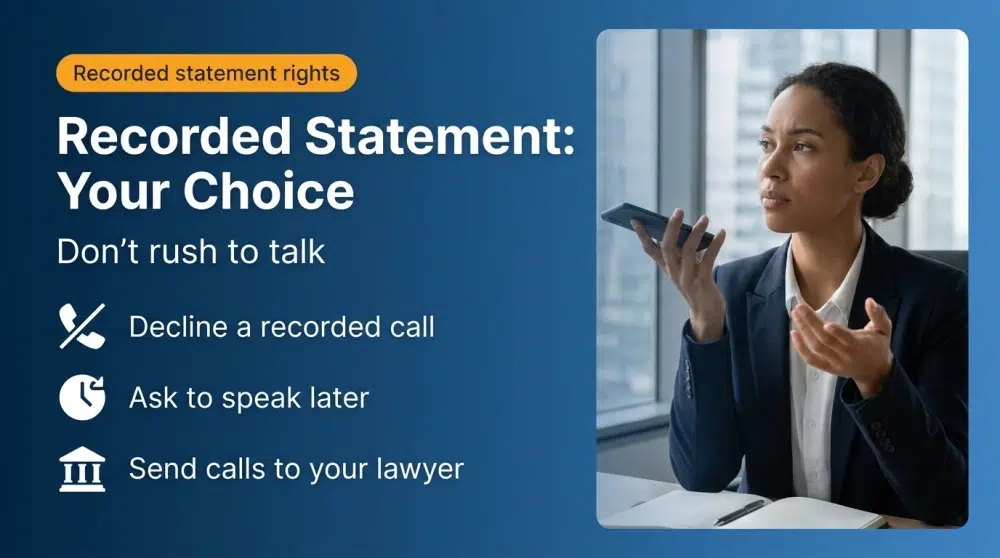
Your own insurance policy may require you to cooperate with your insurer’s investigation, but that obligation has specific boundaries and does not require you to provide a recorded statement to the other party’s insurance company. An opposing insurer’s adjuster calling you the day after an accident and asking to record your account of events is not a legal requirement you must satisfy.
The reason insurance companies call quickly is strategic. They want your account before you have spoken with an attorney, before symptoms have fully developed, and before you understand the legal implications of your words. The call is framed as routine paperwork, but it is a carefully designed data-collection process designed to minimize their exposure.
You have the right to politely decline, to say that you are still receiving medical evaluation, and to direct further inquiries to your attorney. Understanding how to deal with insurance companies after an accident can make a significant difference in how your claim unfolds.
Saying “I’m fine” on a recorded call is not just a mistake, it is the kind of accident claim mistake that can permanently limit the value of your case.
How Long Do You Have to File a Personal Injury Claim in California, Texas, and Illinois?
The statute of limitations is the legal deadline for filing a civil lawsuit. Once that window closes, courts will generally refuse to hear the cas, regardless of how serious the injuries were [4]. Here is how the deadline works in each of the three states most relevant to this discussion:
California
California Code of Civil Procedure § 335.1 establishes a two-year statute of limitations for personal injury claims arising from wrongful acts or neglect [5]. This two-year clock generally begins running on the date of the accident. If a government entity is involved, the timeline shortens considerably and requires a government tort claim to be filed within six months.
Texas
Texas Civil Practice and Remedies Code § 16.003 similarly provides a two-year limitations period for personal injury claims [6]. In Texas, the clock begins on the date the cause of action accrues (typically the date of the accident) with certain exceptions for minors and cases involving fraudulent concealment. The Texas personal injury claims process in state courts follows this two-year window strictly.
Illinois
Under 735 Illinois Compiled Statutes 5/13-202, Illinois also imposes a two-year statute of limitations on personal injury actions [7]. As in California and Texas, the two-year period generally runs from the date of the injury. Certain exceptions apply for minor victims and for cases involving fraudulent concealment of a cause of action.
Two years may feel like a long runway, but the reality is that building a strong injury claim is time-intensive. Medical records must be gathered. Treating physicians must document causation. Accident reconstruction may be needed. Witnesses must be located. Working with our Los Angeles personal injury team or attorneys in Dallas and Chicago ensures these steps move forward systematically before the clock runs out.
What Is a Gap in Treatment and Why Does It Matter?
A “gap in treatment” refers to a period of time between an accident and a victim’s first medical evaluation, or a pause in ongoing medical care after treatment has begun. Insurance defense attorneys treat these gaps as weapons.
The argument is straightforward: if you were truly injured in this accident, why did you wait? Why did you stop going to the doctor? The implication is either that the injuries are not serious enough to warrant compensation, or that they were caused by something other than the accident in question.
This argument can be defeated with proper evidence and legal strategy, but it is far easier to prevent than it is to overcome. Seeing a doctor immediately after an accident (even if you feel no pain) creates a contemporaneous record. If symptoms emerge later, your physician can connect them to the accident visit through clinical notes. That connection is the foundation of your personal injury claim in California, Texas, and Illinois.
Pain showing up later does not mean you have no case. It means you need a smarter strategy, and that strategy begins with early documentation.
Why Is Documentation So Critical After an Accident?
Documentation is not just helpful, it is the foundation of your case. Every piece of evidence you gather in the immediate aftermath of an accident serves a purpose in civil litigation. Here is what matters most:
Medical Records
Your first post-accident medical visit, whether to an emergency room, urgent care, or your primary care physician, creates a timestamp connecting your injuries to the event. The medical record becomes the anchor for all treatment that follows. Delayed symptoms documented by a treating physician with a reference to the accident date are far more defensible than symptoms that appear in records with no accident notation.
Police Reports
A police report documents the basic facts of the collision: parties involved, witness information, officer observations, and sometimes preliminary fault assessments. Obtaining this report quickly is a standard step in the claim process.
Photographs and Video
Scene photos, vehicle damage, road conditions, skid marks, and traffic camera footage can all support your account of how the accident occurred. Digital metadata on photos timestamps them precisely. California law, for example, governs how traffic camera footage is stored and accessed [8].
Witness Information
Names and contact information for anyone who saw the collision can be critical. Witness memory fades quickly, and independent testimony that corroborates your account carries significant weight with insurance adjusters and juries.
A Personal Injury Journal
Beginning a daily log of your symptoms, pain levels, limitations on daily activities, and emotional impact starting from the day after the accident creates contemporaneous evidence that courts and juries find compelling. This journal can support claims for pain and suffering damages that are otherwise difficult to quantify.
What Should You Do Immediately After a Car Accident?
If you have just been in a car accident, your actions in the following hours carry lasting consequences for any future claim. Here is what matters most from a legal standpoint:
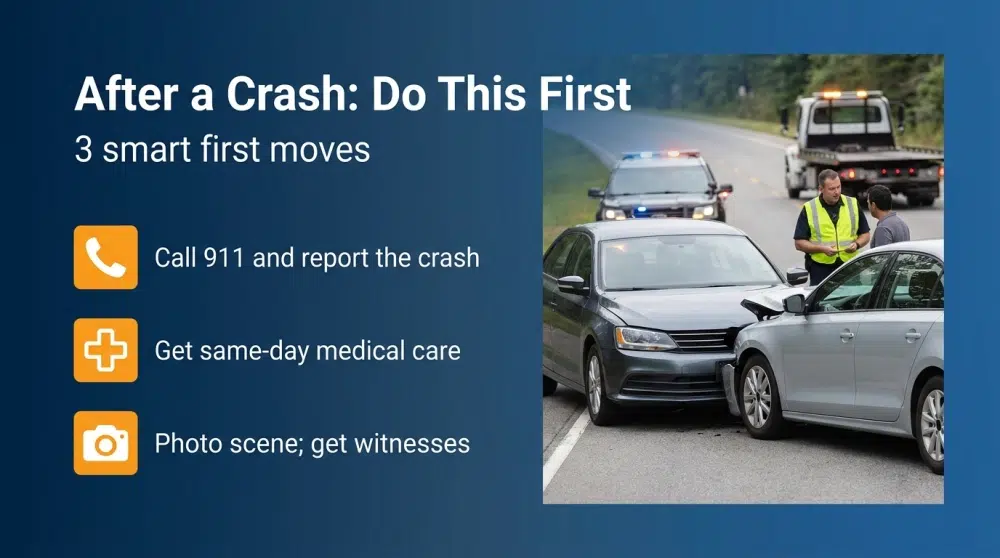
- Do not say “I’m fine” – not to the other driver, not to police, and absolutely not on a recorded insurance call
- Call 911 – have law enforcement document the scene officially
- Seek medical evaluation the same day – even if you feel no pain; adrenaline is masking the truth
- Photograph everything at the scene – all vehicles, road conditions, injuries visible at the time, and any property damage
- Collect witness information – names, phone numbers, and brief descriptions of what they observed
- Do not post about the accident on social media – insurance companies routinely monitor claimants’ social media accounts
- Contact car accident lawyers before giving any statement – an attorney can advise you on what to say and when
These steps apply whether you are in Los Angeles, Dallas, Chicago, or anywhere else in California, Texas, or Illinois. The legal framework governing personal injury claims is remarkably consistent across these states on the critical question of early documentation.
How Does Saying “I’m Fine” Affect Both Plaintiffs and Defendants?
This is a civil matter, and it is worth examining both sides of the equation clearly.
For the Plaintiff (the Injured Party)
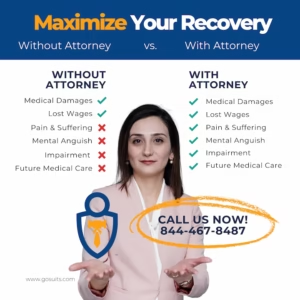
If you are the person who was hurt, saying “I’m fine” at the scene or in a recorded call weakens your ability to recover damages for injuries that later manifest. It gives the defense a powerful weapon: your own words, captured permanently, contradicting your later medical treatment. Damages available in a personal injury case may include medical expenses, lost wages, pain and suffering, and emotional distress [1]. Every one of those categories becomes harder to claim when you have already represented that you were uninjured.
For the Defendant (the At-Fault Party)
If you were the party responsible for the collision, the analysis is different but also important. You might feel that encouraging the other party to say “I’m fine” helps your situation. But if that person later develops serious injuries and your conduct contributed to suppressing their early medical evaluation, your position may actually be worsened in litigation. Courts applying negligence principles look at all the circumstances, including what happened immediately after an accident. Preserving the integrity of the post-accident process protects everyone involved.
In both California and Texas, comparative fault rules apply. In Illinois, modified comparative fault governs damage recovery [7]. In each system, the facts established immediately after an accident carry weight throughout the civil process.
Should You Say “I’m Sorry” After a Car Accident?
Alongside “I’m fine,” apologies are among the most commonly problematic post-accident statements. In common social interaction, saying “I’m sorry” is a natural human response to distressing situations – it does not necessarily mean you are admitting legal fault.
However, in personal injury litigation, an apology captured on a recording or documented in a police report can be characterized as an admission of liability. Defense attorneys and insurance adjusters are trained to treat informal apologies as evidence of fault.
California, Texas, and Illinois do not have uniform statutory protections that prevent accident apologies from being used as admissions in civil cases. Some states have enacted so-called “apology laws” for specific contexts (primarily healthcare settings), but these generally do not extend to standard car accident scenarios.
The practical guidance here is the same as it is for “I’m fine”: say as little as possible at the scene beyond what is legally required. Provide your name, insurance information, and license to the other party as required by law. Wait until you have spoken with a skilled Los Angeles car accident lawyers professional before making any substantive statements about fault, injury, or apology.
What Are the Specific Rules in California?
California operates under a pure comparative fault system [9]. This means that even if you were partially responsible for causing an accident, you can still recover damages, your award is simply reduced by your percentage of fault. A plaintiff found 20% at fault could still recover 80% of their total damages.
This makes what you say after an accident particularly consequential in California. An admission that you “felt fine” or that you were distracted can be used to assign comparative fault to you, directly reducing any award you might receive.
California’s two-year statute of limitations under CCP § 335.1 runs from the date of injury [5]. The discovery rule, which can toll or pause this clock in limited circumstances, applies when an injury was not immediately discoverable. While delayed symptom cases sometimes implicate the discovery rule, this is a fact-specific analysis that requires legal guidance. Do not rely on the discovery rule as a reason to delay medical treatment or legal consultation.
California also requires insurance companies to acknowledge receipt of claims promptly and to accept or deny claims within defined timeframes under state regulations [10]. Understanding these deadlines and your rights is part of building an effective personal injury claim in California.
What Are the Specific Rules in Texas?
Texas follows a modified comparative fault system under which a plaintiff can recover damages only if their own fault was 50% or less [6]. If a jury finds you 51% or more at fault, you recover nothing. This makes the facts established at the accident scene, including any statements you made, even more consequential.
Texas also has a proportionate liability framework that allocates percentages of fault among all responsible parties, including third parties. In multi-vehicle accidents in the Dallas-Fort Worth area or anywhere across Texas, these allocations can become complex quickly. What you said at the scene can affect how fault is apportioned.
Texas law governing the personal injury claims process follows the two-year deadline in the Civil Practice and Remedies Code. The statute begins running on the date the cause of action accrues, which in most accident cases is the date of the crash. Texas courts have not generally extended this clock for delayed symptom cases unless very specific exceptions apply.
What Are the Specific Rules in Illinois?
Illinois operates under a modified comparative fault standard similar to Texas, where a plaintiff who is 51% or more at fault cannot recover any damages [7]. Under Illinois law, juries apportion fault among all parties whose negligence contributed to the accident.
The two-year statute of limitations in Illinois, found at 735 ILCS 5/13-202, runs from the date of injury. In the Chicago metropolitan area and across Illinois, from Aurora to Naperville to Joliet, the same fundamental rules apply: get medical care quickly, document everything, and do not give insurance companies the ammunition of an early “I’m fine” statement.
Illinois also has specific procedural rules governing civil litigation, including arbitration requirements for smaller claims in Cook County courts. The complexity of navigating these systems is one of many reasons why working with personal injury attorneys matters rather than attempting to handle an injury claim independently.
Victims who face wrongful death claims arising from serious accidents in Illinois may also encounter unique statutory requirements. Wrongful death lawyers familiar with Illinois law understand how these claims differ from standard personal injury recovery and what families are entitled to pursue.
What Does a Smarter Legal Strategy Look Like for Delayed Symptoms?
Delayed symptoms without early documentation are ammunition for the defense. But delayed symptoms with careful documentation and legal strategy are entirely manageable.
Here is how a thoughtful approach works in practice:
Step 1: Immediate Medical Evaluation
Even if you feel nothing, see a doctor the same day. Describe the accident to your physician in detail. Ask them to note in your medical record that you were evaluated following a motor vehicle accident. This creates the timestamp that anchors everything that follows.
Step 2: Follow Up Consistently
If symptoms emerge (even mild ones) return to your doctor immediately. Do not wait to see if they get worse. Each medical visit adds a data point connecting your ongoing symptoms to the original accident.
Step 3: Document Symptom Development
A daily symptom journal, kept from the day after the accident, records the evolution of your injuries in real time. Courts and juries find this type of contemporaneous evidence highly credible because it cannot have been created after the fact.
Step 4: Retain Legal Representation Early
The earlier you work with car accident lawyers in your area, the more control you maintain over your narrative. An attorney can send preservation letters to prevent destruction of evidence, advise you on what to say and not say, communicate with insurance companies on your behalf, and begin building the factual record that will support your claim.
Step 5: Understand That Delayed Symptoms Do Not Invalidate Your Claim
The law accounts for the physiology of trauma. Personal injury law recognizes that the body’s shock response can mask injury. The cases that fail are not the ones where symptoms appeared later, they are the ones where documentation was absent. Pain showing up later does not mean you have no case. It means you need a smarter strategy.
Frequently Asked Questions
What if I already said “I’m fine” after my accident, is my claim ruined?
No. A single statement does not automatically end your case, but it does create a challenge your attorney must address. The sooner you seek both medical care and legal representation, the better positioned you are to contextualize that statement within the full picture of your injuries. Learn more in this article on injury crash reports in Los Angeles.
Can the insurance company use my “I’m fine” statement against me in court?
Yes. A recorded statement is a contemporaneous record that can be introduced in civil litigation. This is one of the primary reasons why personal injury attorneys consistently advise against giving recorded statements to insurance adjusters before receiving legal guidance.
What if the other driver apologized, does that mean they admitted fault?
An apology at the scene can be relevant evidence of fault, but its weight depends on the circumstances, the jurisdiction, and how it was made. In California, Texas, and Illinois, there are no broad statutory protections preventing ordinary apologies from being used as admissions in accident litigation. Document what was said and report it to your attorney.
Does the two-year deadline mean I have time to wait before seeing a doctor?
Absolutely not. The two-year statute of limitations governs when you must file a lawsuit, not when you must see a doctor. Delaying medical care creates the treatment gap that defense attorneys exploit to challenge causation. See a doctor on the day of the accident, regardless of how you feel.
How GoSuits Helps Injury Victims
At GoSuits, we practice across California, Texas, and Illinois, handling personal injury claims in Los Angeles, Dallas, and Chicago, as well as throughout these states. If you or someone you care about has been injured in a car accident, a truck collision, or another incident caused by someone’s negligence, a free consultation with a personal injury attorney can help you understand your rights and the value of your claim before it is too late to protect it.

Technology-Driven, Attorney-Led
GoSuits was built around a single premise: injury victims deserve both technological efficiency and direct attorney access. We deploy proprietary case management software that accelerates every phase of your claim, from evidence gathering and medical record compilation to demand letter preparation and settlement negotiations. Our platform gives our attorneys real-time visibility into every case development, which means faster responses and fewer delays.
But technology is only a tool. Every GoSuits client is assigned a designated attorney, not a case manager, not a paralegal intake specialist. You have direct, unfettered access to the lawyer handling your matter. You can call, text, or email your attorney directly. We believe that access is not a luxury; it is the foundation of meaningful representation.
Experienced Trial Attorneys with 30 Years of Combined Experience
Our attorneys bring more than 30 years of combined experience handling personal injury claims across California, Texas, and Illinois. That experience spans everything from complex multi-vehicle accidents and commercial truck crashes to rideshare incidents, workplace injuries, product liability claims, and wrongful death cases. Trial experience matters at every stage of a case, not just at the courthouse door. Insurance companies know which firms try cases and which ones settle. We have taken cases to verdict, and that credibility shapes every negotiation we conduct on your behalf.
You can review our prior cases to understand the range of matters we handle and the outcomes we have achieved for clients. Our attorneys bring focused, direct attention to each matter. Read more about us and our firm’s approach to injury representation.
Practice Areas
Our practice areas include:
- Car accident claims in California, Texas, and Illinois
- Truck and commercial vehicle accidents, including 18-wheelers and semi-trucks
- Motorcycle accident claims
- Rideshare accidents involving Uber and Lyft
- Construction accident injuries
- Slip and fall and premises liability
- Work injury claims
- Product liability
- Wrongful death
If delayed symptoms are a concern in your case, if you said “I’m fine” and are now dealing with real pain, that is precisely the kind of situation where legal guidance makes the difference between a dismissed claim and a fully compensated one. Don’t let the shock of your accident ruin your claim. Schedule a free consultation with GoSuits today.
References & Resources
- Personal Injury – Legal Information Institute, Cornell Law School
- Negligence – Legal Information Institute, Cornell Law School
- Negligence Elements: Duty, Breach, Causation, Harm – LII Cornell
- Statute of Limitations – Legal Information Institute, Cornell Law School
- California Code of Civil Procedure § 335.1 – California Legislative Information
- Texas Civil Practice and Remedies Code Chapter 16 – Texas Constitution and Statutes
- 735 ILCS 5/13-202 – Illinois Compiled Statutes, ILGA
- California Department of Motor Vehicles – DMV.ca.gov
- California Civil Code § 1714 – Comparative Fault, California Legislative Information
- California Department of Insurance – CDI.ca.gov