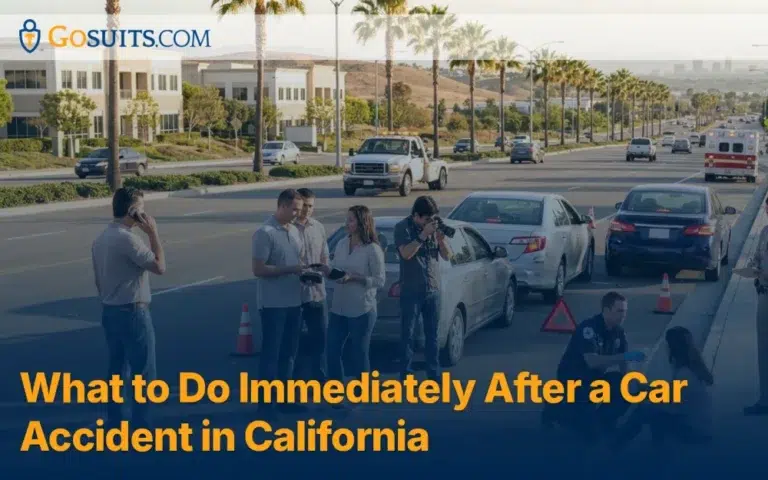
- Why the First Minutes After a Crash Matter in California
- Step 1: Is It Safe to Move? Assessing the Scene
- Step 2: Call 911When Is It Required in California?
- Step 3: Seek Medical AttentionEven If You Feel Fine
- Step 4: Exchange Information and Document the Scene
- Step 5: Report the Accident to the DMV and CHP
- Step 6: Notify Your Insurance Company
- Step 7: Protect Your Personal Injury Claim
- How Fault Works in CaliforniaPure Comparative Negligence
- What Plaintiffs Need to Know About Their Rights
- What Defendants Need to Know After Being at Fault
- What Is the Statute of Limitations for a California Car Accident Claim?
- Common Mistakes That Can Hurt Your California Car Accident Claim
- How GoSuits Helps Injury Victims in Irvine and Los Angeles
- References and Resources
Why the First Minutes After a Crash Matter in California
A car accident can turn an ordinary commute into a life-altering event in an instant. Whether you are driving through Irvine, navigating the 405 freeway in Los Angeles, or traveling surface streets in communities like Anaheim or Santa Monica, the steps you take in the moments immediately following a crash can shape everything that comes afteryour physical recovery, your legal rights, and your ability to pursue compensation.
Think about it. California has more people than any other state, and the roads kind of prove it daily. The California Office of Traffic Safety reports tens of thousands of injury crashes each year, with thousands of fatalities on state highways and local roads. [1] Now picture that playing out in LA County or Orange County. Total chaos. Witnesses drift off, traffic doesn’t wait, and evidence has a way of vanishing within minutes. So yeah, knowing your next move, and what to avoid, really does matter.
Here’s the plan. A walkthrough of every step that matters, from the immediate scene-control stuff to the long-game protection of your injury claim down the line. We’re hitting both sides too, plaintiff and defendant, because California civil law treats those roles pretty differently. Quick disclaimer though. Educational content, not personalized legal advice for whatever you’re navigating right now. Big distinction. And if you or a loved one’s been injured, reaching out to a personal injury lawyer sooner rather than later can make a real difference. Sometimes it’s the whole ballgame.
Step 1: Is It Safe to Move? Assessing the Scene
What should you do immediately after a car crash in California?
The very first thing to assess is safetyyours and everyone else’s. California Vehicle Code Section 20001 requires that any driver involved in an accident resulting in injury or death must immediately stop at or near the scene. [2] Leaving the scene of an injury accident is a criminal offense in California, not merely a civil matter.
Here is what to do in those first moments:
- Stop your vehicle safely. Pull to the nearest safe locationa shoulder, a parking lot, or a side streetwithout obstructing traffic more than necessary.
- Turn on your hazard lights. This signals to approaching drivers that something is wrong and reduces the risk of a secondary crash.
- Check for injuries. Before getting out of the vehicle, look around to assess whether you or your passengers are seriously hurt. Do not move anyone who may have a spinal or neck injury unless there is an immediate danger (such as fire or rapidly rising water).
- Stay at the scene. Do not drive away, even if you believe the accident was minor. California law requires you to remain until you have fulfilled legal obligations, including providing your information and rendering reasonable aid.
Step 2: Call 911When Is It Required in California?
Do you have to call the police after a car accident in California?
California law requires that any accident involving injury, death, or significant property damage be reported to law enforcement. If the accident occurs inside city limits, you should contact the local police department; if it occurs on a state highway or unincorporated area, the California Highway Patrol (CHP) handles the report. [3]
When you call 911, the dispatcher will ask for your location and whether anyone is injured. Stay on the line and follow their instructions. A responding officer will prepare an official accident report, which becomes a critical piece of evidence in any subsequent civil personal injury claim.
Even if the other driver says “let’s handle this privately” or the damage appears minor, a police report gives you an objective, third-party account of what happened. Insurance companies and courts rely heavily on these reports when evaluating fault.
In Los Angeles and surrounding communities, the Los Angeles Police Department (LAPD) and the Los Angeles County Sheriff’s Department each have jurisdiction over different areas. Knowing which agency to expect matters, but in practice, calling 911 routes you to the right responder automatically.
Step 3: Seek Medical AttentionEven If You Feel Fine
Why should you see a doctor after a car accident even without visible injuries?
Probably the most overlooked step on this whole list. Also one of the costliest, both for your body and your claim. Here’s why. Adrenaline after a collision is a powerful pain blocker, it basically lies to you about how hurt you actually are. Whiplash, traumatic brain injuries, internal bleeding, soft tissue damage, herniated discs, none of these necessarily announce themselves right away. Sometimes it’s hours later. Sometimes days. [4]
From a civil litigation standpoint, a gap between the accident and your first medical visit gives opposing counsel and insurance adjusters grounds to argue that your injuries were not caused by the crash. Courts and juries in California look closely at the timeline of medical treatment when evaluating the credibility of injury claims.
What you should do:
- Accept emergency medical care at the scene. If paramedics arrive, let them evaluate you. Their assessment becomes part of the record.
- Go to an emergency room or urgent care facility the same day if you did not leave by ambulance, even if you feel only mild discomfort.
- Follow up with your primary care physician or a specialist. Continuing care documents the progression of your injuries and your good-faith effort to recover.
- Keep records of every appointment, prescription, and out-of-pocket expense. These documents directly support the damages you may seek in a California personal injury claim.
If injuries turn out to be serious or fatal, the legal landscape changes considerably. Fatalities caused by another party’s negligence can give surviving family members the right to pursue a wrongful death claim under California Code of Civil Procedure Section 377.60. [5] Consulting with attorneys who handle fatal crash mattersnot just car accident casesbecomes critical in those circumstances.
Step 4: Exchange Information and Document the Scene
What information do you need to exchange after a car accident in California?
California Vehicle Code Section 16025 requires drivers involved in an accident to exchange certain information with one another. [6] Failing to exchange this information is itself a violation of state law.
You must provide and obtain:
- Full legal name of each driver
- Current mailing address
- Driver’s license number
- Vehicle registration number
- Insurance company name and policy number
Beyond the legal minimum, document everything you can at the scene:
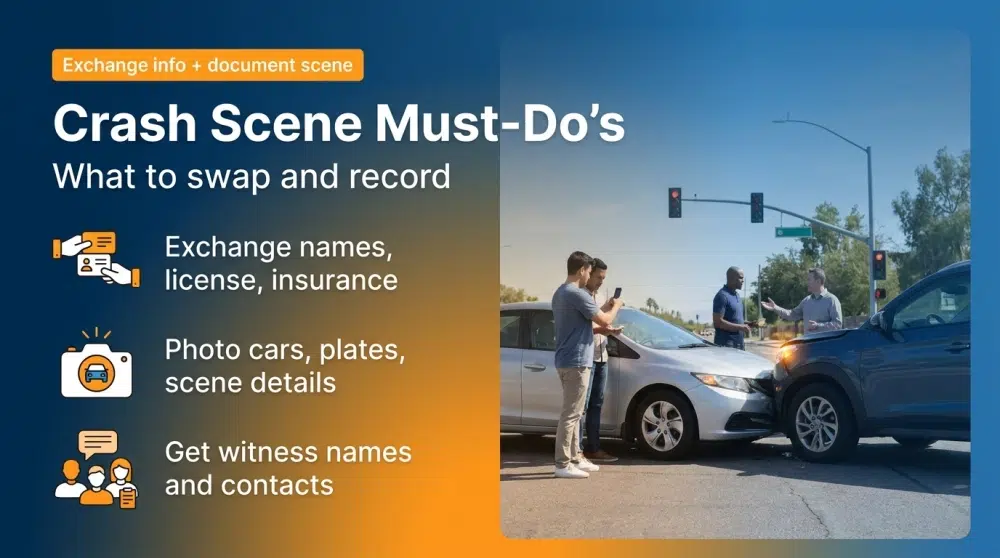
- Photograph all vehicles from multiple angles, capturing damage, license plates, and their positions on the road.
- Photograph the surrounding areatraffic signals, road signs, skid marks, debris, and any visible hazards.
- Collect witness contact information. Bystanders who saw what happened can provide independent accounts that support your version of events.
- Note the time, weather conditions, and road conditions. These factors influence liability analysis in California civil cases.
- Record the badge number and name of any responding officer. This helps you request the official accident report later.
If you are in Los Angeles or Irvine, many high-traffic intersections have traffic cameras. An attorney can help you preserve and request this footage quickly before it is overwritten, which is often within a matter of days.
Step 5: Report the Accident to the DMV and CHP
When must you file an accident report with California authorities?
California has two separate reporting obligations that many drivers confuse:
Law Enforcement Reporting
Under California Vehicle Code Section 20008, the driver of any vehicle involved in an accident resulting in injury or death must file a written report with the CHP or local police department within 24 hours of the accident. [3] If the responding officer at the scene prepares a report, this obligation is typically satisfied through that process.
DMV SR-1 Report
Separate obligation, easy to overlook. California requires you to file an SR-1 form with the DMV, that’s the Report of Traffic Accident Occurring in California, within 10 days of any wreck where someone’s injured, killed, or property damage tops $1,000. [7] And yeah, this one’s all you. Doesn’t matter that the police filed their report. Doesn’t matter that you weren’t the cause. The self-reporting piece still applies.
Failure to file the SR-1 can result in suspension of your driver’s license. The SR-1 is available through the California DMV and can be submitted online, by mail, or through your insurance company.
Defendant perspective: Accurate and timely self-reporting reduces risk of license suspension and demonstrates good faith. However, what you write in these reports may be reviewed during litigation. Consider speaking with an attorney before filing if you are unsure how to characterize events.
Step 6: Notify Your Insurance Company
When and how should you contact your insurer after a California crash?
California requires all drivers to maintain minimum liability insurance: $15,000 for injury or death of one person, $30,000 for injury or death of more than one person, and $5,000 for property damage. [8] These minimums are scheduled to increase under recently enacted California law in the coming years.
You should notify your own insurance company promptly after a crash, even if you do not believe you were at fault. Most policies require prompt notification as a condition of coverage. However, there is an important distinction between notifying your insurer and giving a recorded statement:
- Do notify your insurer of the date, time, and general facts of the accident.
- Do not give a recorded statement to the other driver’s insurance company without first speaking with an attorney. Insurance adjusters are trained to ask questions that can minimize the value of your claim.
- Do not accept a quick settlement offer before your injuries are fully diagnosed and your treatment is complete. Early settlements often do not account for future medical needs.
If you are dealing with an uninsured or underinsured motorist in Los Angeles or Irvine, your own policy may have uninsured motorist (UM/UIM) coverage that can step in. California law requires insurers to offer this coverage, though you can waive it in writing.
Step 7: Protect Your Personal Injury Claim
What steps protect your right to compensation after a California car accident?
Once safety, medical care, and reporting obligations are addressed, your focus should shift to preserving your legal rights. California is a civil litigation state where personal injury claims are governed primarily by tort law. Understanding what strengthens and what undermines your claim is essential.
Actions that protect your claim:
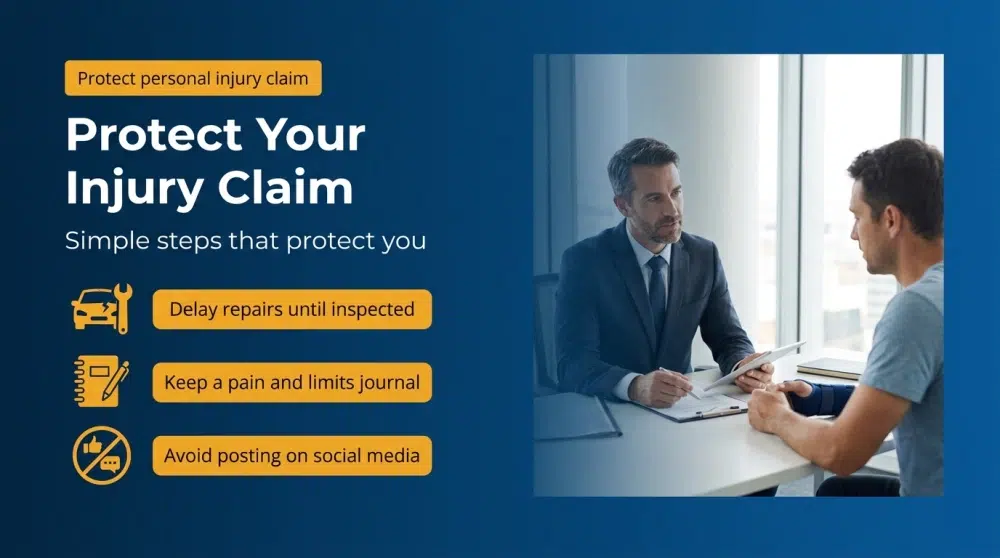
- Preserve all evidence. Do not repair your vehicle until it has been inspected and photographed. Do not discard damaged clothing or personal items from the crash.
- Keep a pain and symptom journal. Document daily how your injuries affect your ability to work, sleep, and perform ordinary activities. This journal becomes powerful evidence of pain and suffering damages.
- Save all communications. Text messages, emails, and written notes with the other driver, their insurer, or any witnesses may be relevant.
- Avoid social media posts. Insurance company investigators routinely monitor social media profiles. A single photo or comment suggesting you are active and well can be used to dispute your injury claims.
- Follow all medical advice. Gaps in treatment or failure to follow through on recommended care can be argued as evidence that you were not truly injured.
California’s car accident lawyers see cases damagedor destroyedby preventable missteps made in the days and weeks after a collision. Seeking guidance early from personal injury lawyers who handle Los Angeles and Orange County cases routinely can help you avoid those pitfalls.
How Fault Works in CaliforniaPure Comparative Negligence
Does partial fault reduce my compensation in a California car accident case?
California follows the doctrine of pure comparative negligence. [9] Under this rule, a plaintiff can recover damages even if they were partially at fault for an accident. However, the damages awarded are reduced in proportion to the plaintiff’s percentage of fault.
For example: if a jury finds that you suffered $100,000 in damages but that you were 25% at fault for the accident, you may recover $75,000. This is different from states that use a “modified” comparative negligence standard, where plaintiffs who are more than 50% at fault may be barred from recovery entirely.
What this means practically:
- Even if you ran a yellow light or were slightly speeding, you may still have a viable claim.
- Defense attorneys and insurers will work to assign you as large a share of fault as possible to reduce their client’s exposure.
- The percentage of fault assigned to each party is a factual determinationusually made by a jury in contested casesand depends heavily on the quality and completeness of the evidence.
Negligence in a California car wreck case basically comes down to four things. Duty, breach, causation, damages. [10] Every driver out there owes everyone else a duty of reasonable care, that’s the baseline. Break that duty by speeding, blowing through a red light, texting, driving drunk, whatever, and if it actually causes harm? You’re probably on the hook civilly for the damage.
What Plaintiffs Need to Know About Their Rights
What damages can an injured person recover in a California car accident civil case?
California civil law permits injured parties to seek several categories of damages in a personal injury claim:
- Economic damages: These are quantifiable lossespast and future medical bills, rehabilitation costs, lost wages, reduced earning capacity, and property damage.
- Non-economic damages: These include pain and suffering, emotional distress, loss of enjoyment of life, and loss of consortium for a spouse or domestic partner. California does not cap non-economic damages in car accident cases (unlike some medical contexts).
- Punitive damages: In rare cases involving malice, fraud, or oppressionsuch as a deliberate act or extreme recklessnessCalifornia courts may award punitive damages under Civil Code Section 3294. [5]
As a plaintiff in Los Angeles or Irvine, your claim may be resolved through insurance negotiation, mediation, or trial. The strength of your case depends on the documentation you gathered, the quality of your medical records, the consistency of your testimony, and the presence of independent evidence. Car accident lawyers in Los Angeles who regularly handle these matters understand which facts insurers scrutinize most heavily and how to present your case effectively.
What Defendants Need to Know After Being at Fault
What are a defendant driver’s obligations and rights after causing a California accident?
If you are the driver whose negligence caused the accident, your obligations and risks are different but equally significant. California’s civil legal system operates separately from any criminal proceedings that may arise from the same event.
Key considerations for defendants:
- Your insurance company takes the lead. Once you report the accident, your insurer typically assigns a claims adjuster who manages communications with the injured party and their legal team.
- You may still face a lawsuit even if your insurer settles with the other party, particularly if your policy limits are insufficient to cover the injured person’s full losses.
- Do not admit fault at the scene or in writing. Statements made at the crash site may be admissible in civil proceedings. Let the facts speak through the evidence, not through impulsive admissions.
- Consider consulting a personal injury attorney if the other party’s injuries appear serious. Defendants also have rights in civil proceedings and may benefit from independent legal counsel separate from what the insurance company provides.
In particularly severe casessuch as those involving fatalities on Los Angeles freeways or major streets in Orange Countya wrongful death claim may be filed against the at-fault driver by surviving family members. Fatal crash attorneys understand both the civil and procedural aspects of these deeply consequential cases.
What Is the Statute of Limitations for a California Car Accident Claim?
How long do you have to file a lawsuit after a car accident in California?
Under California Code of Civil Procedure Section 335.1, the general statute of limitations for personal injury claimsincluding car accident casesis two years from the date of the injury. [5] This means you must file your civil lawsuit within two years of the accident, or your claim may be permanently barred.
There are important exceptions:
- Claims against government entities (such as a city bus or a government vehicle) have a much shorter deadline. You must file a government tort claim with the responsible public agency within six months of the incident before you can sue.
- Minors generally have two years from the date they turn 18 to file, in addition to any applicable tolling during minority.
- Claims where the injury was not immediately discoverable may use a “discovery rule” that starts the clock when you knew or reasonably should have known about the injury.
Two years may seem like a long time, but evidence degrades quickly. Witnesses move or forget. Traffic camera footage is overwritten. Vehicle black box data can be lost. Acting promptly by consulting car accident lawyers in Los Angeles or Irvine gives attorneys the best opportunity to preserve the evidence your case depends on.
Common Mistakes That Can Hurt Your California Car Accident Claim
What are the biggest errors people make after a car accident in California?
Years of civil litigation experience reveal a consistent pattern of avoidable errors. Recognizing these ahead of time helps you protect your rights:
- Delaying medical care. A delay of even a day or two between the accident and your first doctor visit creates a gap that opposing counsel will highlight.
- Saying “I’m fine” at the scene. Adrenaline masks pain. What you feel in the moment is not a reliable indicator of your actual physical condition.
- Giving a recorded statement to the other driver’s insurer. You are under no obligation to do so, and adjusters are skilled at eliciting statements that limit their exposure.
- Accepting a fast settlement. Once you sign a release, you typically waive all future claimseven if your condition worsens.
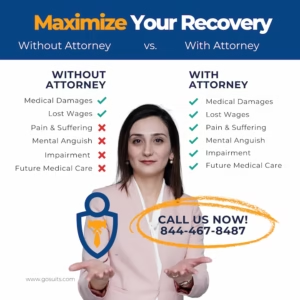
- Not hiring an attorney. California’s tort rules, evidence requirements, and insurance claim procedures are complex. Attempting self-representation in a disputed injury case substantially reduces the likelihood of a fair recovery.
- Failing to file the SR-1. Missing the 10-day deadline with the California DMV can result in license suspension, complicating both your daily life and your legal situation.
How GoSuits Helps Injury Victims in Irvine and Los Angeles
If you or a loved one has been in a crash on California’s roadswhether on the 405 in Los Angeles, the 5 corridor through Orange County, or any surface street in betweenthe steps you take in the hours and days that follow are crucial. At GoSuits, we understand the weight of that moment.
GoSuits serves clients throughout California, including communities across the Los Angeles metro and Orange County. Our attorneys handle car accident claims, wrongful death cases, truck collisions, rideshare accidents, and a range of other personal injury matters. We also serve clients in Texas and Illinois, giving us a multi-state perspective on how civil injury law works in practice.
A Technology-Driven Law FirmWith a Dedicated Attorney for Every Client
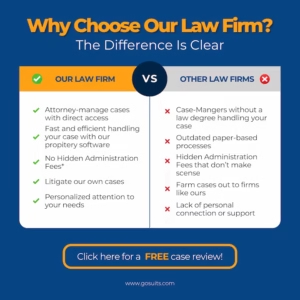
GoSuits is built differently. We use proprietary case management software developed exclusively for our firmtechnology that accelerates document gathering, tracks deadlines, organizes evidence, and keeps your case moving without the delays that plague traditional law practices. But technology is a tool, not a substitute for human judgment or personal attention.
Every GoSuits client is assigned a designated attorney who handles their matter from intake through resolution. We do not use case managers as the point of contact. You have direct, unfettered access to your attorneyby phone, by text, or by emailthroughout the life of your case. When you have questions, you speak to the person who knows your file.
Experience That Matters in Civil Injury Cases
Our team brings over 30 years of combined civil litigation experience to the cases we handle. We have taken injury matters through mediation, arbitration, and trial, and we understand the difference between a case built to settle quickly and a case built to win at trial. That trial readiness matters: insurance companies adjust their evaluation of claims when they know an opposing firm is genuinely prepared to try the case.
Our prior results for clients reflect that approach. You can review a selection of prior cases on our website to get a sense of the types of matters we handle. Every case is different, and past results do not guarantee future outcomes.
What a Free Consultation Covers
When you speak with one of our attorneys in a free initial consultation, we will walk through:
- The facts and circumstances of your accident
- Your medical treatment timeline and how it affects your claim
- The potential value of your economic and non-economic damages
- The insurance coverage landscape for the at-fault party
- Next steps for preserving evidence and protecting your claim
You pay nothing unless we recover for you.
To learn more about who we are, visit our about us page. To meet the attorneys who will handle your case, visit our our attorneys page. For the full scope of cases we handle, see our practice areas page.
If you were injured in a car accident in Irvine, Los Angeles, or anywhere in California, let us review your case at no cost to you.
References and Resources
- California Crash Rankings and DataCalifornia Office of Traffic Safety
- California Vehicle Code Section 20001 (Duty to Stop at Accident Scene)California Legislature
- California Vehicle Code Section 20008 (Accident Reporting Requirements)California Legislature
- Risky Driving and Traffic SafetyNational Highway Traffic Safety Administration (NHTSA)
- California Code of Civil Procedure Section 335.1 (Statute of LimitationsPersonal Injury)California Legislature
- California Vehicle Code Section 16025 (Exchange of Information After Accident)California Legislature
- Accident Reporting RequirementsCalifornia Department of Motor Vehicles
- California Vehicle Code Section 16056 (Minimum Insurance Requirements)California Legislature
- Comparative NegligenceLegal Information Institute, Cornell Law School
- NegligenceLegal Information Institute, Cornell Law School
- Personal Injury Self-Help InformationCalifornia Courts (Judicial Council of California)
- California Highway PatrolTraffic Safety Programs Overview