
When you are injured driving for work in Texas and a third party caused the crash, two separate legal paths are open at the same time. Workers’ compensation pays your medical bills and a portion of your lost wages regardless of fault. A civil lawsuit against the negligent driver can recover what comp will not pay, including pain and suffering, full lost wages, and other damages. Both claims can proceed simultaneously, but the compensation carrier acquires a right to be repaid out of any third-party recovery. Understanding how these systems fit together is essential before accepting any settlement on either track.
Legal Snapshot
- Legal Topic: Texas Workers’ Compensation and Third-Party Liability Claims
- Case Stage: Pre-litigation, litigation, and settlement
- Primary Legal Issue: Dual recovery, subrogation, exclusive remedy, course and scope of employment
- Primary Authority: Texas Labor Code, Subtitle A, Title 5 (Workers’ Compensation Act), Chapters 401–451
- Key Sections: Tex. Lab. Code §§ 406.033, 408.001–408.009, 417.001–417.003
- Date Legal Authority Last Reviewed: July 2025
What Does It Mean to Be “Injured Driving for Work” in Texas?
Texas workers’ compensation law covers injuries that arise “out of and in the course and scope of employment.” [1] For driving incidents, the phrase has a specific meaning: the employee must have been performing a work task or traveling on company business at the time of the crash. Ordinary commutes to and from a fixed workplace generally do not qualify. The analysis changes when the employer controls the route, when the employee is running an errand at the employer’s direction, or when the employee has no fixed place of work and travels between job sites.
Course and scope disputes arise frequently in Dallas-area crashes involving delivery drivers, field technicians, outside sales representatives, and workers who use company vehicles. Whether a particular trip qualifies turns on facts like job duties, employer instructions, and how the travel benefited the employer. That factual determination drives whether the workers’ comp claim is accepted and whether the third-party claim can be pursued.
Why Workers’ Compensation Does Not Pay Pain and Suffering
Texas workers’ compensation is a no-fault system created by the Texas Legislature. The trade-off built into the law is straightforward: a covered employee receives prompt benefits without having to prove the employer was negligent, but those benefits are limited in scope. [1]
What comp does pay includes:
- Medical benefits – reasonable and necessary medical treatment related to the work injury
- Temporary income benefits (TIBs) – approximately 70 percent of the difference between the worker’s average weekly wage before and after the injury, paid during the period of disability
- Impairment income benefits (IIBs) – a supplemental payment based on the worker’s impairment rating once maximum medical improvement is reached
- Supplemental income benefits (SIBs) – additional income benefits for workers with significant impairment who lose substantial earning capacity
- Death benefits – payments to qualifying family members if a work-related injury causes death, and burial expenses up to a statutory limit
What comp does not pay is pain and suffering, mental anguish, loss of consortium, disfigurement damages not captured in the impairment rating, and the full measure of lost future earning capacity. Those categories are recoverable only in a civil lawsuit against a party who is legally responsible for the crash. This gap between the comp benefits paid and the total harm suffered is often significant, particularly when injuries are severe and the responsible driver was negligent or reckless on a busy Dallas-area roadway such as I-635 or US-75.
What Is the Third-Party Civil Claim and Who Can Be Sued?
When someone other than the employer or a co-worker caused the crash, Texas law preserves the injured worker’s right to bring a civil negligence lawsuit against that third party. [2] The employer and its compensation carrier are not defendants in this suit. The third party might be:
- The other driver who ran a red light or rear-ended the vehicle
- A trucking company whose employee caused the collision
- A vehicle manufacturer whose defective part contributed to the crash
- A government entity responsible for dangerous road conditions (subject to strict notice requirements)
The third-party claim is a standard personal injury lawsuit governed by Texas negligence law. The injured worker must prove that the third party owed a duty, breached that duty, and that the breach caused the injuries and resulting damages. Unlike workers’ comp, the civil suit allows recovery of the full range of compensatory damages, and in appropriate cases involving gross negligence or malice, exemplary damages may also be available. Dallas County civil cases are filed in the Dallas County District Court at the George L. Allen Sr. Courts Building.
Illustrative Example
A delivery driver is stopped in stop-and-go traffic on the LBJ Freeway (I-635) when a distracted driver rear-ends the delivery vehicle. The delivery driver sustains a lumbar disc injury. Workers’ comp covers medical bills and pays income benefits at the statutory rate. Because the distracted motorist caused the crash, the delivery driver can also file a civil lawsuit seeking full lost wages, pain and suffering, and other damages that comp does not cover. These are two separate claims running at the same time. This is a hypothetical scenario for illustration purposes only.
What Is the Exclusive Remedy Bar and How Does It Limit Suing the Employer?
A subscribing employer, one that carries Texas workers’ comp insurance is shielded from most civil lawsuits by its employees. Texas Labor Code Section 408.001 provides that workers’ comp benefits are the exclusive remedy for a covered employee’s work-related injury against the employer and its employees acting within the general scope of their employment. [3] In plain terms: you generally cannot sue your own employer in civil court if your employer subscribes to workers’ comp and the injury was work-related.
There is one narrow exception at the employer level: intentional injury cases, which are rare. And the exclusive remedy bar does not protect third parties. If a co-worker caused the crash while deviating from work duties for a personal purpose unrelated to employment, the analysis can become more complex, and an attorney review is warranted.
The limitation is significant because injured workers sometimes assume they can sue their employer for their full damages. In a subscribing employer situation, the civil path is through the third-party claim, not through the employer.
How the Comp Carrier’s Subrogation Lien Works
When a workers’ comp carrier pays benefits on a claim, it gains a statutory right to recover those benefits out of any money the injured worker receives from the third party. This right is called subrogation. [2] The carrier effectively steps into the worker’s shoes to recoup what it paid.
Under Texas Labor Code Section 417.002, the comp carrier may either join the worker’s lawsuit or bring its own subrogation claim after first giving the worker a reasonable opportunity to bring the action. [2] If the worker does not initiate a claim within a reasonable time, the carrier may do so directly.
The practical consequence is that if you settle your third-party case for, say, $300,000 after the comp carrier paid $80,000 in benefits, the carrier generally has a right to be repaid that $80,000 before you see a full check. This is where lien reduction becomes critically important.
How the Comp Carrier’s Lien Gets Reduced
Texas Labor Code Section 417.003 sets out the rules for reducing the carrier’s subrogation interest when an injured worker recovers from a third party. [2] The lien is not paid at full face value. Three adjustments apply:
- Comparative fault reduction: If a court or jury finds the injured worker partially at fault for the crash, the carrier’s lien is reduced by the same percentage. If the worker is found 20 percent at fault, the carrier recovers only 80 percent of its lien.
- Attorney’s fees and expenses: The carrier must pay its proportionate share of the attorney’s fees and case expenses incurred in recovering the third-party funds. This is calculated as a ratio of the carrier’s recovery to the worker’s total recovery. In practice, this often reduces the lien by roughly one-third when an attorney is involved on a standard contingency arrangement.
- Net recovery limitation: The carrier cannot recover more from the worker’s third-party settlement than the worker actually retains. The injured worker must always keep at least one-third of the net recovery (the recovery after the lien is paid). [2]
These rules mean that skillful negotiation of the subrogation lien can meaningfully increase the net amount an injured worker takes home. Carriers do not automatically apply every available reduction, and without attention to the statutory formula, an injured worker can unknowingly repay more than the law requires.
Illustrative Lien Calculation (Hypothetical)
Total third-party settlement: $240,000. Comp carrier paid: $60,000 in benefits. Attorney fee: one-third of gross recovery ($80,000). Expenses: $10,000. Carrier’s proportionate share of fees and expenses: approximately $25,000 (carrier’s $60,000 / $240,000 = 25% of total, applied to $90,000 in fees/expenses). Net lien after fee reduction: approximately $35,000. Worker’s net take-home after lien and fees: approximately $125,000. This example is for illustration only; actual outcomes depend on specific facts and applicable law.
What If the Employer Does Not Carry Workers’ Comp? The Non-Subscriber Exception
Texas is the only state in the country that makes workers’ compensation coverage optional for most private employers. An employer that chooses not to carry workers’ comp insurance is called a non-subscriber. The entire legal analysis changes when the employer is a non-subscriber.
A non-subscribing employer loses the exclusive remedy protection entirely. [4] A worker injured in a work-related crash caused by the employer’s negligence or caused by a co-worker’s negligence on the job, may sue the employer directly for the full range of damages, including pain and suffering, lost wages, and all other compensatory damages. The employer also loses the right to assert that the worker assumed the risk of injury or that the worker’s own negligence contributed to the accident. This removal of common-law defenses is a significant shift in the plaintiff’s favor.
Non-subscribers may offer their own employee accident benefit plans as an alternative, but those plans are not regulated as workers’ comp and do not provide the same statutory protections. If the employer is a non-subscriber, the injured worker needs to promptly determine whether any available benefit plan has a waiver or release that could affect the civil claim. A work injury attorney familiar with Dallas-area non-subscriber cases can review the plan documents before anything is signed.
| Issue | Subscribing Employer | Non-Subscribing Employer |
|---|---|---|
| Can worker sue employer in civil court? | Generally no (exclusive remedy) | Yes – full civil lawsuit permitted |
| Employer can assert contributory fault defense? | N/A (comp is no-fault) | No – employer loses this defense |
| Worker can recover pain and suffering from employer? | No – comp only | Yes – full damages available |
| Third-party claim available? | Yes, against non-employer third party | Yes, against any negligent party |
| Subrogation lien applies? | Yes – comp carrier has lien | Depends on benefit plan terms |
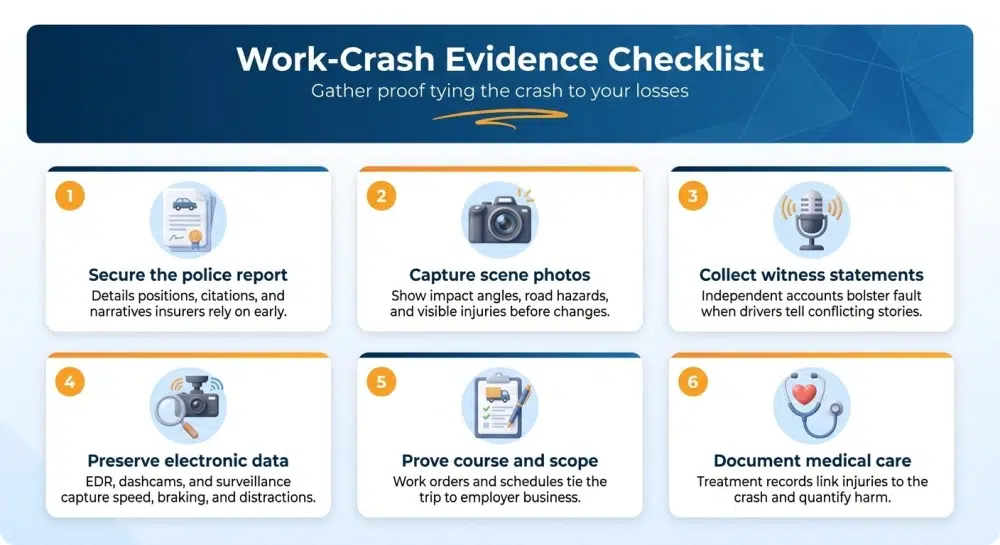
What Evidence Matters in a Work Crash Third-Party Claim?
The third-party civil claim requires the same type of evidence needed in any motor vehicle negligence case, plus documentation specific to the employment context.
- Police report and crash scene photographs: Establish fault, road conditions, and vehicle positions.
- Witness statements: Independent witnesses who saw the collision are particularly valuable in disputed-liability situations.
- Electronic data: Event data recorders from vehicles, dashcam footage, and surveillance cameras along roads such as I-35E or the Dallas North Tollway can preserve critical evidence that disappears quickly.
- Employment records and work orders: Establish that the injured worker was in the course and scope of employment at the time of the crash, which is sometimes disputed by the comp carrier or the employer.
- Medical records and treatment history: Causally link the injuries to the crash and document the extent of harm.
- Wage and income records: Quantify both past lost income and projected future earning capacity loss.
- Workers’ comp claim file: Documents the benefits paid, which establishes the carrier’s subrogation interest.
- Expert witnesses: Accident reconstruction professionals, vocational experts, and medical specialists may be needed in serious cases.
Preserving evidence promptly after a crash is important. Vehicle data and surveillance footage can be overwritten or deleted within days. A written preservation demand sent to the relevant parties shortly after the incident can protect critical evidence from being lost.
What Damages May Be Available in the Third-Party Civil Claim?
In a civil lawsuit against the negligent third party, a Texas injured worker may pursue:
- Past and future medical expenses – all costs of treatment caused by the crash, including surgery, rehabilitation, and future care needs
- Past lost earnings – actual wages and income lost from the date of injury through trial or settlement
- Future lost earning capacity – the reduction in the worker’s ability to earn income going forward, particularly important in cases of permanent impairment
- Physical pain and suffering – compensation for pain already experienced and anticipated in the future
- Mental anguish – emotional distress, anxiety, and suffering resulting from the injury
- Physical impairment – loss of the ability to perform activities and enjoy life as before
- Disfigurement – visible permanent changes to the body caused by the injury
- Wrongful death damages – if a work crash causes a fatality, the estate and qualifying family members may pursue a wrongful death action against the responsible third party
- Exemplary damages – in cases involving gross negligence, Texas law may allow additional punitive-type damages
Recovery depends on the facts, the injuries, applicable law, and how successfully liability and damages are established. There are no guarantees of any particular outcome.
What Texas Deadlines Apply?
Missing a deadline can permanently bar a claim, regardless of how strong the facts are. The following time limits are relevant, but they should be verified with an attorney for each specific situation:
- Workers’ comp claim: An injured worker must notify the employer and file a claim with the Texas Division of Workers’ Compensation. Time limits apply and are set by the Texas Labor Code. Prompt reporting is critical. [1]
- Third-party personal injury lawsuit: Under Texas Civil Practice and Remedies Code Section 16.003, the general statute of limitations for personal injury claims is two years from the date of the injury. [5]
- Wrongful death claim: Also generally two years from the date of death under Texas law. [5]
- Government entity claims: If a government entity may bear responsibility: for example, a TxDOT road defect claim, a shorter notice deadline and specific procedural requirements apply. [DEADLINE REQUIRES LEGAL VERIFICATION for specific government entity situations]
Because the interplay between the comp claim, the third-party lawsuit, and any government notice requirements can create overlapping deadlines, consulting an attorney early in the process is advisable rather than waiting until a deadline is imminent.

What Should You Do After a Work-Related Crash in Dallas?
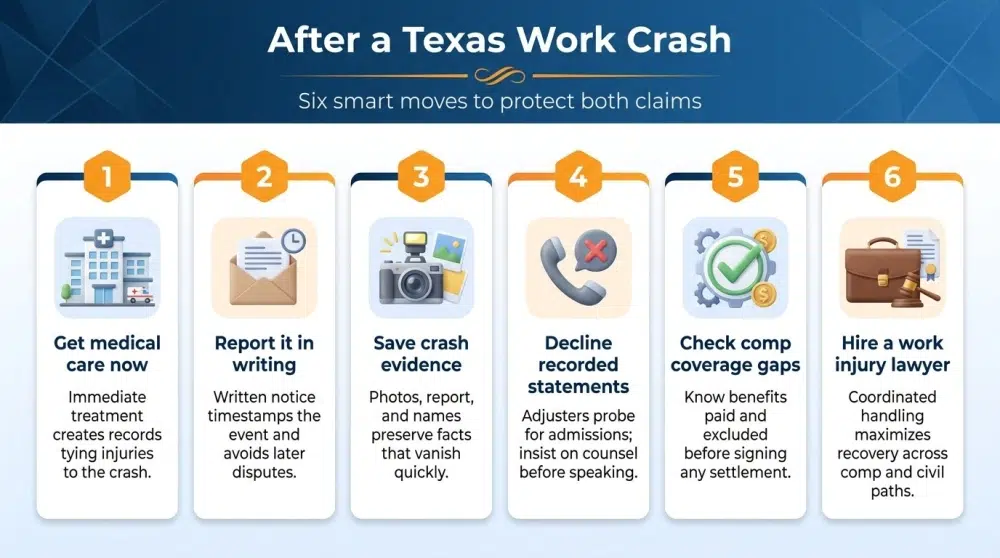
The steps taken in the days and weeks following a work crash can significantly affect both the comp claim and the third-party lawsuit. A general sequence worth following:
- Seek medical attention immediately and follow all treatment instructions. Gaps in treatment are used to challenge the severity of injuries.
- Report the crash to your employer in writing as soon as reasonably possible. Document the date and method of reporting.
- Preserve evidence – take photographs of the scene, vehicles, and injuries; request a copy of the police report; note witness names and contact information.
- Do not give a recorded statement to any insurance adjuster: including the third-party driver’s insurer or your employer’s comp carrier without first speaking with an attorney.
- Understand what the comp carrier is and is not covering before accepting a final settlement on the comp side, as acceptance of certain settlements can affect the third-party claim.
- Consult an attorney experienced in Texas work injury cases before signing any release or settlement agreement on any track of the claim.
The interaction between the work injury claim and the civil claim involves filing deadlines, subrogation negotiations, and coordination across two different legal systems. Handling either claim in isolation without understanding how it affects the other can reduce the total recovery available to an injured worker and the family.
Frequently Asked Questions
Q: If I accept my workers’ comp settlement, does that end my right to sue the other driver?
A: Not automatically. A workers’ comp settlement typically resolves the claim between the worker and the employer’s carrier. It does not release the negligent third party that is a separate claim. However, some settlement documents contain broad release language, so it is important to have any agreement reviewed before signing to confirm it does not inadvertently waive the civil claim. For more on how crashes in the Dallas area are handled, see the Dallas-Fort Worth car crash guide.
Q: Can the comp carrier sue the third party on its own without my involvement?
A: Under Texas Labor Code Section 417.002, if the injured worker does not bring a third-party claim within a reasonable time, the carrier may pursue the claim independently to recover the benefits it paid. If the carrier does recover, the worker is entitled to any proceeds that exceed the carrier’s recovery. [2]
Q: What if the other driver had no insurance or insufficient insurance to cover my injuries?
A: If the at-fault driver was uninsured or underinsured, you may be able to make a claim under your own employer’s commercial auto policy if it carries uninsured or underinsured motorist (UM/UIM) coverage, or under a personal auto policy you hold if applicable. Workers’ comp benefits would continue regardless, but the UM/UIM coverage can help bridge the gap in a third-party recovery shortfall. See the information for Dallas-Fort Worth traffic crash victims for additional background on how coverage gaps affect injured workers.
Q: Does comparative fault affect my workers’ comp benefits?
A: No. Workers’ comp is a no-fault system, so your own negligence does not reduce your comp benefits. Comparative fault only matters in the civil third-party lawsuit, where a jury finding of partial fault on the worker’s part would reduce the civil recovery proportionally under Texas’s modified comparative fault rule. [5]
Q: Does it matter if I was driving a company vehicle versus my own car?
A: The type of vehicle may affect insurance coverage analysis but does not by itself determine whether the injury was in the course and scope of employment. The key question is whether the trip was for the employer’s benefit. Someone driving their personal vehicle to a client site at the employer’s direction may still be in course and scope; someone driving a company truck for a personal errand may not be. Each situation requires a factual analysis.
Q: What is the difference between a subrogation claim and an assignment?
A: Subrogation is the carrier’s statutory right under Texas Labor Code Section 417.001 to step into the worker’s legal position to recover from a third party benefits the carrier already paid. An assignment is a contractual transfer of rights. Texas workers’ comp subrogation operates by statute, not contract, which is why it cannot be waived by agreement between the worker and the employer alone.

Related Texas Personal Injury Resources
The following resources on this site address related topics relevant to workers injured in Texas car and truck crashes:
- Employee rights after a workplace injury in Texas
- Types of damages available in Texas personal injury cases
- Understanding negligence laws in Texas
- Statute of limitations for personal injury in Texas
- Texas modified comparative fault and the 51 percent bar
Talk With a GoSuits Dallas Personal Injury Attorney
Work crash claims in Texas involve a workers’ comp system, a civil lawsuit against the third party, subrogation lien negotiations, and firm deadlines all running at the same time. When injuries are serious, missing a step or misunderstanding the interaction between these systems can reduce the recovery available to an injured worker and their family.
If you were injured driving for work in Dallas or the surrounding DFW area, a member of the Dallas personal injury lawyers team at GoSuits can review the circumstances of your case and explain all available options. The consultation is free.
Work injury claims in Dallas involve the work injury lawyers at GoSuits who regularly handle the dual-track comp and civil claim process. If a crash was fatal, our Dallas wrongful death lawyers can help surviving family members understand their separate rights under Texas law.
Our Dallas personal injury team also helps injured people who face uninsured drivers, disputed liability, and severe injuries the full spectrum of what our Dallas personal injury lawyers handle every day across the DFW Metroplex.
References and Authoritative Sources
- Texas Labor Code, Chapter 408 – Benefits (Workers’ Compensation) – Texas Legislature Online
- Texas Labor Code, Chapter 417 – Subrogation and Third-Party Claims – Texas Legislature Online
- Texas Labor Code § 408.001 – Exclusive Remedy – Texas Constitution and Statutes
- Texas Labor Code § 406.033 – Non-Subscriber Liability and Loss of Common-Law Defenses – Texas Constitution and Statutes
- Texas Civil Practice and Remedies Code § 16.003 – Two-Year Statute of Limitations – Texas Constitution and Statutes
- Workers’ Compensation Overview – Cornell Law School Legal Information Institute
- Workers’ Compensation – United States Department of Labor