Subrogation is the legal process by which an insurer, benefit plan, or government program that paid for an injured person’s losses steps into that person’s shoes to recover the money from the party who caused the harm. In a personal injury case, it usually means a health plan, auto insurer, workers’ compensation carrier, Medicare, or Medicaid wants to be repaid out of the at-fault party’s payment or out of the injured person’s settlement. The rules differ from state to state, and federal law controls for some payers, so the outcome depends on who paid, what the policy or statute says, and where the claim is brought. [1]
This article explains the general rules that hold broadly across the states. It is general legal information, not advice about any particular claim, and it does not replace a review by a licensed attorney in your state.
Legal Snapshot
-
Legal Topic: Subrogation and reimbursement rights of payers in injury claims (nationwide overview)
-
Case Stage: Typically arises after medical bills or benefits are paid and before or during settlement
-
Primary Legal Issue: Whether, and how much, a payer may recover from the at-fault party or from the injured person’s recovery
-
Primary Authority: State common law, state statutes, and insurance contracts, plus federal law for Medicare (42 C.F.R. § 411.24), ERISA plans, Medicaid, and federal medical care programs (42 U.S.C. § 2651)
-
Jurisdiction: Multi-state. Subrogation rules and deadlines vary by state, and federal law governs some payers, such as Medicare and self-funded employer plans. A lawyer licensed in your state can confirm which rules apply to your claim.
-
Date Legal Authority Last Reviewed: November 5, 2026 (pending attorney review)
What Does Subrogation Mean in a Personal Injury Case?
In a personal injury case, subrogation means an insurer that paid for your losses, such as your medical bills, steps into your shoes to recover that money from the at-fault party. The insurer takes over your right to recover what it paid, often from your settlement or verdict. [1] The insurer that pays and takes over the right to recover is called the subrogee. The injured person whose rights it takes over is called the subrogor. [2] A familiar example is an insurer that pays a policyholder’s claim and then gains the right to pursue the person who caused the loss. [2]
You may also hear the terms “reimbursement” and “lien.” These terms overlap but are not identical. Subrogation is generally the payer’s right to pursue the at-fault party in your place. Reimbursement is usually a right, often set out in your policy, to be repaid from money you recover. A lien is a legal claim against the settlement or verdict itself, which can mean it must be paid before you receive your share. A single health plan or insurer may assert more than one of these rights, and the policy language or the law that governs the plan often decides which one applies.
For most injured people, the practical effect is the same. Part of a settlement or verdict may go to a payer with a right to be repaid, not to you. That is why it helps to address subrogation early in a personal injury claim, before a settlement is finalized and the money is paid out.
Who Can Assert Subrogation or Reimbursement Rights?
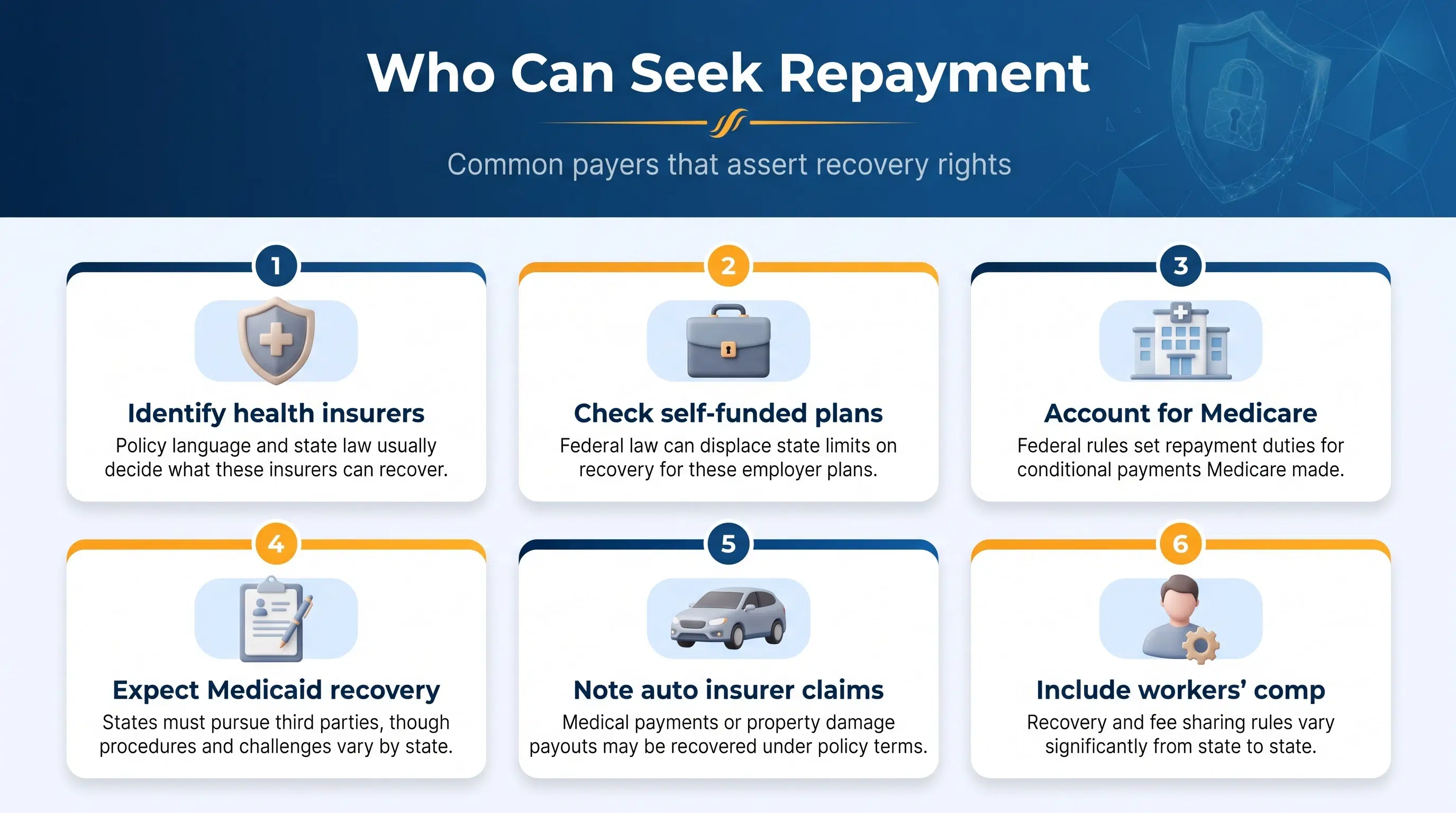
Several kinds of payers commonly seek repayment after an accident. Each one’s right to repayment comes from a different source, and different rules limit how much it can take.
|
Payer |
Where the right usually comes from |
Why the type of payer matters |
|---|---|---|
|
Health insurer (individually purchased or fully insured plan) |
Policy language and state law |
State insurance rules and court decisions often apply, and these rules vary widely by state. |
|
Employer self-funded health plan governed by ERISA |
Plan document and federal law |
Federal law can displace state limits on subrogation for self-funded plans. |
|
Medicare |
Medicare Secondary Payer rules, 42 C.F.R. § 411.24 |
Federal law sets repayment duties and deadlines. |
|
Medicaid |
Federal Medicaid Act and state recovery programs |
Federal law requires states to pursue third-party recovery; state procedures vary. |
|
Auto insurer paying medical payments or property damage |
Policy language and state law |
State law governs whether the insurer may recover and when. |
|
Workers’ compensation carrier |
State workers’ compensation statutes |
Rules on recovery and how attorney fees are shared vary significantly by state. |
|
Federal government (military or VA care) |
Federal Medical Care Recovery Act, 42 U.S.C. § 2651 |
The United States may recover the reasonable value of care it furnished. |
What Law Governs Subrogation Claims?
There is no single national subrogation law. State law governs many private insurance disputes, while federal law governs several of the largest payers. A person with a claim needs to know which body of law applies to each payer asserting a right.
State law
For ordinary health insurance, auto insurance, and many other private policies, state common law, state statutes, and the policy itself control. States disagree on several recurring questions, including:
-
Full compensation first. Some states require the injured person to be fully compensated before the insurer can recover. This is called the “made whole” doctrine.
-
Sharing legal costs. Some states require the insurer to pay its share of the attorney fees and costs that produced the recovery. This is called the “common fund” doctrine.
-
Barred recoveries. Some states bar insurers from recovering certain types of payments altogether.
Some states also have statutes that limit or regulate health insurer recovery, and many have hospital lien laws. Because these rules differ from state to state, a lawyer licensed where you were injured can explain which ones apply to your claim.
ERISA plans
The Employee Retirement Income Security Act (ERISA) regulates many employer-sponsored health plans. In FMC Corp. v. Holliday, 498 U.S. 52 (1990), the U.S. Supreme Court held that ERISA preempts a state anti-subrogation law as applied to a self-funded plan, while insured plans remain subject to state insurance regulation. [6] In practice, a plan being self-funded or insured can change which rules apply to your claim. ERISA generally does not cover government employee plans or certain church plans [new reference: 29 U.S.C. § 1003(b)], and it does not cover individually purchased policies, which are not employer plans.
In US Airways, Inc. v. McCutchen, 569 U.S. 88 (2013), the Court held that in a suit based on an equitable lien by agreement, the ERISA plan’s terms govern, and equitable rules such as the make-whole and common-fund doctrines cannot override clear plan language. [5] Where a plan is silent on an issue, those equitable principles can still help fill the gap. Later, in Montanile v. Board of Trustees of the National Elevator Industry Health Benefit Plan (2016), the Court held that when a participant has spent the whole settlement on nontraceable items, the plan cannot sue to reach the participant’s general assets under ERISA’s equitable-relief provision. [7] That decision is not a license to spend settlement money, and it may not apply if the funds can still be identified. A lawyer should review any plan’s repayment demand before settlement money is paid out.
Medicare
When Medicare pays for care that another party should have paid for, the payment is “conditional,” and Medicare may recover it. Under the federal regulation, a beneficiary or other party who receives a primary payment must reimburse Medicare within 60 days. [3] The Centers for Medicare & Medicaid Services (CMS) also has a direct right to sue any primary payer. [3] If Medicare is not repaid, the primary payer may have to reimburse Medicare even though it already paid the beneficiary. [3] If CMS has to take legal action to recover from the primary payer, it may recover twice the amount of its primary payment. [3] The Medicare statute behind these rules is 42 U.S.C. § 1395y(b)(2).
Medicare’s final repayment demand is generally reduced to account for procurement costs, such as attorney fees and case expenses, under 42 C.F.R. § 411.37 [4]. Medicare Advantage plans and Medicare prescription drug (Part D) plans have their own recovery rights under federal regulations, 42 C.F.R. §§ 422.108 and 423.462. These plans can generally seek repayment the same way Original Medicare does, and federal rules override state laws that would limit that recovery.
Medicaid
The federal Medicaid Act requires participating states to take all reasonable measures to recover medical costs from liable third parties. The U.S. Supreme Court has held that a state’s Medicaid recovery is limited to the part of a settlement that represents medical expenses. In Gallardo v. Marstiller, 596 U.S. 420 (2022), the Court held 7-2 that a state may seek reimbursement from the part of a settlement set aside for future medical care, not only past care. [8] Procedures, formulas, and ways to challenge a Medicaid lien vary by state.
Federal medical care programs
Under the Federal Medical Care Recovery Act, when the United States provides or pays for hospital or medical care for someone injured in circumstances that make a third party legally responsible, it can recover the reasonable value of that care from the third party or its insurer. [9] The implementing regulations appear at 28 C.F.R. Part 43. [10] This commonly involves military and VA care.
How Does This Apply to a Real Case?
Hypothetical example (not a GoSuits case). A driver is rear-ended in stop-and-go highway traffic. Her employer-sponsored health plan pays $30,000 in hospital bills. She later settles with the at-fault driver’s liability insurer. The health plan then sends a letter claiming a right to be repaid from the settlement. How much of the $30,000 the plan can collect may depend on three things: if the plan is insured or self-funded, what the plan document says about the made whole and common fund doctrines, and the law of her state.
Hypothetical example (not a GoSuits case). Medicare beneficiary is injured in a fall at a store. Medicare pays for her emergency treatment while the injury claim is pending. When the case settles, Medicare’s conditional payments for care related to the fall generally must be repaid from the settlement within 60 days. [3] The amount owed is reduced for her share of attorney fees and case expenses, and she can challenge the amount through Medicare’s dispute process[4]. If Medicare is not repaid, the store’s insurer that paid the settlement may also have to repay Medicare, even though it already paid her [3].
These examples are simplified. Real cases often involve several payers at once, such as a health insurer, a hospital with a statutory lien, and a medical payments carrier. Each may have different rules and different amounts.
What Evidence Can Matter?
Evidence in a subrogation dispute focuses on what was paid, why it was paid, and what the governing document or statute allows. No single document decides the outcome, but these categories often matter:
-
The plan or policy itself. For ERISA plans, the full plan document, not just the summary description, is usually what counts, because plan terms can control. [5]
-
Itemized payment ledgers. These show what the payer actually paid for each charge, so you can check that every charge relates to your accident injuries.
-
Medical records and billing statements. They connect treatment to the injury and can reveal unrelated charges that should not be repaid.
-
Settlement documents and allocation language. How a settlement is divided between medical expenses and other damages, such as pain and suffering, can affect how much a payer can claim. Some payers, including Medicare, may not be bound by how the parties divide the settlement. [4]
-
Attorney fee and cost records. These support a request to reduce the payer’s claim by its share of the attorney fees and case expenses that produced the recovery.
-
Lien and demand letters. They establish the amount claimed, the legal basis cited, and response deadlines.
-
Evidence of fault and total damages. Police reports, photographs, witness statements, and wage records show the size of the full claim, which matters if the made-whole doctrine applies in the state.
How Does Subrogation Affect a Settlement or Damages Recovery?
A personal injury recovery may include medical expenses, lost income, pain and suffering, and other damages, depending on state law and the facts. A payer’s right to repayment usually focuses on the part of the recovery tied to the expenses it paid, but some policies and statutes reach further. For example, an ERISA plan’s terms may give it first claim on the entire recovery from the at-fault party, including money meant for lost income or pain and suffering. [5] Under the Medicaid Act as interpreted in Gallardo, a state may reach settlement amounts allocated for future medical care. [8]
Federal law also protects part of the injured person’s recovery in some programs. For federal medical care recovery, no action by the United States takes away the injured person’s right to recover the part of the damages not covered by the government’s claim. [11] Whether a payer’s claim is reduced, negotiated, or waived depends on the payer, the contract, and the law. No result can be promised.
What If the Payer’s Claim Is Disputed?
Subrogation and reimbursement claims are often negotiable. Common grounds for challenging a payer’s demand include charges unrelated to the accident, errors in the amount claimed, missing or unclear contract language, a failure to share procurement costs, and state-law limits. Some state laws and courts recognize the made-whole doctrine, which says an insurer’s recovery should wait until the insured is fully compensated, but whether it applies can depend on the state and on the contract. [12]
The defendant or its insurer also has a stake. Defense-side parties must account for known liens when paying a settlement, because paying the injured person alone does not always end a payer’s rights. For Medicare, the primary payer’s obligation to repay can survive even after it has paid the beneficiary. [3] That is one reason releases and settlement agreements often include lien-handling terms.
What If Insurance Is Involved?
Insurance can appear on both sides of a claim. The at-fault party’s liability insurer usually pays any settlement. Your own health, auto, or other coverage may have paid bills along the way and may be the one seeking repayment. Under a rule followed in many states, an insurer generally cannot use subrogation to sue its own insured for the same loss it covered. That rule does not stop your insurer from seeking repayment out of a settlement you receive from someone else, which is often based on the policy’s reimbursement terms. Because these rules differ from state to state, a lawyer licensed where you were injured can explain how they apply to your claim.
Underinsured and uninsured motorist coverage, medical payments coverage, and property damage claims each have their own recovery rules. A policy that pays first and then pursues the at-fault driver is the classic subrogation scenario, and the injured person’s cooperation obligations under the policy usually continue during that process.
How Long Do I Have to Act?
Subrogation deadlines are not the same everywhere. A payer seeking repayment through subrogation generally steps into your shoes, so its deadline for suing the at-fault party is usually tied to your own claim’s deadline. States differ on when that clock starts and on special rules that may apply. Claims against a government defendant often have shorter notice deadlines. Medicare has its own rule: you must repay it within 60 days after receiving a settlement payment. [3] Payers may also set response deadlines in their demand letters and plan documents. Because these deadlines vary by state, payer, and type of claim, a lawyer licensed where you were injured can confirm which ones apply to you.
What Should I Do Next?
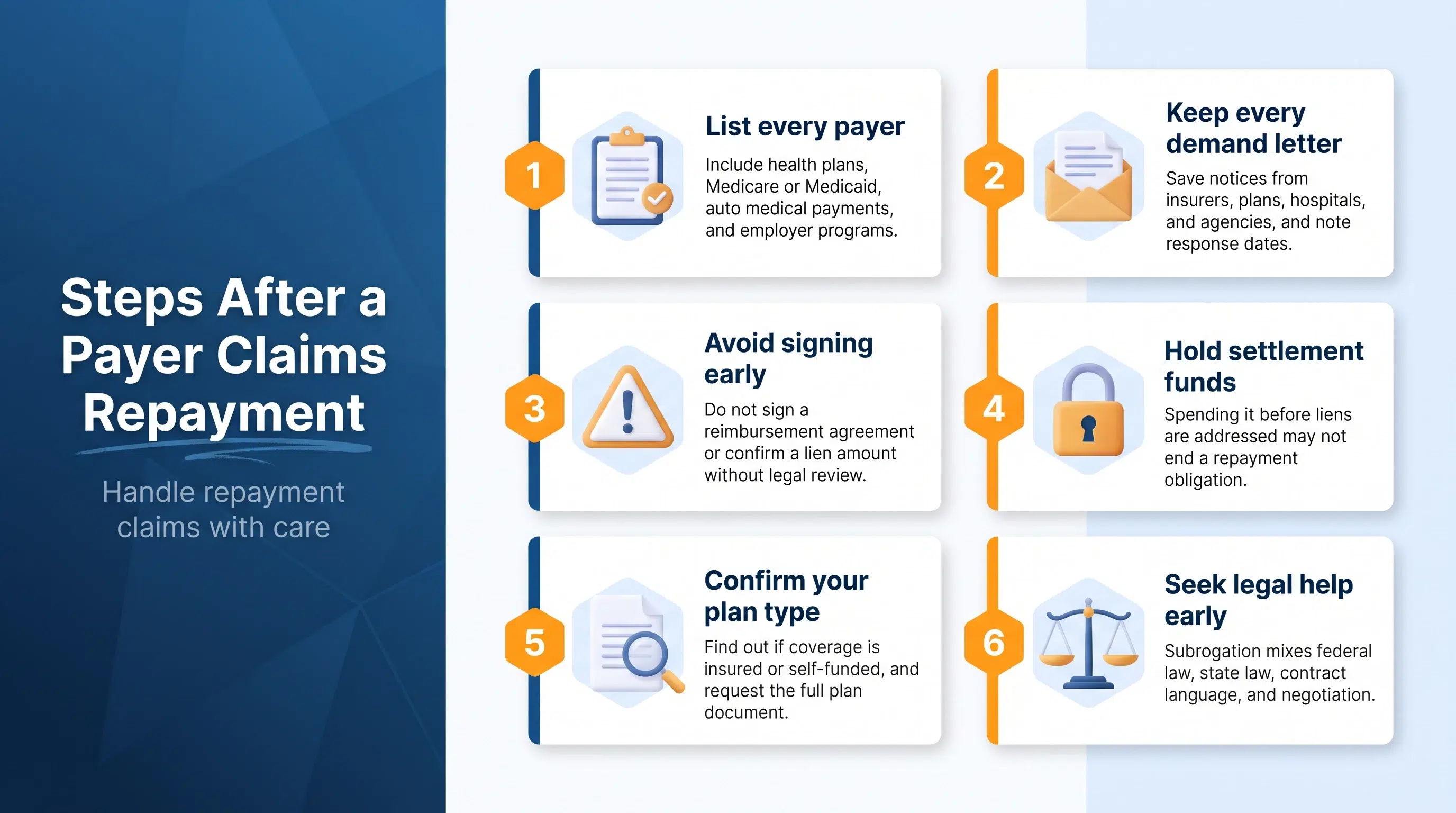
-
Tell your attorney about every payer that has covered any accident-related treatment, including health plans, Medicare or Medicaid, auto medical payments coverage, and employer programs.
-
Keep every letter, notice, and demand from insurers, plans, hospitals, and government agencies, and note any response deadlines.
-
Do not sign a reimbursement agreement or confirm a lien amount without legal review.
-
Do not spend settlement funds until liens and repayment obligations have been identified and addressed. Spending funds does not necessarily end a repayment obligation. [7]
-
Find out if your health coverage is insured or self-funded, and if it comes through your employer, ask for the full plan document.
-
Seek legal help early. Subrogation involves federal and state law, contract language, and negotiation, and it is not a good area to handle alone.
Talk With a GoSuits Attorney
An injury claim can involve medical evidence, liability disputes, insurance issues, repayment demands, and legal deadlines. Whether you were hurt in a crash handled by car accident lawyers, a workplace incident, or another event, a GoSuits attorney can review the circumstances of your situation, explain how personal injury lawyers approach liens and subrogation claims, and discuss your options. You can schedule a free consultation to get started. Past results do not guarantee a future outcome, and every case turns on its own facts and the law of the state where it arises.
This article is general legal information for educational purposes. It is not legal advice, does not create an attorney-client relationship, and may not reflect the law of your state. It is recommended for review by a licensed attorney before publication.
References
-
Subrogation – Legal Information Institute, Cornell Law School
-
Medicare Secondary Payer Manual, Chapter 7 – Centers for Medicare & Medicaid Services
-
US Airways, Inc. v. McCutchen, 569 U.S. 88 (2013) – Justia U.S. Supreme Court
-
FMC Corp. v. Holliday, 498 U.S. 52 (1990) – Legal Information Institute, Cornell Law School
-
Gallardo v. Marstiller, 596 U.S. 420 (2022) – Justia U.S. Supreme Court