Legal Snapshot
- Legal Topic: California Hospital Lien Act – Civil Code §§ 3045.1–3045.6
- Case Stage: Pre-settlement / Settlement Disbursement
- Primary Legal Issue: Hospital lien perfection, notice requirements, and the 50% collection cap
- Primary Authority: California Civil Code §§ 3045.1, 3045.3, 3045.4 [1]
- Date Legal Authority Last Reviewed: July 2025
Under California law, a licensed hospital that provides emergency or ongoing care to an accident victim can assert a lien on any monetary recovery the patient receives from the person responsible for the injury. That lien is limited by statute. California Civil Code § 3045.4 caps the amount a hospital can collect to fifty percent of the net moneys available after paying attorney’s fees, costs, and any prior liens. The hospital cannot simply drain a settlement; it must first satisfy the statutory notice requirements in § 3045.3, and its collection right is bounded by that fifty percent ceiling. [1]
What Is a California Hospital Lien?
A hospital lien is a legal claim a healthcare facility asserts against a personal injury recovery. When a driver is rear-ended on the 405 freeway and taken by ambulance to a hospital in Orange County, that hospital may bill the patient. If the patient later recovers money from the at-fault driver, California law gives the hospital the right to be paid directly out of that recovery rather than waiting for the patient to pay voluntarily.
The lien attaches to the recovery itself, a judgment, settlement, or compromise award not to the patient personally. This distinction matters: a hospital that has a properly perfected lien has a direct claim against the settlement funds, and anyone who pays those funds to the injured person while ignoring a properly noticed lien faces personal liability under § 3045.4.
Hospital liens apply only to injuries caused by a third-party accident or negligent act. They do not apply to injuries covered by workers’ compensation. [1]
What Does California Law Say?
The California Hospital Lien Act is codified at Civil Code §§ 3045.1 through 3045.6. Three sections control most practical questions.
California Civil Code § 3045.1 – The Lien Right
Section 3045.1 grants every licensed hospital that furnishes emergency and ongoing medical services to an injured person a lien upon any damages recovered by that person arising from the accident. The lien covers the “reasonable and necessary charges” for treatment, care, and maintenance at the hospital. [1]
California Civil Code § 3045.3 – Notice Requirements
A lien is not effective unless the hospital delivers or mails by registered mail, return receipt requested, a written notice containing all of the following:
- The name and address of the injured person
- The date of the accident
- The name and location of the hospital
- The amount claimed as reasonable and necessary charges
- The name of each person, firm, or corporation known to the hospital and alleged to be liable to the injured person
This notice must be delivered prior to the payment of any moneys to the injured person, their attorney, or their legal representative. The hospital must also serve a copy of this notice on any known insurance carrier for the alleged at-fault party. [2]
Failure to satisfy these notice requirements voids the lien. An insurer or attorney who pays out settlement proceeds without receiving proper notice is not personally liable to the hospital under § 3045.4.
California Civil Code § 3045.4 – The Fifty Percent Cap
This section creates the most commonly misunderstood rule in the Act. Any person who pays the injured party after receiving proper notice must, before making that payment, pay the hospital the amount of its lien claim, but only to the extent that the lien can be “satisfied out of 50 percent of the moneys due under any final judgment, compromise, or settlement agreement after paying any prior liens.” [3]
Put plainly: the hospital’s claim is capped at half of what remains of the recovery after attorney’s fees, case costs, and any liens with higher priority have been paid. If a patient settles for $100,000, pays $33,000 in attorney’s fees and $5,000 in costs, leaving a net of $62,000, the hospital can claim no more than $31,000 regardless of the actual amount billed.
How the Lien Attaches to a Third-Party Recovery
One of the most important features of a California hospital lien is that it does not burden the patient’s assets directly. The lien attaches specifically to the proceeds of any third-party claim or lawsuit arising from the injury. This means:
- The hospital cannot sue the patient for the full bill as a simple debt collection matter if the lien mechanism applies.
- The hospital’s right to payment depends on the patient actually recovering money from the responsible party.
- If the injured person recovers nothing from the third party, because liability cannot be proven or the at-fault party is uninsured and judgment-proof the hospital’s lien produces nothing.
In the stop-and-go traffic common on SR-73 (the Toll Road) in Irvine and throughout Orange County, rear-end collisions generate significant emergency room charges. Understanding that the hospital’s claim against a settlement is capped at fifty percent can meaningfully change how settlement demands and disbursements are structured.
What Happens When the Hospital Also Billed Health Insurance?
A complication arises when the hospital submits bills both to the patient’s health insurer and pursues a lien against the patient’s personal injury recovery. In that scenario, two separate reimbursement claims may exist simultaneously:
- The hospital’s lien under Civil Code § 3045.1. The hospital’s statutory lien claim.
- The health insurer’s subrogation or reimbursement right. If the health plan paid the hospital, the plan may separately seek reimbursement from the personal injury recovery.
Courts and practitioners have addressed conflicts between hospital liens and health insurance payments. Where a hospital accepts payment from a health insurer at a contracted rate, the total balance the hospital can claim through the lien may be reduced to the contracted rate rather than the full chargemaster price. California case law and in some situations federal law governing ERISA plans affects how these competing claims are resolved. This is one area where the assistance of an attorney is particularly valuable because the interaction of state lien law and federal benefits law is fact-specific.
For injured persons in Orange County and the greater Irvine area, our personal injury lawyers can review how health insurance payments affect the lien amount and whether negotiation with the hospital is appropriate.
How a Defective Notice Can Void a Hospital Lien
The notice requirements of Civil Code § 3045.3 are conditions that must be satisfied for a lien to be effective. A hospital that fails to comply with any element of the notice uses ordinary mail instead of registered mail, omits the date of the accident, or serves notice after the settlement check has been issued risks losing its lien claim entirely.
Common defects that have been litigated include:
- Notice mailed by ordinary first-class mail rather than registered mail with return receipt
- Notice served after settlement funds were already distributed
- Notice that omits the amount of charges claimed
- Notice that fails to identify all known parties alleged to be liable
- Notice served on the insurer without also serving the alleged at-fault party
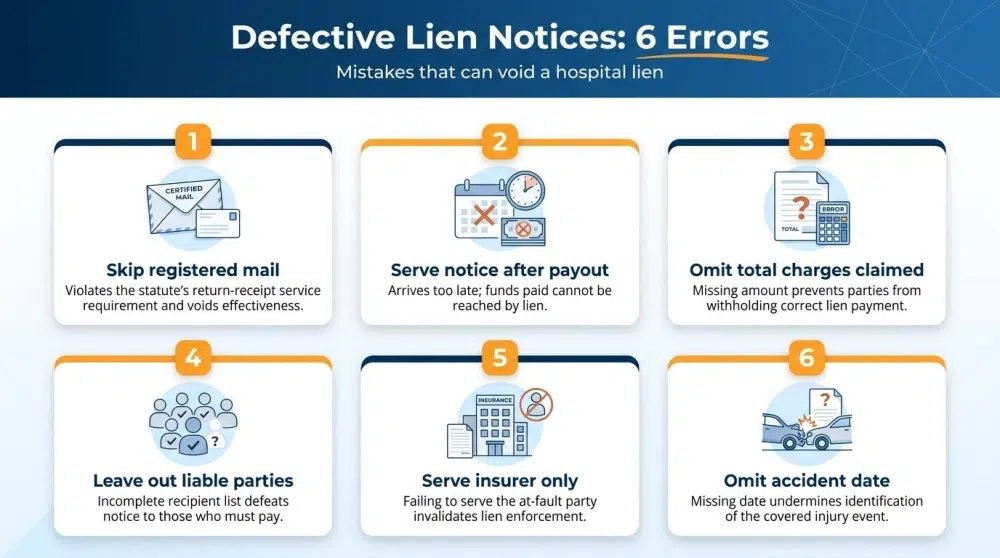
When a lien notice is defective, the hospital’s statutory lien right is defeated. Anyone who pays out the settlement without honoring the lien does not face liability under § 3045.4 if proper notice was never validly served. [2]
Practical Steps for Auditing a Hospital Lien
When a hospital asserts a lien in connection with an injury claim, each of the following steps can affect whether the lien is enforceable and how much may actually be owed.
Request an Itemized Statement
Under California law, a patient or their representative is entitled to an itemized bill. Request a line-by-line statement showing every procedure, supply, room charge, and service. Compare those charges against the date of service, the treating physician’s documentation, and any explanation of benefits if health insurance also paid.
Verify the Notice
Confirm that the hospital served its lien notice before any settlement funds were disbursed, that the notice was sent by registered mail with return receipt requested, and that the notice contains all required information under § 3045.3.
Calculate the Net Recovery
Apply the § 3045.4 formula. Identify the total settlement amount, subtract attorney’s fees and litigation costs, subtract any prior liens with higher priority, and multiply the remainder by fifty percent. That figure is the maximum the hospital can claim.
Consider Negotiation
Hospitals frequently negotiate hospital lien balances, particularly when the calculated fifty percent cap is significantly lower than the amount billed. A written proposal with supporting documentation of the net recovery calculation is often the starting point.
Check for Dual Recovery Issues
If health insurance has already paid a portion of the hospital bill, the remaining lien balance may be limited to the unpaid portion or the contracted rate. Evaluate whether the hospital received any payment from a health plan and whether the lien amount reflects that credit.
How the 50% Cap Works: A Hypothetical
The following is a hypothetical illustration to explain how the statute operates. It is not a description of any actual case or client.
Suppose a driver is injured in a multi-vehicle collision near the Irvine Spectrum and is transported to a nearby hospital. The hospital provides emergency surgery and care, generating a total billed charge of $120,000. The patient retains counsel and pursues a claim against the at-fault driver.
The case settles for $200,000. The attorney’s contingency fee is 33%, or $66,000. Case costs are $8,000. There are no prior liens. The remaining net is $126,000. Fifty percent of that net is $63,000.
Under Civil Code § 3045.4, the hospital’s lien can be satisfied only up to $63,000, even though it billed $120,000. The patient’s personal injury lawyers would present the hospital with a formal lien satisfaction demand based on this calculation. The hospital may then negotiate a further reduction, or may accept $63,000 as satisfaction of its lien.
What Evidence and Records Matter?
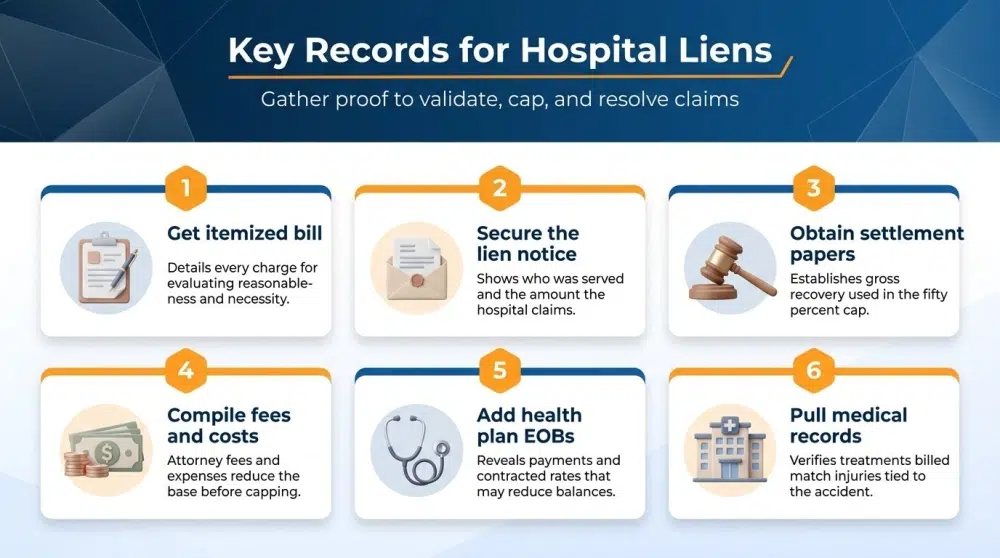
The following records and documents are relevant to analyzing and resolving a hospital lien claim:
- Hospital bill (itemized): The foundation for determining whether charges are “reasonable and necessary” as required by § 3045.1.
- Lien notice: The written document the hospital served on the alleged liable parties and their insurer. Confirms whether the notice is procedurally valid under § 3045.3.
- Return receipt card or proof of registered mailing: Confirms the method of service required by the statute.
- Settlement agreement or judgment: Establishes the gross recovery amount used in the 50% cap calculation under § 3045.4.
- Fee agreement and cost statement: Documents attorney’s fees and costs that reduce the base for the cap calculation.
- Health insurance Explanation of Benefits (EOB): Shows whether a health plan paid any portion of the hospital charges, which may reduce the lien amount or create a competing subrogation claim.
- Medical records: Verify that the treatments billed were actually rendered and were consistent with the documented injuries from the accident.
- Police or accident report: Confirms the date of the accident, which must match the lien notice under § 3045.3.
What Deadlines Apply?
The Hospital Lien Act does not specify a statute of limitations for the lien itself separate from the underlying personal injury claim. However, several deadline-sensitive requirements affect lien rights:
- Notice before disbursement: The hospital must serve its lien notice before any settlement or judgment funds are paid to the injured person or their attorney. A hospital that fails to serve notice before disbursement loses its statutory lien right against those funds.
- Personal injury statute of limitations: The underlying injury claim must be timely filed. In California, the general statute of limitations for personal injury is two years from the date of injury under Code of Civil Procedure § 335.1. [DEADLINE REQUIRES LEGAL VERIFICATION for your specific facts]
- Government entity notices: If the at-fault party is a public entity (such as a city or county), a separate government tort claim must be filed within six months of the incident in most cases. This deadline is entirely separate from the hospital lien notice requirement.
Because deadlines vary based on the specific facts of each case, an attorney should review all applicable time limits.
What Should I Do Next?
If you have received notice of a hospital lien in connection with your personal injury claim, or if you are reviewing settlement documents that reference a hospital bill, there are several practical steps:
- Request the hospital’s itemized billing statement and lien notice in writing.
- Verify that the lien notice was served before any settlement funds were distributed and was sent by registered mail with return receipt.
- Calculate the fifty percent cap using the gross settlement, attorney’s fees, costs, and any prior liens.
- Determine whether any health insurance payment was applied to the hospital bill and whether the lien balance reflects that credit.
- Consult with an attorney before signing any lien satisfaction agreement or disbursing settlement funds.
Personal injury claims in Orange County involve multiple intersecting issues: liability, damages, insurance coverage, and medical bills. Our Irvine personal injury lawyers assist injured clients with understanding how hospital liens affect settlement disbursements and the options available to reduce those liens where the law permits.
If you have questions about a hospital lien or a personal injury claim, you can schedule a free consultation with a GoSuits attorney.
Related California Personal Injury Resources
Understanding how medical bills are handled in personal injury cases is part of a broader set of issues injured people face. The following resources address related topics:
- How Medical Bills Are Paid After a Car Accident A GoSuits knowledge-base article explaining who pays accident-related medical bills on an ongoing basis, including no-fault states, health insurance, and “med pay” coverage.
- California Civil Code §§ 3045.1–3045.6 (Hospital Lien Act). The primary statutory authority governing hospital liens in California, available at the California Legislative Information website.
- California Code of Civil Procedure § 335.1. The two-year statute of limitations for personal injury claims in California. [AUTHORITY TO VERIFY for your specific circumstances]
For injured persons in Orange County, Costa Mesa, Newport Beach, Huntington Beach, and surrounding areas, personal injury lawyers in Irvine can review the full picture of how medical liens, insurance, and settlement structure interact in your specific case.
Talk With a GoSuits Attorney
A hospital lien can significantly affect how much of a personal injury recovery reaches the injured person. Irvine personal injury lawyers at GoSuits review hospital lien claims, verify notice compliance, calculate the applicable fifty percent cap, and work toward lien reductions where appropriate. If you were injured in an accident in Orange County and want to understand how a hospital lien may affect your case, contact GoSuits for a free case evaluation.
References and Legal Authorities
- California Civil Code § 3045.1 – Hospital Lien Act, Lien Right – California Legislative Information (leginfo.legislature.ca.gov)
- California Civil Code § 3045.3 – Hospital Lien Act, Notice Requirements – California Legislative Information (leginfo.legislature.ca.gov)
- California Civil Code § 3045.4 – Hospital Lien Act, 50% Cap and Liability for Improper Payment – California Legislative Information (leginfo.legislature.ca.gov)
- California Civil Code Chapter 4, Hospital Liens [3045.1–3045.6] (added by Stats. 1961, Ch. 2080; amended by Stats. 1992, Ch. 302) – California Legislative Information
- California Health and Safety Code § 1250 – Definition of “Hospital” (Referenced in Civil Code § 3045.1) – California Legislative Information
- Employee Retirement Income Security Act (ERISA), 29 U.S.C. § 1001 et seq. – Federal Law Governing ERISA Health Plans and Subrogation Rights – Cornell Law School Legal Information Institute
- California Code of Civil Procedure § 335.1 – Two-Year Statute of Limitations for Personal Injury Claims – California Legislative Information
- California Rules of Court – California Courts Official Website (courts.ca.gov)
- CourtListener – Free Law Project, California Appellate Case Law Database
- California Supreme Court Opinions – California Courts Official Website