
If you were injured in a California car accident and have no health insurance, you can still receive medical treatment through a process called lien-based care. Under this arrangement, a provider treats you now and agrees to defer payment until your personal injury claim resolves. If the claim settles or results in a judgment, the provider collects from those proceeds. If the claim recovers nothing, you remain personally responsible for the full billed amount. Understanding how these agreements work, what they commit you to, and how California courts evaluate billed charges is critical before you sign anything.
Legal Snapshot
- Legal Topic: Lien-based medical treatment following a California personal injury accident
- Case Stage: Pre-settlement / treatment phase
- Primary Legal Issue: Medical lien agreements, reasonable value of medical services, damages recoverable by uninsured plaintiffs
- Primary Authority: Pebley v. Santa Clara Organics, LLC, 22 Cal. App. 5th 1266 (Cal. Ct. App. 2018); California Civil Code § 3281
- Jurisdiction: California (Orange County / Irvine area)
- Date Legal Authority Last Reviewed: July 2025
What Is Lien-Based Medical Treatment in California?
Lien-based treatment is an arrangement in which a healthcare provider agrees to treat an injured patient without requiring upfront payment. In exchange, the provider records a medical lien, a formal financial claim against any future recovery in the patient’s personal injury case. The lien attaches to settlement funds or a court judgment, not to any specific piece of property.
This model exists because California personal injury claims can take months or years to resolve. Rather than turning away an injured patient who cannot pay out of pocket, providers operating on a lien basis defer payment until the case concludes. If there is no recovery, the provider must still seek payment from the patient directly.
Lien-based treatment is common throughout Southern California, including in Orange County communities such as Irvine, Costa Mesa, Newport Beach, and Santa Ana. After a collision on the I-405 through Irvine or stop-and-go traffic on the SR-55, a crash victim who cannot present an insurance card at an urgent care facility may be referred to a lien-based provider.
What California Law Says About Medical Damages
California Civil Code § 3281 establishes the foundational principle that a person harmed by another’s unlawful act or omission may recover compensation in money, called damages from the person at fault. [1] In a personal injury case, economic damages typically include all reasonable medical expenses caused by the defendant’s negligence.
The specific question of how much a plaintiff may recover for medical treatment, particularly when the plaintiff has no health insurance – became significantly clearer after the California Court of Appeal decided Pebley v. Santa Clara Organics, LLC in 2018. [2]
The Howell Rule and the Pebley Exception
California’s general rule on medical damages comes from Howell v. Hamilton Meats & Provisions, Inc. (2011), in which the California Supreme Court held that a plaintiff with health insurance cannot recover more than the amount actually paid by the insurer the negotiated rate rather than the full “sticker price” billed by the provider. This is because a plaintiff may not recover damages for medical expenses that were never actually incurred due to insurance write-offs.
In Pebley, the Court of Appeal addressed the situation of a plaintiff who was uninsured. The court held that the Howell limitation does not apply to uninsured plaintiffs in the same way. When a plaintiff treats on a medical lien meaning no insurer negotiated a discounted rate and the full billed amount remains owed the trier of fact may consider the full reasonable value of the services, which can be closer to the billed amount. The court reasoned that an uninsured plaintiff faces a genuine financial obligation at the full billed rate, unlike an insured plaintiff whose insurer negotiated a write-off. [2]
This distinction matters because billed charges for lien-based providers are often significantly higher than the rates that insurers negotiate. Pebley opens the door for uninsured plaintiffs to potentially recover a larger medical damages figure, but defendants are not simply stuck with the full billed amount. They may challenge whether the billed rate represents the reasonable value of the services. The ultimate question is the reasonable value of the medical treatment, which juries and courts determine based on available evidence.
How a Medical Lien Agreement Actually Works
A medical lien agreement is a written contract between you (the patient) and the treating provider. Before signing, it is important to understand what the document actually obligates you to do.
Key Terms Typically Found in a Medical Lien Agreement
- Deferred payment. The provider agrees not to demand payment while your case is pending.
- Assignment of proceeds. You authorize your attorney to pay the provider’s bill directly from any settlement or judgment, before you receive your share.
- Personal guarantee. If the case settles for less than the lien balance, or does not settle at all, you remain personally responsible for the unpaid balance. This is one of the most critical provisions, and many patients do not fully appreciate it before signing.
- Interest and fees. Some lien agreements include provisions for interest or administrative fees on the outstanding balance. Read this section carefully.
- No obligation on the attorney. A lien agreement binds the patient. It does not guarantee that your attorney will negotiate a reduction in the lien balance, although in practice many attorneys do attempt to negotiate lien reductions at settlement.
What to Ask Before Signing
Before entering a medical lien agreement, consider asking the provider or your attorney:
- What is the estimated total cost of treatment, and does the lien agreement cap the total amount?
- Is the billed rate the same rate charged to all patients, or is it a special rate for lien-basis patients?
- Does the agreement include interest if the case takes several years?
- Will the provider reduce the lien balance if the total recovery is insufficient to pay all claims?
- Are there alternative sources of coverage, such as MedPay, uninsured motorist medical benefits, or government programs that should be pursued first?
Pursuing all available alternative coverage before committing to a lien arrangement can reduce the amount of your recovery ultimately consumed by unpaid medical bills. An attorney handling personal injury claims in Irvine can help you identify coverage sources you may not know exist.
Letter of Protection vs. Medical Lien Agreement: What Is the Difference?
The terms “medical lien” and “letter of protection” (LOP) are frequently used interchangeably, but they describe slightly different documents depending on context.
A medical lien is the formal legal instrument that encumbers your lawsuit proceeds. It may be filed or recorded in various ways depending on the type of provider. Under California law, hospital liens, for example, are governed by specific statutory rules that require recordation to be effective against third parties. [3]
A letter of protection is typically a letter from your attorney to the provider confirming that the attorney will honor the provider’s bill from settlement proceeds. An LOP is not a statutory lien, it is a contractual commitment. Its enforceability depends on the specific language of the letter and whether the attorney and patient have both agreed to its terms.
In practice, providers and attorneys in Orange County and throughout California often use both documents together: the patient signs a lien agreement, and the attorney also issues an LOP confirming the commitment. Understanding which document you have signed, and what each one obligates you to, is essential before treatment begins.
How Referrals Are Documented and Why Continuity of Care Matters
In a lien-based treatment arrangement, the paper trail connecting your initial injury, your referrals, and your ongoing care is scrutinized carefully, by insurance adjusters, defense attorneys, and potentially a jury at the Orange County Superior Court in Santa Ana.
Documenting the Referral
Lien-based providers are often accessed through referrals. For example, after a rear-end collision on the I-405 near the Irvine Spectrum, an emergency room that cannot accept your case on a lien may refer you to an orthopedic practice or physical therapy clinic that does. This referral should be in writing. Gaps in the referral chain can give an insurer grounds to argue that subsequent treatment was not related to the original accident.
Keep copies of every referral document, diagnosis, and treatment note. Ask providers for copies of their records at each visit. Personal injury cases routinely involve fights over whether all claimed treatment was causally related to the crash.
Why Gaps in Treatment Are Scrutinized
Insurance adjusters and defense attorneys pay close attention to gaps in treatment. If you were injured on the SR-73 Toll Road and received emergency care on the day of the collision but then went several weeks without seeing a doctor, the defense may argue that your injuries were not serious, that you recovered, or that later treatment was for a separate condition. This argument can reduce or eliminate your economic damages.
Continuity of care is not just a medical issue, it is an evidentiary issue. Consistent treatment records create a timeline that supports the connection between the defendant’s negligence and your injuries. Unexplained gaps in that timeline invite doubt.
Understanding how medical bills are paid and documented in a personal injury case is foundational. Our knowledge-base article on how medical bills are paid after a car accident provides additional context on the process from treatment through settlement disbursement.
How This Applies to a Real Case
Example (hypothetical): A driver with no health insurance is rear-ended at a stoplight near the Irvine Spectrum. She is transported to a hospital emergency room, treated for neck and back pain, and discharged. The ER does not accept lien-basis patients, so she pays the emergency visit out of pocket. A few days later, her attorney refers her to an orthopedic clinic and a physical therapy group that both operate on lien agreements. She signs lien documents with each provider. Over six months of treatment, her combined lien balance reaches $45,000 in billed charges.
At settlement, the at-fault driver’s insurer disputes the billed rates, arguing they far exceed what any insurer would actually pay for the same services. Under Pebley, her attorney argues that because she is uninsured and personally responsible for the full billed amount, the jury may consider the full billed value as the reasonable value of services. The insurer counters with expert testimony on prevailing market rates. The parties ultimately negotiate a resolution that accounts for both positions. After attorney’s fees, costs, and lien reductions negotiated by her attorney, she receives a net disbursement, but the lien balances meaningfully reduced her gross recovery.
This is a hypothetical illustration only. It is not a description of any actual GoSuits case or any guaranteed result.
Billed Charges vs. Negotiated Rates: Why This Matters to Your Recovery
One of the sharpest practical tensions in lien-based cases is the difference between what a provider bills and what an insurer would actually pay for the same services.
When a patient has health insurance, the insurer typically negotiates a contracted rate with the provider, often a fraction of the billed charge. The provider accepts that lower amount as full payment and writes off the rest. Under Howell, the plaintiff’s recoverable medical damages are capped at what was actually paid, not the higher billed amount.
When a patient has no insurance and treats on a lien, there is no insurer to negotiate a discounted rate. The full billed charge remains legally owed. This is where Pebley becomes important: the court recognized that an uninsured plaintiff’s reasonable medical damages can be higher than what an insured plaintiff could recover, because the financial obligation is genuinely different. [2]
However, defendants are not required to simply accept the full billed amount. They may offer evidence that the billed rate exceeds the reasonable value of the services in the community. Juries weigh both sides. In practice, lien-based billed amounts are often negotiated down as part of the settlement process, meaning the final net recovery after paying lien balances can be significantly lower than the gross settlement figure.
This dynamic is one of the most important trade-offs to understand before electing lien-based care: it may preserve your right to seek higher damages at trial, but a large lien balance can consume a substantial portion of a moderate settlement.
What Evidence Can Matter in a Lien-Based Treatment Case
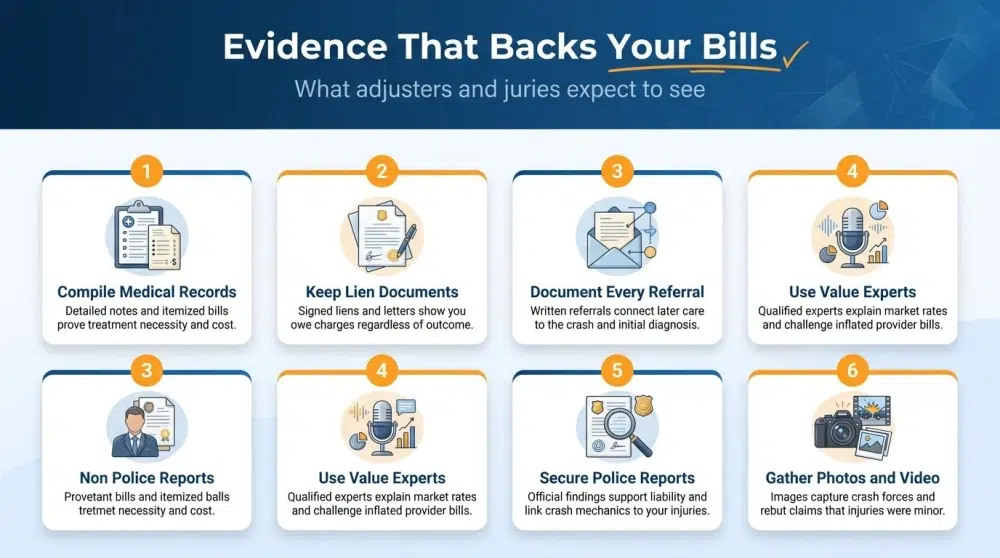
The strength of your medical damages claim depends heavily on the evidence supporting both the causal connection between the crash and your injuries and the reasonableness of the charges incurred.
- Medical records and bills. The foundation of any medical damages claim. Records must document diagnosis, treatment rendered, and the relationship of each service to the injuries caused by the accident.
- Lien agreements and letters of protection. These documents establish that the bills are genuinely owed and not merely paper obligations that will be written off regardless of the outcome.
- Referral documentation. Written referrals connect treatment providers to the original treating physician and support the chain of causation.
- Expert testimony on reasonable value. In contested cases, both sides may call expert witnesses to testify about what the services were worth in the relevant geographic market. This is one area where the Pebley framework plays out in practice.
- Police reports and crash reconstruction. Establish the mechanism of injury and who was at fault.
- Photographs and video of the collision scene. Document the forces involved, which are relevant to causation arguments about injury severity.
Evidence of the collision itself, dashcam footage from SR-133, surveillance video from a nearby business, or witness statements, can be equally important for establishing liability, without which the medical damages analysis becomes irrelevant. Evidence does not automatically establish liability; it must be evaluated in the context of all the facts.
What Damages or Remedies May Be Available
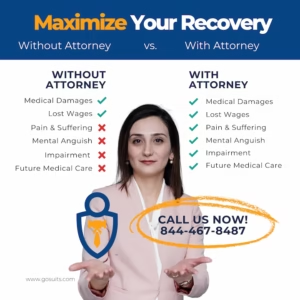
California law allows injured plaintiffs to seek both economic and non-economic damages. The recoverability of each category depends on the applicable law and the specific facts of the case.
Economic Damages
- Past medical expenses. The reasonable value of treatment already received, including lien-basis care. As discussed above, the measure differs for uninsured plaintiffs under Pebley.
- Future medical expenses. If injuries require ongoing or future care, those anticipated costs may be recoverable with appropriate expert support.
- Lost wages. Income lost because of inability to work due to injuries.
- Loss of earning capacity. If injuries permanently reduce your ability to earn income at the same level, future earning capacity losses may be recoverable.
Non-Economic Damages
- Pain and suffering.
- Mental anguish.
- Physical impairment.
- Loss of enjoyment of life.
California does not impose a cap on non-economic damages in standard personal injury cases (as opposed to medical malpractice). The actual amount of non-economic damages is determined by the trier of fact based on the evidence. Recoverability of any damages category depends on establishing both liability and causation.
Injured individuals who have become personal injury clients with pending Irvine area claims involving these types of damages benefit from working with car accident lawyers who understand how lien documentation interacts with the total recovery. Our Irvine personal injury team serves crash victims throughout Orange County, including Newport Beach, Fullerton, and Huntington Beach.
Honest Trade-Offs: When Lien-Based Care May Not Be the Best Option
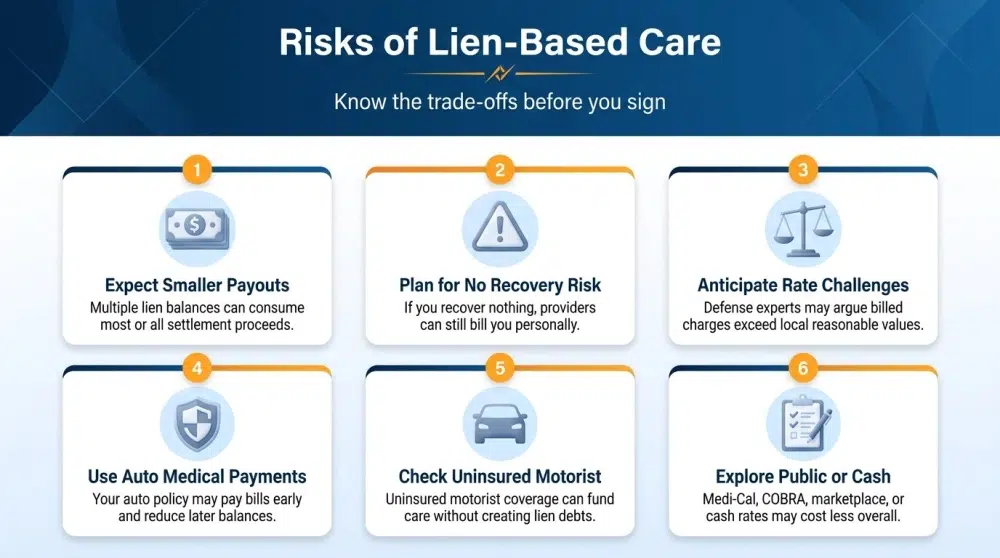
Lien-based treatment is not always the right choice, and it is important to understand the risks before committing.
Risk 1: Lien Balances Can Exceed Recovery
If your case settles for a modest amount, common in cases with disputed liability or limited insurance coverage – the combined lien balances from multiple providers can consume most or all of the recovery. After attorney’s fees and costs, you may receive little or nothing. This outcome is particularly likely when:
- The at-fault driver has minimum limits coverage (currently $15,000 per person in California as of certain recent statutory changes – [4]).
- You have multiple treating providers, each billing at lien rates.
- The case does not proceed to trial where a larger verdict might be available.
Risk 2: Personal Liability if the Case Fails
If the case is dismissed, a jury finds in favor of the defendant, or the plaintiff is found comparatively at fault to a degree that eliminates recovery, the lien provider can still seek payment from the patient personally. California’s comparative fault rules allow a plaintiff to recover even if partially at fault, but any reduction in the recovery percentage reduces the funds available to pay lien balances, and any shortfall remains the patient’s personal obligation.
Risk 3: Defense Challenges to Lien-Based Billed Rates
Defense attorneys routinely challenge the reasonableness of lien-based billed charges at trial. Even if Pebley permits admission of the full billed amount as evidence, a jury may conclude that the reasonable value of the services is lower, resulting in a medical damages award that does not cover the full lien balance. The patient remains personally responsible for the difference.
When Alternatives Should Be Explored First
Before signing a lien agreement, consider whether any of the following may be available:
- Medical payments coverage (MedPay) on your own auto insurance policy
- Uninsured or underinsured motorist medical benefits
- Medi-Cal or other state health programs
- COBRA or marketplace health coverage
- Negotiated cash-pay rates directly with providers
What If Insurance Is Involved?
The at-fault driver’s liability insurer is not a party to your lien agreements. The insurer’s obligation, if liability is established, is to pay damages up to the policy limits. How you financed your medical treatment (lien, out of pocket, or through your own insurance) is relevant to the measure of those damages, but the insurer does not negotiate directly with your lien providers.
Your own auto insurance may include Medical Payments (MedPay) coverage that pays medical bills regardless of fault, and before any settlement. Using MedPay to pay some bills can reduce the lien balance that must come out of your eventual recovery, but your insurer may then have a subrogation right to be reimbursed from the settlement proceeds. Each coverage layer creates its own set of rights and obligations that interact with lien agreements in ways that require careful analysis.
How Long Do I Have to Act?
California’s statute of limitations for personal injury claims is generally two years from the date of injury. [5] If the at-fault party is a government entity, for example, if a municipal vehicle or a Caltrans road defect contributed to the crash a government tort claim typically must be filed within six months of the incident, with specific procedural requirements. [6]
These deadlines are strict. Missing the statute of limitations generally bars the claim entirely. If you are treating on a lien basis, the clock is still running. Do not wait until your treatment concludes to evaluate whether you have a viable claim and how much time remains.
Note: Deadlines should always be confirmed by a licensed California attorney in light of the specific facts of your case. Special rules may apply to minors, individuals under legal disability, or cases involving delayed discovery of injury.
What Should I Do Next?
- Seek appropriate medical care promptly. Document your injuries from the first day. If you have no insurance, ask providers whether they accept lien-basis patients, and do not sign any lien agreement without reading it carefully.
- Identify all available insurance coverage. Check your auto policy for MedPay and UM/UIM medical benefits before assuming lien-based care is your only option.
- Preserve all evidence. Photograph the scene, save the police report, collect witness contact information, and retain all medical records and bills.
- Keep a consistent treatment schedule. Gaps in care create evidentiary problems and may reduce your damages.
- Do not sign a lien agreement without understanding it. Ask your attorney to review any lien document before you sign.
- Consult a personal injury attorney early. The interaction between lien agreements, available insurance coverage, the Pebley rule on damages, and negotiation of lien reductions at settlement is legally complex. Consulting personal injury lawyers early, before significant lien balances accumulate, allows for better strategic planning.
A GoSuits personal injury attorney can review the facts of your situation and explain the options available to you. Schedule a free consultation to discuss your claim.
Related California Personal Injury Resources
The following GoSuits knowledge-base and practice-area resources provide additional information for California crash victims:
Talk With a GoSuits Attorney
Lien-based treatment creates a web of financial obligations that directly affects how much you actually receive from a personal injury settlement. The interplay between billed charges, the Pebley rule, lien reduction negotiations, comparative fault, and available insurance coverage requires careful analysis specific to your situation.
If you were injured in a crash in Irvine, Newport Beach, Costa Mesa, or elsewhere in Orange County, the GoSuits Irvine personal injury team can review the circumstances of your case and explain your options, without charging for the initial consultation. We also serve clients throughout Southern California.
You can reach our team through the GoSuits contact page, or visit our Irvine personal injury practice page to learn more about the types of cases we handle.
When you have questions about your rights after a crash, injury attorneys who understand California law can make a meaningful difference in how your case is evaluated and how your recovery is protected.
References and Legal Authorities
- California Civil Code § 3281 – Damages Defined – California Legislative Information
- Pebley v. Santa Clara Organics, LLC, 22 Cal. App. 5th 1266 (Cal. Ct. App. 2018) – CourtListener
- California Civil Code § 3045.1 et seq. – Hospital Lien Act – California Legislative Information [AUTHORITY TO VERIFY: Confirm current hospital lien statutory section]
- California Insurance Code § 11580.1 – Minimum Liability Coverage Requirements – California Legislative Information
- California Code of Civil Procedure § 335.1 – Two-Year Statute of Limitations for Personal Injury – California Legislative Information
- California Government Code § 911.2 – Government Tort Claims – Six-Month Claim Filing Deadline – California Legislative Information