Texas law governs the injury claim when an accident occurs on Texas soil, regardless of where the injured person lives. An out-of-state resident hurt in Dallas has the same right to pursue a civil claim as any Texas resident, but that claim will be filed in a Texas court, measured against Texas statutes, and subject to the Texas two-year filing deadline. Where the injured person sleeps at night does not change which state’s substantive law applies. This article explains why that rule exists, how the deadline runs for non-residents, how out-of-state health insurance and its subrogation rights interact with a Texas claim, how treatment can continue at home while the case moves forward in Dallas, and how remote depositions and other procedural tools allow an injured person to participate without being physically present in Texas at every stage.
Legal Snapshot
- Legal Topic: Choice of law; non-resident injury claims; Texas statute of limitations
- Case Stage: Pre-litigation through trial
- Primary Legal Issue: Which state’s law governs; two-year filing deadline under Tex. Civ. Prac. & Rem. Code § 16.003
- Primary Authority: Tex. Civ. Prac. & Rem. Code § 16.003; Texas conflict-of-laws doctrine (place-of-injury rule)
- Date Legal Authority Last Reviewed: August 2026
Why Texas Law Applies to the Claim
Texas follows the traditional conflict-of-laws principle known as the lex loci delicti rule: the law of the place where the wrong occurred controls the substantive rights and obligations of the parties. When a collision on I-35E, a slip at a hotel near the Dallas North Tollway, or a premises injury anywhere in Dallas County causes harm, the tortious act happened in Texas. Texas courts apply Texas negligence law, Texas damages rules, and the Texas statute of limitations to that dispute, whether the injured person lives in California, Illinois, or any other state.[1]
This is not merely a procedural convenience. The rule protects defendants, who operate within Texas and structure their conduct in reliance on Texas standards. It also creates predictability for both sides: everyone who drives in Texas, operates a business in Texas, or owns property in Texas knows in advance that Texas tort law will apply if their conduct causes injury here.
For an injured traveler, the practical result is that hiring an attorney admitted in Texas matters, filing suit in a Texas court matters, and understanding Texas procedural rules matters. Your home state’s laws on negligence, comparative fault, or damages do not govern the outcome.
The Texas Two-Year Filing Deadline and Non-Residents
Texas Civil Practice and Remedies Code § 16.003(a) gives an injured person two years from the date a legal injury accrues to file a personal injury lawsuit in a Texas court.[2] That deadline applies to everyone injured in Texas, including out-of-state residents and foreign nationals. The statute does not carve out additional time because an injured person had to travel home for treatment, was unfamiliar with Texas law, or spent months negotiating with an insurer.
In most vehicle crash cases, the clock begins on the day of the accident. A visitor from another state who is injured in a rear-end collision on the LBJ Freeway (I-635) during a business trip to Dallas has the same two-year window as a Dallas resident injured the same day.
When the Deadline Can Shift
Texas law recognizes a limited set of circumstances that can pause or delay the running of the statute:
- Discovery rule: For certain latent injuries whose nature and connection to a specific event were not reasonably discoverable, the limitations period may begin on the date discovery was made or should have been made. This is a narrow exception and courts apply it cautiously. [3]
- Minority: If the injured person is under 18, the period is tolled until the eighteenth birthday. The two-year clock then starts from that date.
- Legal incapacity: A person who lacked legal capacity at the time of injury may have the period tolled until that incapacity is removed. The scope of this exception requires careful legal review.
- Fraudulent concealment: If the defendant actively concealed facts that prevented discovery of the claim, a court may toll the period for the duration of the concealment.
None of these exceptions applies automatically. An out-of-state residence is not itself a tolling condition under Texas law. If you were injured in Dallas and are unsure whether any exception applies to your situation, the safest course is to treat the two-year anniversary of the injury date as an absolute outer boundary and consult an attorney well before that date arrives.
Where the Lawsuit Is Filed
Personal injury lawsuits arising from Dallas incidents are typically filed in the Dallas County District Court at the George L. Allen Sr. Courts Building in downtown Dallas. Texas venue rules under Chapter 15 of the Texas Civil Practice and Remedies Code generally require suit to be filed in the county where the incident occurred or where the defendant resides.[4] Because the accident happened in Dallas County, Dallas County is almost always the proper venue for the claim.
For a non-resident plaintiff, this means the lawsuit is pending in a Texas courthouse even though the plaintiff may live in another state. The plaintiff is not required to be physically present in Dallas for most stages of the litigation, but venue cannot simply be transferred to the plaintiff’s home state merely because it would be more convenient.
How Out-of-State Health Insurance Interacts with the Claim
An injured non-resident will almost certainly use their home-state health insurance to pay for initial and ongoing medical treatment after returning home. That coverage is available regardless of where the injury occurred. However, the insurer’s right to recover its payments from any personal injury settlement or judgment, known as a subrogation lien, follows the injured person into the Texas case.
Understanding Subrogation
When a health insurer pays medical bills on behalf of an injured person, it acquires a right to be reimbursed out of any recovery the injured person later obtains from the at-fault party. This right, called subrogation, allows the insurer to stand in the shoes of the injured person to the extent of the payments it made. In a personal injury settlement in Texas, the injured person and their attorney must account for outstanding subrogation claims before distributing settlement proceeds.
The precise rules governing subrogation depend on the type of insurance plan involved:
- ERISA-governed employer plans: If the injured person’s health coverage is provided through an employer-sponsored plan subject to the Employee Retirement Income Security Act of 1974 (ERISA), the plan documents control the subrogation rights, and federal law significantly limits a state’s ability to restrict those rights.[5] Federal courts have held that self-funded ERISA plans are entitled to full reimbursement from a recovery, even if that leaves the injured person with very little after paying other expenses and attorney fees. This is an area where legal representation is particularly important, because experienced personal injury attorneys often negotiate reduction of ERISA lien amounts.
- Individual marketplace or Medicaid plans: Plans purchased on individual insurance exchanges or government-administered programs like Medicaid have their own subrogation rules, which may differ by state of issuance. Medicaid programs, for example, often have statutory recovery rights that must be honored before the injured person keeps settlement funds.
- Medicare: If the injured person receives Medicare benefits that paid for any accident-related treatment, Medicare has a conditional payment right that must be resolved before settlement proceeds are distributed. Federal law requires the resolution of Medicare liens, and failing to do so can result in liability for the injured person and their attorney.[6]
Personal injury lawyers for the Dallas cluster handle lien resolution as part of the claim process. Lien amounts are not always fixed. Attorneys frequently negotiate with insurers and government programs to reduce outstanding balances, which increases the amount the injured person receives from the settlement.
Treating at Home While the Case Proceeds in Texas
One of the most common practical concerns for out-of-state injury victims is continuity of medical care. Fortunately, the location of the litigation does not require the injured person to receive medical treatment in Texas. After returning home, the injured person should continue treatment with qualified providers in their home state or region. Documenting that treatment carefully is essential to the Texas claim.
What Medical Records Should Capture
For an out-of-state plaintiff, the treating physicians are located in another state and may have no particular familiarity with Texas litigation. The injured person should ensure that records clearly document:
- The specific date, location, and mechanism of the injury as it was reported to the treating provider
- A clear medical opinion connecting the diagnosed condition to the Dallas incident (causation)
- The full history of treatment, including all appointments, procedures, medications, and referrals
- Any restrictions on work, daily activities, or future functional limitations
- All bills, explanation of benefits statements, and health insurer correspondence
Texas courts permit the admission of medical records and billing from out-of-state providers. Rule 902 of the Texas Rules of Evidence and Texas Civil Practice and Remedies Code § 18.001 govern the admissibility of medical bills and permit an injured party to establish the reasonableness and necessity of charges through an affidavit procedure without requiring the treating physician to travel to Texas to testify at trial.[7]
For significant injuries, a treating physician in the home state may be asked to provide a written medical opinion or to testify at a deposition. Texas Rule of Civil Procedure 201 permits depositions of out-of-state witnesses.[8] Courts routinely allow these depositions to be conducted by video, which eliminates the need for the physician to travel to Texas.
Remote Depositions and Court Appearances for Non-Resident Plaintiffs
Modern litigation procedures accommodate out-of-state parties effectively. The non-resident injured person does not need to relocate to Texas or make frequent trips to Dallas to pursue a claim. Several procedural tools exist to manage participation remotely.

Plaintiff’s Deposition
A defendant’s attorneys have the right to depose the plaintiff. For out-of-state plaintiffs, Texas courts generally permit the deposition to occur at a location convenient to the plaintiff, including in the plaintiff’s home state or by video conference. The Texas Rules of Civil Procedure authorize depositions by remote electronic means, and courts have broadly accepted video depositions following their increased use after 2020.[9] An experienced attorney will negotiate with opposing counsel to arrange the most practical format.
Independent Medical Examination
If the defendant requests an independent medical examination (IME) under Texas Rule of Civil Procedure 204, the court will consider the plaintiff’s location in setting the terms of that examination. Courts have discretion over the location, timing, and manner of an IME. An out-of-state plaintiff who would suffer significant hardship by traveling to Texas may request that the examination occur in or near their home state.

Mediation and Settlement Negotiations
Most personal injury claims resolve through settlement before trial. Mediation, the most common settlement mechanism in Texas personal injury cases, can be conducted by video conference. This allows the plaintiff, the defense, and a mediator to negotiate in real time without anyone needing to be in the same physical location.
Trial
If a case proceeds to trial in Dallas County District Court, the plaintiff would need to be present. However, only a small fraction of personal injury cases reach trial. For the majority of claims, the non-resident plaintiff can participate throughout the litigation from their home state with limited or no travel to Texas until a trial setting, which may never come.
Common Scenarios for Out-of-State Visitors in Dallas
Out-of-state visitors tend to concentrate their time in a small number of environments in Dallas: rental vehicles, hotels, restaurants, convention centers, and the highways connecting them. Each setting raises its own liability considerations.
Rental Car Accidents
A non-resident who rents a vehicle at Dallas Fort Worth International Airport or another rental facility and is injured in a crash has a claim against the at-fault driver under Texas negligence law. The rental agreement itself typically provides secondary liability coverage, but the primary claim is against the negligent driver. If the at-fault driver is uninsured or underinsured, the non-resident’s own auto insurance uninsured motorist coverage from their home state may apply, depending on the terms of that policy and whether it covers out-of-state rentals. Out-of-state rental car agreements often include collision damage waivers and liability supplements that interact with a claim in ways that benefit from attorney review.
The Dallas area’s highway system, including the I-635 LBJ Freeway and the Dallas North Tollway, sees substantial commercial traffic and merger-related collisions. Rental car drivers unfamiliar with the local interchange patterns, such as the High Five interchange at I-635 and US-75, may be more vulnerable to multi-lane accidents. Car accident lawyers in Dallas handle these types of claims regularly and are familiar with the factual patterns common to visitor-involved collisions.
Hotel Premises Injuries
Texas premises liability law imposes a duty on commercial property owners, including hotels, to exercise reasonable care to keep the property safe for invitees, the legal classification that applies to paying guests.[10] An out-of-state guest who slips in a hotel lobby, trips on a defective stairway, or is injured by an unsafe condition on hotel property has a Texas premises liability claim. The fact that the guest lives in another state does not reduce the hotel’s duty of care or limit recoverable damages. The location of the hotel determines venue; nearly all Dallas hotels and their parent companies can be sued in Dallas County.
Our Dallas personal injury team handles premises cases involving hotels and other commercial properties. If you were injured at a Dallas hotel, the incident report filed with hotel management at the time of injury, surveillance footage from the property, and maintenance records are all evidence that should be preserved quickly, because commercial properties sometimes delete footage on short retention cycles.
Texas Modified Comparative Fault and Non-Residents
Texas follows a modified comparative fault system under Texas Civil Practice and Remedies Code § 33.001. A plaintiff who is 51 percent or more responsible for the incident cannot recover damages. A plaintiff who is 50 percent or less responsible can recover, but the recovery is reduced proportionally by the plaintiff’s percentage of fault. This rule applies equally to resident and non-resident plaintiffs. A visiting driver who was following too closely on the LBJ Freeway and contributed to a chain-reaction collision, for example, may see their damages reduced by the percentage of fault assigned to them, even if another driver’s negligence was the primary cause.
A personal injury claim in Dallas that proceeds to trial will ask the jury to allocate percentages of responsibility among all parties whose conduct contributed to the injury. Understanding how Texas comparative fault works before making statements to insurers is one reason early legal consultation matters.
Evidence That Can Matter in a Non-Resident’s Dallas Injury Claim
The type of evidence useful in any personal injury case does not change because the plaintiff lives out of state. What changes is the practical challenge of gathering and preserving that evidence when the injured person is no longer physically present in Dallas after returning home. Time is a critical factor. The following categories of evidence are commonly relevant:
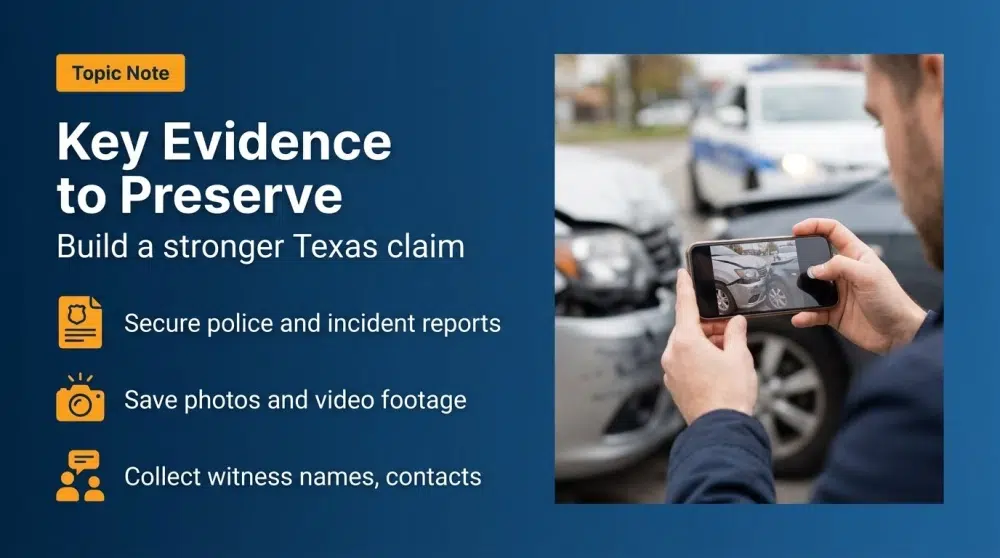
- Police and incident reports: Official reports from the Dallas Police Department or the Texas Department of Public Safety document the facts of an accident, the parties involved, witness information, and any citations issued.
- Photographs and video: Photos taken at the scene and surveillance footage from nearby businesses or traffic cameras can establish road conditions, hazards, and the positions of vehicles. Commercial properties in Dallas typically retain footage for only 30 to 90 days; preservation demands should be sent promptly.
- Witness statements: Bystanders who saw the accident or the condition that caused a fall often scatter quickly. Contact information collected at the scene or through the police report is critical.
- Medical records and bills: Records from emergency treatment in Dallas and from continuing treatment in the home state form the core of the damages case.
- Event data recorders: Modern vehicles store pre-crash data that can reflect speed, braking, and steering inputs. This data requires a formal download process and should be preserved through a litigation hold or court order.
- Employment and income records: Lost wages and reduced earning capacity require documentation of the injured person’s work history, salary, and any time missed from employment.
- Communications with insurers: Statements made to the at-fault driver’s insurer or to a rental car company after an accident can affect the claim. Written records of all communications are important.
Injured travelers who are returning home often cannot stay in Dallas long enough to gather all of this evidence personally. This is one practical reason why retaining a Dallas-based attorney quickly matters: legal counsel can issue preservation letters, request records, and send investigators to the scene before evidence is lost. An attorney familiar with out-of-state driver accident insurance and lien resolution can also advise on the interaction between available insurance coverage and the injury claim from the outset.
Damages Available in a Texas Personal Injury Claim
A non-resident injured in Dallas is entitled to the same categories of compensatory damages as any Texas plaintiff. Recoverability depends on applicable law and the facts of each case. Texas law recognizes the following potential categories:
| Damage Category | Description |
|---|---|
| Past medical expenses | Cost of treatment from the date of injury through the time of settlement or verdict |
| Future medical expenses | Reasonably anticipated future care costs, supported by medical expert opinion |
| Past lost wages | Income lost because of inability to work during recovery |
| Future loss of earning capacity | Reduced ability to earn income going forward if the injury creates long-term impairment |
| Physical pain and suffering | Past and future physical pain associated with the injury and treatment |
| Mental anguish | Emotional distress, anxiety, or suffering caused by the injury and its consequences |
| Physical impairment | Loss of physical function, mobility, or the ability to perform daily activities |
| Disfigurement | Scarring or permanent physical alteration of appearance |
| Wrongful death damages | If the injured person dies, Texas wrongful death law provides a separate set of damages for surviving family members |
Texas Civil Practice and Remedies Code Chapter 41 governs exemplary (punitive) damages, which require clear and convincing evidence of actual malice or gross negligence and are subject to statutory caps.[11] These are rarely available in ordinary negligence cases but may apply in cases involving egregious conduct, such as a drunk driving crash.
How Long Do You Have to File?
For most personal injury claims arising from Dallas accidents, Texas Civil Practice and Remedies Code § 16.003 sets a two-year limitations period from the date of the injury. There is no separate or extended deadline for out-of-state residents. The deadline applies with equal force whether the plaintiff is a Texas resident or a visitor from another state.
If a government entity or employee may be responsible, additional notice requirements under the Texas Tort Claims Act apply. In many cases, written notice of the claim must be submitted to the governmental unit within six months of the incident, and some local governments have even shorter notice windows. These government claim requirements run separately from and in addition to the two-year limitations period.[12]
Deadlines for insurance claims and insurance company-imposed notice requirements are additional considerations. Many auto and premises liability policies require prompt reporting of claims. Delay in notifying an insurer does not reset the statute of limitations, but it can create coverage defenses that complicate recovery.
Consulting a personal injury attorney shortly after an injury is the most reliable way to ensure no deadline is missed. If you have a pending claim from a Dallas incident, do not assume that time is available simply because negotiations with an insurer are ongoing. Settlement negotiations do not toll the statute of limitations.
What Should I Do Next?
If you were injured in Dallas while visiting from another state, the following steps can help protect your legal position:
- Seek medical care immediately in Dallas if needed, and continue with a qualified provider in your home state when you return. Report the accident as the cause of your injuries at every medical appointment.
- Preserve all documents from the scene: photos, police report number, witness contact information, rental car agreements, hotel incident reports, and any written communications from insurance companies.
- Do not give recorded statements to the at-fault party’s insurer without first consulting an attorney. Statements made in the days after an injury are often used later in ways that limit recovery.
- Consult a Texas-licensed personal injury attorney promptly. The attorney can issue evidence preservation demands, evaluate the strength of the claim, identify applicable insurance coverage, and manage the legal process from Dallas while you recover at home.
- Notify your own insurance company of the accident as required under your policy, without making detailed factual admissions.
- Track all out-of-pocket costs related to the injury, including co-pays, travel for treatment, and any services you needed because of your physical limitations during recovery.
An injury claim as a non-resident involves Texas law, your home state’s insurance, and subrogation rights that interact in ways that are not always intuitive. If you were injured in a Dallas accident, a GoSuits personal injury attorney can review your situation, explain how the Texas deadline applies to your facts, and help you understand your options. Schedule a free consultation today.

Related Texas Personal Injury Resources
- Dallas Personal Injury Attorneys: GoSuits Dallas Personal Injury & Accident Lawyers
- Car Accident Lawyers in Dallas: Dallas Car Accident Lawyers
- Slip and Fall Lawyers in Dallas: Dallas Slip and Fall Accident Lawyers
- Knowledge Base Article: Out-of-State Driver Accident Insurance: Who Pays?
- Texas Personal Injury Lawyers: Texas Personal Injury Lawyers
Talk With a GoSuits Attorney
GoSuits serves injured people in Dallas, throughout Texas, in Los Angeles and Irvine in California, and in Chicago, Illinois. If you were injured in Dallas as a non-resident, our personal injury team can explain which Texas laws apply to your claim, how the two-year filing deadline runs from your injury date, and how out-of-state treatment and insurance subrogation interact with the recovery process. Consultations are free, and we handle personal injury claims on a contingency basis, meaning there are no attorney fees unless there is a recovery.
Schedule a free consultation • Prior cases • Our attorneys • About GoSuits • Practice areas
References and Legal Authorities
- Texas Civil Practice and Remedies Code, Chapter 16 (Limitations) – Texas Legislature Online
- Tex. Civ. Prac. & Rem. Code § 16.003(a) – Two-Year Limitations Period – Texas Legislature Online
- Discovery Rule – Legal Information Institute, Cornell Law School
- Tex. Civ. Prac. & Rem. Code, Chapter 15 (Venue) – Texas Legislature Online
- Employee Retirement Income Security Act of 1974 (ERISA) – U.S. Department of Labor
- Medicare Secondary Payer – Centers for Medicare & Medicaid Services
- Tex. Civ. Prac. & Rem. Code § 18.001 (Affidavit Concerning Cost and Necessity of Services) – Texas Legislature Online
- Texas Rules of Civil Procedure – Texas Courts
- Texas Rules of Civil Procedure, Rule 199.1 (Methods of Discovery) – Texas Courts
- Texas Civil Practice and Remedies Code, Chapter 95 (Premises Liability) – Texas Legislature Online
- Tex. Civ. Prac. & Rem. Code, Chapter 41 (Exemplary Damages) – Texas Legislature Online
- Texas Tort Claims Act, Tex. Civ. Prac. & Rem. Code, Chapter 101 – Texas Legislature Online