To file a USAA accident claim in California, report the crash as soon as possible through usaa.com or the USAA Mobile App. USAA’s claims pages describe online and app reporting for policyholders, and they also say someone hit by a USAA member can report a third-party claim even without a USAA policy [1][2]. Reporting to an insurer is separate from California’s other duties and deadlines. Depending on the facts, a driver may also owe a report to the DMV within 10 days under Vehicle Code section 16000 [4], and most injury lawsuits must be filed within two years under Code of Civil Procedure section 335.1 [3]. Opening a claim does not stop those clocks, and it does not guarantee payment.
This article is general legal information about civil insurance claims under California and applicable federal law. It is not legal advice for any specific accident.
Legal Snapshot
-
Legal Topic: Reporting and pursuing a USAA auto insurance claim after a California collision
-
Case Stage: Pre-lawsuit insurance claim
-
Primary Legal Issue: Whether the claim is first-party (under your own USAA policy) or third-party (against a USAA policyholder who may be at fault), and what deadlines apply
-
Primary Authority: California Code of Civil Procedure section 335.1; Vehicle Code sections 16000 and 16056; California Code of Regulations, title 10, sections 2695.5 and 2695.7
-
Date Legal Authority Last Reviewed: November 28, 2026 (attorney verification recommended before publication)
What Does a USAA Accident Claim Mean?
A USAA accident claim is a request that USAA investigate a crash and pay for covered losses. Which kind of claim you file depends on whose policy responds.
|
Claim type |
Whose policy |
Typical coverages involved |
|---|---|---|
|
First-party claim |
Your own USAA policy |
Collision, medical payments, uninsured/underinsured motorist coverage, depending on what you bought |
|
Third-party claim |
The at-fault driver’s USAA liability coverage |
Bodily injury and property damage liability |
USAA states that it evaluates a claim based on the coverage, the deductible, and who is responsible, and that it may pay the policyholder or a third party if the loss is covered [1]. A third-party claimant does not need USAA insurance to report a claim against a USAA member [2].
What Does California Law Say?
California is an at-fault state, so the driver who caused the crash is generally responsible for the resulting harm, and that driver’s liability insurer is the usual source of payment for a third-party claim. Fault is divided under the rule of pure comparative negligence adopted in Li v. Yellow Cab Co. (1975) 13 Cal.3d 804 [8]. Under that rule, an injured person’s own share of fault reduces recovery in proportion rather than barring it entirely, so a person found partly responsible may still recover the remainder. How a jury would divide fault in a given case depends on the evidence.
The negligence framework is rooted in Civil Code section 1714 [11]. Claims-handling conduct by insurers is regulated separately by the California Department of Insurance through the Fair Claims Settlement Practices Regulations, found in title 10 of the California Code of Regulations, sections 2695.1 through 2695.14 [7].
What Legal Rules Apply?
State reporting duties
Vehicle Code section 16000 requires a driver involved in a crash on a street or highway to report it to the DMV within 10 days if anyone was injured or killed, or if property damage to any one person is more than $1,000 [4]. The driver can make the report personally or through an insurance agent, broker, or legal representative. Filing an insurance claim with USAA does not count as filing this DMV report. Separately, under Vehicle Code section 20008, if a crash injures or kills anyone, the driver must make a written report to the California Highway Patrol or the local city police department within 24 hours[5].
Insurer response timelines
Under the Fair Claims Settlement Practices Regulations, an insurer generally must acknowledge a claim, provide forms and assistance, and begin investigating within 15 calendar days of receiving notice (10 CCR § 2695.5(e)). It generally must accept or deny the claim within 40 calendar days after receiving proof of claim (§ 2695.7(b)), and it must pay accepted amounts within 30 calendar days (§ 2695.7(h)) [7]. If an insurer needs more time, it must give written notice explaining what information it needs and why, and repeat that notice every 30 days until it decides (§ 2695.7(c)(1)). These are regulatory standards enforced by the California Department of Insurance. They are not a lawsuit deadline for the injured person.
The California Supreme Court has also held that an injured person generally cannot sue the at-fault driver’s insurance company directly for unfair claims practices (Moradi-Shalal v. Fireman’s Fund Ins. Cos. (1988) 46 Cal.3d 287). That is one reason filing a complaint with the California Department of Insurance, rather than suing the insurer, is the usual way to address claims-handling problems. The injured person can still bring an injury claim against the at-fault driver.
Minimum liability limits
For auto liability policies issued or renewed on or after January 1, 2025, California’s minimum limits are $30,000 for injury to one person, $60,000 for injury to two or more people in one accident, and $15,000 for property damage [6]. A USAA policyholder may carry higher limits than the minimum, and the declarations page of the specific policy controls. Limits matter because they cap what the liability policy itself will pay for a covered claim.
How Does This Apply to a Real Case?
Hypothetical example (not an actual GoSuits case): A driver is rear-ended in stop-and-go traffic on the I-405 and goes to urgent care that evening with neck pain. The other driver is a USAA member. The injured driver is not a USAA customer, so the injured driver would report a third-party claim through USAA’s online third-party reporting [2], keep the claim number, and separately consider whether the DMV report is due within 10 days because of the injury [4].
Hypothetical example (not an actual GoSuits case): A USAA policyholder is hit at a signalized intersection near US-101 in the San Fernando Valley, and the other driver is uninsured. The policyholder would likely start a claim with their own insurer, USAA, and ask what collision, medical payments, or uninsured motorist coverage the policy includes. California’s rules on uninsured motorist coverage appear in Insurance Code section 11580.2. Under that section, an uninsured motorist claim generally must be resolved, filed in court, or submitted to formal arbitration within two years of the crash.
These examples are illustrations only, not GoSuits cases or case results.
Step-by-step: how to report
-
Get medical care first. Health comes before paperwork, and treatment records become part of the claim.
-
Report through USAA. Use usaa.com or the USAA Mobile App, which USAA describes as the place to report, track, and manage a claim [1]. USAA asks for the date and location of the accident, the number of vehicles involved, and basic details about what happened and the damage [1]. Other details, such as witness names and the other driver’s insurance information, can be added later.
-
Record the claim number and adjuster contact. Use them in every later communication.
-
Keep the first report short and factual. Stick to what you know. Do not guess about fault or speculate about injuries that have not yet been evaluated.
-
Handle the DMV report. Decide whether Vehicle Code section 16000 applies to your crash and file within 10 days if it does [4].
-
Consider legal advice before recorded statements or medical authorizations. Adjusters may request them early in the process.
USAA’s third-party claims FAQ says a police report is optional for filing a claim, but it can help when someone is injured, multiple people are involved, or fault is unclear [2]. USAA’s own claims pages do not list a specific reporting deadline. Instead, they ask drivers to report a claim as soon as possible [1]. Most auto policies also require prompt notice of a crash, so policyholders should check their policy for any notice requirement. Even when USAA does not require a police report, California law requires a written report to the police or the California Highway Patrol within 24 hours of any crash that injures or kills someone (Vehicle Code § 20008).
USAA claims phone numbers vary across third-party websites. Use the number on your USAA card, the app, or usaa.com rather than a number copied from an unofficial source.
What Evidence Can Matter?
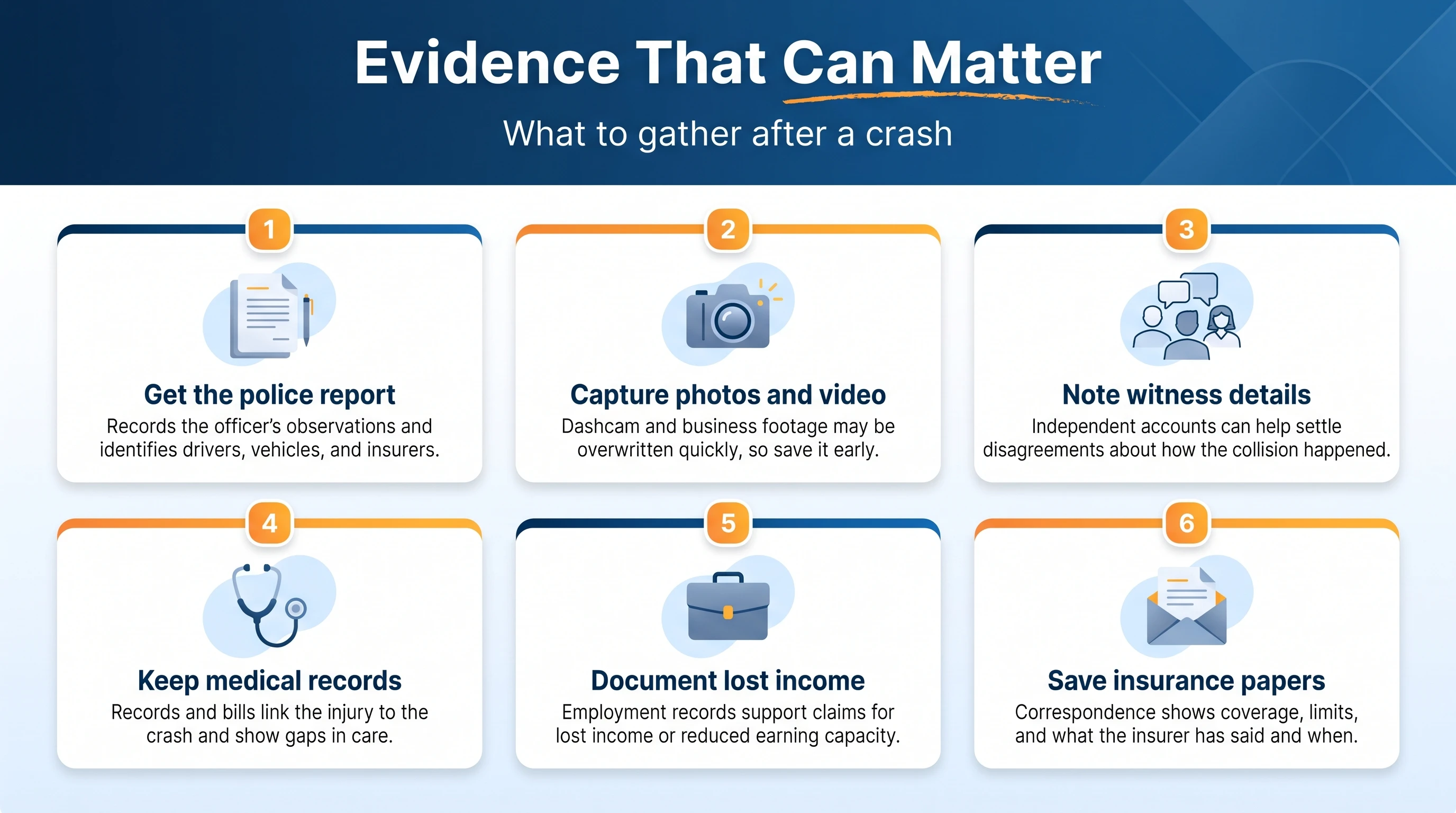
Evidence does not automatically prove liability or damages, but it shapes how an insurer and, later, a court evaluate a claim.
-
Police or CHP report: records the responding officer’s observations and identifies drivers, vehicles, and insurers.
-
Photographs and video: show vehicle positions, damage, road conditions, and visible injuries. Dashcam and nearby business surveillance footage may be overwritten quickly.
-
Witness information: independent accounts can help resolve disagreements about how the collision happened.
-
Medical records and bills: link the injury to the crash and document treatment, including gaps in care that an adjuster may question.
-
Employment records: support claims for lost income or reduced earning capacity.
-
Repair estimates and total-loss valuations: document property damage.
-
Vehicle data and reconstruction analysis: can matter when speed, braking, or point of impact is disputed.
-
Insurance documents and claim correspondence: show coverage, limits, and what the insurer has said and when.
-
Social media activity: posts can be used by an insurer to question the extent of an injury, so claimants should be careful.
What Damages or Remedies May Be Available?
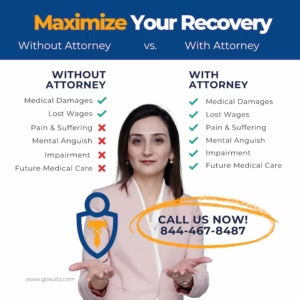
Recoverable damages depend on California law and the facts of the case. A claim may include medical expenses, future medical care, lost income, loss of earning capacity, property damage, and non-economic harm such as pain, mental suffering, and physical impairment. Wrongful death claims have their own rules and recoverable damages. A liability claim against a USAA policyholder is generally paid only up to the available policy limits unless other insurance or assets are available.
One California rule can change damages. Civil Code section 3333.4 (Proposition 213) bars certain uninsured owners and operators from recovering non-economic damages in motor vehicle cases, while economic damages are not removed by that statute, and the statute contains an exception tied to a DUI conviction of the other driver [9]. Anyone who may be affected should have the facts reviewed before settling.
What If USAA Disputes Liability?
An insurer may disagree about who caused the crash, whether the injuries came from the crash, or whether treatment was reasonable. Under pure comparative negligence, USAA may argue that the injured person shares some fault in order to reduce what it pays [8]. Common responses include gathering independent evidence, requesting the written basis for a denial or low evaluation, and tracking the dates of every communication against the regulatory timelines [7].
If a person believes the insurer is delaying or mishandling a claim, a complaint can be filed with the California Department of Insurance through insurance.ca.gov [10]. The Department reviews the insurer’s conduct, but it does not act as a judge on liability or damages, and a complaint does not pause any lawsuit deadline.
What If Insurance Is Involved?
Because a USAA claim is an insurance claim, three coverage questions usually come up early. First, what are the at-fault driver’s liability limits? Second, does the injured person have uninsured or underinsured motorist coverage, or medical payments coverage, on their own policy? Third, will other people have claims against the same limits? The per-accident limit is shared among everyone injured in the crash [6]. Health insurers, Medi-Cal, Medicare, and medical providers may also seek repayment from a settlement.
Many people look for car accident lawyers when a crash involves injuries, a disputed account of fault, or limited policy limits. A settlement release usually ends the claim, so the decision to sign it deserves careful review.
How Long Do I Have to Act?
|
Deadline |
Time frame |
Authority |
|---|---|---|
|
DMV accident report (SR-1) |
10 days after a reportable accident |
Vehicle Code 16000 [4] |
|
Lawsuit for personal injury or wrongful death |
Generally two years |
Code of Civil Procedure 335.1 [3] |
|
Lawsuit for property damage |
Generally three years |
Code of Civil Procedure 338 [12] |
|
Claim against a government entity |
Generally six months to present a claim |
Government Code 911.2 [13] |
These time frames are general and have exceptions. For example, claims against a government entity generally require a written claim within six months (Government Code § 911.2), and the deadline for an injured minor’s lawsuit against a private party is usually paused until the child turns 18 (Code of Civil Procedure § 352). The two-year period usually starts on the date of injury, and negotiations with USAA do not extend it. A lawsuit would be filed in the superior court of the appropriate county, such as Los Angeles County Superior Court or Orange County Superior Court. In personal injury cases, the proper county is generally where the injury occurred or where a defendant lives (Code of Civil Procedure § 395(a)).
What Should I Do Next?
-
Get a medical evaluation and follow the treatment plan.
-
Report to USAA and write down the claim number and adjuster name.
-
Check whether a DMV report is due within 10 days.
-
Save photographs, bills, repair estimates, and all insurer correspondence.
-
Calendar the two-year lawsuit deadline and any shorter notice deadline.
-
Talk with a California attorney before giving a recorded statement, signing broad medical releases, or accepting a settlement. Insurance claims are not a do-it-yourself process when injuries or disputes are involved.
Related California Personal Injury Resources
Readers who want broader background can review GoSuits personal injury information for California, which covers claim types, deadlines, and how a case can move from insurance negotiation to litigation. Crashes on busy corridors such as the I-5, I-405, and US-101 often involve multiple vehicles and several insurers, so the same questions about limits and fault apply there.
Talk With a GoSuits Attorney
An injury claim can involve medical evidence, insurance issues, liability disputes, and legal deadlines. If you were injured in a California crash involving a USAA policyholder or your own USAA policy, our California personal injury lawyers can review the circumstances and explain your options. You can schedule a free consultation. No outcome can be promised.
References
-
Code of Civil Procedure section 335.1 – California Legislative Information
-
Vehicle Code section 16000 – California Legislative Information
-
Vehicle Code section 20008 – California Legislative Information
-
Vehicle Code section 16056 – California Legislative Information
-
Li v. Yellow Cab Company of California (1975) – FindLaw Caselaw
-
Civil Code section 3333.4 – California Legislative Information
-
Civil Code section 1714 – California Legislative Information
-
Code of Civil Procedure section 338 – California Legislative Information
-
Government Code section 911.2 – California Legislative Information