
To choose a personal injury lawyer in Illinois, start by confirming the lawyer is licensed and in good standing with the Attorney Registration and Disciplinary Commission (ARDC), which keeps a free public lawyer search [1]. Then compare how each lawyer communicates, who will actually handle your case, and what the written fee agreement says. Illinois rules require a contingent fee agreement to be in writing, signed by the client, and to explain how expenses are handled whether or not there is a recovery [2]. Be cautious of anyone who contacts you uninvited after a crash, since Illinois limits in-person and live phone solicitation by lawyers [3]. Most Illinois injury lawsuits must be filed within two years [4], so it helps to start these conversations early.
Legal Snapshot
- Legal Topic: Choosing and hiring a personal injury lawyer in Illinois
- Case Stage: Before signing a fee agreement
- Primary Legal Issue: Lawyer licensing, written contingent fee agreements, solicitation rules and filing deadlines
- Primary Authority: Illinois Rules of Professional Conduct 1.4, 1.5 and 7.3; ARDC lawyer records; 735 ILCS 5/13-202
- Last Updated: November 2026
What Does Choosing the Right Lawyer Mean?
There is no single right lawyer for everyone. The right fit is a licensed lawyer who handles your type of case, explains things in a way you understand, answers your questions, and puts the terms in writing before you sign. After a crash on the Kennedy or the Dan Ryan, or a fall in a Loop office building, people are often hurting and short on time. A clear checklist makes the choice easier.
Step 1: Check the License
Every lawyer who practices in Illinois must be registered with the ARDC, the agency of the Illinois Supreme Court that registers and disciplines lawyers [1]. Its lawyer search shows whether a lawyer is authorized to practice and whether there is public discipline on record. The search takes a minute and is free. If a lawyer is licensed in another state but not Illinois, ask how they will handle an Illinois case.
Step 2: Ask Who Will Handle Your Case
Some firms advertise widely and then refer cases to other firms. Others keep cases in house. Neither is automatically wrong, but you should know who your lawyer will be. Illinois rules allow fees to be divided between lawyers from different firms only in limited circumstances, including that the client agrees to the arrangement and the share each lawyer will receive, and the agreement is confirmed in writing [2]. Good questions to ask:
- Will you personally handle my case, or will another lawyer or firm?
- Who will I talk to day to day, and how quickly are calls returned?
- Have you handled cases like mine in the Circuit Court of Cook County or the county where my case would be filed?
- If my case goes to trial, who will try it?
Step 3: Read the Fee Agreement Closely
Most personal injury lawyers work on a contingent fee, which means the fee is a percentage of any recovery. In Illinois, a contingent fee agreement must be in writing and signed by the client. It must state the method for figuring the fee, including the percentage or percentages if the case settles, goes to trial or is appealed, the expenses that will be deducted, and whether expenses come out before or after the fee is calculated [2]. The agreement must also clearly tell you about any expenses you will owe whether or not you win [2]. At the end of the case, the lawyer must give you a written statement showing the outcome and how any payment to you was figured [2].
Read those parts slowly and ask questions. Case costs, such as filing fees, medical records and expert witnesses, can be significant, and agreements differ on how they are handled. Our article on whether you need a lawyer after an Illinois car accident covers when hiring one may make sense.
Step 4: Notice How the Lawyer Communicates
Illinois rules require lawyers to keep clients reasonably informed, to respond promptly to reasonable requests for information, and to explain matters enough for the client to make informed decisions [5]. The first conversation is a preview of that. Does the lawyer listen? Do you get straight answers about the strengths and weaknesses of your case? A lawyer who promises a specific amount or guarantees a win at the first meeting is telling you something worth noticing, because no honest lawyer can know the outcome that early.
Step 5: Be Careful With Uninvited Contact
Illinois generally prohibits lawyers from soliciting new clients by in-person, live telephone or real-time electronic contact for their own financial gain, unless the person is another lawyer or has a family, close personal or prior professional relationship with the lawyer [3]. Lawyers also may not keep soliciting someone who has said no, or use coercion, duress or harassment [3]. If someone shows up at the hospital or calls you out of the blue after a crash on I-290 and pushes you to sign, you can say no and choose your own lawyer later.

How Does This Apply to a Real Case?
Example (hypothetical): A woman is rear-ended in stop-and-go traffic on the Eisenhower Expressway and hurts her neck and shoulder. Within a week she has a stack of mailers and a call from someone who says he can “get her paid fast.” She looks up three Chicago personal injury lawyers on the ARDC lawyer search, confirms each is in good standing, and schedules free consultations.
At each one, she asks who will handle her case and asks to take the fee agreement home to read. One firm explains the percentage, what happens to costs if there is no recovery, and who her contact will be. She signs with the firm whose answers were clearest. This example is for illustration only and is not a GoSuits case.
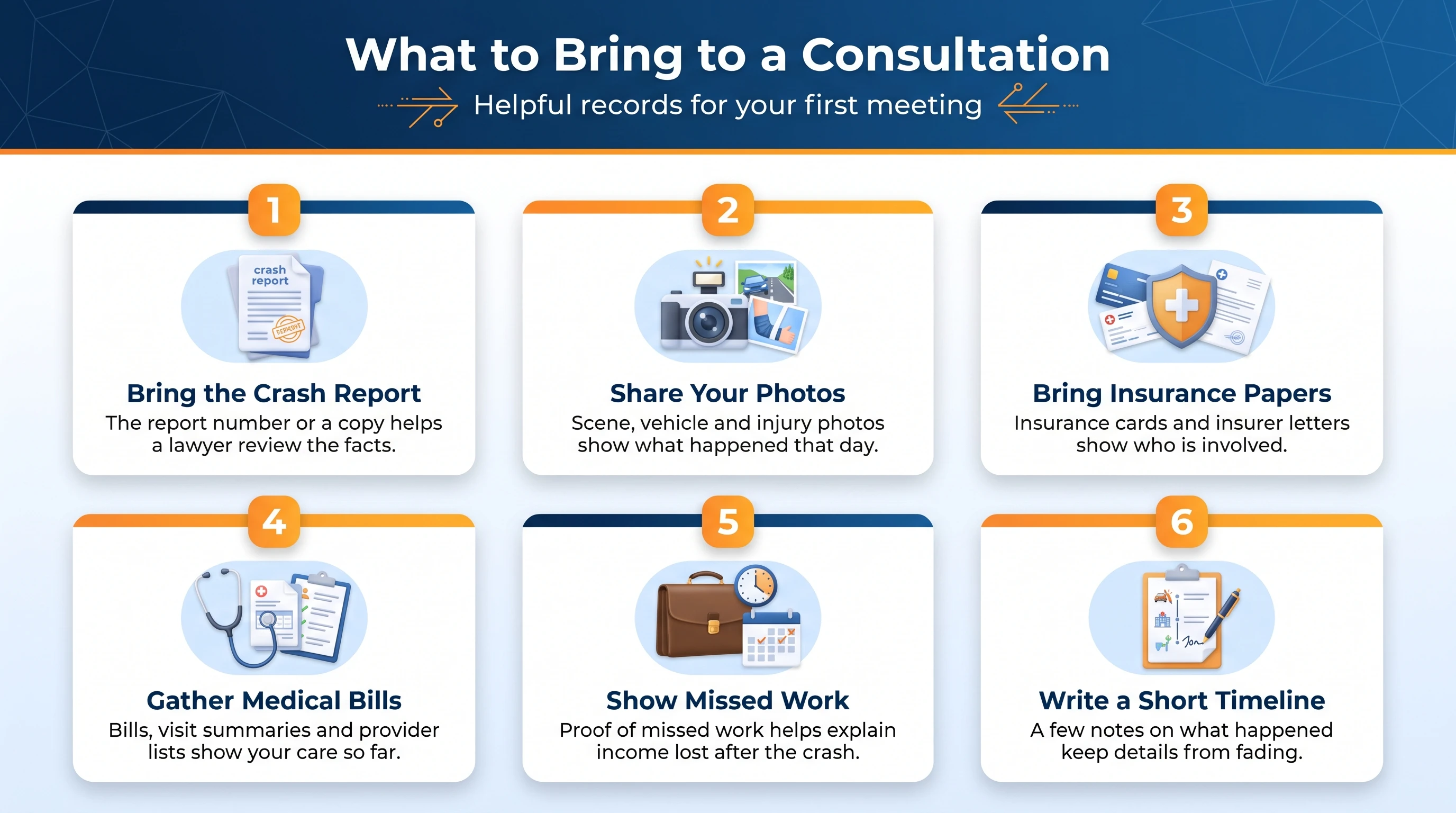
What Should You Bring to a Consultation?
- The crash report number or a copy of the report
- Photos of the scene, vehicles and injuries
- Insurance cards and any letters from insurers
- Medical bills, visit summaries and a list of providers
- Proof of missed work
- A short written timeline of what happened
You do not need everything to start. A lawyer can help gather what is missing.
What If You Were Partly at Fault?
Ask every lawyer you meet how fault may affect your case. Under Illinois law, your recovery is reduced by your share of fault, and you cannot recover if your share is more than 50 percent [6]. A lawyer who explains this honestly, including how the other side may argue it, gives you a more realistic picture than one who skips it.
How Long Do You Have to Choose?
In Illinois, personal injury actions generally must be filed within two years after the cause of action accrued [4]. Claims against a local public entity, such as a city, county or transit agency, generally must be filed within one year [7]. A lawyer needs time to investigate before filing, so waiting until the last months can limit your options. If you already hired a lawyer and are unhappy, you can usually change lawyers; ask the new lawyer how the earlier fee will be handled.
What Should You Do Next?
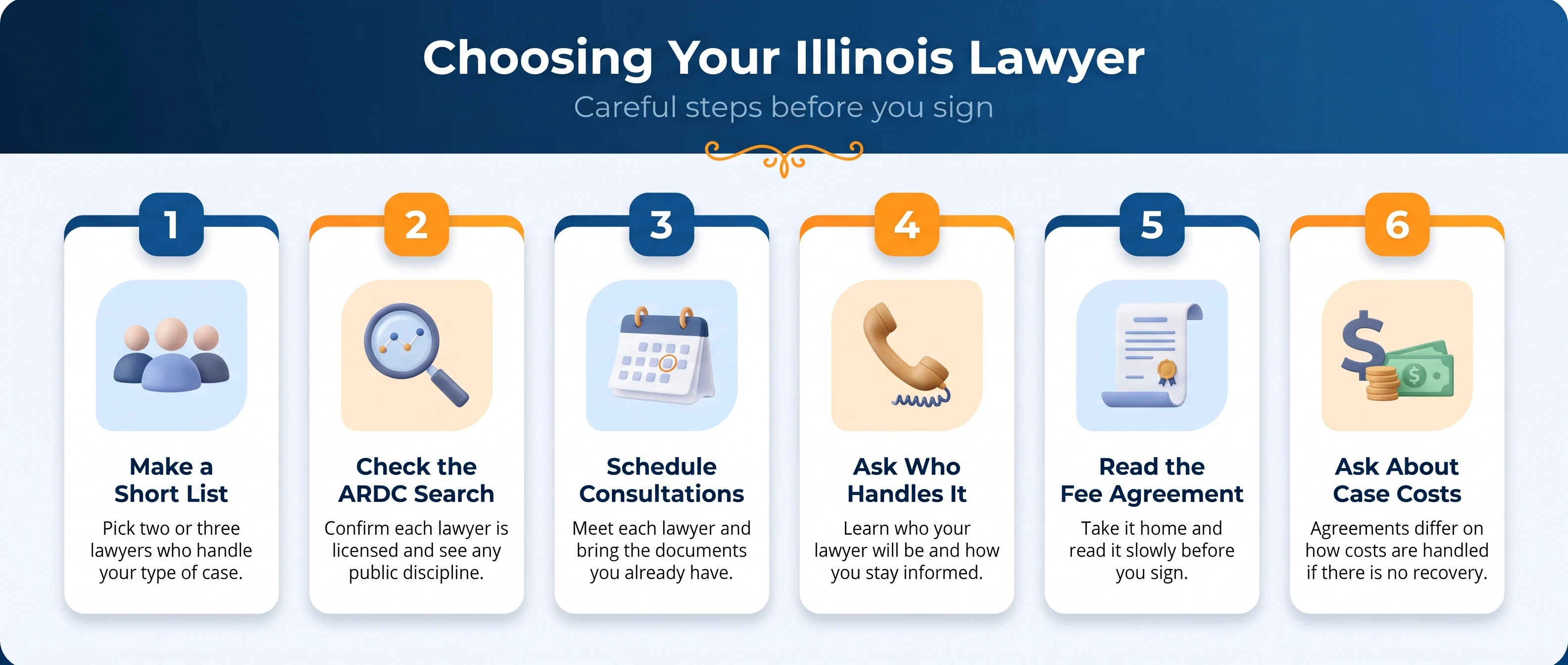
- Make a short list of two or three Illinois lawyers who handle your type of injury case.
- Check each one on the ARDC lawyer search.
- Schedule consultations and bring your documents.
- Ask who will handle your case and how you will be kept informed.
- Take the fee agreement home, read it, and ask about costs before you sign.

Talk With a GoSuits Attorney
Our Chicago office on South Michigan Avenue serves injured people across Cook County and the rest of Illinois. If you were hurt in a crash or fall, our personal injury lawyers in Chicago can answer your questions, explain the fee agreement line by line, and tell you who would be working on your case. You can schedule a free consultation by phone, video or in person. Free consultation. No attorney fee unless there is a recovery. Case costs may still be owed if there is no recovery; the written agreement explains how they are handled.
You can also read about our prior cases, which list each court and case number so you can look them up in the public record, and meet our attorneys.
This article is general legal information, not legal advice. Reading it does not create an attorney-client relationship. Every case depends on its own facts.
References
- Lawyer Search – Attorney Registration and Disciplinary Commission of the Supreme Court of Illinois
- Illinois Rules of Professional Conduct of 2010, Rule 1.5 Fees – Illinois Courts
- Illinois Rule of Professional Conduct 7.3, Solicitation of Clients – Illinois State Bar Association
- 735 ILCS 5/13-202, Personal Injury – Illinois General Assembly
- Illinois Rules of Professional Conduct of 2010, Rule 1.4 Communication – Illinois Courts
- 735 ILCS 5/2-1116, Limitation on Recovery in Tort Actions – Illinois General Assembly
- 745 ILCS 10/8-101, Tort Immunity Act Limitation – Illinois General Assembly