
If someone you love died in a crash that another person caused, your family may have a wrongful death claim, and the clock to file it usually starts on the date of death. In California, a wrongful death lawsuit generally must be filed within two years [1]. In Texas, the general deadline is also two years, measured from the day of death [2]. In Illinois, a wrongful death action generally must be started within two years after the death [3]. Claims involving a city, county or state vehicle or road can have much shorter notice deadlines, sometimes six months or one year. There is no need to decide anything in the first days. Knowing these dates simply means your family will not lose a choice it may want later.
Legal Snapshot
- Legal Topic: Filing deadlines for families after a fatal crash in California, Texas and Illinois
- Case Stage: The weeks and months after a death, before any lawsuit is filed
- Primary Legal Issue: Wrongful death and survival claims, who may bring them, and when
- Primary Authority: California Code of Civil Procedure Sections 335.1, 366.1 and 377.60; Texas Civil Practice and Remedies Code Sections 16.003, 71.004 and 101.101; Illinois Wrongful Death Act, 740 ILCS 180/2, and 745 ILCS 10/8-101
- Last Updated: November 2026
What Is a Wrongful Death Claim?
A wrongful death claim is a civil case brought for the losses a family suffers because a person died through someone else’s wrongful act or negligence. It is separate from any criminal case. A driver can be charged with a crime by the state, and the family can still bring its own civil claim, with its own deadline. The civil deadline does not wait for the criminal case to finish.
Many families also have a second, related claim called a survival claim. A survival claim belongs to the estate and covers losses the person who died had a right to recover before death. The two claims are handled differently, and each has its own timing rules, so it helps to know that both may exist.
What Are the Deadlines in Each State?
| State | Wrongful death lawsuit | Claim against a government body |
|---|---|---|
| California | Generally two years from the death [1] | Written claim generally within six months [7] |
| Texas | Two years; the claim accrues on the death [2] | Notice to the governmental unit within six months, or a shorter period set by a city charter [9] |
| Illinois | Generally two years after the death [3] | Lawsuit against a local public entity generally within one year [11] |
These are general rules. Exceptions exist, and the exact deadline in a family’s case depends on the facts, so treat this table as a starting point for questions, not a final answer.
California: Who Can File and When?
In California, a wrongful death claim may be brought by the person’s surviving spouse or domestic partner, children and the children of a deceased child. If there are no surviving descendants, the people who would inherit under California law may bring it. Some dependent family members, such as a dependent stepchild or parent, and certain minors who lived in the household, may also qualify [4]. A personal representative of the estate may also bring the claim on their behalf [4].
The wrongful death lawsuit generally must be filed within two years [1]. A survival claim, which passes to the estate’s personal representative or successor in interest [6], may be filed within the later of six months after the death or the period that would have applied if the person had lived [5]. California law lets the court award wrongful death damages that are just under all the circumstances, separate from the losses recovered in a survival claim [12].
When a crash involved a government vehicle or a dangerous public road, a written claim must usually be presented to the public agency within six months [7]. That is far shorter than two years, and it is the deadline families most often miss.
Texas: Who Can File and When?
In Texas, a wrongful death action is for the exclusive benefit of the surviving spouse, children and parents of the person who died [8]. Any of them may bring the case for all of them. If none of them files within three calendar months after the death, the executor or administrator must bring the action unless all of them ask the representative not to [8]. Siblings and grandparents are not on this list.
The lawsuit must be filed within two years, and the claim accrues on the day of death [2]. A survival claim for the person’s own injuries passes to the heirs, legal representatives and estate [10], and Texas law suspends limitations for up to 12 months after a death, with special rules once an executor or administrator qualifies [13]. Because those rules interact, a lawyer should confirm the date in each case.
If a governmental unit may be responsible, the Texas Tort Claims Act requires notice within six months of the incident, and a city charter may set a shorter period [9]. Actual notice to the government can matter, but families should not rely on that without advice.
Illinois: Who Can File and When?
In Illinois, a wrongful death action is brought by the personal representative of the person who died, for the exclusive benefit of the surviving spouse and next of kin [3]. If the claim is the estate’s only asset and no estate has been opened, a court may appoint a special administrator to bring it [14]. The jury may award damages for the family’s losses, including grief, sorrow and mental suffering [3].
The action generally must be started within two years after the death [3]. If a family member entitled to recover was under 18 when the claim arose, that person may have until two years after turning 18 [3]. Other exceptions apply to claims tied to certain crimes. Survival claims continue after death under the Probate Act [15] and follow their own timing rules.
For claims against a local public entity in Illinois, such as a city, county, park district or transit body, a civil action generally must be filed within one year from the injury or the date the cause of action accrued [11]. That shorter window applies across Chicago and the surrounding counties.

How Does This Apply to a Real Family?
Example (hypothetical): A father is killed when a delivery truck runs a red light at a busy intersection in Dallas County. His wife and two adult children are in shock and focused on the funeral and on each other. Four months pass. The trucking company’s insurer calls and asks for a recorded statement.
Under Texas law, his wife or children could bring the wrongful death case, and the two-year deadline runs from the day he died [2]. Because more than three months have passed without a filing, the estate’s representative could also bring it unless the family asks otherwise [8]. If a city vehicle had also been involved, a six-month notice deadline might already be close [9]. This is a moment to pause before giving any statement and to ask questions. This example is for illustration only and is not a GoSuits case.
What Evidence Can Matter?
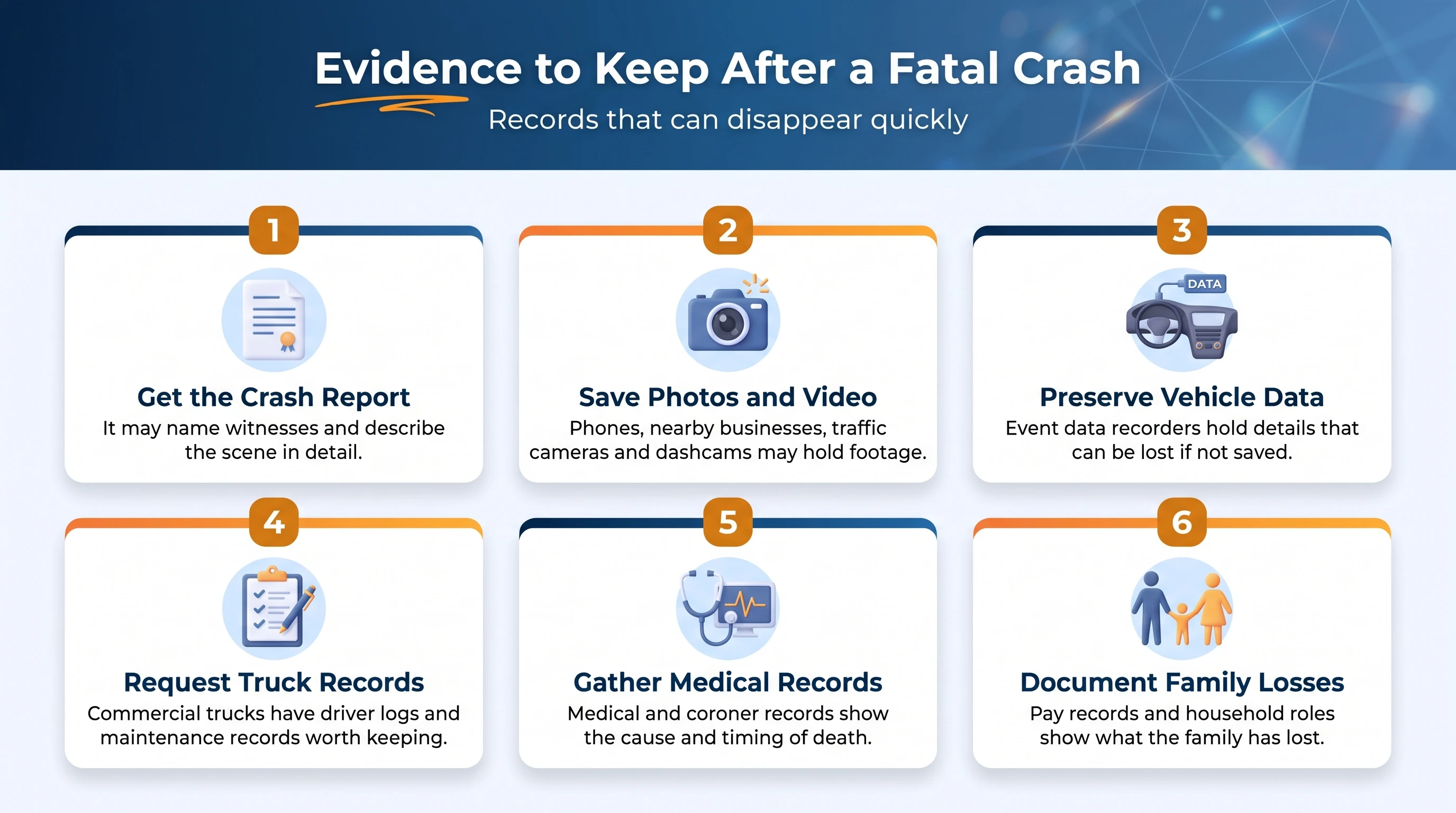
Evidence after a fatal crash can disappear quickly. Things that may matter include:
- The crash report and any investigation file, which may name witnesses and describe the scene
- Photos and video from phones, nearby businesses, traffic cameras and dashcams
- Vehicle data, including event data recorders and, for commercial trucks, driver logs and maintenance records
- Medical and coroner records that show the cause and timing of death
- Proof of the family’s losses, such as pay records, household roles, and the relationship the person had with each family member
Evidence does not prove a case by itself, but keeping it safe early gives the family more options later.
What If Insurance Is Involved?
Nearly every fatal crash claim involves at least one insurer, and sometimes several: the at-fault driver’s policy, an employer’s commercial policy, and the family’s own uninsured or underinsured motorist coverage. An insurer may contact the family soon after the death. You do not have to give a recorded statement or sign anything right away. A release signed early can end every claim from the crash, including ones the family did not yet know about.
What Should Our Family Do Next?
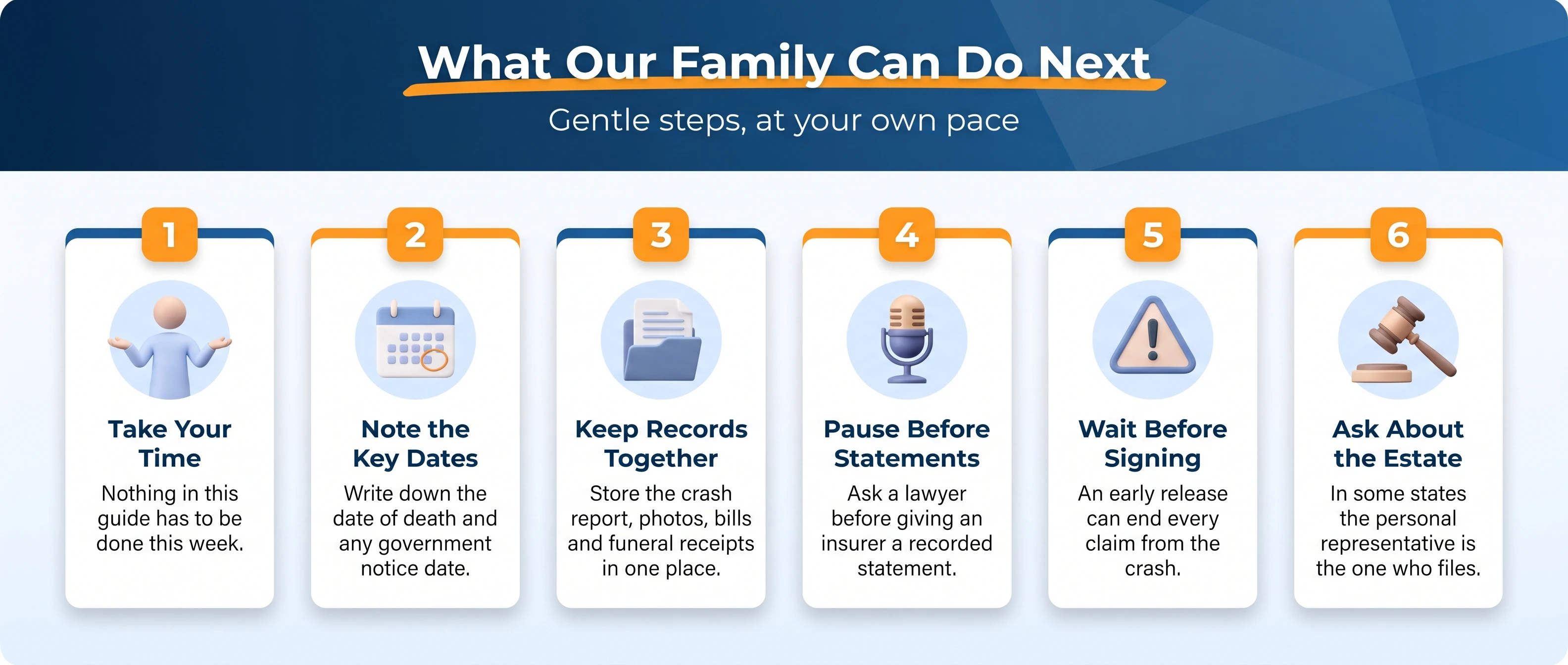
- Take the time you need. Nothing in this article has to be done this week.
- Write down the date of death and, if a government vehicle or road may be involved, mark the shorter notice deadline too.
- Keep the crash report number, photos, medical bills and funeral receipts in one place.
- Before giving any recorded statement or signing a release, ask a lawyer to explain what it means.
- Ask whether an estate needs to be opened, because in some states the personal representative is the one who files.
Related State Resources
If the crash happened in California, our California personal injury overview explains how claims move through the state’s courts. For Texas families, the Texas injury resource page covers the state’s fault and insurance rules. For Illinois, see the Illinois injury and accident page. Families who want to understand what comes after filing can read how long it takes to settle a wrongful death lawsuit.

Talk With a GoSuits Attorney
Losing someone in a crash is not something any family should have to work through alone, and the legal questions can wait until you are ready. When you are, a GoSuits attorney can listen, explain which deadlines apply to your family in California, Texas or Illinois, and answer questions at your pace. You can schedule a free consultation by phone, video or in person. Free consultation. No attorney fee unless there is a recovery. Case costs may still be owed if there is no recovery; the written agreement explains how they are handled.
You can also read about our prior cases, which list each court and case number so you can look them up in the public record.
This article is general legal information, not legal advice. Reading it does not create an attorney-client relationship. Every case depends on its own facts.
References
- California Code of Civil Procedure Section 335.1 – California Legislative Information
- Texas Civil Practice and Remedies Code Section 16.003 – Texas Constitution and Statutes
- 740 ILCS 180/2, Wrongful Death Act – Illinois General Assembly
- California Code of Civil Procedure Section 377.60 – California Legislative Information
- California Code of Civil Procedure Section 366.1 – California Legislative Information
- California Code of Civil Procedure Section 377.30 – California Legislative Information
- California Government Code Section 911.2 – California Legislative Information
- Texas Civil Practice and Remedies Code Section 71.004 – Texas Constitution and Statutes
- Texas Civil Practice and Remedies Code Section 101.101 – Texas Constitution and Statutes
- Texas Civil Practice and Remedies Code Section 71.021 – Texas Constitution and Statutes
- 745 ILCS 10/8-101, Local Governmental and Governmental Employees Tort Immunity Act – Illinois General Assembly
- California Code of Civil Procedure Section 377.61 – California Legislative Information
- Texas Civil Practice and Remedies Code Section 16.062 – Texas Constitution and Statutes
- 740 ILCS 180/2.1, Special Administrator – Illinois General Assembly
- 755 ILCS 5/27-6, Actions Which Survive – Illinois General Assembly