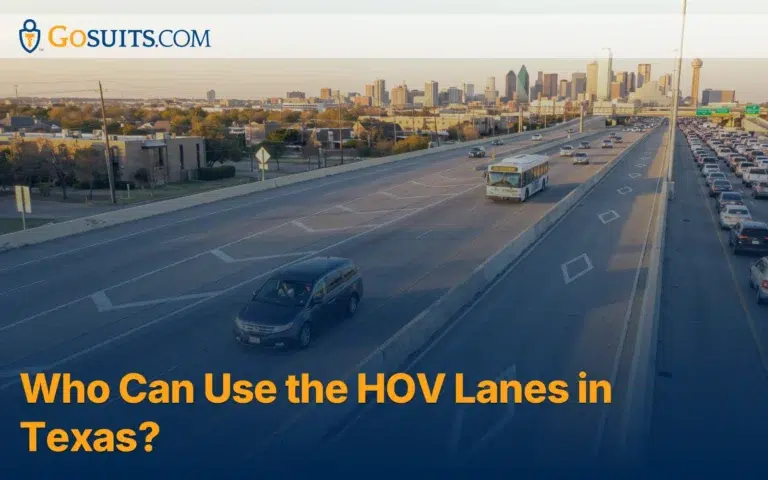
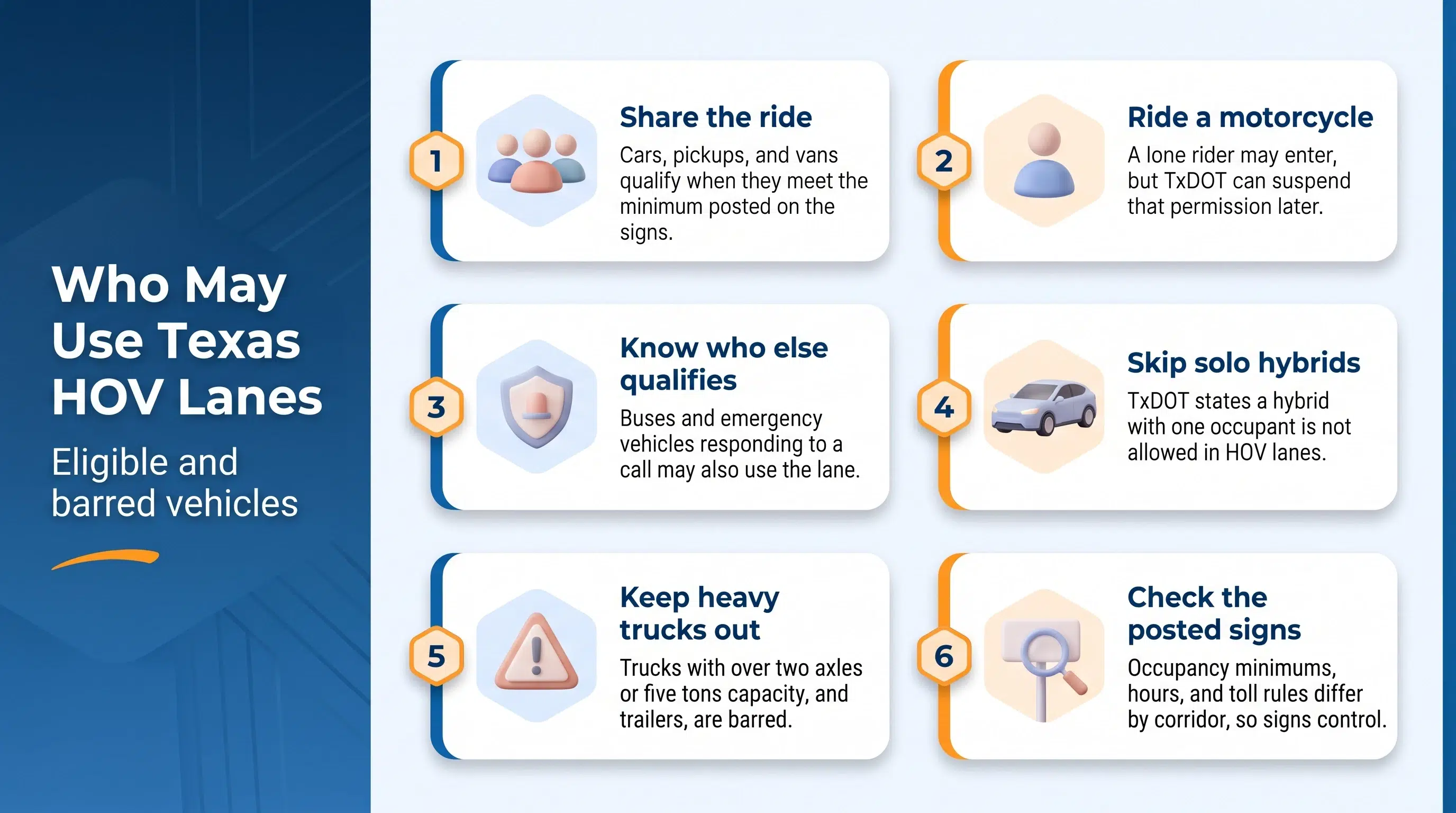
In Texas, a two-axle vehicle carrying two or more people may use an HOV lane, and a motorcyclist may use one even when riding alone. Buses and emergency vehicles responding to a call are also eligible. Trucks with more than two axles, trucks with a gross weight capacity of five tons or more, and vehicles towing trailers may not use HOV lanes. TxDOT also states that single-occupant hybrid vehicles are not allowed [1][2]. Occupancy minimums, hours, and toll rules differ by corridor, so the posted signs control. This article covers civil injury issues only. An HOV lane violation can also matter to fault if a crash happens in or near the lane.
Legal Snapshot
-
Legal Topic: Eligibility to use high-occupancy vehicle (HOV) lanes in Texas, and how HOV lane conduct can affect fault in a civil injury claim.
-
Case Stage: Pre-claim research and early evaluation of a crash involving an HOV or managed lane.
-
Primary Legal Issue: Whether a driver was lawfully in the lane, and how that affects negligence and proportionate responsibility.
-
Primary Authority: 43 Tex. Admin. Code §§ 25.41 and 25.44 (TxDOT rules); Tex. Transp. Code § 544.004; Tex. Civ. Prac. & Rem. Code chs. 16 and 33; 23 U.S.C. § 166 (federal).
-
Date Legal Authority Last Reviewed: November 28, 2026.
What Does “HOV Lane” Mean in Texas?
An HOV lane is a lane reserved, at all times or at scheduled times, for vehicles carrying a minimum number of occupants. TxDOT’s administrative rules define a high occupancy vehicle as a bus or other motorized passenger vehicle occupied by a specified minimum number of passengers. They define an HOV lane as a lane where designated high occupancy vehicles get priority or preference over other traffic [3].
Lanes are labeled “2-plus” to show the minimum number of occupants. Many look like ordinary freeway lanes except for diamond markings on signs and pavement, and some are separated by barriers or medians [2].
A high occupancy toll (HOT) lane is different. It is an HOV lane that lets vehicles with fewer than the minimum occupants, or other eligible vehicles, use it by paying a toll [3]. TxDOT describes HOT lanes as free or discounted for high-occupancy vehicles, with a fee for other vehicles [1]. A solo driver who may legally enter a toll lane is therefore a separate question from whether the lane is a pure HOV lane.
What Does Texas Law Say About Who Can Use an HOV Lane?
Texas HOV eligibility is set largely by TxDOT administrative rules and by the signs posted for each facility, not by a single statewide statute that lists every eligible vehicle. TxDOT’s published FAQ says a two-axle vehicle occupied by two or more people, or a motorcyclist, may use HOV lanes [1].
|
Vehicle or situation |
Generally allowed? |
Source |
|---|---|---|
|
Passenger cars, pickups, and vans with two or more occupants |
Yes, subject to the posted minimum |
|
|
Buses |
Yes |
|
|
Motorcycles, including a lone rider |
Yes |
|
|
Emergency vehicles responding to a call |
Yes |
|
|
Single-occupant hybrid vehicles |
No |
|
|
Trucks with more than two axles, or with a gross weight capacity of five tons or more |
No |
|
|
Vehicles towing trailers |
No |
Whether motorcycles can use HOV lanes is up to TxDOT. Under 43 Tex. Admin. Code § 25.44, TxDOT may allow motorcycles and low-emission vehicles to use HOV lanes without meeting the minimum number of passengers. TxDOT considers whether the lane can handle the extra traffic, and it may suspend or cancel this permission if traffic in the lane slows significantly or federal funding is put at risk [4]. Because of this, riders should check the signs on the specific highway.
TxDOT’s authority to create HOV lanes comes from Texas Transportation Code § 224.153, which also allows TxDOT to let motorcycles and low-emission vehicles use those lanes. Penalties for misusing an HOV lane depend on who operates the lane. For lanes run by certain regional transportation authorities, Transportation Code § 452.0613 allows penalties of up to $100. Because fines can vary by lane and court, readers should not rely on a single figure.
What Legal Rules Apply Beyond Occupancy?
Several layers of rules can apply to a single HOV lane. Each one answers a different question.
-
State administrative rules: 43 Tex. Admin. Code ch. 25, subch. C covers congestion mitigation facilities, including HOV and HOT lane definitions and motorcycle access [3][4].
-
State traffic statute: Tex. Transp. Code § 544.004 requires drivers to follow applicable official traffic-control devices, such as signs and lane markings. It does not say what a particular sign means, and it does not by itself decide who is at fault in a crash [10].
-
Sign and marking standards: TxDOT’s Texas Manual on Uniform Traffic Control Devices covers signs for HOV and managed lanes, including signs that show the minimum number of passengers required [5].
-
Federal law: 23 U.S.C. § 166 governs HOV lanes on highways covered by Title 23 [7].
-
Local operating rules: Transit authorities and TxDOT set the hours, access points, and enforcement practices for each lane, so the rules for a specific highway should be confirmed with the agency that operates it.
Did the Federal Electric Vehicle Exemption Expire?
Yes. Federal law had allowed states to let certain alternative fuel vehicles use HOV lanes without meeting the minimum number of passengers. That exemption ended on September 30, 2025, and the earlier toll-access rule for low-emission vehicles ended on September 30, 2019 [6][7]. After the 2025 expiration, FHWA’s guidance says only qualified HOVs, qualified public transportation vehicles, and certain other listed vehicles may use these lanes [6]. TxDOT’s own FAQ already states that hybrids with a single occupant are not allowed [1]. However, solo drivers of electric vehicles, like any other solo drivers, may be able to use tolled managed lanes by paying the posted toll.
Is There a Law Letting Solo Drivers Pass in an HOV Lane?
No. House Bill 971 in the 2025 regular session of the Texas Legislature proposed a new Transportation Code section letting a driver use an HOV lane regardless of the number of passengers solely to pass a vehicle traveling below the posted speed limit, entering and exiting at designated points [8]. The bill was left pending in committee and did not pass [9]. A bill that did not pass is not law, so a solo driver should not treat an HOV lane as a passing lane.
How Does This Apply to a Real Case?
Hypothetical example (not an actual GoSuits case): A commuter is driving a pickup alone in heavy stop-and-go traffic on I-30 near downtown Dallas. A second driver, alone in a sedan, crosses a buffer or enters the HOV lane at a location that is not a designated access point and collides with a carpool vehicle. In a civil claim, the injured carpool occupants may argue that the second driver was not entitled to be in the lane and failed to keep a proper lookout. The second driver’s insurer may counter that the carpool driver was speeding or changed lanes unsafely. Nobody should assume that an HOV violation, standing alone, decides fault.
The reverse can happen. A driver who is lawfully in the lane can still be partly responsible for a crash. Conduct such as tailgating at the speed differential these lanes can create, or a sudden lane change to reach an exit, can be argued as negligence regardless of who was eligible to be there.
Freeways around Dallas offer several settings for this kind of dispute. TxDOT’s managed lane inventory describes the I-30 East R.L. Thornton HOV lane as 11.1 miles of reversible lanes with a movable barrier, running from Cesar Chavez Boulevard in Dallas to Jim Miller Road in Mesquite [1]. A TxDOT brochure on the LBJ Freeway (I-635) instructs drivers never to cross the double white lines, even with another person in the vehicle, and to enter and exit only at designated locations marked by broken white lines [11]. That brochure is older, so confirm current markings before relying on it. In the Houston area, TxDOT’s inventory lists the I-45 South Gulf Freeway diamond HOV lanes among its managed lane facilities [1].
What Evidence Can Matter After an HOV Lane Crash?
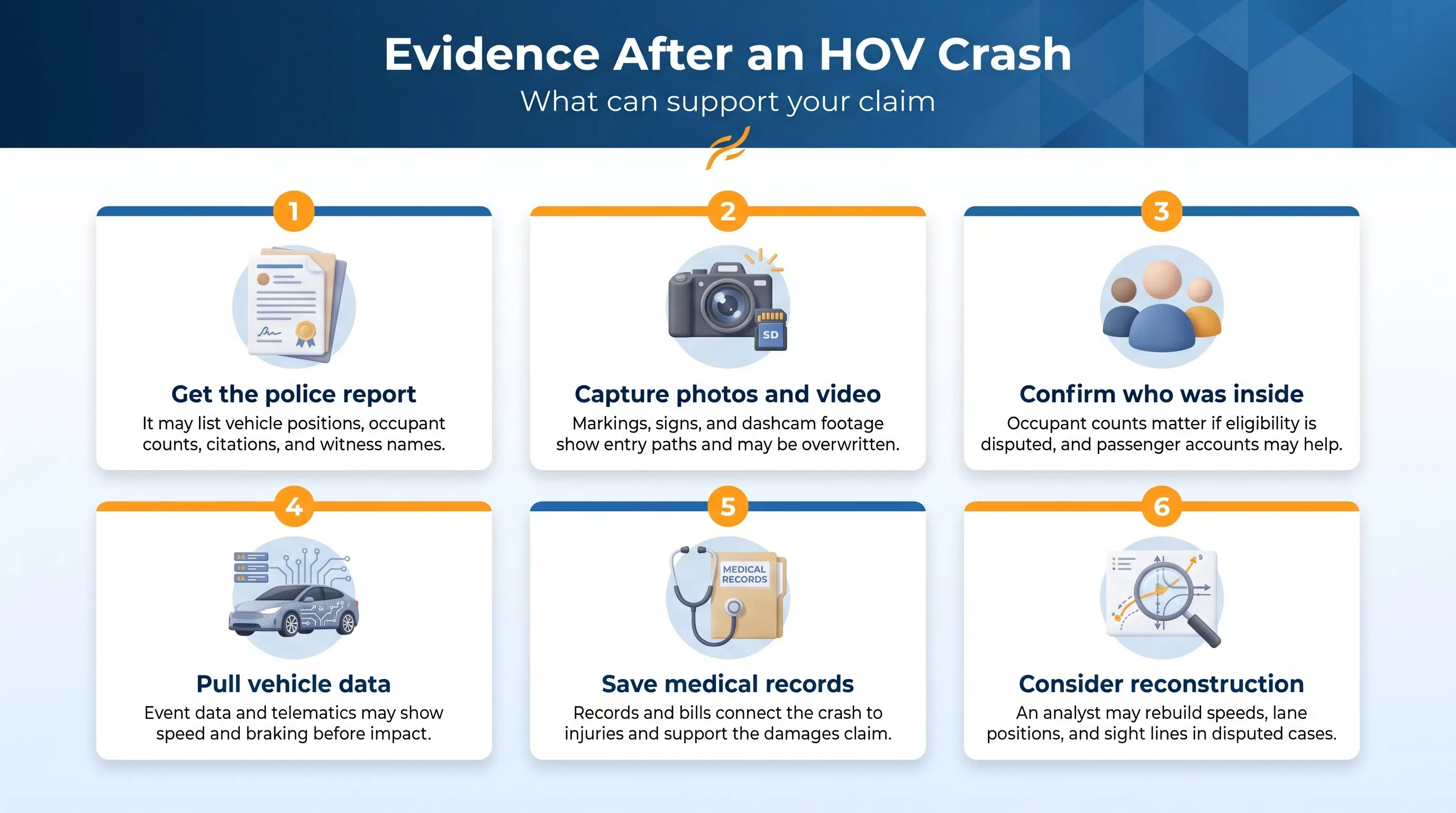
Evidence in an HOV lane crash tends to turn on where each vehicle was, who was inside, and what the signs and markings said. No single item proves liability on its own.
-
Police report: It may record vehicle positions, occupant counts, citations, and witness names. A report is not a final finding of civil fault.
-
Photographs and video: Pictures of pavement markings, buffer areas, diamond signs, and access points show what a driver could see. Dashcam and traffic camera footage can show entry and exit paths. Footage may be overwritten quickly.
-
Occupant information: Whether a vehicle had two or more people can matter if eligibility is disputed. Witness statements and passenger accounts may help.
-
Vehicle data: Event data and telematics may show speed and braking.
-
Medical records and bills: These connect the crash to the injuries and support the damages claim.
-
Employment records: They document missed work and any loss of earning capacity.
-
Insurance documents: Policies, declarations pages, and adjuster communications show available coverage.
-
Reconstruction analysis: In disputed-fault cases, a qualified analyst may reconstruct speeds, lane positions, and sight lines from physical evidence.
What Damages or Remedies May Be Available?
A person injured by another driver’s negligence may seek compensation for several categories of loss. Recoverability depends on Texas law and the facts of each case. Possible categories include:
-
Past and future medical expenses
-
Lost income and loss of earning capacity
-
Physical pain and mental anguish
-
Physical impairment and disfigurement
-
Vehicle repair or replacement costs and other property damage
-
Wrongful death damages for qualifying family members, where a crash is fatal
Exemplary (punitive) damages are available only in limited circumstances under Texas law. They require clear and convincing evidence of fraud, malice, or gross negligence (Civil Practice and Remedies Code § 41.003(a)). No outcome or amount can be promised.
What If the Other Driver Disputes Liability?
Disputes over fault are common, and Texas uses proportionate responsibility. Under Civil Practice and Remedies Code § 33.001, a claimant may not recover damages if his or her percentage of responsibility is greater than 50 percent [12]. When the claimant is 50 percent or less responsible, the recovery is reduced by that percentage under § 33.012 [12]. A hypothetical illustration: if a jury found total damages of $100,000 and assigned 20 percent of responsibility to the injured person, the reduced recovery would be $80,000.
Texas’s proportionate responsibility rule applies to both sides. An injured person may face an argument that an HOV lane maneuver contributed to the crash. A driver being sued may face the argument that being in the lane without being eligible, or changing lanes unsafely to leave it, caused the crash. Breaking a traffic law or ignoring a sign can be treated as evidence of negligence, but Texas courts allow a person to show that the violation was excused, so how a violation affects a claim depends on the facts.
What If Insurance Is Involved?
Most HOV lane crash claims start with the at-fault driver’s liability insurance and the injured person’s own policy. Insurers often ask for recorded statements early. They may use any statement about lane use or speed to argue shared fault. Uninsured and underinsured motorist coverage, personal injury protection, and medical payments coverage may also be relevant, depending on the policies. Health insurers and medical providers may assert reimbursement rights or liens against a recovery. Anyone dealing with these issues should speak with a lawyer rather than handle the claim alone.
Crashes involving transit buses or government-operated vehicles raise a separate issue. Claims against governmental units are generally governed by the Texas Tort Claims Act in Civil Practice and Remedies Code ch. 101 [13], and that chapter has its own notice requirements. Written notice generally must be given within six months after the incident (§ 101.101(a)), and some cities set shorter deadlines in their charters.
How Long Do I Have to Act?
Texas generally gives an injured person two years to file a personal injury lawsuit. The limitations period is in Civil Practice and Remedies Code § 16.003, and wrongful death claims are generally measured from the date of death [14]. Shorter notice deadlines can apply when a government entity is involved, and some situations can change the usual period. An attorney should confirm the deadline for any specific case. Evidence such as traffic video can disappear well before any filing deadline, so early review matters. Civil cases in Dallas County may be filed in the district courts or the county courts at law, which sit at the George L. Allen Sr. Courts Building, while venue for other counties depends on the facts.
What Should I Do Next?
-
Get medical care and follow your providers’ instructions.
-
Report the crash and keep a copy of the police report number.
-
Photograph the lane markings, signs, vehicles, and any access points, if it is safe to do so.
-
Write down witness names and contact details.
-
Keep records of medical bills, missed work, and vehicle damage.
-
Avoid detailed statements to an insurance adjuster before getting legal advice.
-
Speak with a Texas personal injury attorney promptly about deadlines and evidence.
This article is general legal information, not individualized legal advice, and it does not create an attorney-client relationship. Anyone injured in a crash should not try to handle the claim alone, because fault rules, insurance issues, and deadlines can affect the result.
Related Texas Personal Injury Resources
People hurt in a freeway collision often look into GoSuits’s Dallas page for car crash claims and the firm’s Dallas motorcycle crash page, since motorcycles may legally use HOV lanes. Plano, Frisco, Carrollton, and Irving are among the suburbs where commuters regularly join HOV and managed-lane corridors. Statewide information is on the GoSuits Texas injury overview. The firm’s Dallas office page explains how a local review works. Understanding car accident lawyers, motorcycle accident lawyers, and personal injury lawyers across Texas can help a reader decide which questions to ask.
Talk With a GoSuits Attorney
An injury claim can involve medical evidence, insurance issues, liability disputes, and legal deadlines. If you were hurt in a Texas crash involving an HOV or managed lane, a GoSuits attorney can review the circumstances and explain your options. You can schedule a free consultation. Past results do not guarantee a similar outcome in any other matter.
References
-
Managed lanes and HOV FAQs – Texas Department of Transportation
-
High-Occupancy Vehicle Lanes Fact Sheet (October 2019) – Texas Department of Transportation
-
43 Tex. Admin. Code § 25.41, Definitions – Legal Information Institute, Cornell Law School
-
23 U.S. Code § 166, HOV facilities – Legal Information Institute, Cornell Law School
-
H.B. 971, 89th Legislature, Introduced Text – Texas Legislature Online
-
Texas Transportation Code, Chapter 544, Traffic Signs, Signals, and Markings – Texas Statutes
-
LBJ Freeway (I-635) High Occupancy Vehicle Lanes brochure – Texas Department of Transportation
-
Texas Civil Practice and Remedies Code, Chapter 33, Proportionate Responsibility – Texas Statutes
-
Texas Civil Practice and Remedies Code, Chapter 101, Texas Tort Claims Act – Texas Statutes
-
Texas Civil Practice and Remedies Code, Chapter 16, Limitations – Texas Statutes