A serious crash involving a semi-truck or 18-wheeler generates a category of evidence that simply does not exist in an ordinary car accident, federal records that carriers are legally required to maintain, electronic data streams captured by onboard computers, and regulatory files that can reveal a driver’s true fitness and fatigue level at the moment of impact. The problem is time. Federal retention periods are short, carriers are not legally required to hold records longer than the minimum, and some data overwrites itself within days. Without a properly directed preservation demand, evidence that could answer the most important questions in an injury claim can disappear before a civil case ever begins.
Legal Snapshot
- Legal Topic: Trucking evidence preservation; spoliation; FMCSA recordkeeping requirements
- Case Stage: Pre-litigation / immediate post-crash
- Primary Legal Issue: What commercial vehicle records exist, how long carriers must keep them, and what happens when they are destroyed
- Primary Authority: 49 C.F.R. Parts 382, 390, 391, 395 (Federal Motor Carrier Safety Regulations); California Evidence Code § 413; CACI No. 204
- Secondary Authority: Cedars-Sinai Medical Center v. Superior Court, 18 Cal.4th 1 (1998)
- Date Legal Authority Last Reviewed: July 2025
Why Truck Crashes Produce a Unique Evidence Set
A carrier operating commercial motor vehicles across the I-405, the SR-55, or the SR-73 Toll Road in and around Irvine and the broader Orange County corridor operates under a parallel legal regime that private passenger vehicles do not face. The Federal Motor Carrier Safety Administration (FMCSA), operating under authority granted by Congress in 49 U.S.C. § 31136, publishes the Federal Motor Carrier Safety Regulations (FMCSRs) at Title 49 of the Code of Federal Regulations. Those regulations impose affirmative recordkeeping duties on every motor carrier, not just duties triggered by an accident, but ongoing, daily documentation requirements.[1]
The result is that after a crash, a compliant carrier should have a substantial paper and electronic record of nearly every aspect of the driver’s recent history: how many hours the driver worked, when and where the truck moved, whether the vehicle passed inspection, and whether the driver had a recent drug or alcohol test result on file. An injured person and their legal team can seek that entire record, but only if it is preserved before the regulatory clock runs out.
The Federal Records That Exist After a Truck Crash
Hours of Service and Electronic Logging Device Records
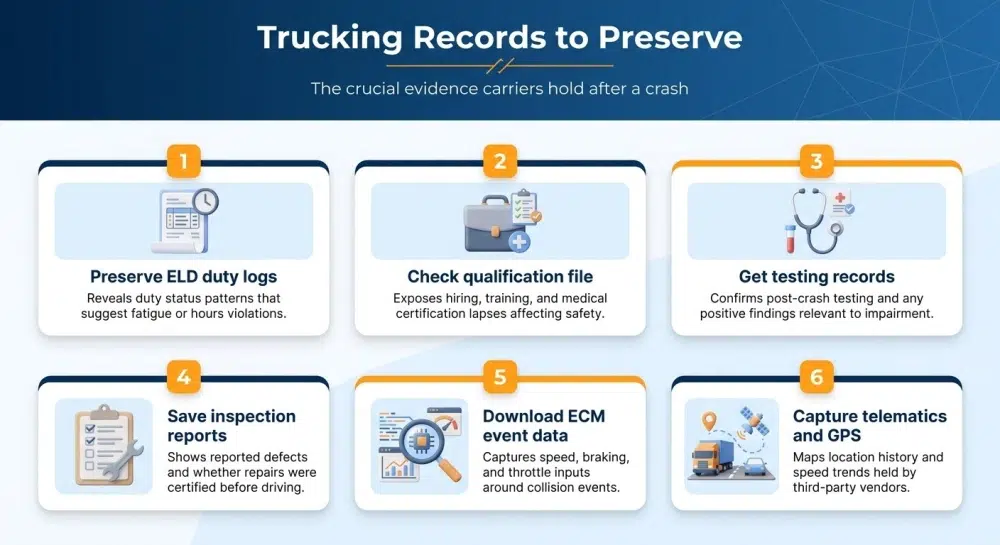
Since December 2017, most commercial motor vehicle operators have been required to use an Electronic Logging Device (ELD) to record the driver’s duty status, off duty, sleeper berth, driving, or on duty not driving for each 24-hour period. The ELD replaces the paper log grid, captures timestamps and GPS coordinates automatically, and is supposed to prevent the “pencil-whipping” of paper logs that concealed hours-of-service violations for decades.[2]
Under 49 C.F.R. § 395.8(k)(1), a motor carrier is required to retain records of duty status and supporting documents for a minimum of six months from the date of receipt.[3] Six months is a short window in the timeline of civil litigation. A crash in January may not produce a lawsuit filing until May. Without a preservation demand, ELD data going back to the days before the crash can be purged as soon as August within the carrier’s full legal compliance.
The ELD records that matter most in a serious collision include the driver’s duty status for the 24 hours before the crash, the previous seven consecutive days of records that the driver is required to carry while on duty, and often the prior 60 to 90 days of records that provide context for whether the driver was operating on a pattern of violations. truck accident lawyers often treat ELD data as the first record to demand because it is also the most fragile.
Driver Qualification Files
Before a driver ever climbs behind the wheel of a commercial vehicle, the carrier must compile and maintain a driver qualification file under 49 C.F.R. § 391.51. That file must include the driver’s application for employment, motor vehicle records from licensing authorities, the certificate of a driver road test or equivalent, results of annual driving record reviews, and the medical examiner’s certificate confirming the driver meets the physical fitness standards for commercial operation.[4]
The retention period for qualification files extends for as long as the driver is employed by the carrier and for three years after the driver’s employment ends. When a driver is terminated or resigns after a crash, the three-year window begins running from that date. A qualification file can reveal a pattern of prior violations, a lapsed medical certificate, or a failure to document required training all facts that can be relevant to claims of negligent entrustment or negligent hiring.
Drug and Alcohol Testing Records
The FMCSA’s controlled substances and alcohol testing program, governed by 49 C.F.R. Part 382, requires carriers to test drivers pre-employment, randomly during employment, after certain accidents, and upon reasonable suspicion of impairment. Under 49 C.F.R. § 382.401, a carrier must retain records of verified positive drug test results and alcohol test results of 0.02 or greater for a minimum of five years; records related to the collection process (other than calibration of testing devices) for two years; and records of negative and canceled test results for one year.[5]
Post-accident drug and alcohol testing is particularly significant. Under 49 C.F.R. § 382.303, a carrier must test a driver as soon as practicable following a crash that involved a fatality, or where there was no fatality, where a citation was issued to the driver and either an injured person required medical treatment away from the scene or a vehicle had to be towed. The post-accident test result and documentation of when and whether the test was administered are records that a preservation demand should specifically identify.
Driver Vehicle Inspection Reports
Under 49 C.F.R. Part 396, drivers are required to prepare a written Driver Vehicle Inspection Report (DVIR) at the completion of each day’s work if defects or deficiencies are discovered that would affect safe operation of the vehicle or result in a breakdown. The DVIR must be retained by the carrier for three months.[6] A DVIR that documented a brake deficiency, a steering problem, or a tire issue in the days before a crash and that was signed off by a mechanic as repaired or certified as not requiring repair, can be directly relevant to whether a vehicle defect contributed to the collision.
The Accident Register
Under 49 C.F.R. § 390.15(b), motor carriers are required to maintain an accident register for three years after the date of each accident. The register must record the date of the accident, the city or town and state where it occurred, the driver’s name, the number of injuries, the number of fatalities, and whether hazardous materials were released.[7] The register also must include copies of all accident reports required by state or other governmental entities or insurers. While the register itself may not be the most detailed source of facts, it confirms that the carrier documented the event and can be compared against the carrier’s later representations about the incident’s severity.
Engine Control Module and Telematics Data
Modern heavy trucks carry an Engine Control Module (ECM) – sometimes called a “black box” that records vehicle speed, throttle position, brake application, engine RPM, and, in many systems, a time-stamped event data record triggered by hard braking or collision events. Telematics systems, which may be operated by the carrier directly or by a third-party vendor, capture GPS location data, speed history, and vehicle diagnostics in near real-time.
Neither ECM data nor telematics records are governed by a specific FMCSA retention regulation the way ELD records are. Retention is instead a matter of the carrier’s own data management policy or the vendor’s storage practices. Some telematics vendors overwrite GPS and speed data on a rolling 30-day cycle. ECM event data may record only the last several hard-braking or crash events, potentially overwriting older data as new events occur. These records must be demanded immediately and an early physical inspection of the truck itself may be the only way to capture ECM event data before it is lost.

Dispatch Records, Load Documents, and Bills of Lading
Dispatch logs, trip planning records, load assignment communications, and bills of lading can show where a driver was directed to travel, what cargo was being carried, what delivery deadline was imposed, and whether the carrier’s dispatch schedule was compatible with the driver’s legally permissible hours of service. These records are not subject to a specific FMCSA minimum retention period in the same way as hours-of-service logs, but they are carrier business records subject to ordinary document retention policies and to any litigation hold triggered by notice of a claim.
A fully loaded semi-truck merges from the SR-55 southbound onto the I-405 near Costa Mesa and rear-ends a passenger vehicle stopped in construction-zone traffic. The crash occurs at 11:45 p.m. The driver’s ELD data for the preceding 14 hours shows he was logged as “off duty” for a rest break that lasted only 4.5 hours rather than the 10-hour minimum required by 49 C.F.R. § 395.3. That data is stored on the ELD and on a server operated by the ELD provider. Without a preservation demand sent to both the carrier and the ELD vendor within days of the crash, the vendor’s 30-day rolling retention policy could eliminate the ELD data before any attorney obtains it through discovery.
What a Spoliation and Preservation Letter Must Demand
A preservation letter – sometimes called a spoliation letter or litigation hold notice, is a written communication that identifies a specific class of documents or data, states the reasonable anticipation of litigation, and demands that the recipient take affirmative steps to prevent destruction or overwriting of that material. The letter does not file a lawsuit and does not guarantee that a court will later impose sanctions if records are lost, but it creates a documented record that the carrier was on notice of the claim and the need to preserve evidence before any destruction occurred.
A preservation letter in a commercial vehicle crash should specifically identify and demand preservation of:
- All ELD records and supporting documents for the driver for at least the 60 days preceding the crash, including raw data files, not just formatted printouts
- All paper or electronic records of duty status for the driver, including any legacy paper logs if paper was used under an exemption
- The complete driver qualification file for the driver who operated the vehicle
- All drug and alcohol testing records for the driver, including pre-employment, random, and any post-accident test ordered in connection with this crash
- All Driver Vehicle Inspection Reports for the vehicle involved, for the 90 days preceding the crash
- All maintenance records, inspection records, and repair orders for the specific vehicle
- The accident register entry for this crash and all supporting materials
- All dispatch records, load documents, bills of lading, and communications related to the trip
- All ECM data and telematics data for the vehicle, including the native data format from any third-party telematics vendor
- Dashcam footage from the cab, if any, and footage from any forward-facing or rear-facing cameras
- All insurance documents and prior claims history related to this driver or vehicle
- Any internal accident investigation reports prepared by the carrier
The letter should be sent by a method that creates a delivery record. It should be addressed to the carrier’s registered agent, the carrier’s safety director, and where identifiable the carrier’s legal counsel or insurer. Sending copies to the ELD vendor and any telematics provider separately may be necessary if those parties hold data independently of the carrier. Where the truck was owned or leased by a separate entity from the carrier, the preservation demand should be directed to the vehicle’s legal owner as well.
The Irvine truck accident lawyers who handle commercial vehicle claims in Orange County typically send preservation letters within 24 to 72 hours of being retained, because telematics data in particular can begin overwriting before the first business week after a crash is complete.
Why California Has No Independent Tort for Spoliation
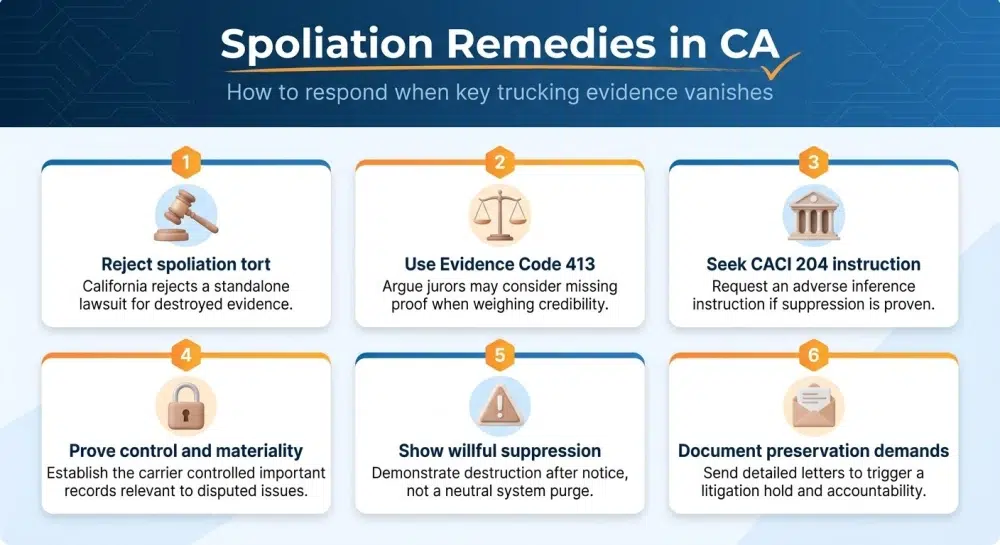
California law does not recognize an independent cause of action for spoliation of evidence by a party to the underlying litigation. The California Supreme Court settled this question in Cedars-Sinai Medical Center v. Superior Court, 18 Cal.4th 1 (1998), holding that courts should not recognize intentional first-party spoliation as an independent tort. The court’s reasoning included the availability of other, more limited remedies within the litigation itself, the risk of creating satellite litigation over the destruction of evidence, and the difficulty of proving that destroyed evidence would have been favorable.[8]
The practical consequence is that an injured person in California cannot file a separate civil lawsuit against a trucking company simply because the company destroyed evidence. The remedy lies within the pending personal injury case, not in a new tort claim.
How the Willful Suppression Instruction Works in Practice
California Evidence Code § 413 provides that in determining what inferences to draw from evidence, the trier of fact may consider the failure of a party to produce evidence that would naturally have been produced by that party if favorable to them. California Civil Jury Instruction (CACI) No. 204, titled “Willful Suppression of Evidence,” tells the jury that if a party willfully suppressed evidence in order to prevent its introduction, the jury may consider this in determining what the evidence would have shown, and may draw an inference that the evidence would have been unfavorable to that party.[9]
This instruction is the practical substitute for the tort that Cedars-Sinai eliminated. When a carrier destroys ELD records after receiving a preservation letter, or when telematics data disappears after the carrier had actual notice of the crash and the anticipated claim, the injured party’s attorney can ask the trial court to instruct the jury that it may infer the destroyed evidence was unfavorable to the carrier. Whether the court gives the instruction depends on a showing that: (1) the party had control over the evidence; (2) the evidence would have been material; (3) the party willfully suppressed it; and (4) the opposing party had no other way to obtain the same information.
A well-documented preservation demand, combined with evidence that the carrier failed to implement a litigation hold after receiving it, is often the foundation for seeking the willful suppression instruction. The instruction does not guarantee a jury verdict, it creates an inference that the jury may, but is not required to, accept. However, in cases involving a commercial vehicle collision where injury is severe and records have been destroyed, a willful suppression instruction can be a significant factor in how the jury assesses the carrier’s credibility throughout the trial.
An injured claimant’s counsel sends a preservation letter to a carrier three days after a collision on the I-5 near Anaheim. Fourteen months later, in discovery, the carrier produces ELD records only for the day of the crash. When asked for the prior 60 days, the carrier’s representative testifies that the records were deleted as part of an automated purge that ran 30 days after the crash. The plaintiff’s attorney presents evidence that the carrier’s system administrator received the preservation letter and forwarded it to the operations manager before the purge ran. At trial, plaintiff’s counsel requests CACI No. 204. Whether the court grants that request, and how the jury weighs it, would turn on the specific facts established at the hearing on the instruction.
The Timeline Pressure and the Role of an Early Inspection
The most perishable records in a commercial vehicle crash are not paper files, they are electronic. ECM event data, telematics GPS streams, and dashcam footage stored on a loop in the cab are all subject to overwriting or deletion within days to weeks of a collision. Paper DVIRs, by contrast, must be kept for three months. Drug and alcohol testing records with positive results must be kept for five years.
Understanding the hierarchy of urgency is important for anyone involved in a serious personal injury claim following a commercial vehicle crash on the SR-73, the I-405, or any other Southern California corridor where heavy truck traffic is common near the Irvine Spectrum and surrounding Orange County communities.
| Record Type | Governing Authority | Minimum Retention Period | Urgency Level |
|---|---|---|---|
| ELD / hours-of-service records | 49 C.F.R. § 395.8(k)(1) | 6 months from receipt | Very High – demand immediately |
| ECM event data | No specific FMCSA minimum; vendor/carrier policy | Days to weeks (variable) | Critical – may require emergency inspection |
| Telematics / GPS data | No specific FMCSA minimum; vendor policy | Often 30 days rolling | Critical – demand includes vendor |
| Dashcam footage | No specific FMCSA minimum; loop recording | Often 24-72 hours overwrite | Critical – hours, not weeks |
| Driver Vehicle Inspection Reports | 49 C.F.R. Part 396 | 3 months | High |
| Accident register | 49 C.F.R. § 390.15(b) | 3 years | Moderate |
| Drug/alcohol testing records (positive) | 49 C.F.R. § 382.401(b)(1) | 5 years | Moderate – longer window |
| Drug/alcohol testing records (negative) | 49 C.F.R. § 382.401(b)(3) | 1 year | High |
| Driver qualification file | 49 C.F.R. § 391.51(c) | Duration of employment + 3 years | Moderate – but demand immediately if driver separated |
An early inspection of the truck itself is a separate thing from the preservation letter. Different purpose entirely. You typically bring in an accident reconstruction engineer or a forensic mechanic to actually put hands on the vehicle and pull the physical evidence, and that means brake wear measurements, tire condition, whether the lights actually work, plus the ECM data that you can only get by plugging directly into the vehicle’s data port. California courts have, in some situations, allowed motions for early inspection of commercial vehicles as part of pre-litigation discovery, and sometimes the inspection just happens by agreement or by court order fairly early on. Here’s the thing though. The longer that truck stays on the road after a crash, the more the ongoing use just grinds down whatever physical evidence was there.
The clock starts at impact. If you’re hurt in a commercial vehicle crash anywhere around Irvine, Newport Beach, Santa Ana, Fullerton, or really anywhere else in Orange County, the window for protecting this evidence isn’t measured in months, it starts the second the crash happens. Getting personal injury lawyers who actually handle commercial vehicle claims involved as soon as possible after a serious collision is, honestly, the practical thing that decides whether any of this evidence still exists when you need it most.
What Damages May Be Available in a California Truck Crash Claim
Under California law, the damages picture in a commercial vehicle case is honestly pretty wide. You’ve got past and future medical expenses, lost income, loss of earning capacity, physical pain, mental anguish, physical impairment, disfigurement, that whole spectrum. Where someone dies in the crash, California’s wrongful death statute gives certain surviving family members their own path to compensation. And when the defendant’s conduct is bad enough to qualify as oppression, fraud, or malice under California Civil Code § 3294, a jury can add punitive damages on top. It’s not automatic. It has to be proven. But it’s part of what California allows.
There’s no formula for what a case is worth. It comes down to the facts, the evidence you can actually get, the law that applies, and the insurance sitting behind the whole thing. Commercial carriers add another wrinkle. You’re often dealing with layered coverage, the carrier’s own liability policy, an excess or umbrella policy on top of that, and sometimes even the vehicle owner’s coverage if the truck was leased or being run under a different entity than the carrier on paper. Our Irvine personal injury team works on commercial vehicle cases and can figure out which coverage layers actually apply in a given situation.
How Long Do I Have to Act in California?
California Code of Civil Procedure § 335.1 sets the usual two-year statute of limitations for personal injury cases. [10] That’s the general rule, but a lot of things can move the deadline in a particular case, including who the defendants are, whether a government entity is on the hook (Government Claims Act requires notice much earlier), and the specific circumstances of the person who got hurt. Two years is not planning space. It’s a wall. And when you consider that the most important evidence in a truck crash starts disappearing within days of impact, the practical timeline honestly isn’t measured in years at all, it’s days.
Deadline note: Limitations periods can vary based on the specific parties involved, the type of claim, and other factors. The foregoing is general information about California law. Anyone with questions about applicable deadlines in a specific situation should consult a licensed California attorney without delay.
Related California Truck Accident and Personal Injury Resources
- Legal Overview for Truck Accident Victims in California
- Irvine Truck Crash Highways: What Victims Should Know
- Irvine: Evidence to Save After a Fatal Accident
- How Attorneys Preserve Vehicle Black Box Evidence
- Jackknife Truck Accidents: Common Causes and Liability
- Broker Negligence: Can You Sue the Trucking Broker?
- CDL Violations and Negligence in Truck Crashes
- How to Gather Strong Evidence for Personal Injury Cases in California
Talk With a GoSuits Attorney
A commercial vehicle crash creates an immediate evidence clock. ELD data, telematics records, and ECM event files can disappear within days. If you or someone you care about was seriously injured in a crash involving a semi-truck, an 18-wheeler, or any other commercial motor vehicle in Irvine, Orange County, or anywhere in Southern California, a GoSuits injury attorney can evaluate the circumstances of your case and explain your legal options, including what steps may be taken right now to prevent critical evidence from being lost.
If the crash resulted in a fatality, our Irvine wrongful death lawyers can also discuss the rights available to surviving family members under California law.
References and Legal Authorities
- 49 C.F.R. Part 395 – Hours of Service of Drivers | LII / Legal Information Institute, Cornell Law School
- 49 C.F.R. § 395.8 – Driver’s Record of Duty Status | LII / Legal Information Institute, Cornell Law School
- 49 C.F.R. § 395.8(k)(1) – Retention of Driver’s Record of Duty Status: Six-Month Minimum | LII / Legal Information Institute, Cornell Law School
- 49 C.F.R. § 391.51 – General Requirements for Driver Qualification Files | LII / Legal Information Institute, Cornell Law School
- 49 C.F.R. § 382.401 – Retention of Drug and Alcohol Testing Records | LII / Legal Information Institute, Cornell Law School
- 49 C.F.R. Part 396 – Inspection, Repair, and Maintenance | LII / Legal Information Institute, Cornell Law School
- 49 C.F.R. § 390.15 – Assistance in Investigations and Special Studies; Accident Register | LII / Legal Information Institute, Cornell Law School
- Cedars-Sinai Medical Center v. Superior Court, 18 Cal.4th 1 (1998) – California Supreme Court (no independent tort for first-party spoliation) | Google Scholar
- CACI No. 204 – Willful Suppression of Evidence | California Civil Jury Instructions
- California Code of Civil Procedure § 335.1 – Two-Year Limitations Period for Personal Injury | California Legislative Information
- 49 C.F.R. § 382.303 – Post-Accident Testing Requirements | LII / Legal Information Institute, Cornell Law School
- Summary of Hours of Service Regulations | Federal Motor Carrier Safety Administration (FMCSA)