
Legal Information Reviewed By: Shawn Hashemi, Admitted to the Illinois Bar (ARDC No. 6350378)
Reviewed: October 2026 | Last Updated: October 2026
Chicago pothole claims against local public entities may be available, but the pothole alone does not establish liability. Under the Tort Immunity Act, a claimant generally must prove the responsible entity had actual or constructive notice of the unsafe condition in reasonably adequate time (745 ILCS 10/3-102). A civil action generally must be filed within one year (745 ILCS 10/8-101).
The road may be maintained by a public entity other than the City, which can change the proper defendant, forum, and deadline.
If the crash also involves another vehicle or an evasive maneuver, some issues may overlap with Chicago car accident claims, although claims against public entities have additional statutory requirements.
This article provides general information about Illinois law and is not legal advice. The requirements and deadlines applicable to a particular claim depend on the facts and the responsible entity.
Key Takeaways:
- Illinois roadway-defect claims against municipalities and other local public entities are subject to the Local Governmental and Governmental Employees Tort Immunity Act (745 ILCS 10/).
- A civil action for injury against a local public entity generally must be filed within one year, rather than the two-year period that generally applies to Illinois personal injury actions (745 ILCS 10/8-101; 735 ILCS 5/13-202).
- Under 745 ILCS 10/3-102, liability generally requires proof that the public entity had actual or constructive notice of the unsafe condition in reasonably adequate time to take measures to remedy or protect against it.
- Prior 311 pothole reports, service requests, and maintenance records may bear on whether the entity had notice, depending on what those records show.
- Section 3-102 limits the maintenance duty to people the entity intended and permitted to use the property in the manner at issue, which can affect the analysis for different types of road users.
- The roadway may be maintained by the City, a county, the State, a park district, or another public entity. Identifying the maintaining entity can affect the defendant, forum, and applicable deadline.
- A claimant’s own conduct can also affect recovery under Illinois modified comparative fault law (735 ILCS 5/2-1116).

Can You Sue a City in Illinois Over a Pothole?
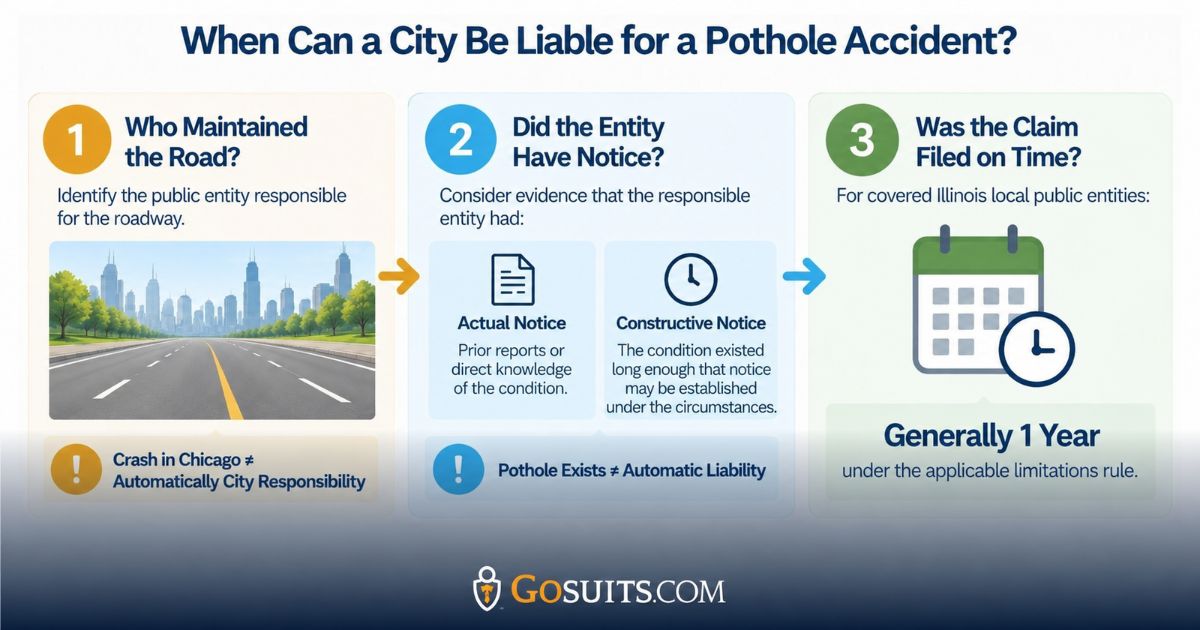
A claim against an Illinois city or other local public entity for injuries caused by a pothole may be available, but ordinary negligence principles are only part of the analysis. The Local Governmental and Governmental Employees Tort Immunity Act provides additional statutory limitations and immunities that can affect the claim (745 ILCS 10/).
For public property, 745 ILCS 10/3-102 addresses the entity’s duty to exercise ordinary care to maintain its property in a reasonably safe condition for people it intended and permitted to use the property.
The statute also provides that the entity is not liable unless it is proven that it had actual or constructive notice of the unsafe condition in reasonably adequate time before the injury to take measures to remedy or protect against it.
For a Chicago pothole accident, that makes three questions especially important:
- Who maintained the roadway? The location of the crash does not by itself establish that the City of Chicago was responsible for maintaining that road.
- Did the responsible entity have notice? Prior reports, maintenance records, and evidence concerning how long the defect existed may bear on this question.
- What filing deadline applies? A civil action against a covered local public entity generally has a one-year deadline under 745 ILCS 10/8-101.
These questions should be evaluated separately. A pothole’s existence alone does not establish that a public entity is liable for the resulting crash or injuries.
Who Maintains the Road Where the Crash Happened?
A pothole inside Chicago is not necessarily maintained by the City of Chicago. Identifying the entity responsible for the roadway is an important early step because it can affect who a claim is brought against, where it must be filed, and which deadlines apply.
Depending on the location, roadway jurisdiction may involve the City of Chicago, Cook County, the State of Illinois through a State agency, the Illinois Tollway, or another local public entity. A roadway’s physical location inside city limits does not, by itself, establish which entity had responsibility for the condition.
One common issue is a crash on a road associated with the State highway system. Claims against the State generally fall within the exclusive jurisdiction of the Illinois Court of Claims rather than proceeding as an ordinary tort action against a municipality in circuit court.
Identifying jurisdiction early also matters because State and local claims do not necessarily follow the same procedural rules.
Claims involving a CTA bus or L train follow a separate statutory framework from ordinary roadway-maintenance claims. See our overview of claims involving a CTA bus or L train for more information about the distinct rules that may apply.
These distinctions provide a general starting point:
Who Is Responsible for Maintaining Chicago Roads?
| Maintaining Entity | Typical Roadway Context | What Generally Changes |
|---|---|---|
| City of Chicago | City streets and alleys under municipal jurisdiction | The Tort Immunity Act may apply, including the one-year deadline in 745 ILCS 10/8-101 |
| Illinois Department of Transportation / State of Illinois | State highways and roads under State jurisdiction | Claims against the State generally fall within the Illinois Court of Claims framework, with separate filing and notice rules |
| Illinois State Toll Highway Authority | Roadways within the Illinois Tollway system | The Tollway is a State agency with responsibility for the toll highway system; its status and the applicable claim procedure must be evaluated separately |
| Cook County | Roads within the county highway system under County jurisdiction | Cook County falls within the Tort Immunity Act’s definition of a local public entity |
| Chicago Park District | Property under Park District jurisdiction, which may include certain roads or drives | A park district falls within the Tort Immunity Act’s definition of a local public entity |
| Chicago Transit Authority | Relevant when a CTA vehicle or CTA property is involved, rather than as a general roadway-maintenance category | CTA claims are governed separately, including the one-year personal injury limitation in 70 ILCS 3605/41 |
This table provides general orientation to roadway jurisdiction in the Chicago area. It does not determine which entity maintains a particular location.
State Road Claims Follow a Different Framework
When the responsible party is the State of Illinois, the procedural framework can be materially different from a claim against the City.
Under 705 ILCS 505/8, the Illinois Court of Claims has exclusive jurisdiction over specified claims against the State. Section 22(h) generally provides a two-year filing period for claims that fall within its “all other claims” category.
Personal injury claims against the State also require special attention to 705 ILCS 505/22-1. That provision generally requires specified notice to be filed with both the Attorney General and the Clerk of the Court of Claims within one year after the injury or accrual. However, the statute states that this notice is not required if the Court of Claims claim itself is filed within one year of accrual.
These rules are separate from the one-year deadline that generally applies to civil actions against Illinois local public entities under 745 ILCS 10/8-101. For that reason, identifying the maintaining entity should come before assuming that a City of Chicago deadline or procedure applies.
How Long Do You Have to Sue the City of Chicago?
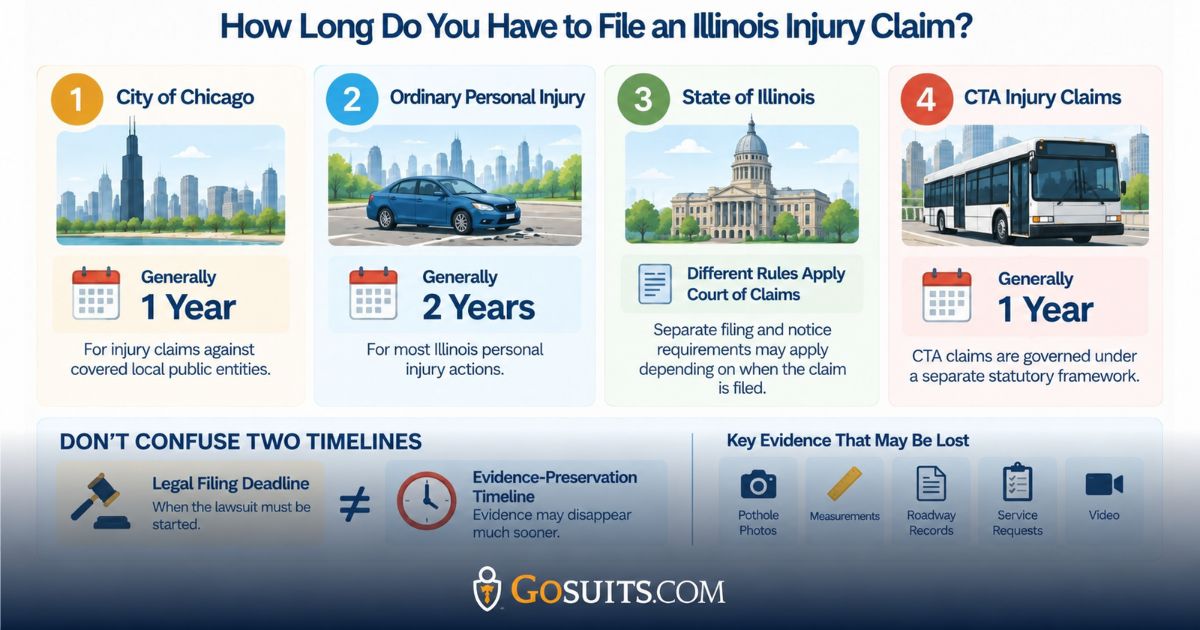
A civil action for injury against the City of Chicago generally must be filed within one year after the injury was received or the cause of action accrued under 745 ILCS 10/8-101. That is shorter than the general two-year limitations period for most Illinois personal injury actions under 735 ILCS 5/13-202.
The applicable deadline can change when a different public entity is involved. For example, claims involving a CTA bus or L train follow a different statutory framework from an ordinary roadway-defect claim against the City. This is another reason roadway jurisdiction should be identified early.
- City of Chicago and other covered local public entities: Generally one year under 745 ILCS 10/8-101.
- Ordinary Illinois personal injury actions: Generally two years under 735 ILCS 5/13-202.
- Claims against the State: Court of Claims rules apply. Covered claims generally must be filed within the period established by 705 ILCS 505/22. Personal injury claims also have a one-year notice requirement under 705 ILCS 505/22-1, but that notice is not required if the Court of Claims claim itself is filed within one year of accrual.
- CTA personal injury claims: Generally one year under 70 ILCS 3605/41. CTA is governed separately from the Tort Immunity Act.
Exceptions can affect particular deadlines. For example, Illinois law contains provisions concerning minors and people under legal disability, but those rules must be considered together with the statute governing the particular defendant and claim.
Ongoing medical treatment or settlement discussions should not be assumed to extend the applicable filing period.
The Evidence Timeline Can Be Shorter
The legal deadline is not the same as the practical evidence-preservation timeline. The legal deadline is also different from how long an Illinois injury lawsuit takes after it has been filed.
A pothole may be repaired, a roadway may change, and potentially relevant video or records may become unavailable before the limitations period expires.
Photographs showing the defect’s location and dimensions, roadway-jurisdiction information, service-request records, and other available evidence may therefore become important well before the deadline for filing an action.
What You Have to Prove Under the Illinois Tort Immunity Act
For a roadway-condition claim against a local public entity, the existence of a pothole alone does not establish liability. Section 3-102 of the Illinois Tort Immunity Act limits the entity’s maintenance duty to intended and permitted users exercising ordinary care and requires proof of actual or constructive notice of the unsafe condition.
The claimant must also establish the elements required by the underlying negligence claim. The evidence used to show how negligence is proven in a Chicago crash may include proof that the condition and alleged breach caused the injury. Separate statutory immunities may still affect the claim even when the requirements of § 3-102 are otherwise satisfied.
The main requirements can be summarized this way:
What the Illinois Tort Immunity Act Requires in a Roadway Defect Claim
| Requirement | What It Generally Means | Authority |
|---|---|---|
| Duty to Maintain | A local public entity must exercise ordinary care to maintain its property in a reasonably safe condition for qualifying uses and users | 745 ILCS 10/3-102 |
| Intended and Permitted User | The claimant’s use must fall within the uses and users the entity both intended and permitted, as addressed by § 3-102 | 745 ILCS 10/3-102 |
| Actual or Constructive Notice | The claimant must prove the entity knew or had constructive notice of the unsafe condition with reasonably adequate time to take protective or remedial measures | 745 ILCS 10/3-102 |
| Applicable Immunities | Other provisions of the Tort Immunity Act may independently limit liability depending on the facts | 745 ILCS 10/ |
| Shortened Deadline | A covered civil action against a local entity or employee generally has a one-year deadline | 745 ILCS 10/8-101 |
| Claimant’s Own Care | Section 3-102 itself refers to qualifying use in the exercise of ordinary care, while Illinois comparative-fault law can separately reduce or bar recovery | 745 ILCS 10/3-102; 735 ILCS 5/2-1116 |
This is a general summary of the statutory framework, not an assessment of any individual pothole claim.
Actual and Constructive Notice
Notice is an element the claimant must establish under § 3-102 of the Illinois Tort Immunity Act. It is not enough to show that the pothole existed when the accident happened.
Actual notice generally concerns evidence that the responsible entity knew about the unsafe condition. Prior service requests, complaints, inspections, or maintenance records may bear on that issue depending on what the records establish. In Hanley v. City of Chicago, 343 Ill. App. 3d 49, 54 (2003), evidence that the pothole had previously been patched was relevant to whether the City had notice of the condition.
Constructive notice can arise even without proof of direct knowledge. Illinois courts assess whether a condition existed long enough, or was sufficiently conspicuous, that public authorities exercising reasonable care and diligence should have known about it (Barr v. Frausto, 2016 IL App (3d) 150014, ¶ 22). There is no single amount of time that automatically establishes constructive notice.
The claimant must also connect the alleged roadway defect to the crash and resulting injury, as part of establishing how negligence is proven in a Chicago crash.
Section 3-102(b) also specifically addresses constructive notice. Among other things, it provides circumstances in which a public entity does not have constructive notice based on whether a reasonably adequate inspection system would have discovered the condition or whether the entity operated such a system with due care.
Intended and Permitted Users
The public entity’s duty under § 3-102 does not extend to every person making every use of public property. The statute applies to people whom the entity both intended and permitted to use the property, in the relevant manner and at reasonably foreseeable times.
That distinction can matter in roadway cases. A motorist using an ordinary vehicle travel lane for vehicular travel generally presents a different intended-use question from someone using the same part of the roadway for another purpose.
The Illinois Supreme Court illustrated the distinction in Boub v. Township of Wayne, 183 Ill. 2d 520 (1998). The court concluded that the bicyclist in that case was permitted to use the road and bridge but was not an intended user for purposes of the municipality’s duty under § 3-102. The analysis considered the nature of the roadway and the absence of signs or pavement markings indicating bicycle-specific use.
Boub should not be reduced to a rule that bicyclists can never bring roadway-defect claims. Whether a particular road user falls within § 3-102 can depend on the property, its markings or designated uses, and the circumstances.
How Is Notice Actually Proven?
Notice may be established through records showing that the responsible entity knew about the specific roadway defect, or through evidence supporting an inference that the condition had existed long enough or was conspicuous enough for the entity to have discovered it.
For a Chicago pothole claim, potentially relevant evidence may include:
- Prior 311 service requests identifying the pothole or location
- Maintenance and repair records showing prior work or inspection activity
- The timing of earlier reports compared with the date of the crash
- Photographs or video showing the condition, location, and apparent characteristics of the defect
- Historical street-level imagery that may help establish whether the condition existed earlier
- Witness accounts from people familiar with the location and how long the condition had been present
Chicago publishes 311 pothole service-request data, including reported locations and request status information. Those records can provide a practical starting point for determining whether a pothole had previously been reported.
A prior report does not automatically establish actual or constructive notice under 745 ILCS 10/3-102. The record still must be evaluated for matters such as whether it concerns the specific defect, when the report was received, what information it contained, and whether there was reasonably adequate time to take measures to remedy or protect against the condition.
Constructive notice may also be supported by evidence concerning the duration and conspicuity of the defect. Illinois courts have considered how long a condition existed and how apparent it was when determining whether a public entity could reasonably be charged with knowledge of it.
This makes location-specific documentation particularly important. Photographs showing the pothole alongside a scale reference and a fixed landmark can help document its dimensions and precise position before the roadway condition changes.
Immunities That May Apply Even If the Entity Knew
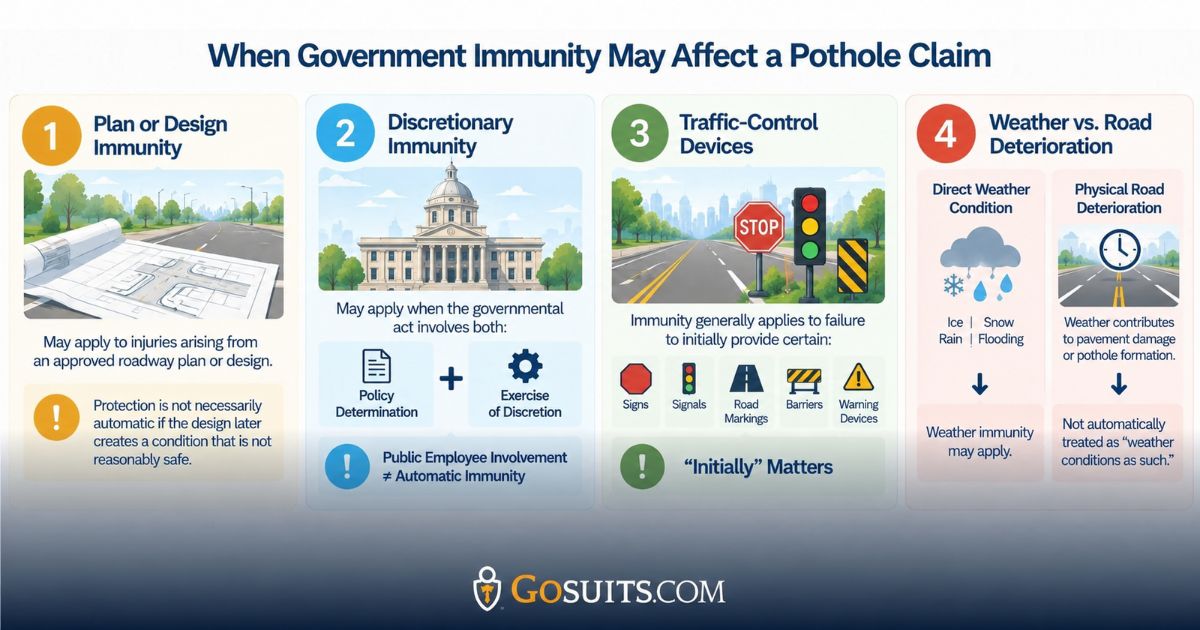
Proving that a public entity had notice of a roadway condition does not necessarily resolve liability. The Illinois Tort Immunity Act contains separate immunities that may apply depending on what allegedly caused the injury and what governmental act or decision is at issue.
Plan or Design Immunity
Under 745 ILCS 10/3-103, a local public entity generally is not liable for an injury caused by the adoption of an approved plan or design for construction or improvement of public property.
The statute contains an important qualification. If, after the plan or design is put into use, it appears that the design created a condition that is not reasonably safe, § 3-103(a) does not provide the same protection.
For a pothole claim, this provision should therefore not be treated as automatic immunity simply because the roadway was originally constructed according to an approved design.
Discretionary Immunity
745 ILCS 10/2-201 can protect a public employee whose position involves determining policy or exercising discretion when an injury results from an act or omission involving both policy determination and the exercise of discretion.
Whether this immunity applies depends on the nature of the particular governmental decision. It should not be assumed that every road-maintenance or repair activity is discretionary merely because a public employee was involved.
Traffic-Control Devices and Roadway Markings
Under 745 ILCS 10/3-104, local public entities and employees are generally immune from liability for injuries caused by the failure to initially provide traffic-control devices, warning signs, roadway markings, barriers, and similar devices.
The word “initially” matters. The statute should not be described as blanket immunity for every claim involving an existing sign, marking, warning device, or barrier.
What If Weather Contributed to the Pothole?
Weather-related immunity does not automatically cover physical roadway deterioration caused by weather.
Section 745 ILCS 10/3-105 generally provides immunity for injuries caused by the effect of weather conditions as such on streets, highways, sidewalks, and other public ways. The statute identifies conditions such as wind, rain, flooding, hail, ice, and snow.
But § 3-105 expressly states that “weather conditions as such” do not include physical damage to or deterioration of streets and other public ways resulting from weather conditions.
That distinction matters for a pothole claim. A crash caused directly by ice presents a different statutory question, including how Illinois treats fault when weather contributes, from a claim involving physical deterioration of the roadway. Whether an immunity applies still depends on the condition alleged to have caused the injury and the facts of the claim.
What Evidence Supports a Pothole Claim?
Useful evidence in a pothole claim can document the roadway defect, identify the entity responsible for the road, address notice, connect the condition to the crash, and establish the resulting injuries or property damage.
Because a pothole can later be repaired or altered, documenting the location and condition as soon as reasonably possible may help preserve evidence of what existed near the time of the crash.
Evidence That May Support a Chicago Pothole Claim
| Evidence | What It May Bear On | Access or Time Limits |
|---|---|---|
| Prior 311 or Service Request Records for the Location | Whether the Entity Had Actual Notice and How Long the Condition May Have Existed | Published Records; Identify the Specific Location and Nearby Block Early |
| Maintenance and Repair Records for the Block | Notice, the Condition’s History, and Prior Partial Repairs | Typically Obtained by Request From the Maintaining Entity |
| Roadway Jurisdiction Records | Which Entity Maintained the Road, Affecting the Defendant, Forum, and Deadline | Establish Early |
| Photographs of the Defect With a Scale Reference and Fixed Landmark | The Size, Depth, and Precise Location of the Condition | Document as Soon as Safely Possible; the Defect May Be Repaired or Altered |
| Historical Street-Level Imagery | How Long the Condition May Have Existed | Availability Varies by Location and Imagery Date |
| Illinois Traffic Crash Report | The Reported Location, Sequence, and Recorded Observations | Request Early; Supplements May Be Added |
| Vehicle Damage Documentation and Repair Estimates | The Nature of the Impact and Resulting Property Damage | Obtain Before Repairs Are Completed |
| Tow and Roadside Assistance Records | The Location and Immediate Aftermath | Retained by the Provider; Request Early |
| Medical Records and Itemized Billing | The Injuries and Treatment Connected to the Incident | Ongoing; Gaps in the Record May Affect Evaluation |
Not every pothole claim will involve every type of evidence listed above, and the existence of any one item does not by itself establish liability.

Document the Pothole and Location
Photos are more useful when they show both the defect and where it sits in the roadway. Where it can be done safely, several angles and a scale reference can help document its approximate size.
Record the intersection, address, direction of travel, lane, and nearby landmarks so the specific defect can be distinguished from other potholes nearby.
Preserve Records That May Address Notice
Prior 311 requests, complaints, inspections, and maintenance records may help show whether the responsible entity knew about the condition before the crash.
The timing and specificity of those records matter because § 3-102 requires actual or constructive notice of the unsafe condition in reasonably adequate time to take protective or remedial measures.
Document Injuries and Vehicle Damage
Vehicle photos, repair records, witness information, medical records, bills, and income documentation may help establish the consequences of the crash and the damages being claimed. The role of how a police report affects an injury claim depends on the information recorded and the other evidence available.
When a pothole causes a driver to swerve or lose control, the evidence may need to address both the road condition and any other driver’s actions in the collision. The issues involved in Chicago car accident claims may overlap with a roadway-defect claim, but liability depends on the facts and the legal duties that apply to each party.
Preserving evidence does not prove liability by itself. It provides information that can be evaluated alongside roadway jurisdiction, notice, causation, immunities, comparative fault, and damages.
Can You Be Found Partly at Fault?
Yes. A person injured in a pothole accident may be assigned part of the fault, and that can reduce or, in some cases, bar recovery under Illinois law.
Illinois follows a modified comparative fault rule, so being partially at fault for a crash in Illinois does not necessarily prevent recovery. Under 735 ILCS 5/2-1116, a claimant whose contributory fault is 50% or less may still recover damages, but the damages are reduced in proportion to that person’s share of fault. If the claimant’s contributory fault is more than 50%, recovery is barred.
In a pothole accident, the comparative-fault analysis may consider evidence concerning the driver’s conduct and the circumstances of the crash. Depending on the facts, disputed issues could include:
- Vehicle speed in relation to the conditions
- Whether the driver was distracted
- Whether the pothole was visible or reasonably avoidable
- The driver’s position within the roadway
- Traffic, lighting, and surrounding roadway conditions
- Whether another vehicle or circumstance affected the driver’s ability to respond
These factors do not automatically establish fault. The issue is whether the claimant’s conduct contributed to the injury based on the evidence.
Section 745 ILCS 10/3-102 separately ties a local public entity’s maintenance duty to use of the property in the exercise of ordinary care. That requirement is distinct from comparative fault under § 2-1116.
When fault is disputed, photos, video, witness accounts, and other evidence about the roadway and the driver’s conduct may become relevant.
Vehicle Damage Claims Versus Injury Claims
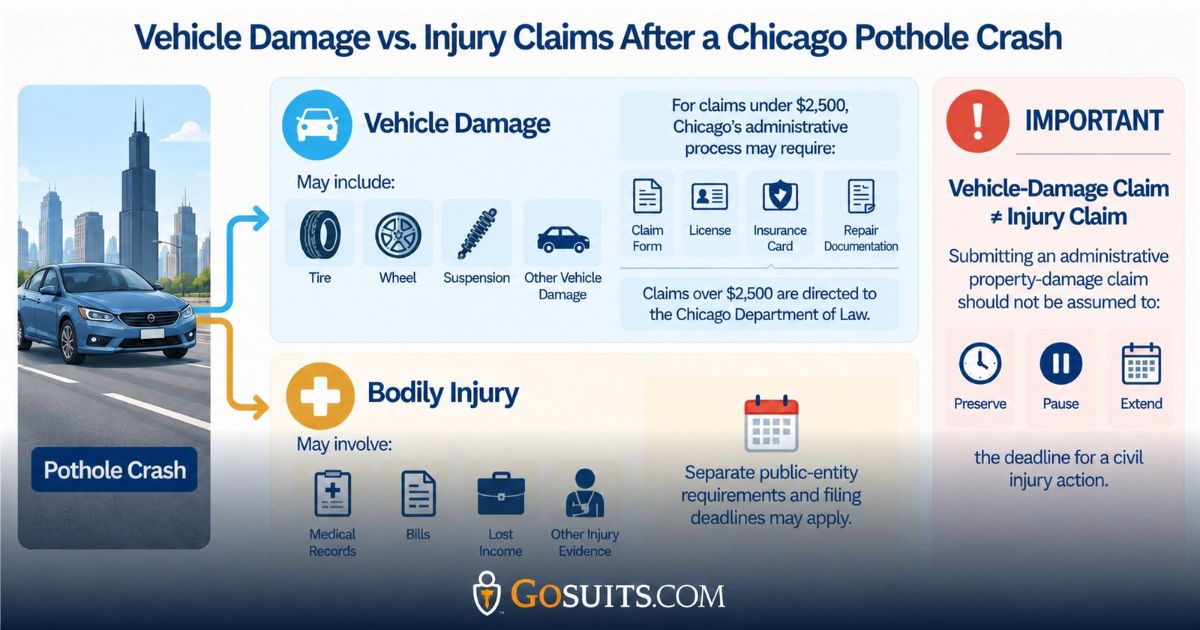
A pothole accident can involve vehicle damage, bodily injury, or both, but Chicago’s administrative process for vehicle damage should not be confused with a personal injury action against the City.
The Chicago Office of the City Clerk accepts administrative vehicle-damage claims involving potholes on City streets. For claims under $2,500, the City provides an administrative process requiring a completed vehicle-damage claim form and supporting documentation. For claims over $2,500, the City Clerk directs claimants to the Chicago Department of Law. Read the City Clerk’s vehicle-damage claims instructions.
For claims over $2,500, consult the Chicago Department of Law’s claims process for the applicable procedure. If your claim is exactly $2,500, confirm the correct procedure directly with the City Clerk rather than assuming either published threshold applies.
A vehicle-damage claim may involve costs associated with damage to items such as a tire, wheel, suspension, or other vehicle components when the evidence connects that damage to the pothole. The amount and recoverability of any property damage depend on the evidence and applicable law.
A bodily-injury claim raises additional issues. Medical records, bills, lost-income documentation, and other evidence may be relevant, but the claimant must still address the requirements applicable to a tort claim against the responsible public entity, including notice of the roadway condition under 745 ILCS 10/3-102 and the applicable filing period.
If you have collision coverage, review your policy or ask your insurer whether it may cover the vehicle damage. Coverage depends on the policy terms and circumstances. An insurance claim is separate from a claim against a public entity and does not extend the applicable civil filing deadline.
If another motorist was also involved, uninsured or underinsured motorist coverage may be relevant, depending on the circumstances and the terms of the applicable policy (215 ILCS 5/143a; 215 ILCS 5/143a-2). This coverage is separate from a claim against a public entity and should not be assumed to apply to every pothole accident.
Does Filing a Vehicle-Damage Claim Protect an Injury Claim?
Do not assume that submitting an administrative vehicle-damage claim preserves or extends the deadline for a civil action.
Under the Tort Immunity Act, “injury” expressly includes both personal injury and damage to or loss of property. A civil action against a covered local entity for an injury generally has a one-year deadline under 745 ILCS 10/8-101.
Someone with both vehicle damage and bodily injuries should therefore treat the two issues separately. Participating in Chicago’s administrative vehicle-damage process should not be assumed to satisfy, pause, or extend the filing requirements that apply to a civil action.
What Does Chicago Require for a Vehicle-Damage Claim?
For a pothole-related vehicle-damage claim under $2,500, the City Clerk currently identifies several supporting materials, including:
- A copy of the driver’s insurance card
- A copy of the driver’s license
- A completed and signed Damage to Vehicle Claim Form
- A paid repair receipt or two written repair estimates
- A letter of experience from the insurance company for claims over $500
The City Clerk states that a police report is generally required for vehicle-damage claims involving other incidents, but is not required for pothole damage.
The City also cautions that once a claim has been submitted and introduced to the City Council, additional materials cannot be added to the claim. Checking the current requirements before submitting the packet is therefore important.
What If a Motorcyclist or Cyclist Hit the Pothole?
Motorcyclists and bicyclists can face different intended-user issues under Illinois law.
A motorcyclist lawfully using an ordinary vehicle lane may present a different intended-user analysis from a bicyclist. Illinois defines a motorcycle as a motor vehicle (625 ILCS 5/1-147), but intended-user status under 745 ILCS 10/3-102 still depends on the property and circumstances.
The rider must still prove the other elements of the claim, including notice, causation, and compliance with the applicable deadline.
For bicyclists, the intended-user issue can be decisive. In Alave v. City of Chicago, 2023 IL 128602, the Illinois Supreme Court held that the City did not owe a duty under § 3-102(a) to a bicyclist injured after striking a pothole because the evidence did not establish that the City intended bicyclists to use the roadway. Permission to ride on a road, or the foreseeability of bicycle use, does not by itself establish intended-user status.
A Chicago bicycle accident attorney may also consider whether the roadway’s markings, designated uses, and other physical features support intended-user status. The intended-user issue in a pothole case is distinct from the duties owed to people riding bicycles in a dooring incident, which raises a different set of legal questions.
Boub v. Township of Wayne, 183 Ill. 2d 520 (1998), remains relevant to this analysis. Whether a bicyclist qualifies as an intended user depends on the particular roadway and the available evidence, including signs, pavement markings, and other physical indications of intended use. Neither decision means that every bicycle pothole claim is automatically barred; the analysis depends on the specific facts.
Even when intended-user status is satisfied, the claimant generally must still prove that the responsible entity had actual or constructive notice of the unsafe condition in reasonably adequate time before the injury.
What Damages Are Recognized?
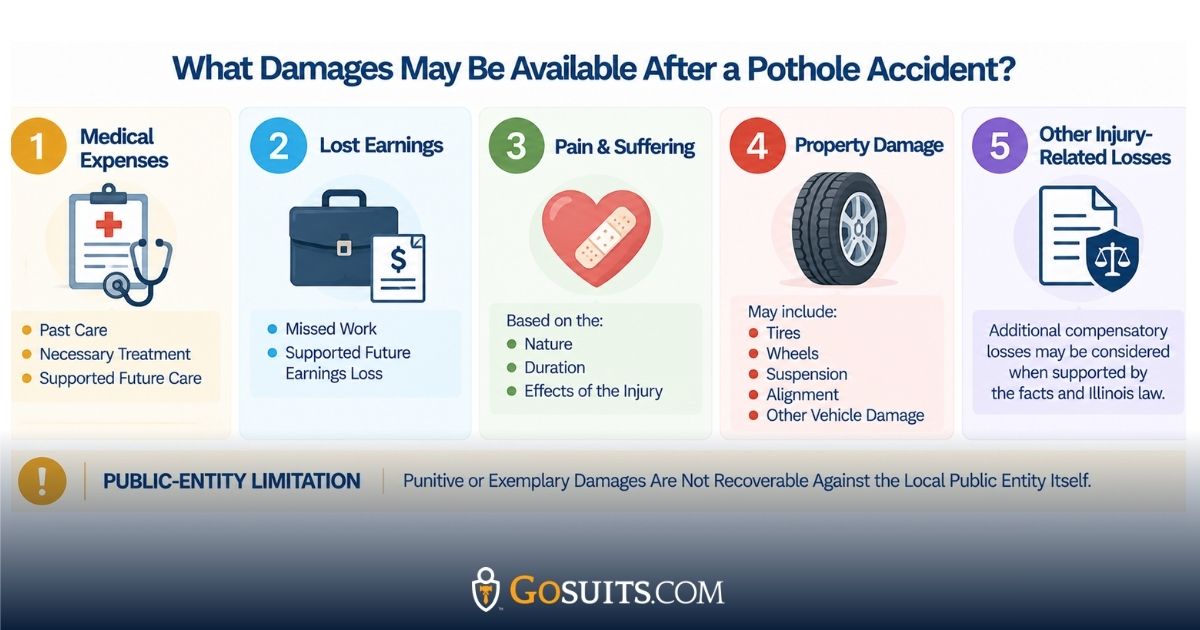
When a pothole claim results in bodily injury or property damage, recoverable compensation may include economic and non-economic losses that are supported by the evidence and legally attributable to the accident. (IPI Civil No. 30.01)
The available damages depend on what the crash actually caused, and how injury claims are evaluated in Illinois depends on the medical evidence and the losses supported in the particular case. Potential categories may include:
Medical Expenses: Reasonable expenses for necessary medical care related to the injuries may be recoverable. Claims where treatment did not begin immediately may require additional consideration of the medical evidence connecting the treatment to the accident. Depending on the evidence, this can include past medical expenses and reasonably certain future medical expenses (IPI Civil No. 30.06).
Lost Earnings: A claimant who misses work because of accident-related injuries may seek compensation for lost earnings when the loss can be established with appropriate evidence. Future loss of earnings may also be relevant when adequately supported (IPI Civil No. 30.07).
Pain and Suffering: Illinois law recognizes pain and suffering as a form of compensatory damages in personal injury cases. The amount, if any, depends on the evidence concerning the nature, duration, and effects of the injury (IPI Civil No. 30.05).
Property Damage: A pothole accident may also result in vehicle damage. Depending on the circumstances, claimed losses can involve tires, wheels, suspension components, alignment, or other parts damaged in the incident. Repair estimates, invoices, photographs, and other documentation may help establish the nature and amount of the claimed property loss (see IPI Civil Nos. 30.10–30.14, as applicable).
Other Injury-Related Losses: Additional compensatory damages may be available when supported by the facts and Illinois law. The appropriate categories depend on the injuries and losses actually caused by the accident.
One important limitation applies to claims against local public entities: punitive or exemplary damages are not recoverable against the local public entity itself under 745 ILCS 10/2-102.
Establishing damages is separate from establishing liability. A claimant must still prove the requirements applicable to the roadway-condition claim, including causation and, under § 3-102, actual or constructive notice of the unsafe condition.
What Can Reduce What You Keep From a Settlement?
The amount a claimant ultimately receives can be less than the gross settlement or judgment because attorney fees, case expenses, valid health-care liens, and certain reimbursement obligations may need to be paid or resolved first.
Possible deductions may include:
- Attorney fees and case expenses under the written representation agreement.
- Health-care liens under the Illinois Health Care Services Lien Act. The total amount of liens under that Act generally cannot exceed 40% of the verdict, judgment, award, settlement, or compromise (770 ILCS 23/10).
- Medicare reimbursement for conditional payments related to the injury when a liability insurer or another primary payer is responsible (42 U.S.C. § 1395y(b); CMS, “Medicare’s Recovery Process”). Other health-plan reimbursement rights depend on the applicable plan terms and law.
- Other case-specific obligations that legally attach to the recovery.
A health-care provider lien under the Illinois Health Care Services Lien Act must satisfy statutory requirements, including written notice containing specified information and service on both the injured person and the party alleged to be liable. A good-faith payment made before service of the lien notice may prevent creation of an enforceable lien to the extent of that payment (770 ILCS 23/10(b)). How liens affect a settlement depends on the type of lien or reimbursement right involved.
Illinois comparative fault can also reduce the recovery before these deductions are considered. Under 735 ILCS 5/2-1116, fault of 50% or less generally reduces damages proportionally, while fault greater than 50% bars recovery.
For that reason, the gross recovery and net recovery can be very different, and there is no standard percentage that every claimant ultimately keeps. Our Chicago personal injury attorneys can evaluate these issues in the context of the specific claim.
Sources
Official City Sources
- Chicago Office of the City Clerk: Claims
- Chicago Department of Law: Claims
- City of Chicago Data Portal: Reported Cases of Potholes That Are Open
Illinois Statutes
- 745 ILCS 10/3-102: Duty to Maintain Public Property and Notice
- 745 ILCS 10/8-101: Limitation Period for Actions Against Local Entities
- 735 ILCS 5/13-202: General Personal Injury Limitation Period
- 735 ILCS 5/2-1116: Illinois Modified Comparative Fault
- 625 ILCS 5/1-147: Definition of Motorcycle
- 215 ILCS 5/143a: Uninsured and Hit-and-Run Motor Vehicle Coverage
- 215 ILCS 5/143a-2: Additional Uninsured Motorist Coverage
- 770 ILCS 23/10: Health Care Services Liens
Illinois Supreme Court Decisions
Illinois Appellate Court Decisions
- Hanley v. City of Chicago, 343 Ill. App. 3d 49 (2003)
- Barr v. Frausto, 2016 IL App (3d) 150014, ¶ 22

Additional Illinois Statutes
- 705 ILCS 505/8: Illinois Court of Claims Jurisdiction
- 705 ILCS 505/22: Court of Claims Filing Limitations
- 705 ILCS 505/22-1: Notice Requirements for Personal-Injury Claims Against the State
- 70 ILCS 3605/41: Limitation Period for CTA Personal-Injury Claims
- 745 ILCS 10/2-102: Punitive and Exemplary Damages
- 745 ILCS 10/2-201: Discretionary Immunity
- 745 ILCS 10/3-103: Plan or Design Immunity
- 745 ILCS 10/3-104: Traffic-Control Devices and Markings
- 745 ILCS 10/3-105: Weather-Condition Immunity
Illinois Pattern Jury Instructions
Federal Law and Government Sources
- 42 U.S.C. § 1395y(b): Medicare as Secondary Payer
- Centers for Medicare & Medicaid Services: Medicare’s Recovery Process
Frequently Asked Questions
Can you sue a city in Illinois for a pothole accident?
A claim may be available, but the pothole alone does not establish liability. Under 745 ILCS 10/3-102, the claimant generally must prove that the responsible local public entity had actual or constructive notice of the unsafe condition in reasonably adequate time. Other statutory immunities may also affect the claim.
How long do I have to sue the City of Chicago?
A civil action against the City of Chicago generally must be filed within one year after the injury or accrual of the cause of action under 745 ILCS 10/8-101. This is shorter than the general two-year period for most Illinois personal injury actions under 735 ILCS 5/13-202. Different rules may apply to other entities.
Do I have to prove the City knew about the pothole?
Generally, yes. Section 3-102 requires proof that the responsible local public entity had actual or constructive notice of the unsafe condition in reasonably adequate time before the injury to take measures to remedy or protect against it. Actual notice concerns direct knowledge, while constructive notice may be established through evidence about the condition’s duration and conspicuity.
How do you prove a city had notice of a pothole?
Records may help establish notice, including 311 service requests identifying the location, complaints, inspection and maintenance records, prior repair history, historical street-level imagery, and witness observations about how long the defect existed. A prior report is not conclusive; its timing, specificity, and connection to the same condition matter under Section 3-102.
What if the pothole was on a State road or tollway?
The responsible entity determines where a claim may be brought and which deadlines apply. Claims against the State generally fall within the Illinois Court of Claims framework under 705 ILCS 505/8, with separate filing and notice provisions under Sections 22 and 22-1. The Illinois State Toll Highway Authority is a separate entity, so its forum and filing timetable should be verified rather than assumed to follow the rules for other State claims.
Can I file a claim just for damage to my car?
Yes. Chicago’s Office of the City Clerk provides an administrative process for certain pothole-related vehicle-damage claims under $2,500; claims over that threshold are directed to the City Law Department. The process is separate from a personal-injury action, and submitting an administrative claim should not be assumed to extend a civil filing deadline.
Does it matter that the pothole was caused by winter weather?
It may. Section 3-105 addresses injuries caused by the effect of weather conditions as such on public ways, but excludes physical damage to or deterioration of streets resulting from weather. How the provision applies depends on the condition alleged to have caused the injury and the circumstances; it should not be treated as a categorical rule for every pothole claim.
Can the City avoid liability even if it knew about the pothole?
Potentially. Notice is only one part of the analysis. The Tort Immunity Act also contains provisions addressing approved roadway plans or designs, certain discretionary decisions, and the failure to initially provide specified traffic-control devices (745 ILCS 10/3-103, 2-201, and 3-104). Whether any provision applies depends on the facts and the specific conduct alleged.
Is the analysis different for a cyclist or motorcyclist?
It can be. Section 3-102 limits the duty to people the entity intended and permitted to use the property in the manner at issue. Illinois courts have applied that rule to bicyclists, including in Boub v. Township of Wayne, 183 Ill. 2d 520 (1998). That decision should not be read as a categorical bar to every bicycle claim; the roadway and circumstances matter.
Can I be found partly at fault for hitting a pothole?
Yes. Under Illinois’s modified comparative-fault statute, a claimant’s recovery is generally reduced in proportion to their contributory fault and barred if that fault is more than 50% of the proximate cause of the injury or damage (735 ILCS 5/2-1116). The result depends on the evidence, including the road conditions and the driver’s conduct.