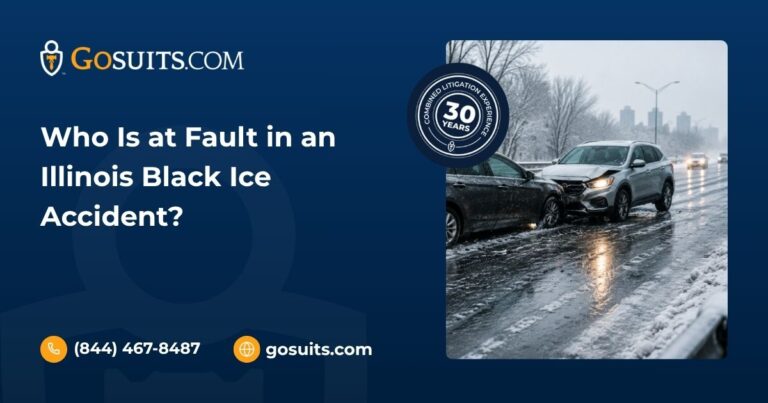
A driver can still be found at fault for a black ice accident under Illinois law. The presence of black ice does not automatically excuse a driver from liability. Instead, Illinois law requires drivers to use reasonable care under existing road and weather conditions, including adjusting their speed, following distance, and driving behavior when icy conditions are present.
Whether a driver is legally responsible depends on the specific facts of the accident and whether they acted reasonably under the circumstances.
After a black ice accident, questions about fault, insurance coverage, medical expenses, and vehicle damage often arise. Determining responsibility involves examining the actions of everyone involved, the roadway conditions, and the available evidence rather than the presence of ice alone.
Key Takeaways
- Black ice does not automatically relieve a driver of liability under Illinois law.
- Drivers have a duty to adjust their speed, following distance, and driving behavior to match road and weather conditions.
- Illinois follows a modified comparative negligence rule, which may allow recovery as long as an injured person is not more than 50% at fault.
- More than one driver may share responsibility in a black ice collision or chain-reaction crash.
- Claims against government entities for naturally occurring black ice are generally restricted by Illinois immunity law, although a legally distinct theory may apply in unusual circumstances.
- The evidence collected after the accident often plays an important role in determining fault.

Why isn’t black ice automatically treated as an unavoidable accident in Illinois?
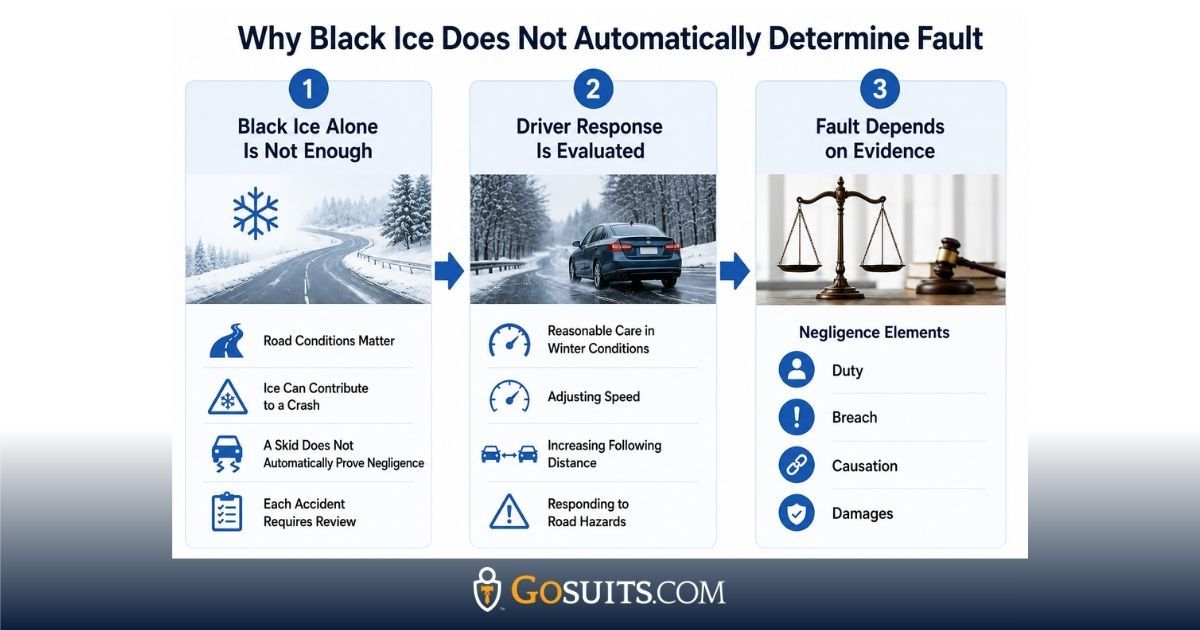
Black ice alone does not determine who is at fault for an accident. Under Illinois law, drivers have a duty to exercise reasonable care under existing road and weather conditions. Even when black ice contributes to a collision, liability depends on whether a driver acted as a reasonably careful person would have under similar circumstances, rather than on the presence of ice alone.
At the same time, the occurrence of a skid or loss of control does not by itself prove negligence. A collision may be treated as unavoidable if the evidence does not show that any driver failed to use reasonable care.
The Legal Duty of Care Drivers Owe in Winter Conditions
Illinois negligence law requires drivers to operate their vehicles with reasonable care regardless of the weather. This includes adjusting speed, increasing following distance, and responding appropriately to changing road conditions when ice, snow, or freezing temperatures are present.
Like any negligence claim, a black ice accident is generally evaluated using four elements:
- Duty: Every driver has a duty to exercise reasonable care while operating a vehicle.
- Breach: A driver may breach that duty by driving too fast for conditions, following too closely, or otherwise failing to respond appropriately to winter hazards.
- Causation: The breach must have proximately caused the collision and the resulting injuries.
- Damages: The injured party must have suffered legally recognized losses, such as medical expenses, lost income, property damage, or other compensable harm.
Because Illinois law requires drivers to adjust their conduct to existing conditions, traveling at or below the posted speed limit does not automatically establish that a driver exercised reasonable care. A safe speed and following distance depend on the specific road, traffic, and weather conditions at the time of the accident.
What Makes Black Ice Different From Other Winter Hazards
Unlike visible snow or slush, black ice is often difficult to detect because it forms as a thin, nearly transparent layer of ice on the roadway. It commonly develops overnight or in areas that cool more quickly, such as bridges, overpasses, elevated ramps, and shaded sections of road.
Although black ice can make driving more hazardous, its presence does not automatically determine liability. Courts and insurance companies generally examine how each driver responded to the conditions, including whether they adjusted their speed, maintained a safe following distance, and exercised reasonable care before the collision occurred.
What driver behaviors can establish fault in a black ice crash?
The presence of black ice does not, by itself, determine who is at fault for a collision. Instead, courts and insurers may evaluate the driver’s speed, following distance, lookout, braking, steering, and other conduct leading up to and during the collision to determine whether they exercised reasonable care.
Even when weather contributes to an accident, a driver may still be found negligent if their conduct failed to account for the conditions.
Driver Behaviors That May Establish Fault in a Black Ice Accident |
||
|---|---|---|
| Driver Behavior | Why It May Establish Fault | Illinois Legal Basis |
| Driving Too Fast for Conditions | Traveling at a Speed That Is Unreasonable for Icy Roads, Even Below the Posted Speed Limit | 625 ILCS 5/11-601(a) – Speed Restrictions |
| Following Too Closely | Failing to Leave Sufficient Stopping Distance on Slippery Roads | 625 ILCS 5/11-710(a) – Following Too Closely |
| Driving With Obstructed Windows or Mirrors | Snow or Ice That Materially Blocks the Driver’s View May Impair Safe Vehicle Operation | 625 ILCS 5/12-503 – Windshield and Window Obstruction Requirements |
| Sudden Braking, Oversteering, or Panic Maneuvers | Driver Response May Contribute to the Collision After Encountering Black Ice | Illinois Negligence Law |
Driving Too Fast for Conditions
Illinois law requires drivers to travel at a speed that is reasonable and proper for existing road, traffic, and weather conditions.
Under 625 ILCS 5/11-601(a), complying with the posted speed limit does not automatically establish that a driver acted reasonably. During icy conditions, a reasonable speed may be substantially below the posted limit, depending on visibility, traffic, traction, and other circumstances.
Following Too Closely
Black ice significantly increases stopping distances, making a safe following distance especially important. Under 625 ILCS 5/11-710(a), drivers may not follow another vehicle more closely than is reasonable and prudent under the circumstances.
A driver who rear-ends another vehicle after failing to leave sufficient space on an icy roadway may be found partly or entirely at fault, depending on the facts of the accident.
Driving With Obstructed Windows or Mirrors
Illinois law prohibits driving with snow, ice, moisture, or other material on the windows or mirrors when it materially obstructs the driver’s clear view of the highway.
Under 625 ILCS 5/12-503, a driver whose visibility was materially impaired by ice or snow may have violated the Illinois Vehicle Code. That violation may be considered with the other evidence when determining whether the driver acted negligently.
Sudden Braking, Oversteering, or Panic Maneuvers
Encountering black ice can cause a vehicle to lose traction, but the driver’s response may also affect the outcome. Sudden braking, sharp steering corrections, or other panic maneuvers can sometimes worsen a skid or contribute to a collision.
Rather than focusing solely on the presence of black ice, courts and insurers generally evaluate whether the driver’s actions were reasonable under the circumstances.
Who can be held liable besides the driver who lost control?
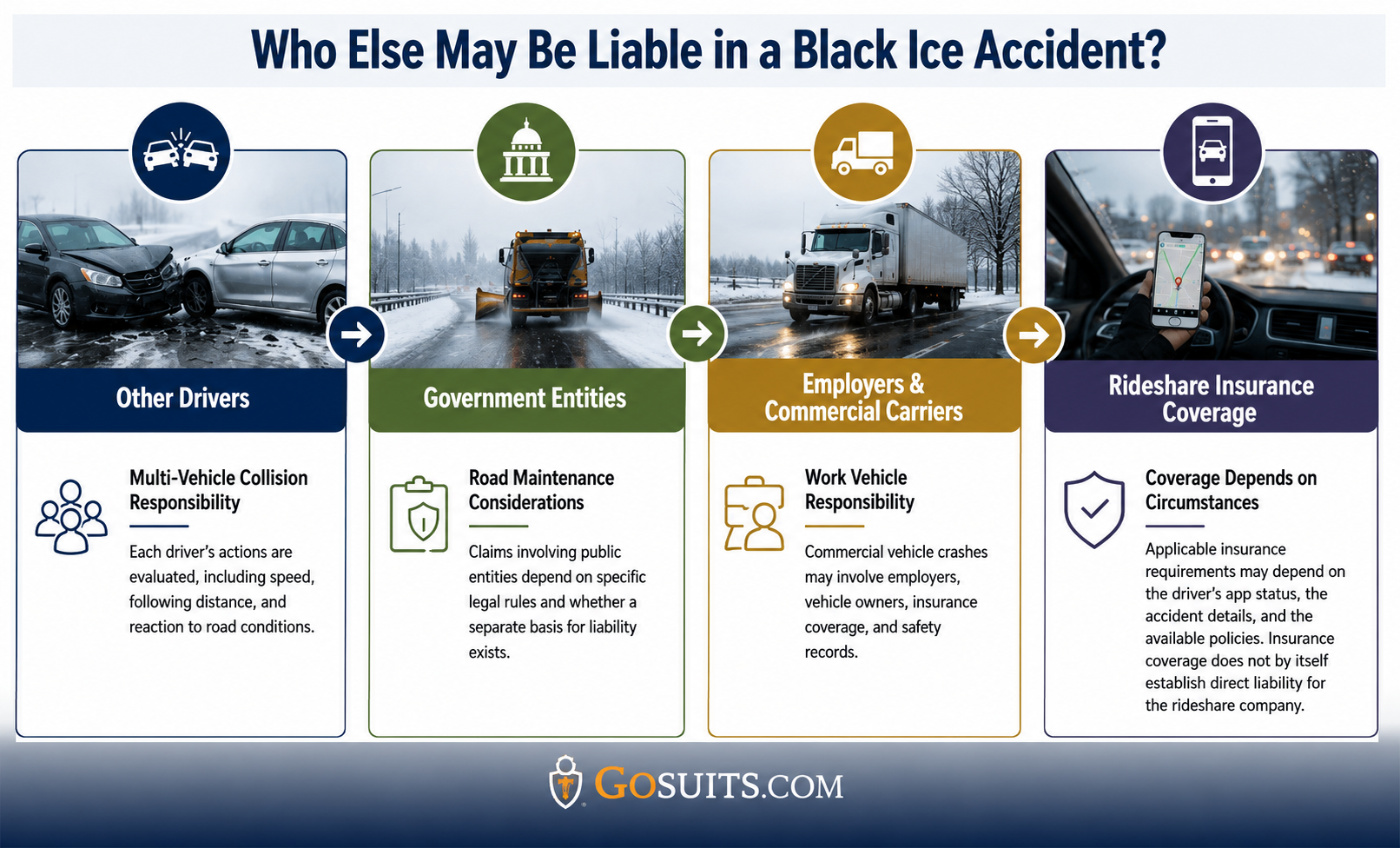
A driver who loses control on black ice is not always the only party whose actions are evaluated after a collision. Depending on how the accident occurred, more than one driver or, in limited circumstances, another person or entity may share legal responsibility.
Illinois law generally determines liability based on each party’s conduct rather than the presence of black ice alone.
Other Drivers Involved in a Multi-Vehicle or Chain-Reaction Crash
Black ice can contribute to multi-vehicle collisions on high-speed roadways, including DuSable Lake Shore Drive, the Dan Ryan Expressway, and the Kennedy Expressway.
In these situations, each driver’s actions are evaluated individually. One driver may have been traveling too fast for conditions, while another may have followed too closely or failed to react safely after the initial collision.
Illinois follows a modified comparative negligence system, meaning responsibility may be divided among multiple drivers based on each person’s contribution to the accident. The fact that black ice was present does not automatically assign or eliminate fault for any individual driver.
Government Entities Responsible for Road Maintenance
Claims against the City of Chicago, Cook County, or another local public entity for black ice on a public roadway are highly restricted.
Under section 3-105 of the Illinois Local Governmental and Governmental Employees Tort Immunity Act, a local public entity and its employees generally are not liable for injuries caused by the effects of weather conditions on streets, highways, and other public ways. This protection can apply even when snow or ice contributed to the crash.
A viable claim would usually require a legally distinct basis beyond the mere presence of naturally occurring black ice, such as evidence that the public entity created or contributed to a hazardous condition through conduct not protected by the Act. Whether any exception or separate theory applies is highly fact-specific.
Claims involving IDOT or another state agency may be governed by different statutes, immunities, procedures, and forums than claims against local public entities.
Employers, Commercial Carriers, and Rideshare Insurance
If a black ice crash involves a commercial truck, bus, delivery vehicle, or other work vehicle, an employer or vehicle owner may be responsible when the driver was acting within the scope of employment or another recognized basis for liability applies.
Commercial-vehicle claims may also involve carrier insurance, maintenance records, driver-training evidence, or federal and state safety requirements. Readers can learn more from our Chicago truck accident attorneys.
A rideshare collision may involve separate insurance requirements based on the driver’s app status. The availability of rideshare insurance does not, by itself, establish that Uber or Lyft is directly liable for the driver’s conduct.

How does Illinois’ comparative negligence rule affect a black ice claim?
Illinois follows a modified comparative negligence rule under 735 ILCS 5/2-1116. If more than one party contributed to a black ice accident, each person’s percentage of fault is evaluated. An injured party may still recover damages as long as they are 50% or less at fault. If they are found to be more than 50% at fault, they generally cannot recover damages from another at-fault party.
For example, if a driver has $100,000 in proven damages and is found 20% at fault, the recoverable amount may be reduced to $80,000. If they are found 50% at fault, they may recover $50,000. However, if they are found 51% at fault, Illinois law generally bars recovery.
Comparative negligence is particularly important in black ice accidents involving multiple vehicles, where each driver’s actions are evaluated to determine their share of responsibility.
What Evidence Helps Prove Fault in a Black Ice Accident Case?
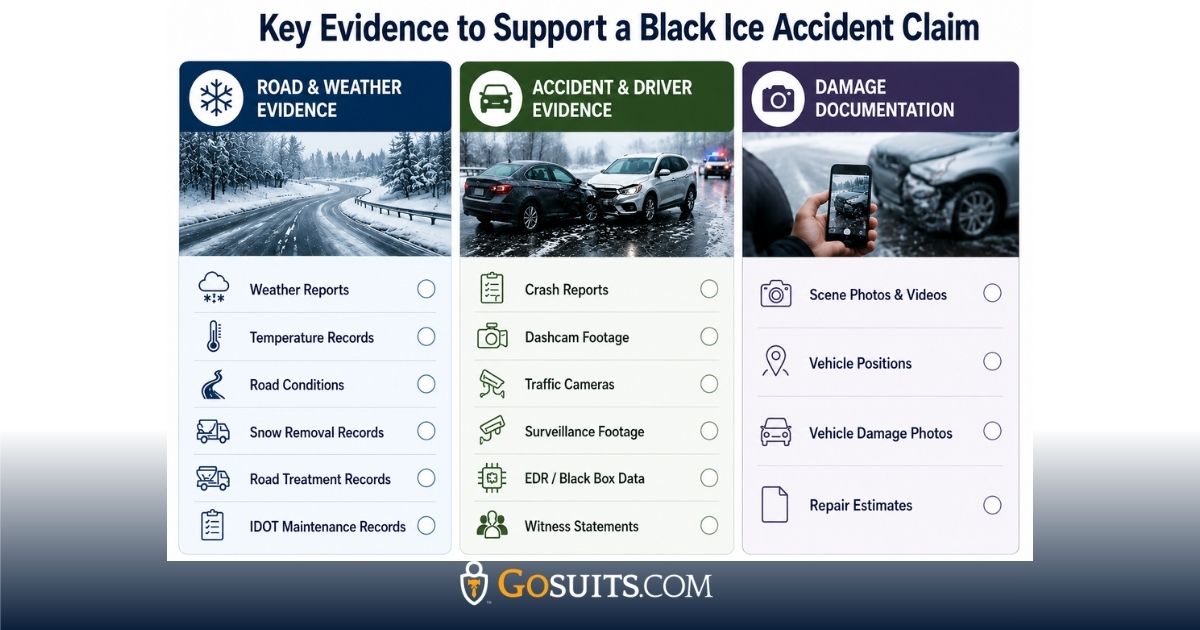
Determining fault in a black ice accident often depends on the available evidence. Rather than assuming the collision was unavoidable because of the weather, insurers and courts generally examine the roadway conditions, each driver’s actions, and the physical evidence to determine whether reasonable care was exercised under the circumstances.
Documentation That Strengthens a Black Ice Claim
The following evidence may help establish how the accident occurred and how responsibility should be allocated:
- The Illinois Traffic Crash Report or other law enforcement documentation
- Weather reports showing precipitation, road conditions, and visibility at the time of the accident
- Temperature records demonstrating when freezing conditions existed
- Dashcam footage from the vehicles involved
- Traffic camera or nearby surveillance footage, when available
- Event Data Recorder (EDR) or “black box” data showing vehicle speed, braking, and steering inputs
- Statements from witnesses who observed the roadway conditions or the collision
- Photographs or videos of the accident scene, vehicle positions, and roadway conditions
- Road-treatment, snow-removal, or salting records maintained by the responsible roadway authority, when relevant
- Illinois Department of Transportation (IDOT) maintenance records for state-maintained roadways, when applicable
- Photographs and repair estimates documenting vehicle damage
Preserving this information as early as possible can help provide a clearer picture of the road conditions and the actions of the drivers before the collision.
Why Black Ice Claims Can Involve Fault Disputes
Black ice accidents can present unique factual questions because the ice itself is often difficult to see and may form rapidly as temperatures change. As a result, insurers may carefully evaluate whether the collision resulted primarily from the roadway conditions, a driver’s conduct, or a combination of both.
Under Illinois law, the presence of black ice alone does not automatically establish or eliminate fault. Instead, the analysis generally focuses on whether each driver exercised reasonable care under the circumstances, taking into account factors such as speed, following distance, visibility, and the available evidence. Because every accident is different, fault determinations depend on the specific facts of each case.
What damages can be recovered in a black ice accident claim?
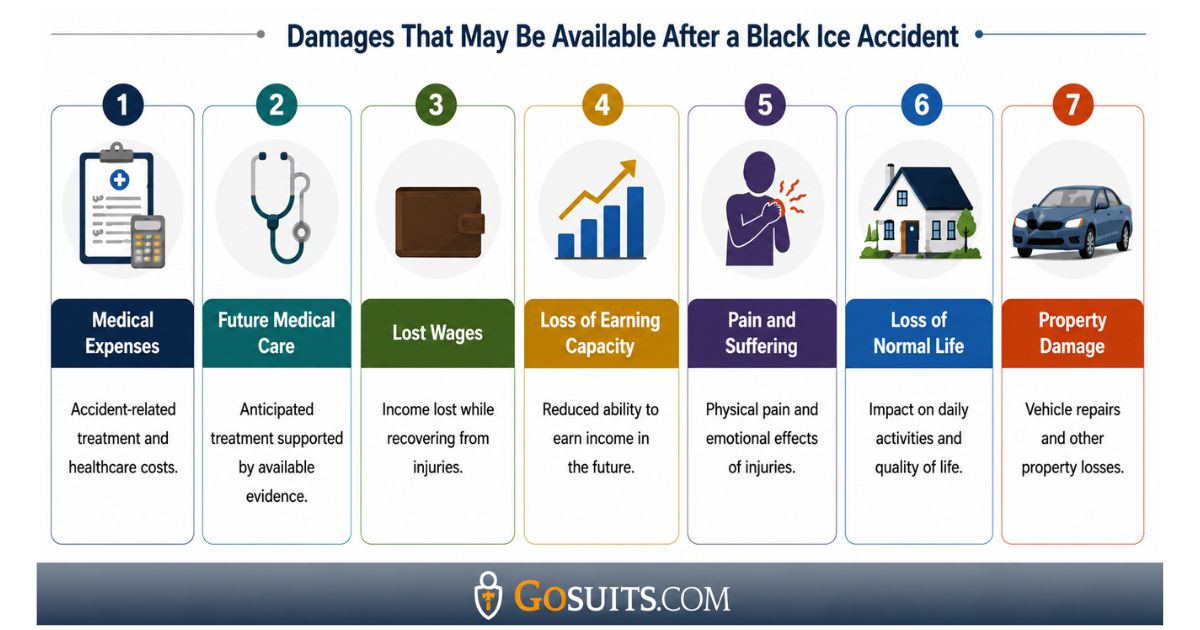
The damages available after a black ice accident depend on the facts of the case, the injuries sustained, and the applicable Illinois law. In qualifying claims, an injured person may be able to recover both economic and non-economic damages supported by the available evidence.
Medical Expenses
Compensation may be available for reasonable and necessary medical expenses related to the accident, including emergency treatment, hospitalization, physician visits, rehabilitation, prescription medications, and other qualifying healthcare costs.
Future Medical Care
If an injury is expected to require ongoing treatment, a claim may include the anticipated cost of future medical care supported by medical records, healthcare providers, or other available evidence.
Lost Wages
Individuals who miss work because of accident-related injuries may be able to recover compensation for the income lost during their recovery. This may include wages, salary, commissions, bonuses, or other employment-related earnings that would have been received but for the injury.
Loss of Earning Capacity
When injuries affect a person’s ability to earn income in the future, compensation may be available for a reduced earning capacity, depending on the nature and extent of the impairment.
Pain and Suffering
Illinois law may allow recovery for the physical pain, emotional distress, and other non-economic effects resulting from injuries sustained in a black ice accident. The extent of these damages depends on factors such as the severity of the injuries, the recovery process, and the impact on the individual’s daily life.
Loss of Normal Life
A claim may also include compensation for the loss of normal life, which refers to the reduced ability to participate in everyday activities, hobbies, family responsibilities, social events, or other aspects of life that were affected by the injuries.
Property Damage
When applicable, compensation may be available for damage to a vehicle or other personal property resulting from the collision, including reasonable repair costs or other recoverable property losses.
The damages available in any particular case depend on the evidence presented, the applicable Illinois law, and the specific circumstances surrounding the accident.
In the most serious accidents, a collision may result in fatal injuries. Families seeking information about these situations can learn more from our Chicago wrongful death attorneys.

How long do you have to file a black ice accident lawsuit in Illinois?
Illinois generally allows two years from the date of an injury to file a personal injury lawsuit under 735 ILCS 5/13-202.
Different deadlines may apply when a public entity or public employee is involved. Many actions against Illinois local public entities must be filed within one year, while claims involving the State of Illinois or IDOT may be governed by different statutes and procedures. Insurance policies may also require notice or other action sooner than the civil filing deadline.
Prompt investigation can also help preserve traffic-camera footage, weather data, witness information, vehicle records, and roadway-maintenance documents.
Speak With GoSuits About a Chicago Black Ice Accident
Black ice collisions can raise difficult questions about driver conduct, comparative fault, insurance coverage, and the available evidence. Determining responsibility may require reviewing the road conditions, vehicle movements, witness accounts, weather records, and the conduct of everyone involved.
GoSuits helps people evaluate Chicago winter-accident claims and understand the legal options that may be available under Illinois law. Learn more about the services provided by our Chicago car accident attorneys.
Contact GoSuits for a free case evaluation.
FAQs
What if I was partly at fault for sliding on black ice?
You may still be able to recover compensation under Illinois’ modified comparative negligence rule. Your recovery may be reduced by your percentage of fault, but it is generally barred only if you are more than 50% at fault.
Is hitting black ice always considered an unavoidable accident?
No. The presence of black ice does not automatically establish either negligence or an unavoidable accident. Fault depends on whether the evidence shows that one or more drivers failed to use reasonable care under the conditions.
What if another driver says the ice caused the crash?
Black ice is only one factor considered during a fault determination. Police reports, witness statements, roadway conditions, and other evidence may help establish whether a driver’s actions contributed to the collision.
Can I sue the City of Chicago for an untreated icy road?
Claims based only on naturally occurring ice or snow are generally barred by Illinois weather-condition immunity. A claim would usually require a legally distinct basis beyond the public entity’s failure to remove or treat the ice, and the applicable rules are highly fact-specific.
What evidence is most important after a black ice accident?
Helpful evidence includes the police report, photographs, weather records, witness statements, dashcam footage, and roadway maintenance records when available.
Does the posted speed limit determine fault on icy roads?
No. A driver may still be found negligent if their speed was unsafe for the road and weather conditions.
Should I Report a Black Ice Crash?
A crash should be reported to law enforcement when Illinois law requires it or when emergency assistance is needed. Even when officers do not attend the scene, promptly documenting the roadway, vehicles, injuries, witnesses, and insurance information may help preserve important evidence.