
Being partially at fault does not automatically prevent you from recovering damages in Illinois. A plaintiff may still recover when their contributory fault is 50% or less, although the damages proved are reduced by that percentage. If the plaintiff’s fault is more than 50% of the proximate cause of the injury or damage, recovery is barred.
An insurer’s early allegation of shared fault can be discouraging, but it is not necessarily a binding legal determination. The final allocation depends on the evidence, including the circumstances of the accident, witness accounts, photographs, video, vehicle data, and other relevant information.
Here is the Quick Answer:
- Illinois follows a modified comparative-fault rule under 735 ILCS 5/2-1116.
- You may still recover damages if your share of fault is 50% or less, but your recovery is reduced by your percentage of fault.
- If your contributory fault is more than 50% of the proximate cause of the injury or damage, recovery is generally barred.
- An insurance company’s fault assessment is not a binding legal determination and may be reconsidered as additional evidence becomes available.
- Comparative fault depends on the specific facts, including the conduct of the parties, the available evidence, and whether that conduct was a proximate cause of the injury.
- Police materials, witness accounts, photographs, video, vehicle or electronic data, and, in technically disputed cases, qualified analysis may contribute to the evaluation of fault. No single item automatically determines civil liability.
- Being partially at fault does not change the applicable filing deadline. Many Illinois personal injury claims are subject to the general two-year statute of limitations in 735 ILCS 5/13-202, although exceptions may apply depending on the type of claim and the parties involved.

What is Illinois’ modified comparative negligence rule?
Illinois follows a modified comparative-fault rule, which means that being partially responsible for an accident does not automatically prevent an injured person from recovering damages.
Under 735 ILCS 5/2-1116, a plaintiff may recover damages when their contributory fault is 50% or less, but the recovery is reduced in proportion to that percentage of fault. If the plaintiff’s contributory fault is more than 50% of the proximate cause of the injury or damage, recovery is barred.
Although “comparative negligence” is the familiar term commonly used to describe the system, the Illinois statute uses “contributory fault” when referring to fault attributed to the plaintiff. That fault determines whether recovery is reduced or barred under 735 ILCS 5/2-1116.
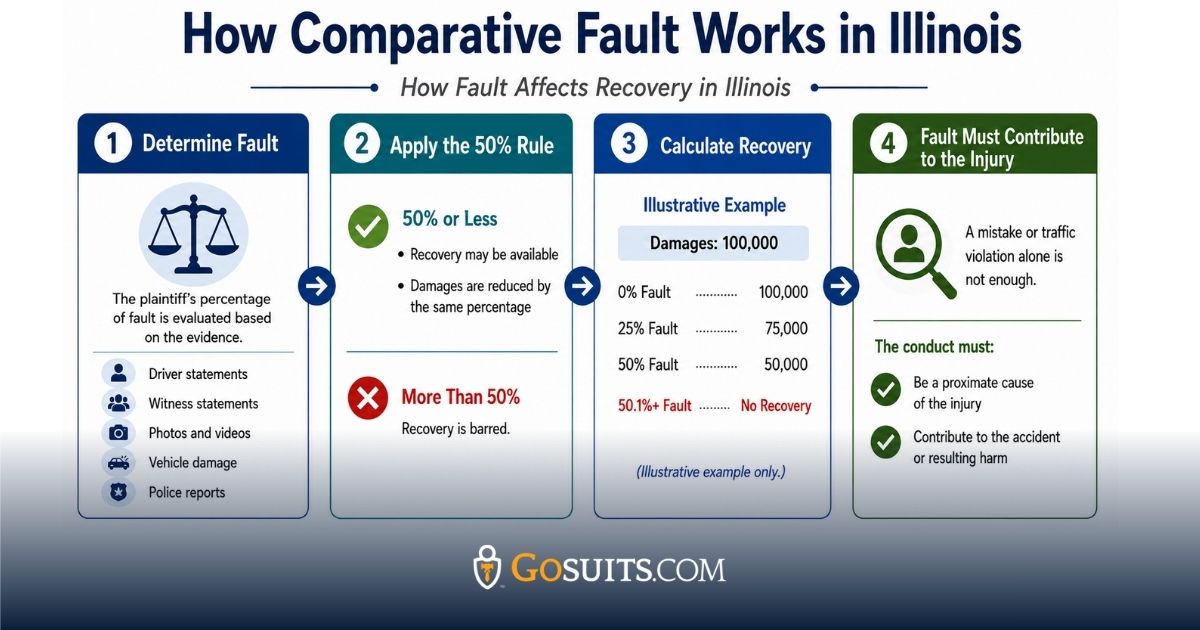
The 50% Threshold: Where Recovery Is Cut Off
The key question under 735 ILCS 5/2-1116 is not simply whether an injured person was partially at fault, but how much fault is attributed to them. If the plaintiff’s contributory fault is 50% or less, recovery may still be available, although any damages proved are reduced by that same percentage. If the plaintiff’s contributory fault is more than 50%, the statute bars recovery.
For example, if a jury determines that a plaintiff proved $100,000 in damages and was 50% at fault, the recoverable amount would be reduced to $50,000. If the plaintiff were found 50.1% at fault, recovery would be barred because the plaintiff’s share of fault exceeds the statutory threshold.
This example illustrates how 735 ILCS 5/2-1116 operates mathematically and is not intended to predict the value or outcome of any individual claim.
Fault must be connected to the injury
Comparative fault is not based solely on whether someone made a mistake or violated a traffic rule. Under 735 ILCS 5/2-1116, the plaintiff’s conduct must be a proximate cause of the injury or damage for which recovery is sought. In other words, the analysis focuses on whether the person’s actions actually contributed to the accident or the resulting harm.
Illinois courts have explained that proximate cause requires more than simply identifying careless conduct. In First Springfield Bank & Trust v. Galman, 188 Ill. 2d 252 (1999), the Illinois Supreme Court explained that proximate cause includes both cause in fact and legal cause, meaning the injury must have been a reasonably foreseeable result of the conduct at issue. This principle helps distinguish conduct that merely occurred before an accident from conduct that legally contributed to the injury.
For that reason, an unrelated traffic violation does not automatically establish comparative fault. Instead, the evidence must show that the plaintiff’s conduct was a proximate cause of the collision, occurrence, injury, or claimed damage. Illinois Pattern Jury Instructions addressing proximate cause and contributory negligence similarly require the trier of fact to determine whether the plaintiff’s conduct contributed to the injury before assigning a percentage of fault.
How Illinois’ Rule Differs From Other States
States use different approaches when a person seeking compensation shares some responsibility for an accident. Under a modified comparative-fault system like Illinois’, recovery is permitted only up to a specified threshold, with damages reduced according to the plaintiff’s percentage of fault. Illinois bars recovery when the plaintiff’s contributory fault is more than 50%.
Some jurisdictions follow pure comparative fault, which generally allows recovery regardless of the plaintiff’s percentage of fault, although the damages are reduced accordingly.
Others follow contributory negligence, where a plaintiff’s own negligence may completely bar recovery. Understanding which system applies is important because the same facts can produce different legal outcomes depending on the governing law.
How does the fault percentage actually reduce your compensation?
When a plaintiff’s contributory fault is 50% or less, Illinois reduces the damages proved by the percentage of fault attributed to the plaintiff. If the plaintiff’s contributory fault is more than 50%, 735 ILCS 5/2-1116 bars recovery. The reduction is applied after the damages have been established through the evidence.
How Comparative Fault Affects Damages in Illinois |
||
|---|---|---|
| Your Fault Percentage | Damages Proved | Illustrative Result |
| 10% | $100,000 | $90,000 |
| 30% | $100,000 | $70,000 |
| 49% | $100,000 | $51,000 |
| 50% | $100,000 | $50,000 |
| 51% | $100,000 | $0 (Recovery Barred Because Fault Exceeds 50%) |
The examples above show how the comparative-fault calculation works once the damages proved and the plaintiff’s percentage of fault have been determined. In practice, the parties may disagree about both the amount of damages and the appropriate allocation of fault, making these issues central to settlement negotiations or litigation.
➤ Note: This table illustrates the mathematical operation of 735 ILCS 5/2-1116. It does not predict the value or outcome of any individual claim. Damages and fault percentages must be established through the evidence, agreement of the parties, or a finding by the trier of fact.
Who decides what percentage of fault you bear?
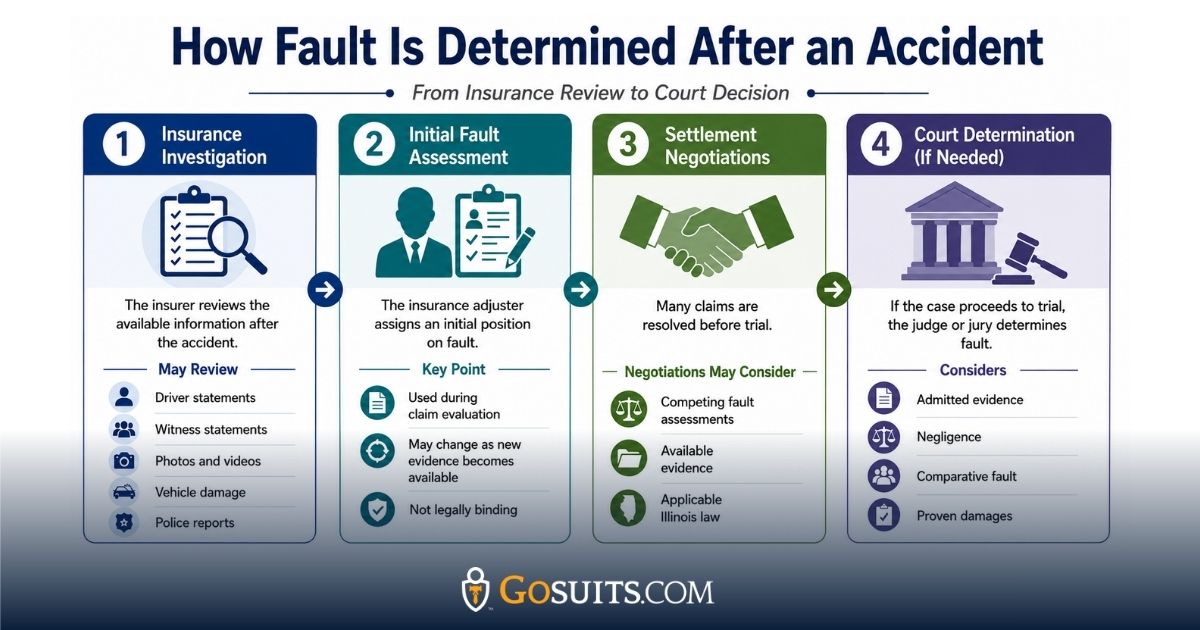
During an insurance claim, an adjuster may take an initial position on fault based on the information available at that stage of the investigation.
That assessment can influence settlement discussions, but it is not a binding court determination. If a disputed claim proceeds to trial, the trier of fact, either a jury or, in a bench trial, the judge, determines each party’s fault based on the admitted evidence.
Many personal injury claims are resolved before reaching trial. In those situations, the parties may negotiate using competing assessments of fault without a judge or jury assigning a formal percentage. The outcome of those negotiations often depends on the strength of the available evidence and each party’s evaluation of the legal and factual issues.
How Insurance Adjusters Assess Fault
Insurance adjusters evaluate fault by reviewing the available evidence and applying the relevant facts and traffic laws to the circumstances of the accident. Depending on the claim, an adjuster may consider:
- Statements from the drivers or other involved parties
- Witness names and statements
- Photographs and video of the accident scene
- Vehicle damage and the location of the impact
- Traffic-control information, such as signals, signs, and lane markings
- Crash reports and the responding officer’s observations
- Information regarding any traffic citations that were issued
- Available electronic or vehicle data, such as dashcam footage or event data recorder information
- Applicable Illinois traffic laws and roadway rules
An adjuster evaluates this information on behalf of the insurer and its insured when assessing responsibility for the accident. The insurer’s assessment may differ from the injured person’s position and may change if additional evidence becomes available during the claims process.
A police report or traffic citation may be considered as part of the investigation, but neither automatically establishes civil fault or determines the outcome of a negligence claim.

How Fault Is Determined If the Case Goes to Court
If a claim cannot be resolved through negotiation, the trier of fact evaluates the admitted evidence to determine whether the defendant was negligent, whether the plaintiff was also negligent, whether either party’s conduct was a proximate cause of the injury, the percentage of fault attributable to the plaintiff, and the amount of damages proved. Illinois Pattern Jury Instructions provide guidance on issues such as ordinary care, contributory negligence, proximate cause, burden of proof, and the reduction of damages based on comparative fault.
Depending on the issues in dispute, the parties may also present testimony from qualified witnesses, including accident reconstruction or medical professionals. Such testimony may help explain technical or medical issues when appropriate, but it is not required in every Illinois car accident case.
What kinds of actions can increase your assigned fault percentage?
A person’s conduct may support a comparative-fault argument when it was negligent and was a proximate cause of the accident, injury, or damage. However, the existence of a traffic violation or other mistake does not automatically establish a particular percentage of fault. The allocation depends on the specific facts and the evidence presented in each case.
Examples of conduct that may be considered in a comparative-fault analysis include:
- Speeding or driving too fast for traffic, visibility, weather, or road conditions
- Distracted driving, including phone use, when it contributed to the collision
- Following another vehicle too closely
- Failing to signal when the omission contributed to the crash
- Making an unsafe lane change
- Failing to yield the right-of-way where required
- Entering an intersection against a traffic signal
- Driving while impaired
- Failing to keep a proper lookout
In other types of negligence cases, the analysis is similar. For example, in a pedestrian accident, a person’s actions may be considered if they entered traffic when it was not reasonably safe or failed to yield where required.
In a premises-liability claim, a defendant may argue that the injured person failed to avoid a visible condition, but the outcome depends on the property owner’s legal duties, the surrounding circumstances, foreseeability, proximate cause, and the evidence as a whole. None of these examples automatically results in a finding of comparative fault.
Illinois Seatbelt Rule
Under 625 ILCS 5/12-603.1(c), failing to wear a seatbelt cannot be used as evidence of negligence, does not limit an insurer’s liability, and does not diminish recovery for damages arising from the ownership, maintenance, or operation of a motor vehicle.
Although Illinois law generally requires occupants to wear an available seatbelt, that legal requirement is separate from the rule governing the admissibility of seatbelt evidence in a civil personal injury case.
What should you do if an insurer says you’re partially at fault?
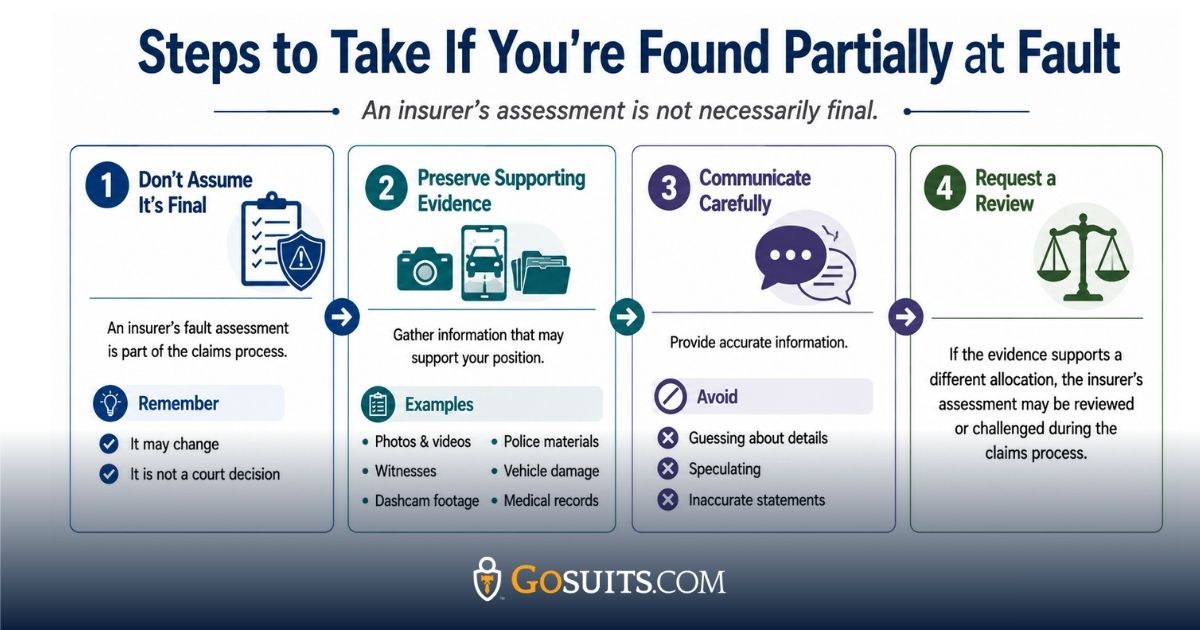
If an insurer says you were partially at fault for an accident, do not assume that the assigned percentage is final. Preserve available evidence, provide accurate information, avoid guessing about facts you do not remember, and consider asking a Chicago personal injury attorney to review the insurer’s assessment before accepting a settlement based on it.
An insurer’s position is one part of the claims process and may change as additional evidence becomes available.
Don’t Accept the Insurer’s Fault Percentage as Final
An insurer’s allocation of fault is a claims or negotiating position, not a binding judicial determination. During the investigation, the insurer may revise its assessment if new information, such as photographs, witness testimony, video footage, electronic data, or expert analysis, supports a different view of how the accident occurred.
If the claim cannot be resolved and proceeds to litigation, comparative fault is ultimately determined by the trier of fact based on the admitted evidence. A fault assessment should be challenged when the available evidence supports a different allocation, rather than simply because the parties disagree.
Gather Evidence That Supports a Lower Fault Percentage
Evidence may play an important role when the parties disagree about how an accident occurred or who was responsible. Depending on the circumstances, helpful information may include:
- Photographs or video of the accident scene
- Vehicle-damage photographs
- Dashcam footage
- Nearby surveillance footage
- Witness names and contact information
- Traffic-signal or road-condition evidence
- Available phone, vehicle, or electronic data
- The crash report and underlying officer observations, where available
- The disposition of any traffic citations
- Medical documentation relevant to the injury mechanism
- Accident reconstruction analysis in serious or technically disputed cases
A police report or traffic citation does not, by itself, conclusively establish civil fault. Whether particular evidence may be considered and the weight it receives depend on the circumstances of the case and the applicable rules of evidence.
Be Careful and Accurate in Insurance Communications
Statements made during the claims process may affect how an insurer evaluates fault. When discussing an accident, it is generally important to provide truthful information and avoid guessing about details such as speed, visibility, traffic signals, lane position, distraction, or other facts that you do not clearly remember.
An apology does not automatically establish legal fault, but factual admissions made while explaining what happened may become relevant during the claim. Before providing a recorded statement to another party’s insurer, an injured person may wish to seek legal advice. At the same time, policyholders should remember that their own insurance policy may include contractual notice and cooperation obligations that should be followed.
Does Illinois’ comparative negligence rule apply to all types of accidents?
Illinois’ comparative-fault statute applies broadly to negligence actions involving bodily injury, death, or physical property damage, as well as to product-liability claims within the statute’s scope. It commonly arises in car, truck, motorcycle, pedestrian, and premises-liability cases, but it should not be understood as automatically applying to every type of personal injury claim.
Different or additional legal rules may apply depending on the nature of the claim. These can include intentional torts, certain statutory causes of action, claims governed by federal law, workers’ compensation matters, claims involving government bodies or employees, and other actions governed by claim-specific statutes. Because different legal frameworks may apply, the rules governing one type of case do not necessarily control another.
In premises-liability cases, comparative fault may become an issue if a defendant argues that the injured person failed to notice or avoid a condition. However, the outcome does not depend solely on whether the condition was visible. Courts may also consider the property owner’s legal duty, the nature and visibility of the condition, whether the harm was reasonably foreseeable, whether the plaintiff’s conduct was a proximate cause of the injury, the conduct of all parties involved, and other applicable premises-liability principles. A visible condition alone does not automatically prevent recovery or determine the plaintiff’s percentage of fault.

Does the statute of limitations still apply if you were partially at fault?
Yes. Being partially at fault does not suspend or extend the deadline for filing a personal injury claim. Many Illinois personal injury actions are subject to the two-year statute of limitations in 735 ILCS 5/13-202, but the applicable filing deadline depends on the defendant, the type of claim, and the surrounding circumstances. In general, 735 ILCS 5/13-202 requires personal injury actions to be filed within two years after the cause of action accrued.
The two-year limitations period does not apply identically to every case. Different filing deadlines or procedural requirements may apply depending on factors such as the type of cause of action, the claimant’s age or legal disability, discovery-rule issues, statutes of repose, or other claim-specific statutory provisions.
Claims involving the City of Chicago, the Chicago Transit Authority (CTA), another public entity, or a government employee may also be subject to different legal requirements and should be reviewed promptly. Importantly, comparative fault itself does not change the statute of limitations or provide additional time to file a claim.
FAQs
Can I still sue if I was 40% at fault for my accident?
Potentially, yes. Under 735 ILCS 5/2-1116, a plaintiff who is found 40% at fault may still recover damages if the other elements of the claim are established. Any damages proved would generally be reduced by the plaintiff’s percentage of fault, resulting in a 40% reduction rather than a complete bar to recovery.
What happens if fault is split exactly 50/50?
A plaintiff who is exactly 50% at fault is not barred from recovery under the current Illinois statute. Because 735 ILCS 5/2-1116 bars recovery only when the plaintiff’s contributory fault is more than 50%, a plaintiff found to be exactly 50% at fault may still recover, with the damages proved reduced by 50%.
What if I am found 50.1% at fault?
Recovery is generally barred. Because 50.1% is more than 50%, 735 ILCS 5/2-1116 prevents recovery. This illustrates why the statutory language “more than 50%” is more precise than simply referring to a “51% bar.”
Can the insurance company's fault percentage be challenged?
Yes. An insurance company’s assessment of fault is part of the claims process and is not a binding judicial determination. If additional photographs, witness statements, video, electronic data, expert analysis, or other evidence supports a different allocation of fault, that position may be addressed during negotiations or, if necessary, evaluated by the trier of fact.
Does a traffic ticket determine civil fault?
No. A traffic citation does not automatically establish civil liability or a particular percentage of fault. The circumstances of the accident, the disposition of the citation, the admissible evidence, and whether the alleged conduct was a proximate cause of the injury all remain relevant when determining comparative fault.
Can not wearing a seatbelt reduce my Illinois accident recovery?
No. Under 625 ILCS 5/12-603.1(c), failure to wear a seatbelt cannot be considered evidence of negligence or used to reduce recovery for damages arising from the ownership, maintenance, or operation of a motor vehicle.
Is Illinois a no-fault state?
No. Illinois generally follows an at-fault system for motor vehicle accidents. A person seeking compensation from another driver generally must establish that driver’s legal responsibility, subject to Illinois’ comparative-fault rule and the available insurance coverage.
Does partial fault affect how much a case is worth?
Yes. When recovery is permitted under 735 ILCS 5/2-1116, the plaintiff’s percentage of fault directly reduces the recoverable damages. Disputed fault may also influence settlement negotiations, litigation strategy, and the amount of evidence needed to support the claim. However, no particular settlement value can be predicted based on fault percentage alone.