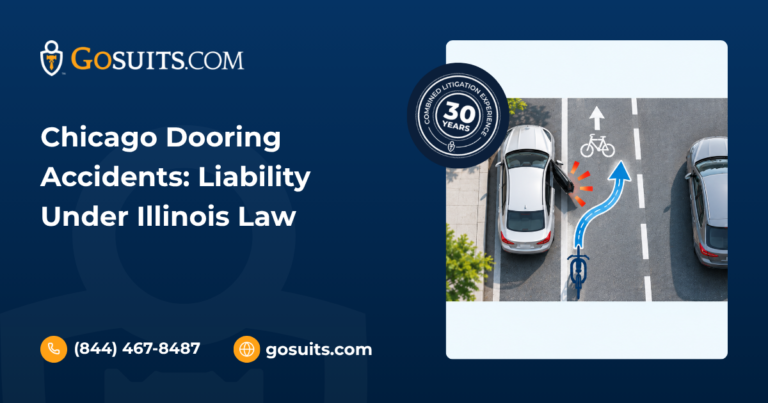
A dooring accident in Chicago happens when someone opens a vehicle door into a cyclist’s path, causing a collision, fall, or other crash. Illinois law places the duty to open the traffic-side door safely on the person opening it, which may be the driver or a passenger. Liability still depends on the evidence, including proximate cause.
These crashes can become more complicated when the cyclist never hits the door, a passenger opened it, or no citation was issued. Illinois law does not limit the door-opening duty to drivers, and cyclists riding on a highway generally have the rights and duties applicable to vehicle drivers.
In Chicago, identifying who opened the door, where the vehicle was positioned, and how the crash occurred can be central to the liability analysis.
Here is the Quick Answer:
- A Chicago dooring crash happens when someone opens or leaves a vehicle door in a cyclist’s path.
- Under 625 ILCS 5/11-1407, the duty applies to the person opening the door, which may be a driver or passenger.
- A cyclist may still have a claim even without hitting the door if the door-opening conduct proximately caused the crash and injuries.
- A traffic ticket does not decide civil liability, and the absence of a citation does not automatically defeat a claim.
- Under Illinois modified comparative fault, a cyclist may recover damages if they are 50% or less at fault, with damages reduced by their percentage of fault.
- Useful evidence can include the crash report, identity of the door-opener, photos, video, witnesses, medical records, and documentation of bicycle damage.
- Potential damages may include medical expenses, lost earnings, pain and suffering, loss of a normal life, and property damage.
- Insurance may involve the vehicle policy, commercial or rideshare coverage, or potentially the cyclist’s own UM/UIM coverage depending on the facts and policy terms.
- Most Illinois personal injury lawsuits have a two-year filing period, but some claims involving local public entities or the CTA can have a one-year deadline.

What Is Dooring?
Dooring is a bicycle crash caused when a vehicle door is opened, or remains open, in a rider’s path. It often occurs when a cyclist is traveling beside parked or stopped vehicles and someone opens a traffic-side door into the space the cyclist is using.
The area beside parked vehicles that an open door can occupy is commonly called the door zone. A dooring crash can happen in more than one way:
Direct impact: The cyclist strikes a door that opens or is already open in the rider’s path.
Avoidance crash: The cyclist swerves or brakes to avoid the door and falls or becomes involved in a collision with other traffic.
Illinois law directly addresses vehicle doors. Under 625 ILCS 5/11-1407, a person may not open a vehicle door on the side available to moving traffic unless it is reasonably safe and can be done without interfering with other traffic. The statute separately prohibits leaving that door open longer than necessary to load or unload passengers.
The Two Duties Under Illinois’ Dooring Law
| Duty | What It Requires | Typical Situation |
|---|---|---|
| Opening the Door | A traffic-side door should not be opened unless it is reasonably safe and will not interfere with moving traffic. | A door swings open into an approaching cyclist’s path. |
| Leaving the Door Open | A traffic-side door should not remain open longer than necessary to load or unload passengers. | A cyclist encounters a door that was already standing open. |
Chicago also has a separate local rule addressing vehicle doors. Chicago Municipal Code § 9-80-035 prohibits opening a vehicle door into moving traffic when doing so would interfere with that traffic. A violation of the ordinance may be relevant to the negligence analysis, but it does not automatically establish civil liability. The injured person must still prove the required elements of the claim, including proximate cause.
Illinois also generally gives people riding bicycles on a highway the rights and duties applicable to vehicle drivers under 625 ILCS 5/11-1502. Whether a particular dooring accident establishes civil liability, however, depends on the circumstances and evidence surrounding the crash.
Who Is Liable for a Dooring Accident in Chicago?
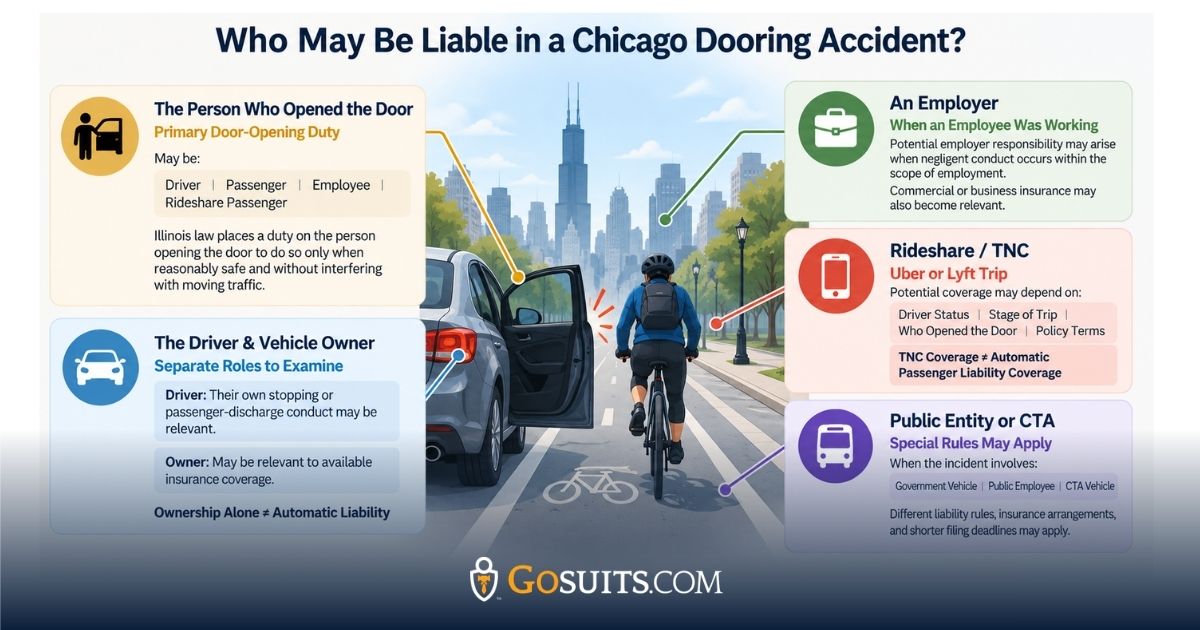
Illinois places the door-opening duty on the person who opens the door, and more than one party may be part of the liability analysis depending on the circumstances. The person opening the door may be the driver, a passenger, an employee acting within the scope of work, or a rideshare passenger. A vehicle owner, employer, transportation network company, or public entity may also become relevant depending on the facts and available coverage.
More than one party may be part of a dooring claim, depending on who opened the door and why they were in the vehicle.
Who May Be Liable in a Chicago Dooring Accident
| Party | When They May Be Part of the Analysis | Coverage That May Respond |
|---|---|---|
| The Person Who Opened the Door | The statutory duty in 625 ILCS 5/11-1407 applies to the person opening a door on the side available to moving traffic | The vehicle’s liability policy or other applicable coverage, depending on the policy terms |
| The Driver, When Someone Else Opened the Door | The driver’s own conduct may also matter, such as how or where the vehicle was stopped to discharge passengers | The vehicle’s liability policy may be relevant |
| The Vehicle’s Owner | Ownership may be relevant to identifying applicable insurance, even when the owner was not the person who opened the door | The owner’s automobile policy, subject to its terms and the facts |
| An Employer | An employer may be vicariously liable where an employee’s negligent conduct occurred within the scope of employment | Commercial automobile or other applicable business coverage may be relevant |
| A Transportation Network Company | TNC insurance requirements may apply when a driver was providing transportation network company services under 625 ILCS 57 | Coverage required under the Transportation Network Providers Act may be relevant, depending on the stage of the trip and policy terms |
| A Local Public Entity or the CTA | Special rules may apply where a local-government vehicle, public employee, or CTA vehicle is involved | Public-entity insurance or self-insurance may be relevant; shortened filing periods may also apply |
This table provides a general framework for identifying parties and possible coverage. It does not determine liability or coverage in an individual claim.
The Person Who Opened the Door
The most important first question is who actually opened the door. Section 11-1407 states that “no person” may open a vehicle door on the side available to moving traffic unless doing so is reasonably safe and will not interfere with other traffic.
That wording matters because the duty is not limited to the driver. A rear-seat passenger, front-seat passenger, or another person getting out of the vehicle may be subject to the same statutory door-opening requirement.
Identifying the door-opener separately from the driver and vehicle owner can therefore be important when determining whose conduct is at issue and which insurance coverage may apply.
The Driver and the Vehicle’s Owner
A driver who did not open the door is not automatically responsible simply because they were driving the vehicle. Their own conduct may still be relevant, however, if it independently contributed to the crash.
For example, the location and manner in which a vehicle was stopped to let passengers out may be part of the negligence analysis. The vehicle owner may also be important for insurance purposes, but ownership alone should not be described as establishing liability for another person’s act.
An Employer, When the Door-Opener Was Working
An employer may sometimes be responsible for an employee’s negligence under respondeat superior when the employee was acting within the scope of employment. Illinois courts examine the circumstances of the employee’s conduct rather than treating employment status alone as enough to impose liability, similar to how negligence is proven in a Chicago crash.
In a dooring case, this issue may arise with delivery workers, couriers, tradespeople, commercial drivers, or other employees using a vehicle while performing job duties. The employment relationship can also affect which commercial insurance policies may need to be reviewed.
When an Uber or Lyft Passenger Opens the Door
A rideshare dooring claim can involve a more complicated coverage analysis because the person who opened the door may be a passenger rather than the TNC driver.
Illinois’ Transportation Network Providers Act, 625 ILCS 57/10, requires different levels of automobile liability coverage depending on the driver’s status. The statute distinguishes between periods when the driver is merely logged into the platform and periods beginning when the driver accepts a ride request and continuing through completion of the ride.
That does not mean TNC coverage automatically applies to every negligent act by a passenger. The available coverage depends on the circumstances of the trip, who qualifies as an insured under the relevant policy, and the policy language itself. The passenger’s own potential responsibility and other available coverage may also need to be examined.
When a City Vehicle, CTA Bus, or Public Employee Is Involved
Different procedural rules can apply when a dooring crash involves a local public entity, public employee, or CTA vehicle. Similar shortened-deadline and liability issues can arise in claims involving a CTA bus or L train.
Under 745 ILCS 10/8-101, many civil actions against Illinois local public entities or their employees generally must be commenced within one year, subject to statutory exceptions. Claims directly against the CTA are governed separately by the Chicago Transit Authority Act, and 70 ILCS 3605/41 currently provides a one-year limitations period for personal injury actions against the Authority.
This distinction matters because the ordinary two-year limitations period that applies to many Illinois personal injury actions may not control when a government defendant is involved.
Does a Traffic Ticket Decide Who Is at Fault?
No. A traffic ticket can be relevant evidence in a Chicago dooring claim, but it does not automatically establish civil liability. Illinois generally treats the violation of a safety statute or ordinance as prima facie evidence of negligence, not negligence per se.
In Kalata v. Anheuser-Busch Companies, Inc., 144 Ill. 2d 425 (1991), the Illinois Supreme Court explained that a qualifying statutory or ordinance violation may support a negligence claim, but the injured person must still prove proximate cause and the other required elements. The defendant may also present evidence that they acted reasonably under the circumstances.
The same principle works in reverse. The absence of a traffic ticket does not automatically defeat a civil claim. Liability is evaluated from the applicable duties and the available evidence, which may include photographs, video, witness accounts, the crash report, and medical records. Our guide to how a police report affects an injury claim explains the role that report may play in an Illinois case.
What If You Swerved and Never Hit the Door?
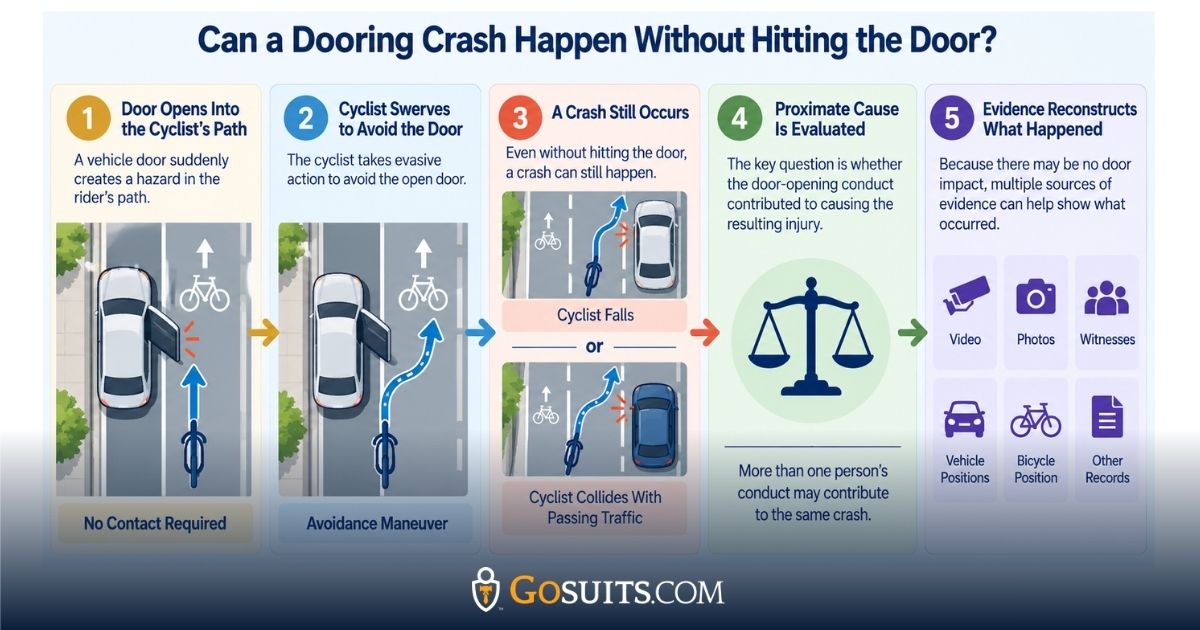
Physical contact with the vehicle door is not required for the door-opener’s conduct to be considered in a Chicago bicycle accident claim. A cyclist may encounter an opening door, swerve to avoid it, and fall or collide with another vehicle. In that situation, the central question is whether the door-opener’s conduct was a proximate cause of the resulting injury.
Illinois Pattern Jury Instruction 15.01 addresses proximate cause and recognizes that an injury can have more than one cause. This means another contributing event, such as the involvement of a passing vehicle, does not necessarily remove the door-opener’s conduct from the causation analysis.
For example, if a cyclist moves left to avoid a door opening into the rider’s path and is then involved in a collision with passing traffic, the conduct of both the door-opener and another road user may need to be evaluated.
Liability still depends on the evidence and whether each person’s conduct satisfies Illinois negligence and proximate-cause requirements.
Because there may be no physical impact with the door itself, independent evidence can become particularly important in a no-contact crash. Video, photographs, witness accounts, the positions of the bicycle and vehicle, and other records may help establish why the cyclist swerved or fell and how the sequence occurred.
Can a Cyclist Be Found Partly at Fault in Illinois?
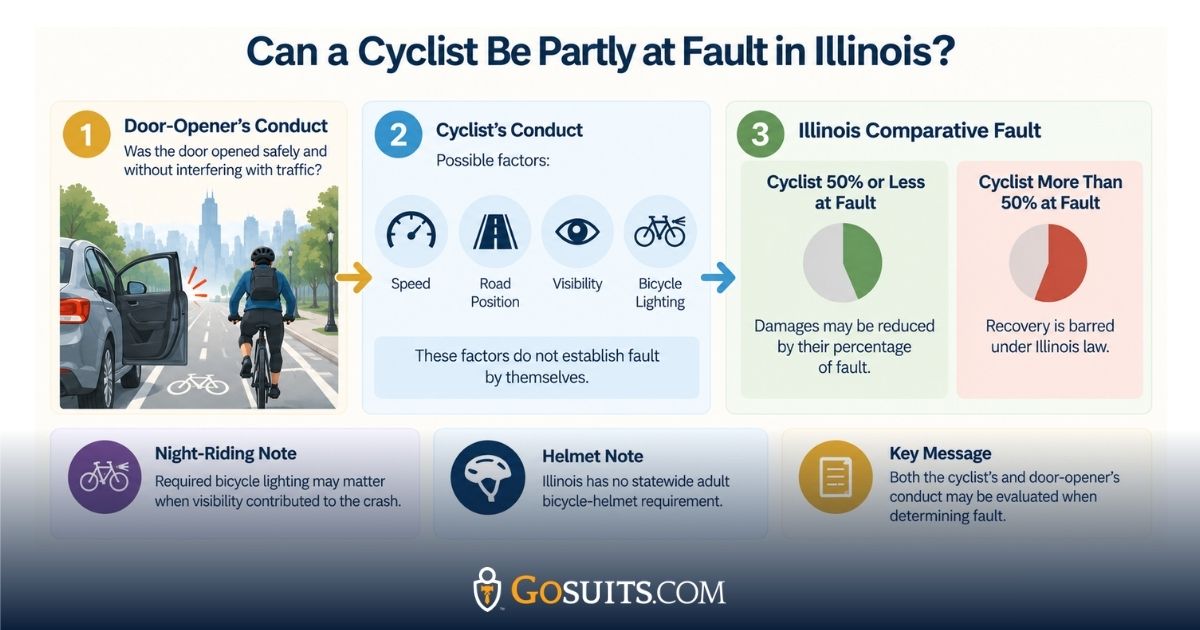
Yes. A cyclist can be assigned part of the fault for a dooring accident under Illinois’ modified comparative fault rule. Under 735 ILCS 5/2-1116, damages are reduced in proportion to the plaintiff’s share of fault when that share is 50% or less. Recovery is barred when the plaintiff’s contributory fault is more than 50% of the proximate cause of the injury. This is the same framework that applies when being partially at fault for a crash in Illinois.
In a dooring claim, the cyclist’s conduct may be evaluated alongside the conduct of the person who opened the door. Depending on the evidence, the analysis may consider:
- the cyclist’s speed;
- the direction of travel;
- the cyclist’s position on the roadway or within a bicycle lane;
- visibility conditions at the time of the crash;
- compliance with applicable bicycle lighting requirements.
These factors do not establish comparative fault by themselves. The issue is whether the cyclist’s conduct contributed to causing the injury. Illinois applies the same comparative-fault principles when evaluating how Illinois assigns fault when road conditions contribute, although the underlying facts and duties differ.
What About Bicycle Lighting?
Illinois imposes specific equipment requirements for nighttime riding. Under 625 ILCS 5/11-1507, a bicycle used at night must have a white front lamp visible from at least 500 feet and qualifying rear reflective or lighting equipment.
If visibility is relevant to how a dooring crash occurred, compliance with these requirements may become part of the comparative-fault and causation analysis. The significance of any lighting issue depends on its connection to the crash rather than on the violation alone.
What If the Cyclist Was Not Wearing a Helmet?
Illinois does not impose a statewide bicycle-helmet requirement on adult riders. Helmet nonuse should therefore not be described as a violation of an Illinois statewide adult bicycle-helmet law.
That does not mean every helmet-related argument is automatically irrelevant. Questions about whether helmet use has any legally permissible bearing on particular claimed injuries or damages are distinct from the statutory comparative-fault question and depend on the applicable evidence and law.
The key distinction is that comparative fault in a dooring case focuses on conduct that contributed to causing the injury-producing event. The person opening the door and the cyclist can each have their conduct evaluated without assuming that either side’s actions automatically determine the outcome.
What Evidence Supports a Dooring Claim?
A dooring claim is usually evaluated through evidence showing who opened the door, where the vehicle and bicycle were positioned, how the crash occurred, and what injuries or property damage followed. In Chicago cases, identifying the door-opener separately from the driver can be especially important because 625 ILCS 5/11-1407 places the door-opening duty on the person who actually opens the door.
Several records can help establish the sequence of events:
Evidence Commonly Used to Support a Dooring Claim
| Evidence | Why It Matters | Time Sensitivity |
|---|---|---|
| Illinois Traffic Crash Report and Any Supplementary Report | Documents the vehicle, involved parties, location, and reported crash sequence | Request early because later investigation may add information or clarify identities |
| Identity of the Door-Opener, Separate From the Driver | The statutory duty applies to the person who opened the door, so the driver’s identity alone may not answer the liability question | Important to document at the scene when possible, especially if the door-opener was a passenger |
| Photographs of the Vehicle, Door, Bicycle Lane, and Roadway | May show the vehicle’s position, lane markings, door location, and surrounding conditions | Most useful when taken before vehicles or conditions change |
| Independent Witnesses | May corroborate who opened the door and how the cyclist reacted | Contact information can become difficult to recover after the scene clears |
| Business, Residential, or Traffic-Camera Video | May capture the door opening, vehicle position, cyclist’s path, or a no-contact avoidance maneuver | Potentially time-sensitive because retention policies vary and footage may later be overwritten |
| Rideshare Trip Records | May help establish whether a transportation network company trip was underway and who was associated with the ride | Often controlled by a third party and may require preservation or formal production |
| Medical Records and Itemized Bills | Document the injuries, reported symptoms, treatment, and medical expenses connected to the crash | Develop over time as treatment continues |
| Bicycle, Helmet, Clothing, and Damaged Equipment | May document impact damage and support the property-damage portion of the claim | Preserve before repair, disposal, or replacement when practicable |
These are common forms of evidence, not a checklist of items that must exist for every dooring claim.
Why Identifying the Door-Opener Matters
A cyclist may exchange information with the driver and later discover that a passenger actually opened the door. That distinction can affect both the negligence analysis and the search for applicable insurance because § 11-1407 applies to the person who opened the traffic-side door.
For that reason, the names and contact information of the driver, door-opener, and vehicle owner should be treated as separate factual questions rather than assumed to be the same person.
Why Video Can Be Important
Video can be particularly useful when the parties disagree about the vehicle’s position, how far the door opened, or whether the cyclist swerved without making contact. Illinois courts recognize photographs and video as potentially admissible evidence when properly authenticated, although admissibility ultimately depends on the evidentiary foundation and circumstances of the case.
There is no single Chicago-wide retention period that applies to every business, residential building, private camera, or other recording system. Because retention practices vary, potentially relevant footage may need to be identified and preserved before it is overwritten or deleted.
The crash report, photographs, witness accounts, and medical documentation can still matter even where no video exists. Medical documentation can also require closer review in claims where treatment did not begin immediately.
What Insurance Coverage May Apply?
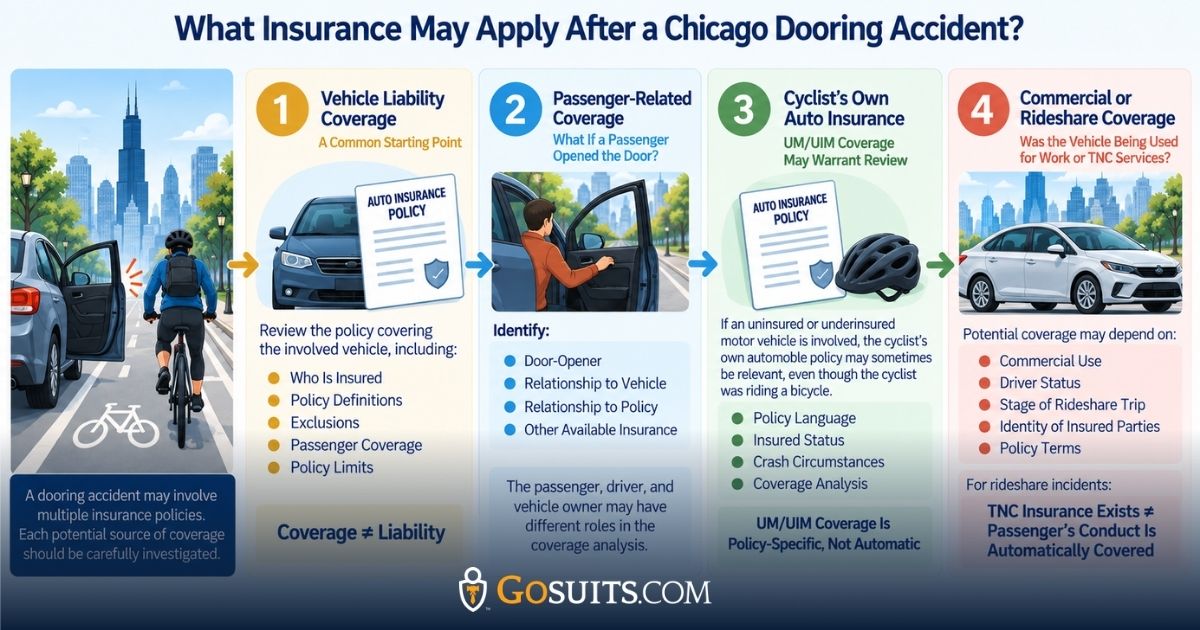
The vehicle’s liability coverage is often one of the first policies examined after a dooring accident, but other coverage may also be relevant depending on who opened the door, the vehicle’s use, and the policy terms.
A cyclist’s own automobile insurance may also warrant review in some circumstances, even though the cyclist was riding a bicycle when the crash occurred.
The Vehicle’s Liability Coverage
Illinois requires motor vehicles subject to its financial-responsibility laws to carry minimum liability protection. In a dooring claim, the policy covering the involved vehicle may therefore be an important starting point.
Coverage is not the same as liability. The fact that a policy covers the vehicle does not establish that its insurer must pay for every act involving the driver or a passenger. The policy’s definitions, exclusions, insured-person provisions, and the facts of the crash can affect whether coverage applies.
Coverage When a Passenger Opened the Door
When a passenger rather than the driver opened the door, identifying applicable coverage can become more complicated. The passenger’s relationship to the driver, vehicle, and policy may matter, and other insurance available to that person may also require review.
This is one reason identifying the door-opener separately from the driver and vehicle owner can be important early in a claim.
Uninsured and Underinsured Motorist Coverage
Illinois regulates uninsured and underinsured motorist coverage through 215 ILCS 5/143a and 215 ILCS 5/143a-2. Depending on the circumstances and the wording of the policy, a cyclist’s own automobile policy may be relevant to an injury involving an uninsured or underinsured motor vehicle even though the cyclist was not occupying a car.
This should be treated as a policy-specific coverage question, not an automatic source of recovery. Section 143a-2 itself ties underinsured status and coverage to the insured as defined by the applicable policy.
Commercial and Rideshare Coverage
Additional coverage questions can arise when the vehicle was being used for work or for transportation network company services.
Under the Transportation Network Providers Act (625 ILCS 57/10), insurance requirements vary according to the TNC driver’s status. The statute distinguishes the period when a driver is logged into the platform but has not accepted a ride from the period when TNC services are underway. Related coverage questions can also arise when examining rideshare coverage when the driver has no insurance.
When a rideshare passenger opens a door into a cyclist’s path, however, the existence of TNC insurance does not by itself establish that the passenger’s conduct is covered. The stage of the trip, the identity of the insured parties, the policy language, and the circumstances of the crash all remain relevant.
What Damages Are Recognized in an Illinois Dooring Claim?
A dooring claim can involve the same compensatory damages recognized in other Illinois personal injury cases, including medical expenses, lost earnings, pain and suffering, loss of a normal life, and property damage.
The available damages depend on the evidence rather than on the crash being classified as a dooring accident.
Common categories include:
- Medical expenses: The reasonable value of necessary medical care, treatment, and services related to the injury.
- Lost earnings or profits: Income or other qualifying earnings lost because of the injury, including future losses when sufficiently supported.
- Pain and suffering: Physical pain and suffering caused by the injuries, including future effects when reasonably certain.
- Loss of a normal life: A diminished ability to enjoy or participate in the ordinary and pleasurable aspects of life.
- Property damage: Damage to personal property may also be claimed where supported by evidence.
Photos, receipts, repair estimates, medical records, and wage documentation may help support these losses. No diagnosis, treatment history, or type of bicycle damage corresponds to a preset amount.
What Can Reduce What You Keep From a Settlement?
The amount paid to settle a dooring claim may be different from the amount the injured cyclist ultimately receives. Depending on the case, attorney fees, case expenses, valid health-care liens, and certain insurance reimbursement or subrogation claims may need to be resolved before funds are distributed.
Illinois’ Health Care Services Lien Act, 770 ILCS 23, allows qualifying health-care providers to assert liens against a personal injury recovery when the statutory requirements are met. The combined liens governed by the Act generally cannot exceed 40% of the settlement, judgment, award, or compromise, but that does not mean 40% is automatically deducted from every case.
Separate reimbursement claims may also arise when Medicare, Medicaid, a private health insurer, or another benefit plan paid injury-related expenses. These claims are legally distinct from provider liens, and how liens affect a settlement depends on the governing law, plan terms, and facts of the case.
Attorney fees and case expenses may also affect the final distribution under the representation agreement. Because these deductions vary from claim to claim, the gross settlement amount should not be treated as the cyclist’s guaranteed net recovery.
How Long Do You Have to File a Dooring Claim in Illinois?
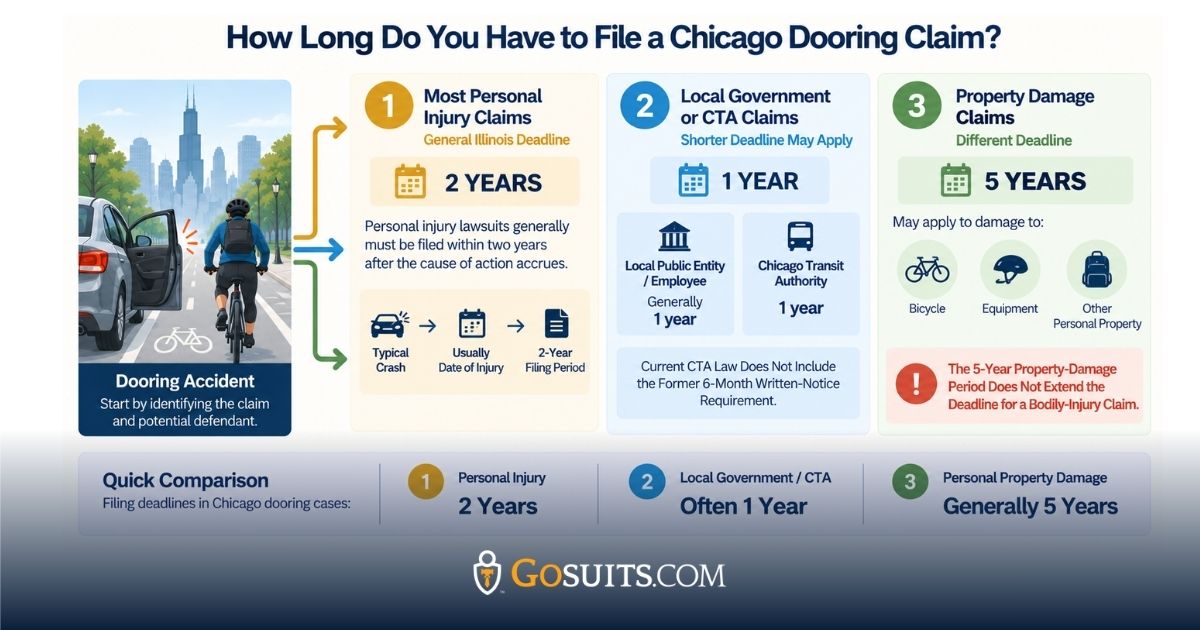
Most Illinois personal injury lawsuits arising from a dooring accident must be filed within two years after the cause of action accrues, which in a typical crash is the date of the injury. However, shorter deadlines can apply when a government entity or public employee is involved.
Under 735 ILCS 5/13-202, an action seeking damages for personal injury generally must be commenced within two years after the cause of action accrued.
Claims Involving a Local Government Entity or Employee
A shorter deadline may apply if the dooring crash involves a local public entity or one of its employees.
Under 745 ILCS 10/8-101(a), most civil actions for injury against a local entity or its employees must be commenced within one year from the date the injury was received or the cause of action accrued.
That distinction can matter if, for example, the vehicle involved in the crash belonged to a local government and the potential defendant falls within the statute.
Claims Against the Chicago Transit Authority
Claims against the Chicago Transit Authority require separate attention. Under the current Chicago Transit Authority Act, 70 ILCS 3605/41, a civil action against the CTA for personal injury must be commenced within one year from the date the cause of action accrued.
The current version of § 41 does not contain the former six-month written-notice requirement. The one-year filing deadline remains in the statute.
Property Damage Can Have a Different Deadline
Illinois generally provides a five-year limitation period for an action seeking damages for injury to personal property under 735 ILCS 5/13-205. That can be relevant to damage to a bicycle or other personal property.
A cyclist should not assume that the longer property-damage period extends the deadline for an accompanying bodily-injury claim. Different claims arising from the same crash can be governed by different limitation periods.
Exceptions and tolling rules can also affect a particular case, so the applicable filing deadline depends on the claim, defendant, and circumstances. The filing deadline is also different from how long an Illinois injury lawsuit takes after a case has been started.
Where Dooring Commonly Happens in Chicago
Dooring can happen anywhere cyclists travel beside vehicles whose doors open toward their path. In Chicago, the risk is especially relevant on streets where bicycle travel, curbside parking, passenger loading, deliveries, and other vehicle activity occur close together.
Representative Chicago corridors with current bicycle infrastructure include Milwaukee Avenue, Belmont Avenue, Archer Avenue, Kedzie Avenue, and Bryn Mawr Avenue. CDOT identifies protected or designated bicycle facilities on portions of these streets, although the street configuration varies by corridor and by block. These examples are not rankings of where dooring is most likely to occur. In an individual crash, the relevant issues are the actual bicycle facility, curbside parking or loading configuration, vehicle position, and surrounding traffic conditions.
The physical setting matters more than the neighborhood name. Common situations that can create a dooring conflict include:
- Bike lanes or bicycle routes running alongside curbside parking
- Cyclists traveling beside a line of parked vehicles
- Passengers entering or exiting vehicles along busy streets
- Rideshare pickups and drop-offs near bicycle routes
- Delivery or commercial vehicles stopping near the cyclist’s path
- Vehicles stopped or parked near restaurants, stores, residential buildings, transit stops, and other active destinations
Chicago maintains an extensive network of bicycle facilities, and City geographic data specifically identifies bicycle routes throughout the street network. The design of those facilities varies by location. Some projects physically separate bicycle traffic from motor vehicles, while other street configurations can place cyclists closer to parked or stopped vehicles.
The Street Layout Matters
The neighborhood alone does not determine fault. The vehicle’s position, cyclist’s path, lane markings, parking configuration, door position, and surrounding traffic conditions may all matter.
Illinois law also does not limit door-opening liability to marked bike lanes. Under 625 ILCS 5/11-1407, a person may not open a vehicle door on the side available to moving traffic unless it is reasonably safe and does not interfere with that traffic.
Photos, video, witness accounts, and other evidence showing the actual street layout can therefore be more useful than simply identifying the neighborhood where the crash occurred.
The same Illinois door-opening statute applies outside Chicago, including in communities such as Evanston and Oak Park, although additional local ordinances may also apply.
Sources
- 625 ILCS 5/11-1407, Opening and Closing Vehicle Doors
- Chicago Municipal Code § 9-80-035, Opening and Closing Vehicle Doors
- 625 ILCS 5/11-1502, Traffic Laws Apply to Persons Riding Bicycles
- Kalata v. Anheuser-Busch Companies, Inc., 144 Ill. 2d 425 (1991)
- Illinois Pattern Jury Instructions, Civil, No. 15.01, Proximate Cause: Definition and Use
- 735 ILCS 5/2-1116, Limitation on Recovery in Tort Actions
- 625 ILCS 5/11-1507, Lamps and Other Equipment on Bicycles
- 625 ILCS 57/10, Transportation Network Providers Act: Insurance
- 745 ILCS 10/8-101, Limitation
- 70 ILCS 3605/41, Chicago Transit Authority Act
- 625 ILCS 5/7-203, Requirements as to Policy or Bond
- 215 ILCS 5/143a, Uninsured and Hit-and-Run Motor Vehicle Coverage
- 215 ILCS 5/143a-2, Additional Uninsured and Underinsured Motor Vehicle Coverage
- 770 ILCS 23/10, Health Care Services Lien Act
- 770 ILCS 23/50, Subrogation Claims
- 735 ILCS 5/2-2301, Settlement of Claims; Payment
- 735 ILCS 5/13-202, Personal Injury Limitations Period
- 735 ILCS 5/13-205, Five-Year Limitation for Injury to Property
- City of Chicago, Bike Routes Map
- Chicago Department of Transportation, Complete Streets
Frequently Asked Questions
Who is usually liable when a cyclist is hit by an opening car door?
Liability often focuses on the person who opened the door. Illinois law requires a person to open a traffic-side door only when it is reasonably safe and does not interfere with moving traffic.
Can a passenger be liable for opening a car door into a cyclist?
Yes. 625 ILCS 5/11-1407 applies to any person who opens the door, including a passenger.
Can I have a claim if I swerved to avoid the door and never hit it?
Potentially. Physical contact is not required by § 11-1407. The key issue is whether the door-opening conduct was a proximate cause of the injury.
Does a traffic ticket prove who was at fault for a dooring crash?
No. A citation can be relevant, but it does not decide civil liability. Likewise, no citation does not automatically defeat a claim.
Can I still recover compensation if I was partly at fault?
Possibly. Under 735 ILCS 5/2-1116, a cyclist who is 50% or less at fault may recover reduced damages. More than 50% fault generally bars recovery.
Is a cyclist automatically at fault for riding outside a bike lane?
No. Riding outside a marked bike lane does not automatically establish negligence. Fault depends on the circumstances of the crash.
Do adult cyclists have to wear helmets in Illinois?
Illinois currently has no statewide bicycle helmet law. Local rules may differ, and helmet use does not by itself determine who caused the dooring crash.
How long do I have to file a dooring injury lawsuit in Illinois?
Most Illinois personal injury claims generally have a two-year deadline. Shorter one-year periods can apply to certain public entities, including the CTA.
What if an Uber or Lyft passenger opened the door?
The passenger may be central to liability. Insurance depends on the trip stage, applicable policies, and who qualifies as an insured.
What evidence is most useful after a dooring crash?
Useful evidence can include the crash report, driver and passenger identities, photos, video, witnesses, medical records, and documentation of bicycle damage.