
















































What should a family do in the first weeks?
Take care of yourselves first. Funeral arrangements, the estate and the people who need to be told will fill the first days, and no legal step has to come before them.
Within that, a few things protect the case without adding much work. Keep every document: the death certificate, bills, letters from insurers and employers, and the phone records of calls with adjusters. Write down what you remember about the last conversations with your loved one and what officers or medical staff told you. Ask a family member to save photographs of the person, since a jury will want to know who they were. Do not post about the circumstances online, and avoid discussing fault with anyone representing the other side.
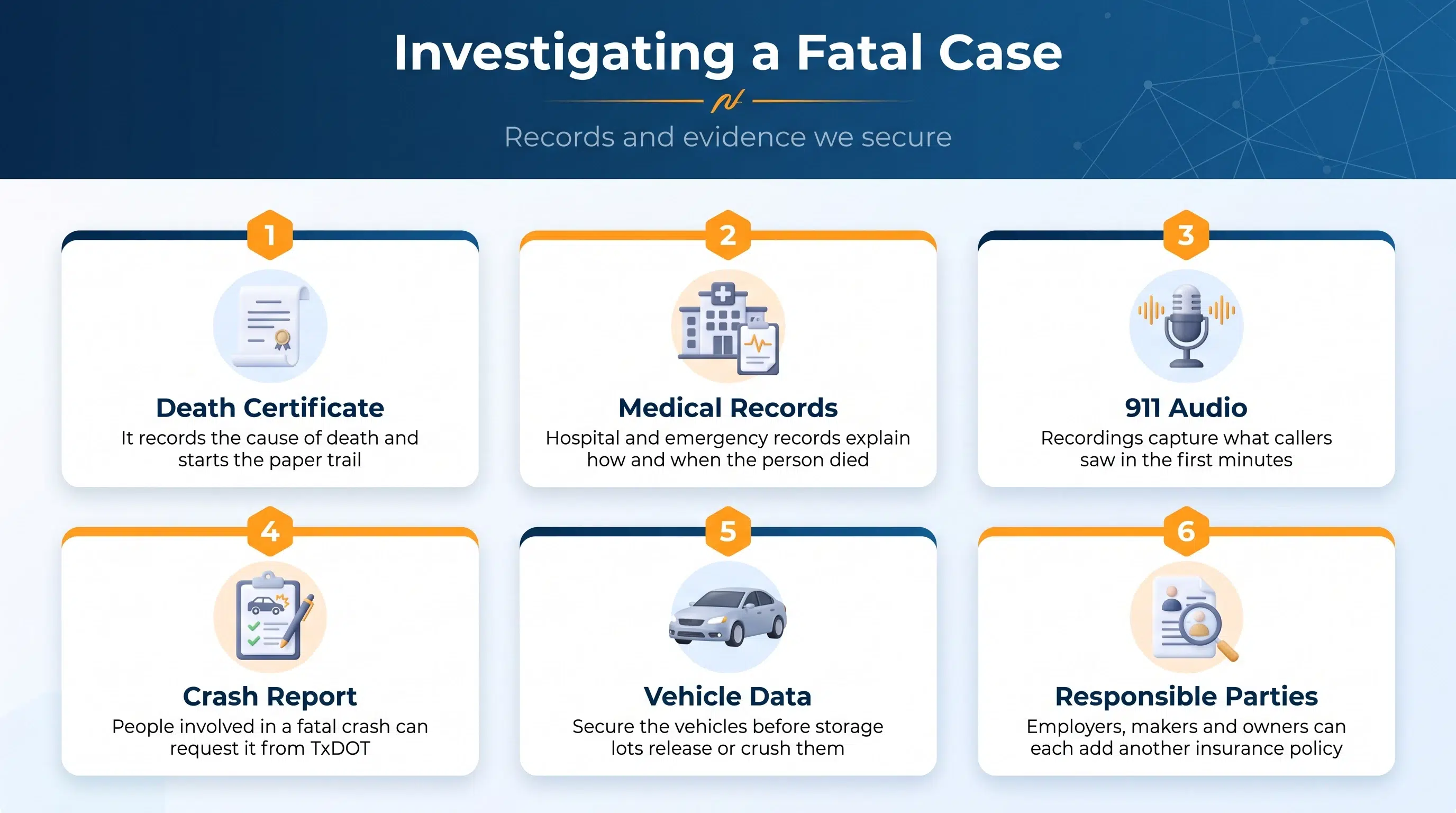
If the person died in a crash, ask the police department or TxDOT how to get the report and tell us where the vehicles are being stored. Storage lots release and crush vehicles on their own schedule, and an unretrieved car can be gone within weeks.
Who can bring a wrongful death claim in Texas?
Not everyone who grieves is allowed to sue. Under Texas Civil Practice and Remedies Code section 71.004, a wrongful death action is for the exclusive benefit of the deceased person’s surviving spouse, children and parents. Any one of them can bring the case, or they can bring it together.
Siblings, grandparents, partners who were not married to the person, and other relatives cannot bring the claim themselves, however close they were. That surprises many families, and it is one of the first things we sort out.
There is also a backstop. If none of those family members files within three calendar months of the death, the executor or administrator of the estate is required to bring the case, unless all of the eligible family members ask them not to. In practice, many families file with the help of an attorney well before that.
Is it one lawsuit or two?
Often there are two claims, and they belong to different people. The wrongful death claim compensates the surviving spouse, children and parents for what they lost. The survival action, under section 71.021, carries the person’s own injury claim forward to their estate and heirs and covers what they themselves suffered before dying, such as medical expenses and conscious pain.
The same facts usually support both, and they are commonly filed together, but the distinction matters for who recovers what and for the probate paperwork. Our checklist for families after a wrongful death covers the early documents to gather.
What can a family recover?
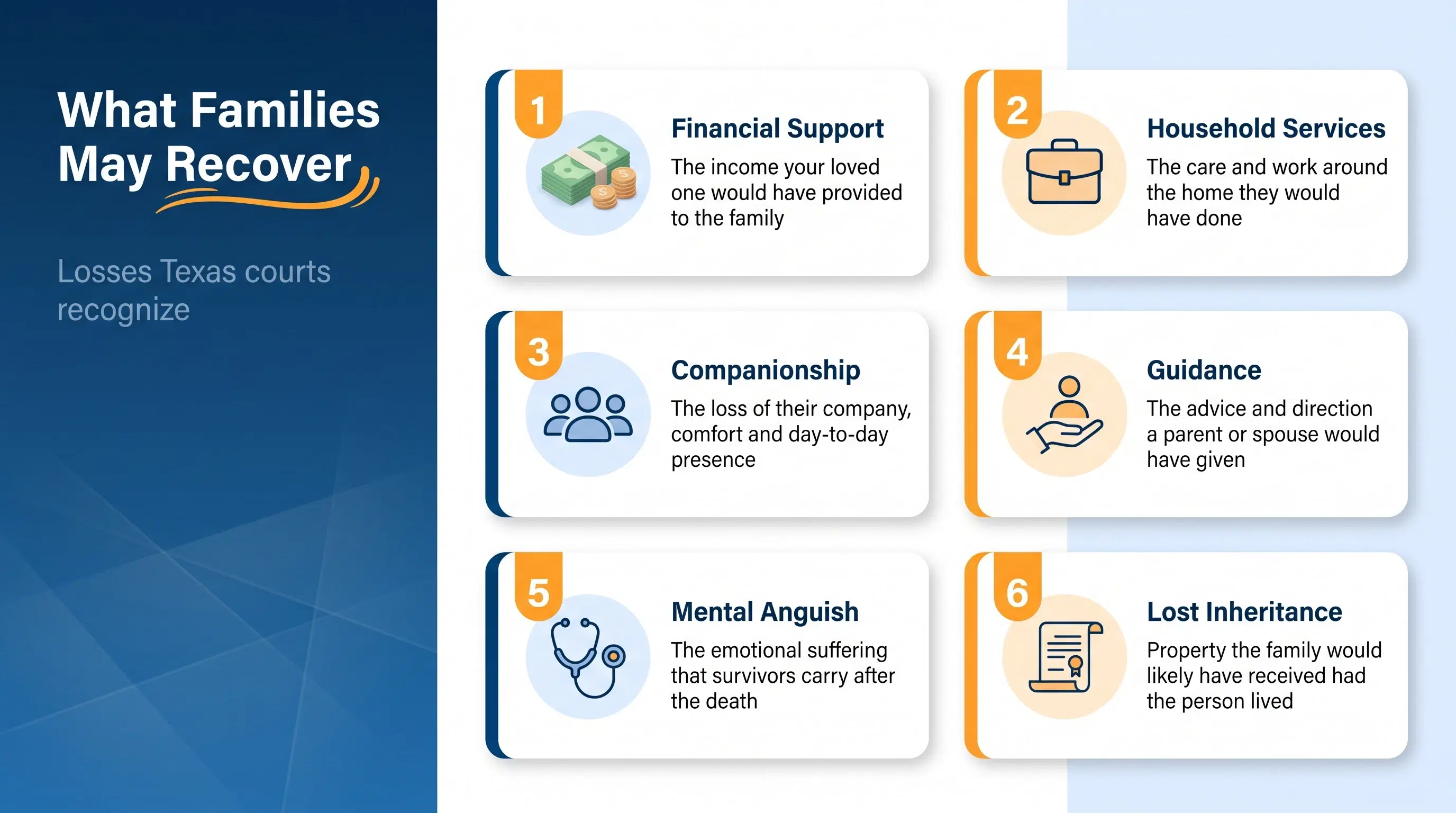
Texas courts allow recovery for the financial support and services the person would have provided, the loss of their companionship and guidance, and the mental anguish of the survivors. Inheritance the family would likely have received can also be a loss. The jury awards damages in proportion to the injury resulting from the death, and the award is divided among the eligible family members as the jury finds.
These numbers rest on evidence. A teacher, a software engineer and a stay-at-home parent each contributed in different ways, and an economist or vocational analyst may be needed to put the lost earnings and household services into figures. Companionship cannot be priced, but a jury can be shown what the relationship looked like through photographs, letters and the words of the people who knew them.
Where a death was caused by gross negligence or a willful act, Texas also permits exemplary damages under section 71.009, subject to statutory limits.
Beyond pursuing the gross recovery from the responsible party’s insurer, GoSuits negotiates with hospitals, ER groups and medical lien holders at settlement to reduce what is owed out of the award, so more of the money reaches the family.
Money does not undo a death, and we do not pretend it does. It can pay for what the family now has to carry.
How long does a family have to file?
Two years from the date of death, under Civil Practice and Remedies Code section 16.003(b). The clock starts at death, not at the date of the crash or injury, which matters when someone dies after weeks in a hospital.
Claims against a city, county or transit agency can have a much shorter notice period, six months under the Texas Tort Claims Act, and some city charters set shorter ones. A death on a public road, a city property or a government vehicle needs early legal attention for that reason.
What does a Plano wrongful death investigation involve?
We begin with the death certificate and records of the cause of death, and collect any autopsy report, hospital records and emergency response records, including 911 audio. For a crash, we request the Texas Peace Officer’s Crash Report and secure the vehicles before they are released from storage. People involved in a fatal crash, and people who may sue because of it, can ask TxDOT for the report.
Then we look beyond the obvious. If a driver was working, whose business was it? If a vehicle failed, who built it and who last serviced it? If the death happened at a building or job site, who controlled safety, and what did they know? Each answer can open another insurance policy.
When there is a parallel criminal case, such as an intoxicated driving charge, it moves on its own schedule. The civil claim does not depend on a conviction, and an acquittal does not end it.
Where do fatal Plano cases come from?
The most familiar cause is a vehicle crash. Plano is ringed by fast roads, the Dallas North Tollway, US 75, the Bush Turnpike and the Sam Rayburn Tollway, and Preston Road runs through the middle. Impacts at those speeds, or a collision with a pedestrian near a DART station or a shopping district, can be fatal.
Other deaths come from workplace incidents, falls from height, defective products and fires. A family unsure which category their loss falls into can ask us on the first call.
Plano hospitals such as Medical City Plano and Texas Health Presbyterian Hospital Plano often hold the medical records that explain how and when a person died, and we request them early.
How are fatal crash cases on Plano’s major roads different?
A death caused by a vehicle usually gets more investigation than an injury. Police may reconstruct the scene, and the district attorney may review whether to bring charges. The civil case can use much of that material, but it also depends on evidence the police did not collect: the other driver’s phone records, an employer’s dispatch history, a maintenance file or a bar’s receipts.
Speed makes a difference as well. Roads like the Dallas North Tollway and the Bush Turnpike allow speeds at which impacts are harder to survive, and a company or insurer that tries to blame a victim’s driving needs to explain the physics. Data from the vehicles often speaks louder than a witness, which is why we try to secure them early.
Pedestrians and cyclists killed near DART stations or in shopping districts raise their own questions: lighting, crosswalk design, driver attention and speed. Each of those can name a responsible party beyond the driver.
What if the insurance company calls first?
It often does, sometimes within days. The adjuster may express sympathy, ask for a recorded statement and suggest that an early settlement would be a relief. You are under no obligation to speak with them, and a fast offer, made before the full economic and personal loss is understood, is rarely sized to it.
Sign nothing, and do not accept payment that comes with a release until a lawyer has read it. If the offer is a policy limit, that is a sign other insurance might exist, and we look for it.
Who handles the estate, and why does it matter?
The estate is a separate piece. Someone has to be named to represent it, whether under a will or through the probate court, in order to bring the survival claim and to receive the funds that belong to the estate. The family members who bring the wrongful death claim are not necessarily the same people as the estate’s representative, although they often overlap.
We work with families and, if needed, with a probate lawyer, so that nothing is missed. Settlement money is divided among those entitled by the jury’s findings or by agreement, and the paperwork differs depending on whether a claim belongs to the estate or to the individuals. Getting that right at the start avoids delays when the money arrives.
Can the deceased’s own fault reduce the recovery?
Yes. Texas applies proportionate responsibility to wrongful death claims, and the family’s recovery can be reduced by the percentage of fault assigned to the person who died. If that percentage is more than 50, recovery is barred (Civil Practice and Remedies Code section 33.001). Insurers raise this argument in fatal cases because the person who could answer it is gone, so we gather physical, video and witness evidence to answer it for them.
Which Plano wrongful death cases do we take?
We represent surviving spouses, children and parents after deaths caused by crashes on the Dallas North Tollway, US 75, the Bush Turnpike and Preston Road, and after fatal workplace incidents, falls from height, defective products and fires. Under chapter 71 of the Texas Civil Practice and Remedies Code, those family members bring the wrongful death claim, and the estate may bring a separate survival claim. These cases are handled by our Dallas-area wrongful death lawyers.
Many fatal cases on these roads involve a commercial vehicle, and our Dallas-area truck accident team works the carrier side of those claims. For any other question about your loss, our Dallas personal injury office is glad to talk it through with your family.
Next steps
You can schedule a free consultation whenever you are ready.