No, not in the way most riders assume. Uber’s rideshare insurance, the coverage that follows an UberX or Comfort trip through its “waiting,” “en route” and “on trip” stages, does not apply to Uber Black or Uber Black SUV. Uber states that commercially licensed drivers, including Black and Black SUV drivers, must carry their own commercial auto insurance, and that its rideshare policies do not cover those trips [1]. In California, those drivers operate as licensed charter-party carriers whose minimum insurance is set by the California Public Utilities Commission, starting at $750,000 for vehicles that seat eight or fewer [3]. If you were hurt in or by an Uber Black in Los Angeles, the claim usually runs through the driver’s or fleet company’s commercial policy, not Uber’s. Texas and Illinois follow a similar pattern, explained below.
Legal snapshot
- Legal topic: Insurance coverage for premium rideshare trips (Uber Black, Uber Black SUV, Lyft livery and charter-party drivers)
- Case stage: Identifying the responsible insurer after a crash
- Primary legal issue: Whether the transportation network company (TNC) insurance rules or commercial for-hire insurance rules apply
- Primary authority: California Public Utilities Code section 5433 and CPUC General Order 115-G (California); Texas Insurance Code chapter 1954 (Texas); 625 ILCS 57/10 (Illinois); Uber and Lyft published insurance terms
- Date legal authority last reviewed: October 27, 2026
What is the difference between Uber Black and a regular Uber ride?
The difference is legal as well as cosmetic. An UberX, Comfort or XL driver is a “TNC driver” using a personal vehicle, and state TNC laws set the insurance that must be in place for that trip. Uber Black and Black SUV drivers are professional, commercially licensed drivers. Uber requires them to hold commercial auto insurance (“personal auto insurance does not qualify”) and every permit their city requires to operate a commercial livery vehicle [1].
That distinction decides which insurance rules govern a crash. TNC insurance is defined by the app’s status at the moment of impact. Commercial livery insurance is a policy the driver or fleet company buys to meet for-hire rules, and its limits come from that policy and the regulator, not from the app’s status.
Does Uber’s insurance cover Uber Black or Black SUV trips?
Uber says it does not. Its commercial coverage page states that drivers using a commercially licensed vehicle (black car, limousine, livery, for-hire or taxi) “must have your own commercial insurance to drive with Uber,” and that Uber’s rideshare auto policies do not cover those commercial trips [1]. Uber’s own description of the insurance it maintains also excludes “commercially licensed and insured drivers” using a limo, livery or black car vehicle [2].
Lyft takes the same approach. For livery and charter-party (TCP) drivers nationwide, Lyft says it does not procure insurance and those drivers buy their own policies to meet state and local requirements [5].
The practical result is that two people injured on the same street on the same night may be dealing with completely different insurers, depending on whether the car they were in was dispatched as UberX or as Uber Black.
What does California law require for Uber Black?
In California, Uber Black and Black SUV drivers operate as charter-party carriers permitted by the California Public Utilities Commission (CPUC). General Order 115-G sets their minimum liability insurance by seating capacity, counting the driver [3]:
| Vehicle seating capacity | Minimum liability insurance (CPUC General Order 115-G) |
|---|---|
| 8 persons or fewer (most Black sedans and SUVs) | $750,000 |
| 9 to 15 persons | $1,500,000 |
| 16 persons or more | $5,000,000 |
Compare that with the rules for a regular UberX or Comfort trip under Public Utilities Code section 5433 [4]:
- App on, waiting for a request: primary coverage of at least $50,000 per person, $100,000 per incident and $30,000 for property damage, plus at least $200,000 in excess coverage from the TNC.
- Ride accepted through drop-off: at least $1,000,000 in primary liability coverage.
- Passenger in the vehicle: uninsured and underinsured motorist coverage of $60,000 per person and $300,000 per incident, provided by the TNC.
The uninsured and underinsured motorist figure reflects SB 371, which lowered the requirement from $1,000,000 [6]. A Black car’s commercial policy may or may not include uninsured motorist coverage at similar levels; that depends on the policy, which is one reason the actual policy needs to be obtained early in a claim.
So an UberX passenger in Los Angeles has a $1,000,000 statutory floor once the ride is accepted, while the legal minimum for a Black sedan is $750,000. Many commercial operators buy more than the minimum, but the number that matters is the one on the policy in force on the day of the crash.
What about Uber Black in Texas and Illinois?
Texas (including Dallas)
Texas Insurance Code chapter 1954 governs insurance for TNC drivers using personal vehicles: at least $50,000 per person, $100,000 per incident and $25,000 property damage while logged on and waiting, and $1,000,000 during a prearranged ride [7]. For Uber Black and Black SUV in Dallas, Uber lists commercial insurance and a Dallas driver permit as requirements, which places those trips outside the TNC policy in the same way [8].
Illinois (including Chicago)
Illinois sets TNC insurance in 625 ILCS 57/10: the same $50,000/$100,000/$25,000 floor while logged on, $1,000,000 in primary coverage once a ride is accepted, and $50,000 in uninsured and underinsured motorist coverage while a passenger is aboard [9]. For Uber Black and Black SUV in Chicago, Uber requires commercial insurance, a Restricted Livery Public Chauffeur License and livery vehicle plates issued through the City of Chicago [10].
The minimum commercial limits for Black cars in Texas and Illinois depend on state and local for-hire rules that differ from California’s General Order 115-G. They should be confirmed from the policy itself in each case.
When does rideshare insurance start, and does waiting at the curb count?
For a regular UberX or Lyft ride, coverage turns on app status, not on whether you are in the car. The lower “waiting” tier begins when the driver goes online; Uber describes coverage as starting from the moment a driver taps “Go” [2]. The $1,000,000 tier begins when the driver accepts your ride request, so a driver parked at your pickup spot waiting for you is already in the higher tier [4].
The rider wait-time fee Uber charges (after two minutes for most products and after five minutes for Uber Black, or two minutes at airports) is a billing rule. It does not change which insurance applies [11].
For Uber Black, the timing question is different. The driver’s commercial policy generally covers the vehicle while it is being operated for hire under that policy’s terms, so the key questions are which policy was in force and whether the driver was operating within it.

How does this apply to a real crash?
Example (hypothetical): A passenger books an Uber Black from LAX to Santa Monica. On the I-405 near the 10 interchange, the Black sedan rear-ends a car in stop-and-go traffic, and the passenger suffers a back injury. Uber’s TNC policy does not apply to the trip. The claim goes to the commercial auto policy carried by the driver or the charter-party company that owns the car, and the starting question is that policy’s limit, which in California must be at least $750,000 for a vehicle seating eight or fewer.
Example (hypothetical): The same passenger instead books UberX for the same trip and the same crash happens. Because the ride was accepted, California requires at least $1,000,000 in primary liability coverage, and the passenger is also protected by $60,000/$300,000 in uninsured and underinsured motorist coverage if another driver caused the crash and lacked insurance.
Many people searching for car accident lawyers after a crash like this do not realize the ride type changes the insurer, the policy limits and sometimes the defense strategy. It is one of the first facts car accident lawyers in Los Angeles confirm when a rideshare passenger calls.
What evidence matters in an Uber Black claim?
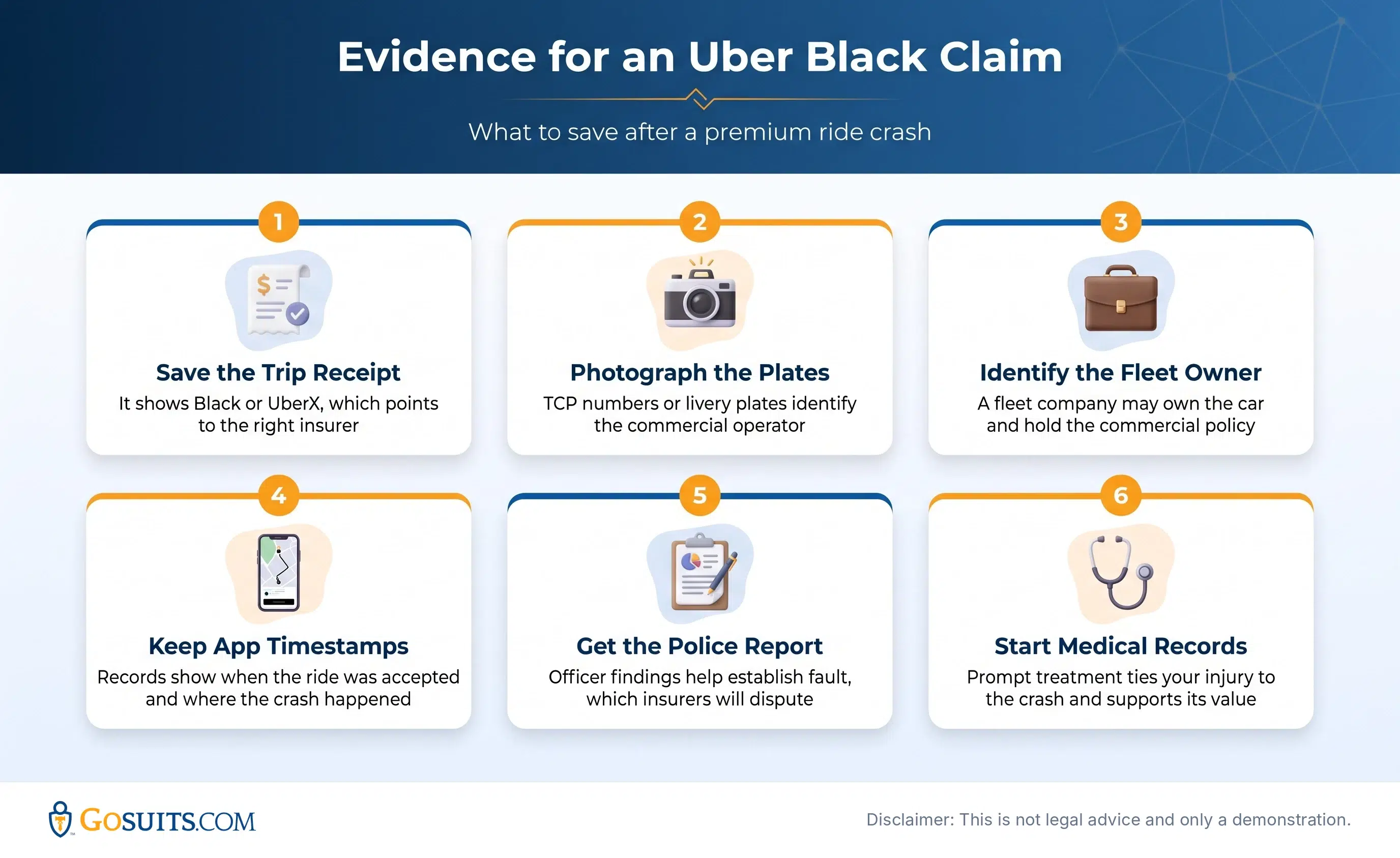
- The trip receipt: It shows the service type (Black, Black SUV, UberX, Comfort), which tells you whether to look for a commercial policy or the TNC policy.
- The vehicle’s plates and permit markings: In California, charter-party carriers display a TCP number; in Chicago, livery vehicles carry livery plates. These identify the operator.
- Driver and company identity: Black cars are often owned by a fleet company rather than the driver, and that company may be a separate defendant and policyholder.
- App data and timestamps: They confirm when the ride was accepted and where the car was at impact.
- The police report and scene photos: They establish fault, which the commercial insurer will dispute just as a TNC insurer would.
- Medical records: Prompt treatment ties the injury to the crash and supports the value of the claim.
Evidence supports a claim but does not decide it on its own; fault and causation are still proven under ordinary negligence rules.
What damages may be available?
The ride type changes who pays, not what an injured person can claim. Depending on the facts and the state’s law, damages may include past and future medical expenses, lost income and earning capacity, pain and suffering, emotional distress, disfigurement and property damage. When a crash is fatal, eligible family members may bring a wrongful death claim. California applies pure comparative fault, while Texas and Illinois bar recovery when the injured person is more than 50 percent at fault, so any share of fault assigned to the injured person reduces or ends the recovery.
What if the insurer says the trip isn’t covered?
Coverage disputes in premium-ride cases usually take one of three forms. Uber’s insurer may decline because the trip was a commercial Black trip. The commercial insurer may question whether the driver was operating within the policy, for example in a vehicle not listed on it. Or the driver’s personal insurer may decline because the car was being used for hire. Each denial needs to be tested against the actual policy language, the permits and the trip records. Los Angeles personal injury lawyers handling these cases usually request the commercial policy declarations in writing at the outset. Representation by personal injury lawyers early in the process helps keep a coverage dispute from becoming a gap in recovery.
If a family is dealing with a fatal Black car crash, the same coverage questions apply to a wrongful death claim in Los Angeles, with the added complexity that several family members’ claims may draw on one policy limit.
What about Waymo and other driverless rides?
Driverless rides have no driver tiers at all. In California, a company operating autonomous vehicles must show insurance, a surety bond or self-insurance of $5,000,000 under Vehicle Code section 38750 [12]. In Texas, an automated vehicle must carry the liability coverage state law otherwise requires [13]. Waymo’s rider terms also include a binding individual arbitration clause with a 30-day opt-out, and their liability cap does not apply to personal injury caused by Waymo’s negligence [14].
How long do you have to act?
In California, most personal injury lawsuits must be filed within two years (Code of Civil Procedure section 335.1), and a claim against a public entity generally requires a written claim within six months. Texas and Illinois also apply a two-year limit to most personal injury suits. Commercial policies can also require prompt notice, so waiting can create problems well before the lawsuit deadline [15].
What should you do next?
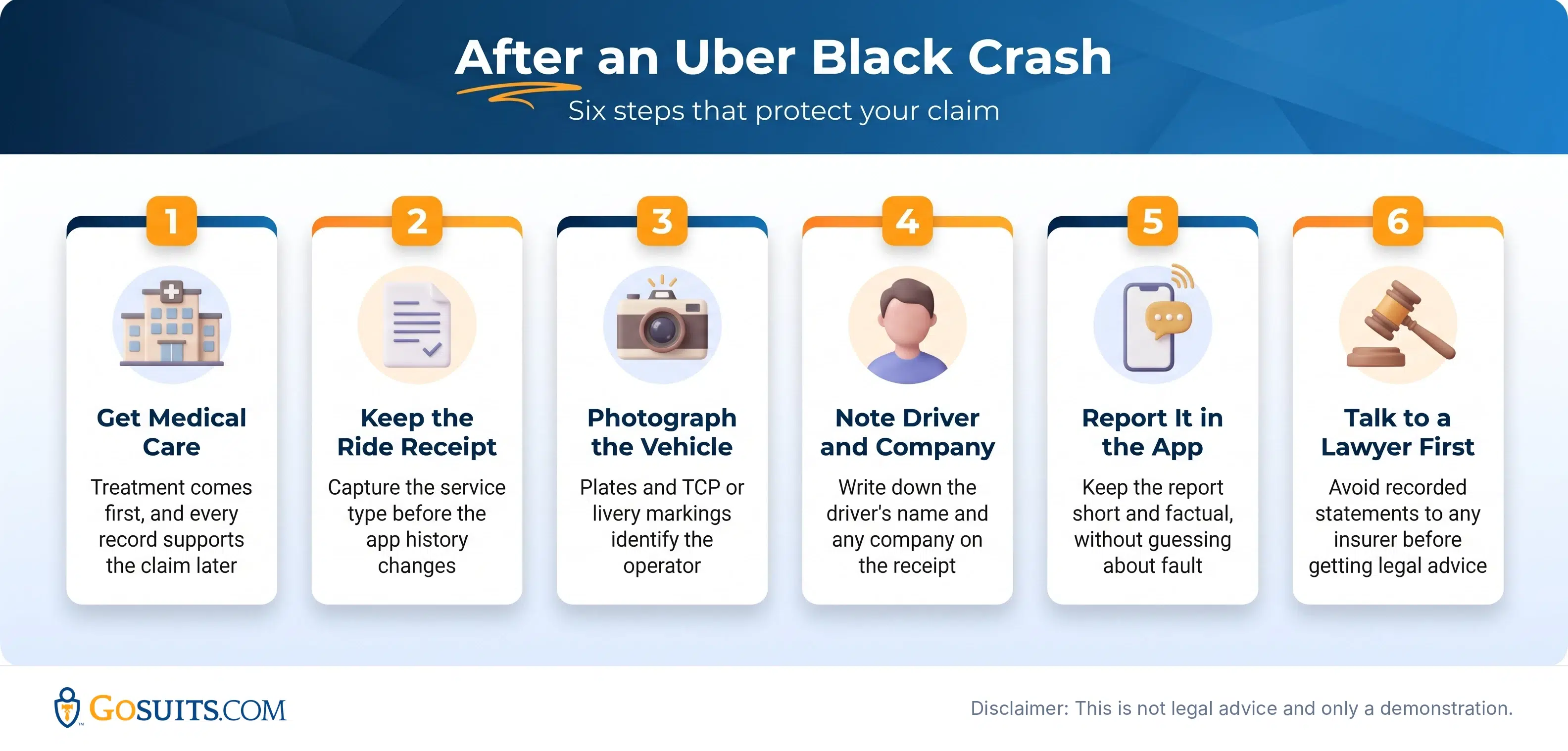
- Get medical care and keep every record.
- Save the trip receipt that shows the service type before the app history changes.
- Photograph the vehicle’s plates, any TCP or livery markings, and the scene.
- Write down the driver’s name and any company name on the vehicle or receipt.
- Report the crash in the app with short, factual details, and do not give a recorded statement to any insurer before getting legal advice.
For a full overview of how the standard TNC tiers work, see our guide to rideshare accident insurance in California. If you were hurt in a Los Angeles rideshare or Black car crash, our Los Angeles rideshare crash team can identify which policy applies.
Talk with a GoSuits attorney
A premium-ride claim can involve a commercial insurer, a fleet company, the platform and sometimes another driver, each with its own position on coverage. If you were injured in an Uber Black, Black SUV or other rideshare crash, a GoSuits attorney can review the trip records and policies and explain your options. To talk about your situation, schedule a free consultation.
GoSuits represents injured people in California, Texas and Illinois. Every client works with a designated attorney, and our proprietary case software keeps evidence, trip data and medical records organized from the first call. You can review selected results on our prior cases page, meet our attorneys, learn more about us, or see all of our practice areas.
This article is general legal information, not legal advice. Insurance requirements and platform terms change; the policy and law in force on the date of the crash control.
References
- Commercial Insurance Coverage FAQ – Uber
- Auto Insurance Maintained by Uber – Uber
- General Order 115-G, Charter-Party Carrier Insurance Requirements – California Public Utilities Commission
- Public Utilities Code Section 5433 – California Legislature
- Driver Insurance – Lyft
- SB 371 (Chapter 314, Statutes of 2025), Transportation Network Company Insurance – LegiScan
- Texas Insurance Code Chapter 1954, Insurance for Transportation Network Company Drivers – Texas Legislature
- Dallas Driver Requirements and Permits – Uber
- 625 ILCS 57/10, Transportation Network Providers Act Insurance – Illinois General Assembly
- Chicago Vehicle Requirements – Uber
- Wait Time Fees – Uber Help
- Vehicle Code Section 38750, Autonomous Vehicles – California Legislature
- Texas Transportation Code Section 545.454, Automated Motor Vehicles – Texas Public Law
- Waymo Terms of Service – Waymo
- Code of Civil Procedure Section 335.1 – California Legislature