After a crash someone else caused in Texas, the most important steps are to get medical care, call the police, exchange information, document the scene, and avoid admitting fault or downplaying your injuries. Texas is an at-fault state, so the at-fault driver’s liability insurance is generally the first source of payment for your losses. Your own policy may also help through personal injury protection (PIP), uninsured/underinsured motorist (UM/UIM) coverage, or collision coverage. A civil lawsuit generally must be filed within two years under Texas Civil Practice and Remedies Code § 16.003 [4], and your recovery can be reduced, or barred, if you are found more than 50% responsible [5].
Legal Snapshot
-
Legal Topic: Steps and legal rights after a non-fault motor vehicle collision in Texas
-
Case Stage: Immediate aftermath, claim investigation, and pre-lawsuit evaluation
-
Primary Legal Issue: Fault, proportionate responsibility, and the two-year filing deadline
-
Primary Authority: Tex. Civ. Prac. & Rem. Code §§ 16.003 and 33.001; Tex. Transp. Code ch. 550 and § 601.072; Tex. Ins. Code §§ 1952.101 and 1952.152
-
Date Legal Authority Last Reviewed: October 16, 2026 (attorney review pending)
What Does “Not Your Fault” Mean Under Texas Law?
“Not your fault” is an everyday phrase, but Texas law asks a more precise question: whose negligence caused the crash, and in what percentage? Texas answers that question under the proportionate responsibility rules in Chapter 33 of the Civil Practice and Remedies Code. A driver can be mostly, but not entirely, blameless, and that difference affects the value of a claim [5]. A driver can be mostly, but not entirely, blameless, and that distinction affects the value of a claim.
This article covers civil claims only. A traffic ticket, arrest, or criminal charge against the other driver is a separate proceeding from an injured person’s civil claim, and the outcome of one does not automatically decide the other.
What Does Texas Law Say About Your Duties at the Scene?
Texas imposes duties on every driver involved in a crash, regardless of who caused it. Under Transportation Code § 550.021, a driver in a crash that results or is reasonably likely to result in injury or death must stop at the scene, and § 550.023 requires drivers to share identifying and insurance information and to give reasonable aid to anyone injured [1].
Section 550.026 requires the driver to notify police immediately, by the quickest means of communication, when a collision causes injury or death, or damages a vehicle so that it cannot be normally and safely driven [1]. In practice, calling 911 also creates a time-stamped record. If officers investigate, Transportation Code § 550.062 governs the officer’s written crash report, which is filed with TxDOT [1].
Texas drivers no longer have to file their own written crash report with TxDOT when police do not respond. The state repealed that requirement in 2017, and TxDOT no longer accepts the driver’s report, known as the CR-2 or “blue form.” If an officer investigates a crash involving injury, death, or at least $1,000 in apparent property damage, the officer must submit a report to TxDOT within 10 days. If no officer comes, keep your own notes, photos, and any local form you were given for your records.
What Legal Rules Apply?
Several Texas statutes work together after a non-fault crash. The table summarizes the main ones.
|
Rule |
Authority |
Practical effect |
|---|---|---|
|
Two-year filing deadline |
Tex. Civ. Prac. & Rem. Code § 16.003 |
Most personal injury and property damage suits must be filed within two years after the claim accrues [4] |
|
Proportionate responsibility |
Tex. Civ. Prac. & Rem. Code ch. 33, including § 33.001 |
A claimant found more than 50% responsible cannot recover; at 50% or less, damages are reduced by that percentage [5] |
|
Minimum liability insurance |
Tex. Transp. Code § 601.072 |
Statutory minimums are $30,000 per person and $60,000 per accident for bodily injury, and $25,000 for property damage [7] |
|
UM/UIM coverage |
Tex. Ins. Code § 1952.101 |
Insurers must offer it, and it applies unless the policyholder rejects it in writing [8][9] |
|
Personal injury protection |
Tex. Ins. Code § 1952.152 |
An offer-and-reject coverage that can pay certain expenses regardless of fault [8] |
|
Medical expense evidence |
Tex. Civ. Prac. & Rem. Code § 41.0105 |
Recovery of medical expenses is limited to the amount actually paid or incurred by you or on your behalf, not the full amount billed [6] |
Civil lawsuits are filed in Texas county or district courts and are governed by the Texas Rules of Civil Procedure and Texas Rules of Evidence [13]. In a Dallas County case, for example, that means the district courts housed at the George L. Allen Sr. Courts Building.
What Should I Do at the Scene and in the First Days?
The following steps are general information, not individualized advice, and every crash is different.
-
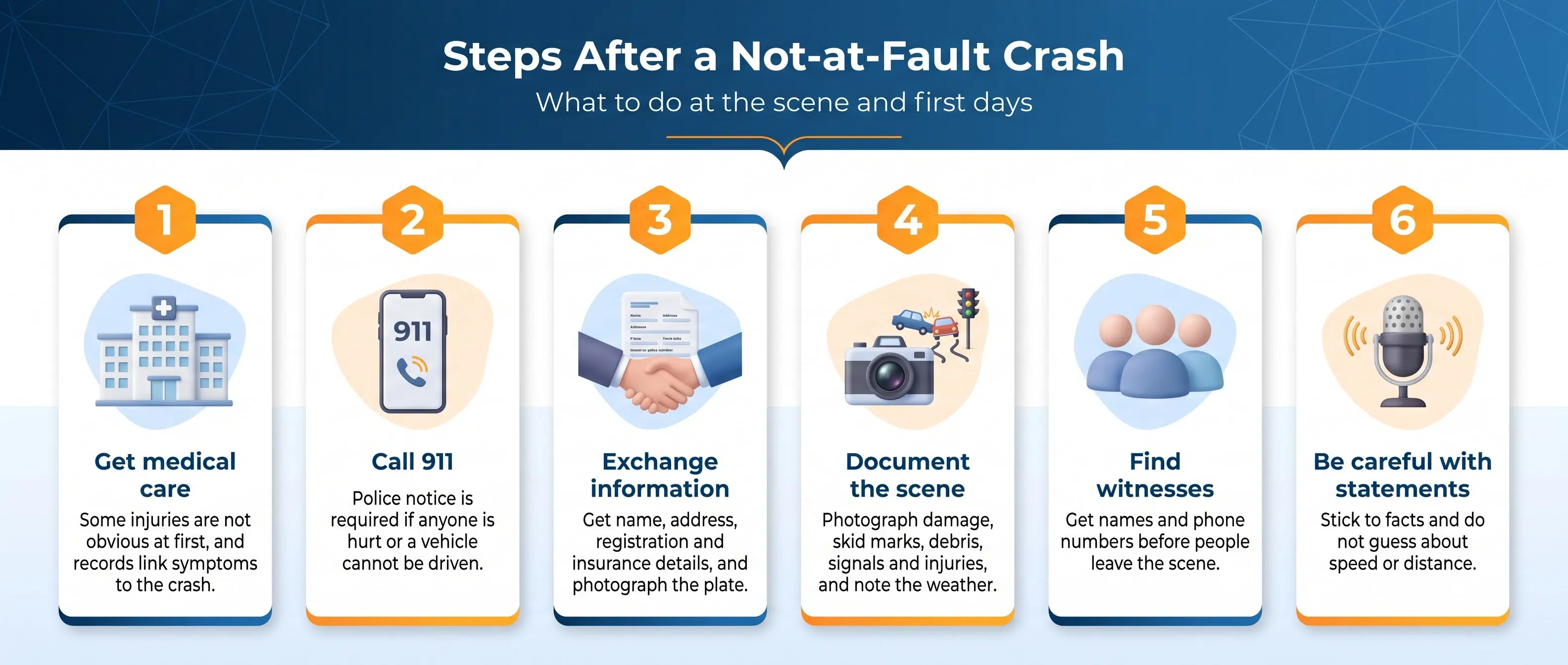
Get medical attention. Some injuries, including concussions and soft-tissue injuries, may not be obvious at the scene. Medical records also create a link between the crash and your symptoms.
-
Call 911. If anyone is hurt or a vehicle cannot be driven, Texas law requires immediate notice to police [1]. If you can do so safely, move out of live lanes, which matters on busy corridors such as I-35E, the Dallas North Tollway, or I-45 in the Houston area.
-
Exchange information. Collect the other driver’s name, address, vehicle registration, and insurance details [1]. Photograph the insurance card and license plate.
-
Document everything. Photograph vehicle damage, skid marks, debris, traffic signals, and your injuries. Note the weather, lighting, and any nearby cameras.
-
Identify witnesses. Get names and phone numbers before people leave.
-
Be careful with statements. Stick to facts, do not guess about speed or distance, and do not say you are “fine.” Consider speaking with an attorney before giving a recorded statement to any insurer.
-
Notify your own insurer. Many auto policies require prompt notice of a crash, and the exact deadline varies by policy, so check your policy’s notice terms soon after the crash.
-
Keep records. Save bills, receipts, pay stubs, repair estimates, and a simple journal of symptoms and missed activities.
How Does This Apply to a Real Case?
Hypothetical Example 1 (not an actual GoSuits case): A driver is stopped in stop-and-go traffic on US-75 (Central Expressway) when another vehicle strikes the rear bumper. The officer lists the other driver’s failure to control speed as a contributing factor. Rear-end collisions often involve clearer fault, but the other driver’s insurer may still argue that the injured driver stopped suddenly or that symptoms stem from an earlier condition. Fault and causation can both be disputed even when the collision seems straightforward.
Hypothetical Example 2 (not an actual GoSuits case): A driver is hit at an intersection in downtown Dallas. Each driver says the light was green. Without video, independent witnesses, or vehicle data, the question may turn on credibility, and a jury could assign a percentage of fault to each driver. Under the 51% bar, even a modest finding against the injured driver reduces recovery, and a finding above 50% ends it [5].
What Evidence Can Matter?
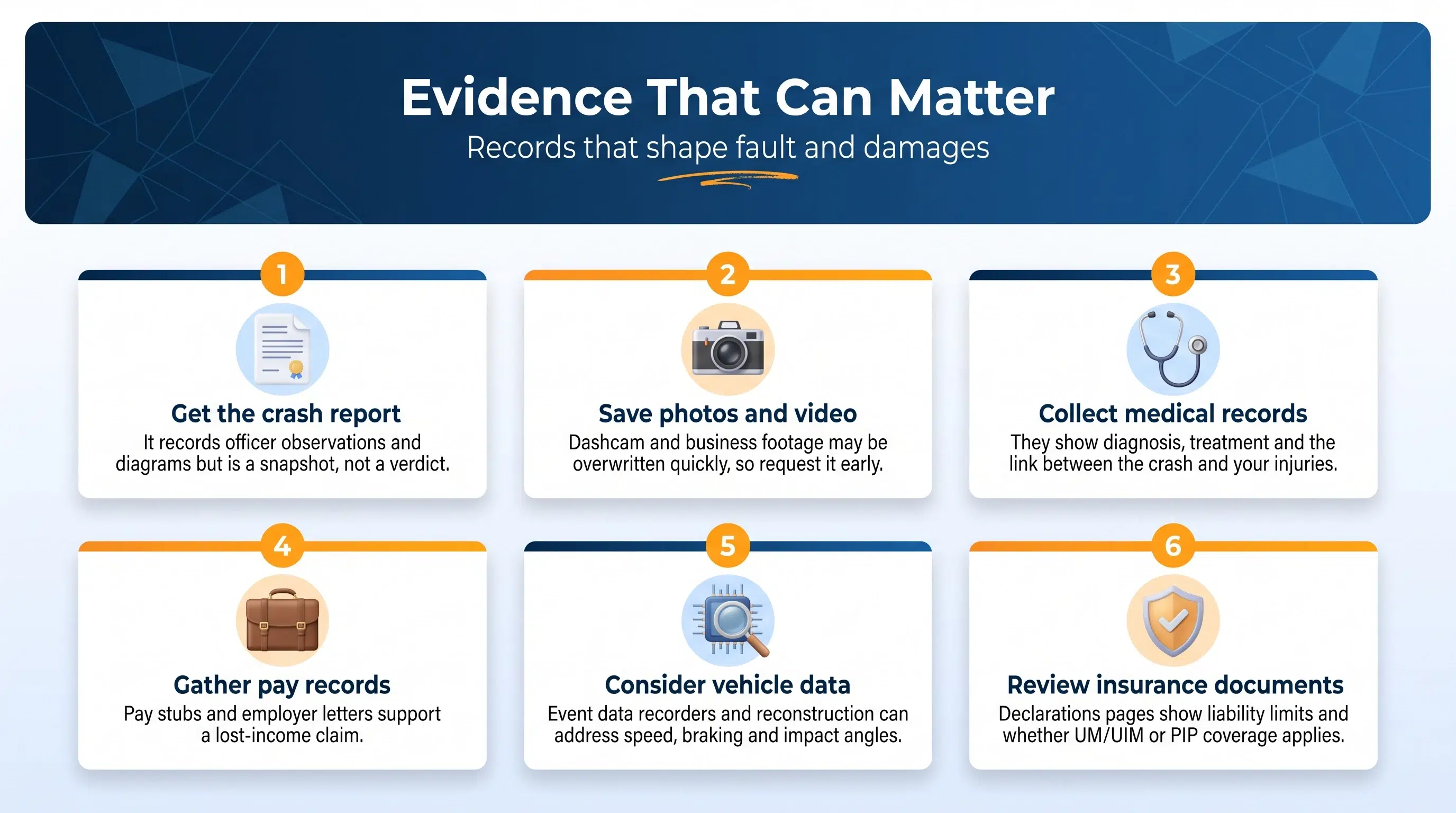
No single item proves liability automatically, but several categories commonly shape how fault and damages are evaluated.
-
Peace officer’s crash report (CR-3). The report records the officer’s observations, a diagram, and codes for factors that contributed to the crash. It is a snapshot, not a final decision on fault, and officers often arrive after the crash has happened. Under Texas Transportation Code § 550.065, people involved in the crash, their representatives, and certain others, such as insurers, can generally get a full copy, and TxDOT sells copies online [2][3]. Reports may take several days to become available, so check TxDOT’s website for the current process and fee.
-
Photographs and video. Dashcam, traffic camera, and business surveillance footage may be overwritten quickly, so early requests matter.
-
Witness statements. Independent witnesses can help resolve conflicting accounts.
-
Medical records and bills. These document diagnosis, treatment, and the connection between the crash and your injuries.
-
Employment records. Pay stubs and employer letters support lost-income claims.
-
Vehicle data and reconstruction. Event data recorders and accident reconstruction analysis can address speed, braking, and impact angles in disputed cases.
-
Insurance documents. Declarations pages show liability limits and whether UM/UIM or PIP coverage applies.
-
Phone and social media activity. Messages and posts can be used by either side, so avoid posting about the crash or your activities while a claim is pending.

What Damages or Remedies May Be Available?
Recoverable damages depend on Texas law and the facts of each case, and no outcome is guaranteed. In a car crash claim, categories commonly considered include:
-
Past and future medical expenses
-
Lost wages and loss of earning capacity
-
Physical pain and mental anguish
-
Physical impairment and disfigurement
-
Property damage, including repair costs or vehicle value
-
Exemplary (punitive) damages in limited cases, such as some drunk driving crashes, which require clear and convincing evidence of gross negligence, malice, or fraud under Chapter 41 of the Texas Civil Practice and Remedies Code
In 2025, Texas lawmakers considered Senate Bill 30, which would have changed how medical expenses and non-economic damages, such as pain and suffering, are proven in injury cases [10]. The bill died when the House and Senate could not agree on a final version, so the existing rules remain in place [14].
What If the Other Driver Disputes Liability?
Disputes are common. From the defense side, a driver or insurer may argue that the injured person was partly responsible (for example, speeding, distraction, or failing to yield), that the injuries are not as serious as claimed, that treatment was excessive, or that a pre-existing condition explains the symptoms. Because of the 51% bar, even a partial fault argument carries real financial weight [5].
If you are the one being blamed, the same rules apply in reverse. A driver sued after a crash may rely on comparative responsibility under Chapter 33 as a defense. Either side benefits from legal guidance early, since statements made in the first days are often used later. Handling a disputed claim without a lawyer can put the claim at risk.
What If Insurance Is Involved?
When another driver causes the crash, their liability insurance is usually the first claim to file. Texas requires drivers to carry at least $30,000 per person and $60,000 per crash for bodily injury, and $25,000 for property damage [7]. Serious injuries can quickly exceed those limits.
If the other driver is uninsured or underinsured, or flees the scene, your own uninsured/underinsured motorist (UM/UIM) coverage may apply. Texas insurers must offer it, and the Texas Department of Insurance explains that a policyholder who does not want it must reject it in writing [9]. Personal injury protection (PIP) works the same way under Texas Insurance Code § 1952.152 [8]. Check your policy and any rejection forms you signed. Your health insurer, employer health plan, or a hospital or other medical provider may also have a right to be repaid from your settlement, so review any liens or repayment claims before the settlement is finalized.
Adjusters may call quickly and ask for recorded statements or offer an early settlement. Early offers may not account for future treatment. A GoSuits Texas injury resource page explains how our firm approaches these claims, and a lawyer can review any release before you sign it.
How Long Do I Have to Act?
Most Texas personal injury and property damage lawsuits must be filed within two years after the day the claim accrues, under § 16.003 [4]. For a crash, that is usually the date of the crash. Exceptions, such as those for injured minors or injuries that could not have been discovered right away, are narrow, so a GoSuits attorney can confirm the exact deadline for your case.
Claims involving a government vehicle, such as a city, county, or transit authority vehicle, follow different rules under the Texas Tort Claims Act. The government entity generally must receive written notice of the claim within six months of the crash, and some cities require notice even sooner [12].
Insurance policy notice deadlines are separate from the lawsuit deadline and may be much shorter.
|
Deadline type |
General timing |
Status |
|---|---|---|
|
Police notice of qualifying crash |
Immediately [1] |
Required when a crash causes injury or death or leaves a vehicle unable to be driven safely |
|
Civil lawsuit, most injury and property claims |
Two years from accrual [4] |
Narrow exceptions, such as for injured minors, may apply |
|
Government-entity claims |
Notice often within six months [12] |
Some cities require notice sooner |
|
Insurance policy notice |
Varies by policy |
Often much shorter than the lawsuit deadline, so check your policy |
What Should I Do Next?
Start by following up on medical care and gathering your records, including the CR-3 once it is available. Keep copies of every bill and every communication with insurers. Avoid posting about the crash online, and avoid signing releases or medical authorizations you do not fully understand.
If you were hurt, consider speaking with a lawyer before accepting any offer. An injury claim can involve medical evidence, insurance coverage questions, disputed fault, and filing deadlines. Texas car accident lawyers can review the reports, coverage, and medical documentation, explain the options, and address deadlines. If your crash happened in the DFW area, our Dallas injury team and Dallas-area collision page describe local services. Crashes along corridors such as I-30, I-635, and the High Five interchange in Dallas, or in suburbs like Plano, Frisco, and Carrollton, raise the same fault and insurance questions covered here.

Talk With a GoSuits Attorney
If you were injured in a Texas crash that someone else caused, a GoSuits personal injury attorney can review the circumstances and explain your options. You can schedule a free consultation. Prior results do not guarantee a similar outcome, and this article is general legal information, not legal advice. Reading it does not create an attorney-client relationship.
References
-
Texas Transportation Code, Chapter 550 (Accidents and Accident Reports) – Texas Legislative Council
-
Motor Vehicle Traffic Crash Data and Crash Report Purchase – Texas Department of Transportation
-
Texas Civil Practice and Remedies Code, Chapter 16 (Limitations) – Texas Statutes
-
Texas Civil Practice and Remedies Code, Chapter 33 (Proportionate Responsibility) – Texas Statutes
-
Texas Civil Practice and Remedies Code, Chapter 41 (Damages) – Texas Statutes
-
Texas Transportation Code, Chapter 601 (Motor Vehicle Safety Responsibility Act) – Texas Statutes
-
Texas Insurance Code, Chapter 1952 (Automobile Insurance Coverages) – Texas Statutes
-
Senate Research Center Analysis of C.S.S.B. 30, 89th Legislature – Texas Legislature Online
-
Texas Civil Practice and Remedies Code, Chapter 101 (Texas Tort Claims Act) – Texas Statutes