Yes. Under California law, a person who suffers a brain injury because of another party’s negligence or other wrongful conduct may be able to bring a civil lawsuit for money damages. Most injury lawsuits must be filed within two years of the injury under Code of Civil Procedure section 335.1 [1], and claims against a public entity generally require a written government claim within six months [3]. California applies pure comparative fault, so a person who shares some blame for the incident is not automatically barred from recovery. Whether a particular claim succeeds, and for how much, depends on the facts, the medical evidence and the law that applies. This article is general information, not legal advice.
Legal Snapshot
-
Legal Topic: Civil claims for traumatic brain injury (TBI) caused by another party’s negligence in California
-
Case Stage: Pre-suit evaluation and early claim decisions
-
Primary Legal Issue: Whether another party’s wrongful conduct caused the brain injury, and whether the claim is filed on time
-
Primary Authority: California Code of Civil Procedure section 335.1; Civil Code sections 1714, 1431.2 and 3294; Government Code section 911.2
-
Date Legal Authority Last Reviewed: November 11, 2026 (research date; attorney review pending)
What Does a Brain Injury Claim Mean?
A brain injury claim is a civil lawsuit, or the pre-suit demand that precedes one, seeking compensation from a party who caused a traumatic brain injury. The CDC describes a TBI as an injury that affects how the brain works, caused by a bump, blow or jolt to the head or by a penetrating head injury [10]. The NINDS lists falls, motor vehicle crashes, sports injuries, blast injuries and being struck by an object among the causes [11].
A civil claim is separate from any criminal case. It asks who is legally responsible and what the injured person lost, not whether anyone should be punished. A concussion can be a TBI, and symptoms of a mild TBI may appear right away or develop over days [12]. That delayed pattern is one reason these claims need careful medical documentation.
What Does California Law Say?
California law lets injured people seek compensation from those whose careless or wrongful conduct harmed them. Under Civil Code section 1714, everyone is responsible for injuries caused by their failure to use ordinary care [7]. Under Code of Civil Procedure section 335.1, a lawsuit for an injury caused by someone else’s wrongful act or negligence generally must be filed within two years [1].
State law governs nearly every brain injury case between private parties. Federal law comes into play mainly when a federal employee or agency is involved, such as a crash with a postal truck. Under the Federal Tort Claims Act, the injured person must first file a written claim with the federal agency, generally within two years of the injury, and can sue only after the agency denies it or six months pass without a decision (28 U.S.C. sections 2675 and 2401(b)) [14]
In a California brain injury case, an attorney typically looks first at four questions: who owed a duty of care, how that duty was breached, if the breach caused the brain injury, and what damages resulted. An attorney will also check if a public entity, an employer, or a defective product is involved, because each one changes the rules that apply.
What Legal Rules Apply?
|
Issue |
California Rule |
Authority |
|---|---|---|
|
Filing deadline (private defendant) |
Generally two years from the injury |
Code Civ. Proc. § 335.1 [1] |
|
Claim against a public entity |
Written claim generally due within six months of accrual |
Gov. Code § 911.2 [3] |
|
Shared fault |
Pure comparative fault; damages reduced by the plaintiff’s percentage |
Li v. Yellow Cab Co. (1975) 13 Cal.3d 804 |
|
Multiple defendants |
Noneconomic damages are several only, in proportion to each defendant’s fault |
Civ. Code § 1431.2 [5] |
|
Past medical expenses |
Limited to amounts paid or incurred |
Howell v. Hamilton Meats (2011) 52 Cal.4th 541 [9] |
|
Punitive damages |
Clear and convincing proof of oppression, fraud or malice |
Civ. Code § 3294 [6] |
|
Injured person was a minor or lacked capacity |
Time of the disability is not counted toward the deadline, subject to the statute’s terms |
Code Civ. Proc. § 352 [2] |
Proposition 51, codified at Civil Code section 1431.2, defines economic damages as losses with a measurable dollar value, such as medical expenses and lost earnings. It defines noneconomic damages as losses without a set dollar value, such as pain, suffering, emotional distress, and loss of companionship [5]. Under Proposition 51, when more than one party is at fault, each generally pays only its own share of the noneconomic damages. That distinction matters in brain injury cases, because noneconomic losses, such as personality changes and cognitive decline, are often a major part of the harm.
How Does This Apply to a Real Case?
The following examples are hypothetical and are not GoSuits cases or results.
Hypothetical 1, a rear-end collision. A driver is stopped in stop-and-go traffic on the 405 through the San Fernando Valley and is hit from behind. Her head strikes the headrest and side window. The emergency department diagnoses a concussion and discharges her. Over the next weeks she has trouble with memory and concentration and cannot do her job as before. A claim against the at-fault driver would focus on negligence, causation and the later medical course. If a jury found her 20 percent at fault for some reason, her damages would be reduced by that percentage rather than eliminated.
Hypothetical 2, a fall on commercial property. A shopper slips on an unmarked wet floor at a store in Orange County, hits his head on tile, and later develops headaches and balance problems. A premises claim would ask whether the owner knew or should have known about the hazard and acted reasonably. Falls are a leading cause of TBI-related hospitalizations [10].
Hypothetical 3, a public roadway defect. A cyclist is thrown over the handlebars by a defect in a city-maintained street and suffers a brain injury. Because a public entity may be involved, the six-month government claim deadline becomes the first and most urgent step [3].
What Evidence Can Matter?
Brain injuries are often invisible, so documentation carries extra weight. No single item proves a case on its own.
-
Emergency and treatment records: These establish the first symptoms, mechanism of injury and early diagnosis. Records that note a head strike or loss of consciousness can help link the injury to the incident.
-
Imaging and neurological testing: CT and MRI results, and later cognitive or neuropsychological testing, may help show the nature and extent of impairment. Normal imaging does not necessarily mean no injury, so these records need medical interpretation.
-
Witness accounts: Family, coworkers and friends can describe changes in memory, mood, patience and work performance that the injured person may not recognize.
-
Incident evidence: Police reports, photographs, traffic or surveillance video, vehicle data and property records can show how the event happened and who was responsible.
-
Employment and financial records: Pay records, job reviews and missed-work documentation support lost income and earning capacity claims.
-
Medical bills and payment records: Under Howell, the amounts actually paid or incurred shape the recoverable past medical expense figure [9].
-
Social media and communications: Posts and messages can be used by either side to describe activity levels and recovery, which is one reason to be careful about what is shared.
Qualified medical, vocational and life-care witnesses may be needed to explain long-term effects and future care needs. Whether such testimony is necessary depends on the case.
What Damages or Remedies May Be Available?
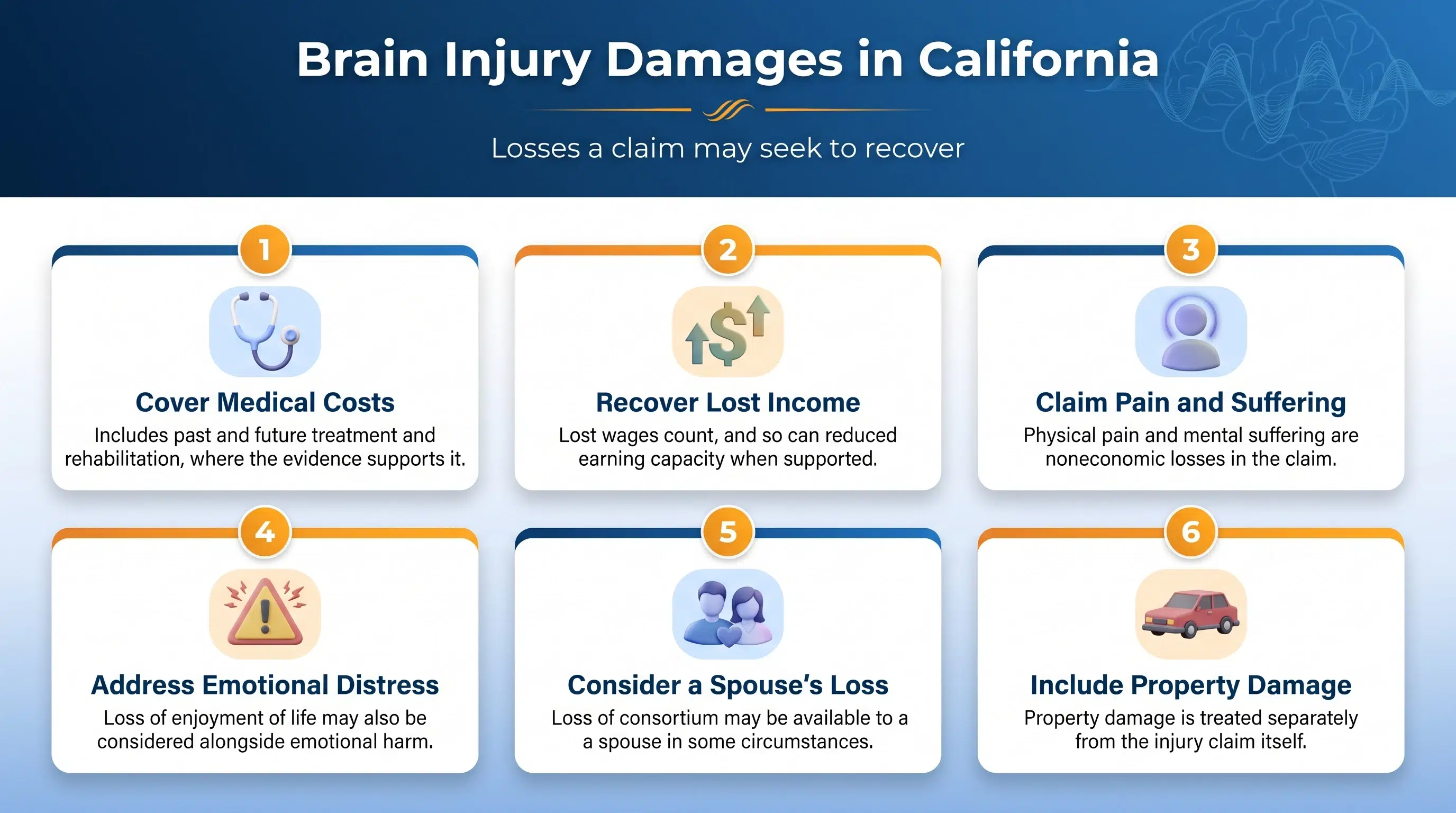
California law may allow compensation for both economic and non-economic losses, depending on the facts and proof [5]. Possible categories include:
-
Past and future medical and rehabilitation expenses
-
Lost wages and, where supported, loss of earning capacity
-
Physical pain and mental suffering
-
Emotional distress and loss of enjoyment of life
-
Loss of consortium, meaning the loss of a spouse’s or registered domestic partner’s companionship and support
-
Property damage, which has a separate deadline from the injury claim
Punitive damages are not available for ordinary negligence. Under Civil Code section 3294, they require clear and convincing evidence of oppression, fraud, or malice, and a company is generally liable for them only when an officer, director, or managing agent was involved [6]. If a brain injury results in death, the person’s spouse or domestic partner, children, and in some cases other family members may bring a separate wrongful death claim under Code of Civil Procedure section 377.60, and our wrongful death lawyers can explain how that claim differs. No outcome or amount can be promised.
What If the Other Party Disputes Liability?
Defendants often dispute brain injury claims, and they have recognized arguments available. Common ones include:
-
Causation: The defense may argue the symptoms came from a pre-existing condition, another event or an unrelated medical issue.
-
Comparative fault: The defense may argue the injured person was partly responsible. Under Li, that reduces recovery by the plaintiff’s share of fault rather than barring it.
-
Allocation among defendants: Under section 1431.2, each defendant pays only its percentage of noneconomic damages. In DaFonte v. Up-Right, Inc. (1992) 2 Cal.4th 593, the California Supreme Court applied that rule to fault attributed to an employer who was immune from suit [13]. This can matter when a workplace is involved.
-
Severity: The defense may argue that a mild TBI has resolved, or that treatment was unnecessary or overpriced.
-
Timeliness: The defense may raise the statute of limitations or a missed government claim deadline.
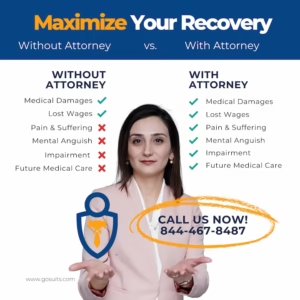
Each of these is a question of evidence and law. This is where a personal injury lawyer is important, because these disputes are rarely resolved without organized medical and factual proof. Representing yourself in a brain injury dispute carries serious risk, since cognitive symptoms can make self-advocacy difficult.
What If Insurance Is Involved?
Insurance usually shapes how a brain injury claim is valued and paid. The at-fault party’s liability insurance is the usual source of payment, but the policy limits may be low compared with the cost of a serious traumatic brain injury (TBI). California’s minimum auto liability limits, for example, are only $30,000 per person. Depending on the policy and the facts, the injured person’s own uninsured or underinsured motorist coverage under Insurance Code section 11580.2 may also help. And under Civil Code section 3333.4, an injured driver who was uninsured at the time of the crash generally cannot recover noneconomic damages, such as pain and suffering.
Health insurers, Medi-Cal, Medicare and medical providers with liens may claim reimbursement from a recovery, which affects what the injured person actually keeps. Insurance adjusters may request recorded statements or broad medical authorizations early. Talk to a lawyer before agreeing to either, particularly after a head injury. Insurance negotiations do not pause the filing deadline.
How Long Do I Have to Act?
The deadline depends on who is responsible for the injury. The table below shows the general rules, and a GoSuits attorney can confirm the deadlines that apply to your situation.
|
Situation |
General Deadline |
Authority |
|---|---|---|
|
Private party (driver, business, property owner) |
Two years from the injury |
Code Civ. Proc. § 335.1 [1] |
|
City, county, state or other public entity |
Written claim within six months of accrual |
Gov. Code § 911.2 [3] |
|
After a public entity’s written rejection |
Generally six months to sue; up to two years from accrual if no written notice is given |
Gov. Code § 945.6 [4] |
|
Missed the six-month claim date |
Application for leave to present a late claim, generally within one year of accrual |
Gov. Code § 911.4 [8] |
|
Injured person was a minor or lacked legal capacity when the claim accrued |
Tolling may apply; terms are fact-specific |
Code Civ. Proc. § 352 [2] |
|
Federal agency involved |
Administrative claim first; separate federal deadlines |
28 U.S.C. §§ 2401(b), 2675 [14] |
Tolling for minors or for people lacking capacity does not automatically apply to claims against public entities, and it can be disputed. Because brain injury symptoms can be delayed, the date on which a claim began to run may itself become a contested issue. Do not assume that a later diagnosis restarts the clock.
What Should I Do Next?
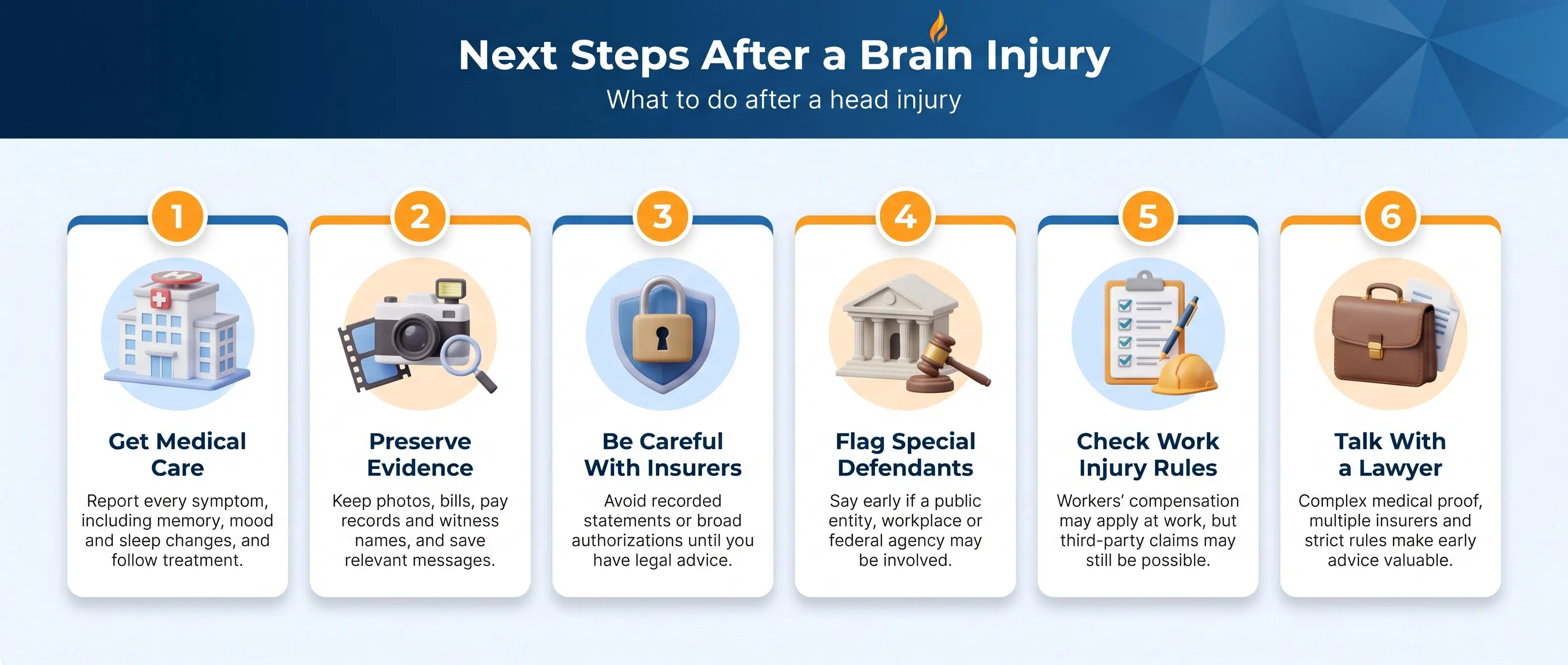
-
Get medical care and follow it. Seek evaluation for any head injury and report every symptom, including memory, mood and sleep changes. Consistent treatment records matter for health and for any later claim.
-
Preserve evidence. Keep photos, medical records, bills, pay records and the names of witnesses. Save, do not delete, relevant messages.
-
Be careful with insurers. Avoid giving recorded statements or signing broad authorizations before getting legal advice.
-
Identify possible deadlines early. If a public entity, a workplace or a federal agency may be involved, say so at the start, because shorter deadlines and special procedures may apply.
-
Talk with a lawyer. A brain injury claim can involve complex medical proof, multiple insurers and strict deadlines.
If the brain injury happened at work, California’s workers’ compensation system generally applies under Labor Code section 3600. A worker may still be able to sue a third party outside the employment relationship, such as a property owner, contractor, or equipment maker, and under Labor Code section 3852, filing a workers’ comp claim doesn’t take away that right.
Related California Personal Injury Resources
In California, brain injuries often result from car crashes on busy highways such as Interstate 5 and US-101, as well as falls, pedestrian crashes, and workplace incidents. Under Code of Civil Procedure section 395, a lawsuit is generally filed in the county where the injury happened or where the defendant lives. Cases in Los Angeles County are filed in the Los Angeles County Superior Court, and Orange County cases in the Orange County Superior Court, where many civil cases are heard at the Central Justice Center in Santa Ana. For a broader look at injury claims across the state, see our California personal injury practice page.
Talk With a GoSuits Attorney
A brain injury claim can involve medical evidence, insurance issues, liability disputes and legal deadlines. If you or a family member was injured in California, you can schedule a free consultation so a GoSuits attorney can review the circumstances and explain your options. No result can be guaranteed.
This article provides general legal information about California law and is not legal advice. It does not create an attorney-client relationship. Laws change, and every case turns on its own facts.
References
-
Code of Civil Procedure section 335.1 – California Legislative Information
-
Code of Civil Procedure section 352 – California Legislative Information
-
Government Code section 911.2 – California Legislative Information
-
Government Code section 945.6 – California Legislative Information
-
Civil Code section 1431.2 – California Legislative Information
-
Civil Code section 3294 – California Legislative Information
-
Civil Code section 1714 – California Legislative Information
-
Government Code section 911.4 – California Legislative Information
-
Facts About TBI – Centers for Disease Control and Prevention
-
Traumatic Brain Injury (TBI) – National Institute of Neurological Disorders and Stroke
-
Traumatic Brain Injury: What It Is, Symptoms and Treatment – Cleveland Clinic
-
DaFonte v. Up-Right, Inc. (1992) 2 Cal.4th 593 – Supreme Court of California Opinions, Stanford
-
28 U.S.C. section 2401 – Legal Information Institute, Cornell Law School