- What are Irvine’s top car accident hotspots today?
- How do crash trends in Irvine compare with Orange County and California?
- Why do certain Irvine roads and intersections see more crashes?
- What should you do right after a car accident in Irvine?
- Which California laws affect Irvine car crash claims?
- How are fault and damages proven in an Irvine car crash case?
- What defenses do drivers and insurers raise in Irvine crash cases?
- How do I-5 and I-405 crashes impact injury claims?
- What compensation might be available in California car crash cases?
- How can you plan routes to avoid Irvine crash hotspots?
- Where can you find official Irvine crash maps and records?
- When should you consider calling an attorney after an Irvine crash?
- How does settlement negotiation typically work in California car cases?
- What if you were hit by an uninsured or hit-and-run driver in Irvine?
- What should you bring to a consultation after an Irvine crash?
- Who is GoSuits and how do we help after an Irvine crash?
- References and Resources
What are Irvine’s top car accident hotspots today?
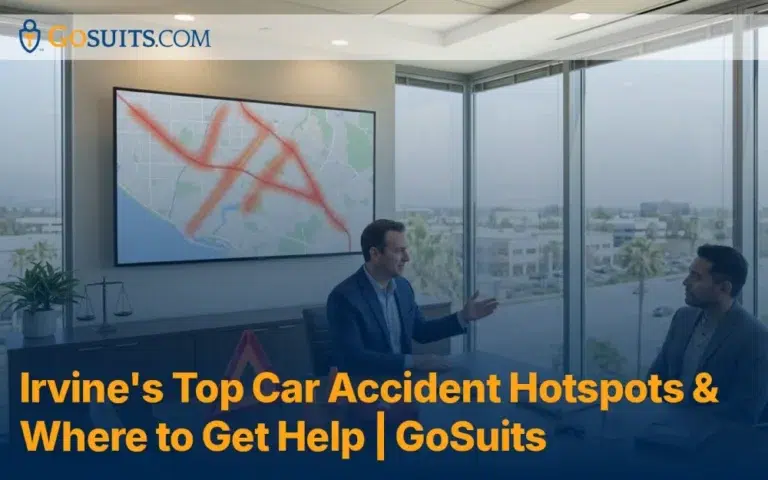
Irvine’s traffic system is unique in how it seamlessly integrates major freeways with fast access roads, efficiently connecting thriving commercial, shopping, and residential areas. When examining public accident maps alongside state-level safety statistics, one can clearly see that a substantial concentration of incidents tends to happen near these zones.
- I-405 corridor through Irvine, including interchanges near Jamboree Road, Culver Drive, and the approach to SR-133. These segments combine high volumes, frequent merging, and peak-hour congestion that increase rear-end and sideswipe risks [1] [2].
- I-5 through central and eastern Irvine, especially near the Irvine Spectrum area and major cross streets like Sand Canyon Avenue and Alton Parkway, where on-ramps and lane changes are dense during commute windows [1].
- SR-133 and SR-73 interfaces affecting traffic transitioning toward coastal routes and the Foothill-South area, adding speed differentials and weaving sections that challenge drivers unfamiliar with exits [5].
- Jamboree Road from the 405 to Barranca Parkway and beyond, a multi-lane arterial serving The District, The Marketplace, and business centers that creates frequent turning movements and traffic signal cycles [1] [2].
- Culver Drive at intersections like Barranca Parkway and Irvine Boulevard, with steady commuter flow and neighborhood access that elevates intersection conflict points [1].
- Jeffrey Road at Irvine Boulevard and Trabuco Road, which experience peak-hour surges and school-related travel patterns that require added attention to left-turn and pedestrian phases [1].
- University Drive and the UCI area, where student, pedestrian, and cycling activity interact with arterials connecting to SR-73 and Jamboree [1].
- Irvine Center Drive, Alton Parkway, and Barranca Parkway in and around Irvine Spectrum, with frequent lane changes near shopping, office, and entertainment destinations, particularly nights and weekends [1].
- Woodbridge corridors intersecting with Culver Drive and Yale Loops, where community traffic and school zones combine with peak-hour turning pressure [1].
These hotspots line up with statewide findings that intersections and major arterials are areas where conflicts such as angle crashes and rear-end impacts tend to occur. These issues often stem from problems with signal timing, queuing and turning traffic [4] . Freeways witness more high-speed collisions and multi-vehicle chain reactions when congestion rapidly rises and falls [3] .
How do crash trends in Irvine compare with Orange County and California?
Irvine is renowned for its expansive streets, meticulously planned bike paths along carefully selected routes, and excellent connections to major highways. Despite these features, Irvine has transformed into a substantial employment center over time. Information from state and national resources offers insightful context on local risk factors.
- State and national baselines. The National Highway Traffic Safety Administration reported more than 42,000 traffic fatalities nationwide in 2022, underscoring the persistent severity of high-speed roadway environments [3].
- California collision rankings. The California Office of Traffic Safety compiles SWITRS-based rankings that compare cities by size group across crash types like alcohol-involved, hit-and-run, and speed-related collisions. These rankings help contextualize where a city’s totals stand relative to peers each year [2].
- Local growth and exposure. Irvine’s population and daytime workforce have grown substantially, increasing vehicle miles traveled and roadway exposure. Census data reflect strong population growth, especially in areas south of I-5 near Irvine Spectrum, which experience intense peak-hour flows [11].
When you compare Irvine corridors to county and statewide patterns, the same core risk factors recur: high-speed merges on I-5 and I-405, lane changes under congestion, and busy turning movements at multi-lane intersections. State and federal sources help identify where targeted design countermeasures and mindful driving can reduce crash severity [2] [4].
Why do certain Irvine roads and intersections see more crashes?
Several well-documented risk factors explain Irvine’s crash hotspots:
- Intersection conflict points. Intersections introduce crossing, merging, and turning movements that increase the opportunity for angle and rear-end impacts. Federal analyses note that a significant share of serious crashes occur at or near intersections, especially where speeds are moderate to high and queues form at peak times [4].
- Speed variation and sudden congestion. Freeways like I-5 and I-405 experience rapid transitions from free flow to stop-and-go. Sudden slowdowns and frequent merges magnify rear-end and sideswipe risks, and higher speeds raise injury severity when impacts occur [3].
- Complex driving environments. Irvine Spectrum, The Marketplace, and business parks concentrate driveways, signalized intersections, and pedestrian activity, which can increase sudden lane changes, left-turn conflicts, and queue spillbacks into through lanes [1].
- Time-of-day patterns. Commuter peaks, evening entertainment hours, and weekend retail surges tend to interact with arterial corridors like Jamboree Road and Irvine Center Drive, intensifying turning pressure and crossing movements [2].
- Driver factors. State and federal analyses consistently identify speed, distraction, and impairment as leading contributors to crash frequency and severity. Risky driving behaviors interact with intersection geometry and congestion to amplify collision likelihood [3] [4] [15].
What should you do right after a car accident in Irvine?
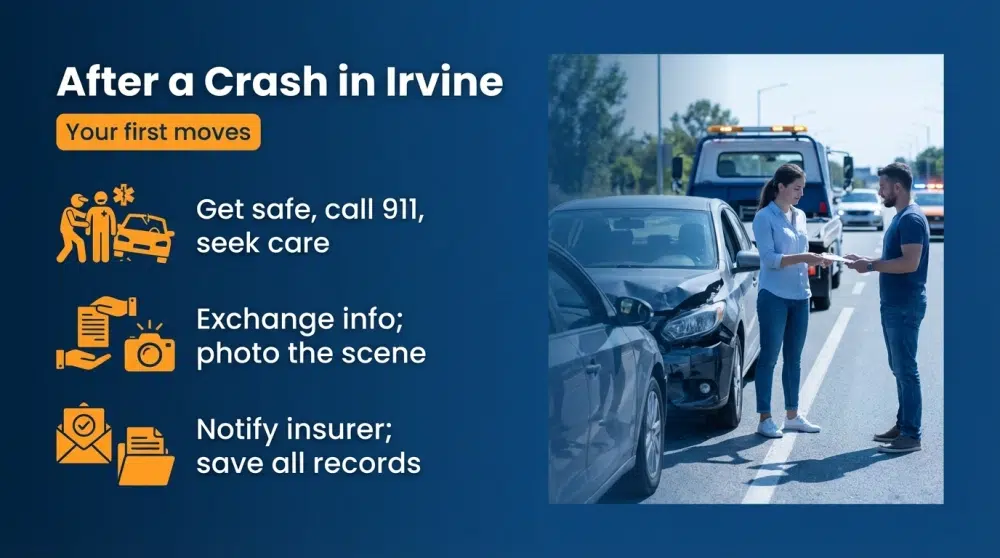
There are practical steps you can take to protect your health and your rights after a crash in Irvine:
- Move to safety and call 911. If possible, get out of travel lanes and request medical help. Police reports often capture key facts and witness information that may be critical later.
- Exchange information and document the scene. Collect driver and insurance details, note vehicle positions and damage, and take photos of the roadway, traffic signals, and debris. If safe, capture skid marks, signal phases, and any nearby cameras or businesses that may have video.
- Seek medical evaluation. Some injuries surface hours or days later. Prompt evaluation helps your recovery and creates a contemporaneous record of symptoms.
- File required reports. California requires an SR-1 collision report to DMV within 10 days if anyone was injured or killed or if property damage exceeds a statutory threshold. You can find the reporting guidance on the California DMV site [6].
- Notify your insurer. Provide basic facts and cooperate with your policy duties, but be careful with recorded statements until you understand the full picture.
- Preserve evidence. Keep medical bills, wage records, repair estimates, and any communications. If you suspect nearby video, request it quickly because many systems overwrite within days.
Which California laws affect Irvine car crash claims?

What is the filing deadline for a California personal injury car crash claim?
California generally provides a two-year statute of limitations for personal injury actions. If you miss this deadline, you can lose the right to file. See California Code of Civil Procedure section 335.1 for the governing deadline [7].
How does California’s comparative negligence rule apply?
California follows pure comparative negligence. That means a plaintiff’s recovery is reduced by their percentage of fault, if any, but not barred entirely. The California Supreme Court adopted this framework in Li v. Yellow Cab Co. of California, which remains the bedrock comparative fault decision in the state [8].
Do you have to report collisions to the DMV?
Yes, as mandated by the guidelines outlined in California law, it is essential that people involved in accidents causing injury or death, or property damage exceeding a certain limit, submit an SR-1 form to the DMV within ten days of the incident. The DMV provides a comprehensive online guide for reference purposes detailing these forms and procedures. For more information on this matter, please visit the California Department of Motor Vehicles (DMV) website at [6].
Are there other California rules that often come up?
- General duty of care. Drivers owe others a duty to use reasonable care. This general duty is the basis for negligence analysis, along with violations of the Vehicle Code proven at trial.
- Hit-and-run statutes. California Vehicle Code section 20002 addresses duties after property-damage-only collisions and is frequently implicated when a driver leaves the scene [12].
- Punitive damages. While uncommon, punitive damages can be available in cases involving malice, oppression, or fraud. For example, egregious DUI conduct can implicate punitive principles. See Civil Code section 3294 for the standard [10].
How are fault and damages proven in an Irvine car crash case?
Both sides develop evidence to tell the story of what happened, why it happened, and how it affected those involved.
What evidence helps establish fault?
- Police reports. These can include collision diagrams, driver statements, and noted Vehicle Code violations. While not conclusive, they provide a factual starting point.
- Scene documentation. Photos, videos, skid measurements, debris fields, and signal timing data can clarify angles of impact and speed.
- Vehicle data and repairs. Event data recorder downloads, airbag module data, and repair estimates help quantify impact forces and directions.
- Witnesses and businesses. Independent witnesses and nearby security cameras can provide neutral corroboration of sequence and signals.
- Public datasets. SWITRS-based tools map collision patterns by roadway segment, which can contextualize whether a location regularly produces similar crash types [1] [2].
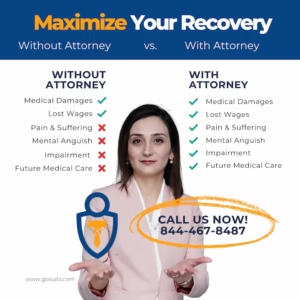
How are medical and financial losses proven?
- Medical documentation. ER records, imaging, treatment plans, and provider notes create a timeline linking the crash to your injuries.
- Wage and employment records. Pay stubs, timesheets, and employer letters support claims for time missed and lost earning capacity.
- Out-of-pocket expenses. Prescriptions, travel, medical devices, and home modifications can be aggregated and supported with receipts.
- Non-economic harms. California’s jury instructions recognize pain, suffering, and loss of enjoyment as compensable losses when supported by credible evidence [9].
What defenses do drivers and insurers raise in Irvine crash cases?
It is common for defendants and insurers to challenge fault, causation, and damages. Frequent positions include:
- Comparative fault. The defense may argue you shared responsibility, such as a late yellow turn at Jamboree or a quick lane change on I-405. Under California’s pure comparative negligence, any percentage of fault reduces recovery proportionally [8].
- Causation disputes. They may claim your symptoms predated the crash or stem from a later event, requiring strong medical documentation.
- Low-impact arguments. Adjusters may assert the property damage appears minor and thus injuries should be minimal, which medical literature does not necessarily support for all individuals.
- Mitigation challenges. Insurers sometimes argue delays in treatment or gaps in care increased the claimed losses.
- Time-bar defenses. Missing the statute of limitations can end a case before it begins, so knowing the deadline is essential [7].
How do I-5 and I-405 crashes impact injury claims?
Freeway collisions around Irvine present distinct issues that can shape claims:
- Multi-vehicle sequences. Chain reactions complicate fault analysis because you must untangle primary impacts from secondary collisions, sometimes requiring reconstruction and careful witness correlation.
- High-speed severity. Even slight misjudgments in lane changes or following distance can produce severe injuries at freeway speeds. National data link speed with heightened fatality risk, which often translates into more complex medical and life care planning [3].
- Commercial traffic. Freight and delivery activity on I-5 and I-405 adds heavy vehicles to the mix, increasing stopping distances and potential for underride or override dynamics. Identifying all contributing parties, such as a shipper or a maintenance contractor on a disabled vehicle, can be crucial.
- Work zones. When construction narrows lanes or shifts merges, signage and taper lengths become important evidence, and state agency records may be relevant to the analysis [5].
Highly skilled experts with expertise in analyzing the intricate details of highway accidents can gather various types of evidence such as event data recorders, dashcam footage, telematics data, and public records on past incidents. They then use this information to craft comprehensive narratives for insurance claims or legal cases.
What compensation might be available in California car crash cases?
Available compensation depends on liability, coverage, and the evidence of harm. In California civil cases, recoverable items can include:
- Medical expenses. ER, hospitalization, surgery, therapy, medications, and future medical needs, supported by provider records and expert testimony when necessary [9].
- Lost income and earning capacity. Time missed from work and long-term vocational impact documented with employment and medical evidence [9].
- Property damage. Vehicle repair or total loss valuation, diminished value where supported, and personal items damaged in the crash.
- Non-economic damages. Human losses like pain, suffering, inconvenience, physical impairment, and loss of enjoyment of life as recognized in California jury instructions [9].
- Punitive damages in rare cases. Reserved for conduct that meets California’s statutory standard of malice, oppression, or fraud, such as certain extreme DUI circumstances, and subject to strict proof requirements [10].
How can you plan routes to avoid Irvine crash hotspots?
While no route is risk-free, you can make choices that reduce exposure to common crash mechanisms:
- Favor fewer conflict points. Where practical, select routes with fewer busy left-turns during peak hours. For example, using corridors with protected left-turn phases or alternative timing can reduce exposure to angle crashes [4].
- Time departures. Shifting a commute by 10 to 15 minutes during the heaviest congestion on I-405 or I-5 can smooth stop-and-go volatility that fuels rear-end collisions [3].
- Use freeway to arterial transitions mindfully. Plan merges and exits early near Jamboree, Culver, or Sand Canyon. Avoid last-second weaving in dense traffic that raises sideswipe risks [1].
- Watch entertainment and retail peaks. Weekend afternoons and evenings around Irvine Spectrum, The Marketplace, and University Town Center increase parking lot exits and mid-block turn pressure. Give extra space and anticipate sudden stops [1].
- Monitor incident conditions. Checking official incident pages can help you avoid secondary crashes around disabled vehicles or lane closures [13].
Cities often make adjustments such as fine-tuning traffic signals, adding protected bike lanes, or enhancing pedestrian infrastructure in order to create a safer environment over time. However, your daily driving decisions continue to be crucial in the short term [14] .
Where can you find official Irvine crash maps and records?
- UC Berkeley TIMS. Statewide Integrated Traffic Records System mapping lets you visualize collisions by city, corridor, and crash type to see patterns and frequency over selected time windows [1].
- California OTS rankings. Yearly comparisons by population group and crash category offer a way to benchmark cities against peers and track improvement over time [2].
- Caltrans District 12. District resources include project information, maintenance updates, and safety initiatives affecting Orange County freeway corridors that run through Irvine [5].
- CHP incident information. For current incidents on state highways, the CHP page can help drivers decide whether to reroute around active closures or backups [13].
- City of Irvine transportation. Local pages highlight infrastructure projects, mobility planning, and safety programs that can affect crash risk on city streets [14].
When should you consider calling an attorney after an Irvine crash?
It is essential to reach out to the appropriate parties promptly when injuries require medical attention, liability remains unclear, or multiple vehicles are involved in accidents on highways like I-5 and I-405. Initiating early communication can help you avoid complications, secure time-sensitive evidence, and effectively manage insurance interactions. Many people start this process by initiating a conversation to understand the scope of issues such as statutes of limitations and create plans for documentation and treatment [7].
When deciding whether to handle a claim on your own or seek professional assistance, several factors should be taken into consideration. Initially, reflect on the intricacy of the liability concerns at hand. Secondly, take into account the level of injuries sustained, if any. Lastly, contemplate the number of parties involved in your case, including various insurance companies. If you find that your claim is contentious and revolves around a car accident, working with an accomplished attorney can be highly beneficial. These professionals excel at handling evidence, negotiating with insurers, and preparing for litigation when necessary. They guarantee your strongest possible representation during what could potentially be a difficult time in your life.
In terms of daily life, it is clear that local residents understand the importance of having a dependable legal representative readily available. This becomes especially true when unfortunate car accidents occur. It is here where Irvine accident lawyers prove their worth. Due to their extensive knowledge and familiarity with the area, they are well-versed in typical collision patterns as well as various venue considerations that may influence case strategy. Having an attorney who knows these aspects of local law inside and out can significantly increase your chances of achieving a just outcome for your situation. So, if you find yourself dealing with the aftermath of a car accident in Irvine, don’t hesitate to seek legal assistance from an experienced professional familiar with all the particulars that may affect your case. They are best equipped to ensure a fair resolution on your behalf.
How does settlement negotiation typically work in California car cases?

Insurance claims typically start with a thorough investigation process that involves collecting essential documents like police reports, pictures of the damaged vehicle, repair estimates, medical records, and proof of any lost earnings. Once the victim has been appropriately treated and stabilized, many cases proceed to the negotiation phase where demands are exchanged and both parties work towards reaching a mutual agreement.
- Demand package. A written submission outlines liability, injuries, treatment, bills, wage loss, and non-economic harms, often with supporting visuals for clarity.
- Insurer evaluation. Claim handlers assess comparative fault, causation, medical necessity, and policy limits, and may request additional records.
- Negotiation. Offers and counteroffers may continue over weeks or months. If liability or causation is disputed, the process can take longer and may involve mediations.
- Litigation as leverage or necessity. When disputes persist, filing a complaint preserves deadlines and compels structured discovery, including depositions and expert disclosures, which can reset negotiations or lead to trial.
During this entire time frame, it is essential to maintain thorough medical records and convey reliable details about work restrictions and daily limitations in order to present a convincing, trustworthy explanation of the damages that you have sustained.[9].
What if you were hit by an uninsured or hit-and-run driver in Irvine?
Uninsured motorist and underinsured motorist coverage in your own policy can be critical if the at-fault driver lacks sufficient insurance. After a hit-and-run, prompt reporting to law enforcement and your insurer helps preserve rights under your policy, and notifying DMV can be required based on injury and property damage thresholds [6]. California Vehicle Code section 20002 sets duties after property-damage-only collisions; leaving without providing information can trigger civil and criminal issues [12].
Gather all the information you can safely get your hands on: partial license plate numbers, descriptions of vehicles, and any dashcam or nearby business video. Sometimes, CHP incident logs and local agency follow-up can provide additional details if a suspect vehicle is later identified [13] .

What should you bring to a consultation after an Irvine crash?
Bringing organized information helps make the most of your first meeting:
- Crash documentation. Police report number, photos, videos, and a written timeline of events.
- Medical records and bills. ER discharge papers, imaging, treatment notes, prescriptions, and any recommended future care.
- Work and income details. Recent pay stubs, employer letters about time missed, and job descriptions that show physical demands.
- Insurance details. Your auto policy declarations page showing coverages, and any communications from insurers.
- Expense log. Out-of-pocket costs for transportation, devices, home assistance, or childcare connected to recovery.
- Questions and goals. A written list of questions about timelines, documentation needs, and next steps.
Who is GoSuits and how do we help after an Irvine crash?
At our firm, we specialize in assisting individuals who have been involved in major traffic accidents in Irvine and the surrounding Orange County area. A complimentary consultation is offered to help you understand your options, timeframes, and necessary paperwork so that you can make well-informed decisions about your course of action moving forward. Our services extend statewide throughout California, with our dedicated team ready to promptly schedule a meeting and guide you through the specifics relevant to your case.
GoSuits leverages an innovative technology-driven approach centered around proprietary software that efficiently organizes evidence, medical records, and case timelines for faster, more focused case development. Although we utilize advanced technology to streamline our work, every client is assigned a dedicated attorney rather than a case manager, ensuring seamless access to their lawyer from start to finish.
Our history includes results for clients in high-stakes roadway cases. You can see a representative sample at prior cases. We are trial ready, and courtroom experience often helps position cases for better outcomes during negotiation. Learn more about the team at our attorneys and our story at about us.
We handle a full range of traffic injury matters in California, including freeway collisions, intersection crashes, pedestrian and bicycle injuries, rideshare claims, and serious catastrophic harm. Explore more at practice areas. We bring more than 30 years of combined experience to investigations, negotiation, and trial preparation, and we are committed to clear communication and efficient case progression from day one.
References and Resources
- Transportation Injury Mapping System SWITRS Tools – UC Berkeley SafeTREC
- Collision Ranking Results – California Office of Traffic Safety
- Traffic Fatalities 2022 FARS – National Highway Traffic Safety Administration
- Intersection Safety – Federal Highway Administration
- Caltrans District 12 Orange County – California Department of Transportation
- Collision Reporting and SR-1 – California DMV
- Code of Civil Procedure 335.1 – California Legislative Information
- Li v. Yellow Cab Co. of California, 13 Cal.3d 804 – Google Scholar
- Civil Jury Instructions CACI, Damages Series – Judicial Council of California
- Civil Code 3294 Punitive Damages – California Legislative Information
- QuickFacts Irvine city, California – U.S. Census Bureau
- Vehicle Code 20002 Hit-and-Run Property Damage – California Legislative Information
- Traffic Incident Information Page – California Highway Patrol
- Transportation and Mobility – City of Irvine
- Speeding and Risky Driving – National Highway Traffic Safety Administration