









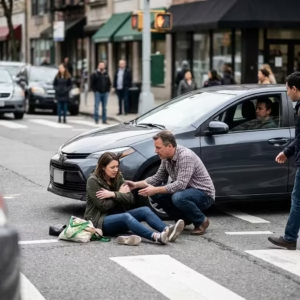


What should you do in the first week after a Joliet car crash?
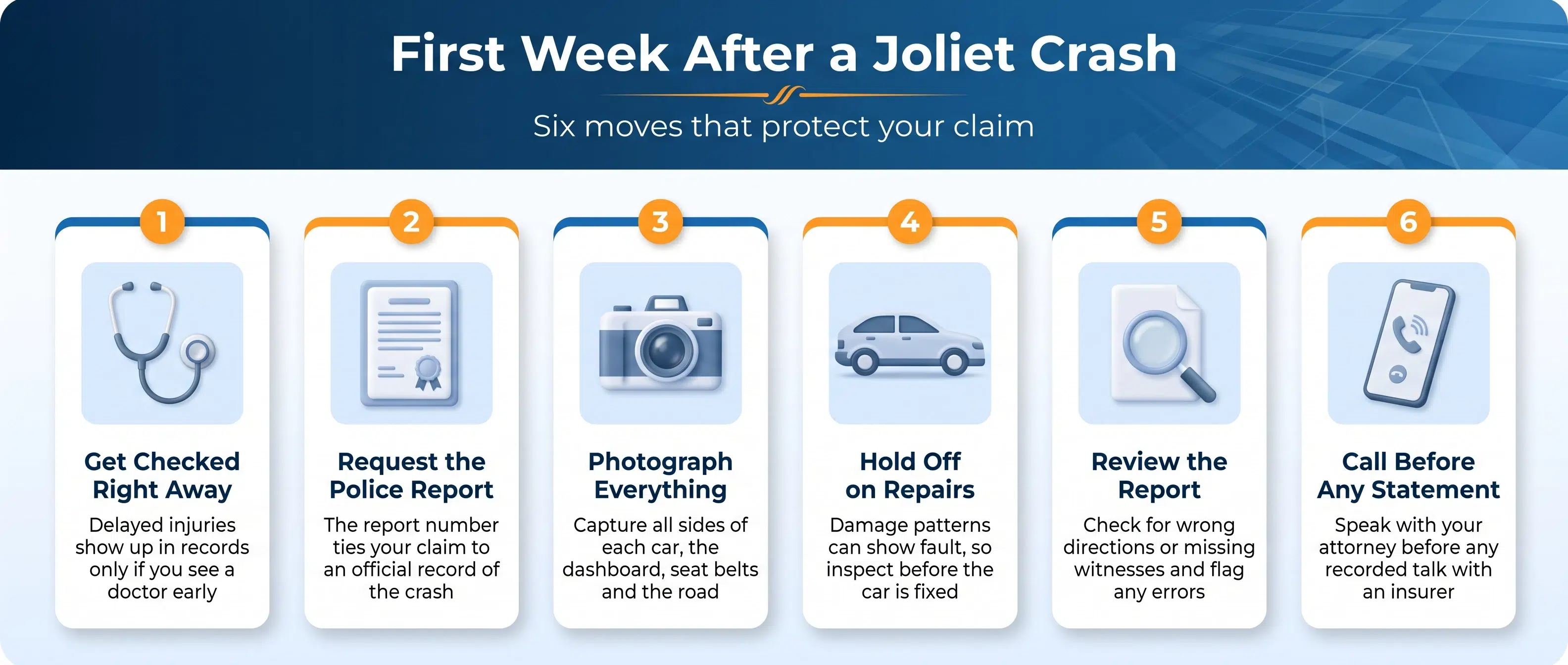
Medical care comes first, even if you walked away. Soft tissue injuries, concussions and herniated discs often announce themselves a day or two later, and a gap in treatment gives an insurer something to point at. If you can, go to a hospital emergency room the same day. Saint Joseph Medical Center on Madison Street in Joliet and Silver Cross Hospital in New Lenox both have emergency departments.
Next, get the police report. Whichever agency responded, the Joliet Police Department, the Will County Sheriff or the Illinois State Police on the interstates, the report number is what ties your claim to an official record. Read it for mistakes. If it lists the wrong direction of travel or leaves out a witness, tell us so it can be corrected or answered.
Do not repair the car yet if the damage is relevant to fault. Photograph all sides, the interior, the dashboard if warning lights came on, and the seat belt. Then talk with our personal injury team serving the Chicago area and Joliet before you say anything recorded to the other driver’s insurance company.
Who pays when the other driver caused the crash?
In Illinois the driver who causes a crash is responsible for the harm, and the claim usually runs through that driver’s liability policy. Trouble starts when the policy is thin, or when there is none. Then your own uninsured or underinsured motorist coverage may come into play, and the order in which you notify insurers can matter. We read your policy early for exactly that reason.
Employers get pulled in more often than people expect. Joliet is full of warehouse and logistics traffic, and a delivery driver, a sales rep or a contractor in a work vehicle may have a company policy behind them. A driver who hit you on the way between jobs is a different case from one who hit you on a Saturday outing.
Where do Joliet collisions tend to happen, and why does it matter?
It matters because the location tells us where to look for proof. On I-80, stop-and-go traffic produces rear-end crashes, and a chain of three or four vehicles means several insurers and several stories. In town, busy intersections such as Jefferson Street and Larkin Avenue are where driver inattention and failure-to-yield collisions show up. Along US 30 by the Louis Joliet Mall, shoppers pulling in and out of lots create sideswipes and low-speed impacts that still hurt. Out toward New Lenox, the stretch around Route 6 and I-355 mixes highway speeds with turning traffic.
Each of those places has different evidence. A signalized intersection may have timing records and a gas station camera. A highway crash may have dashcam footage from a passing truck. We find out which applies to yours.
What evidence disappears fastest?
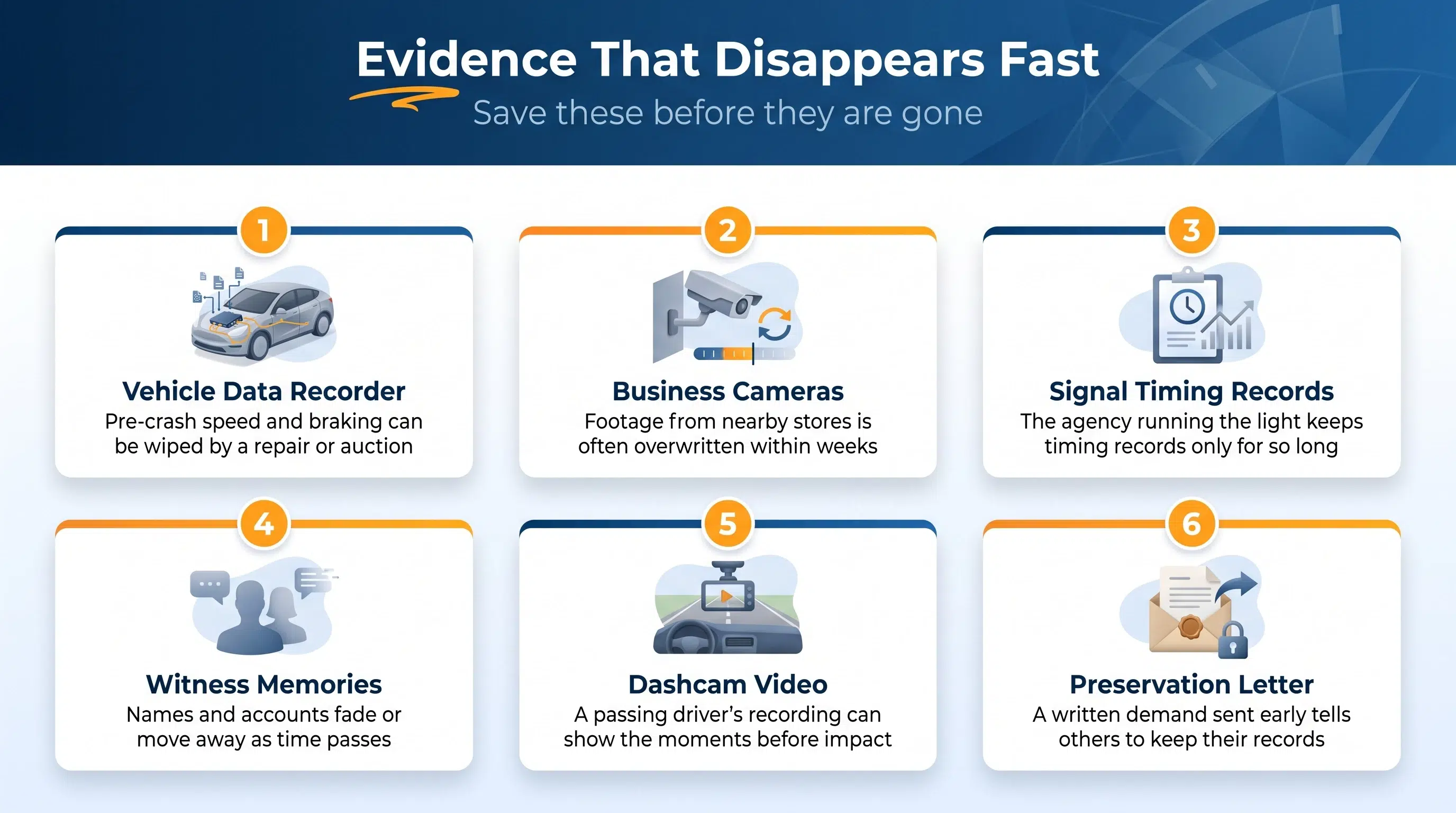
The vehicle’s own recorder, for one. Many cars store pre-crash speed, throttle, brake and belt data, and the module can be wiped by a repair or a total-loss auction. Business cameras often overwrite footage in a few weeks at most. Traffic signal timing records are held by the agency that runs the signal and are not kept forever. Witnesses forget, or move.
That is why a letter demanding preservation goes out early in our cases, and why we ask clients not to let the car be sold or scrapped until we have looked at it.
How does Illinois treat a driver who is partly at fault?
If you share blame for a crash, you can still recover, with a limit. Under 735 ILCS 5/2-1116, a plaintiff whose fault is more than 50 percent is barred from recovering anything, and a plaintiff at 50 percent or less has damages reduced by their own share. So a driver found 20 percent at fault who has a $100,000 loss collects $80,000 under the rule. This is why insurers work so hard to move a percentage point or two onto the injured person: a speed estimate, a late turn signal, a phone on the seat. You can read more in our article on being partially at fault in Illinois.
Evidence is how we push back. Skid marks, vehicle data and independent witnesses tend to beat an adjuster’s guess.
What is a Joliet car accident claim worth?
There is no honest number without the records. The value follows the injuries and what they cost: emergency care, imaging, surgery or injections, physical therapy, time off work, and the pain and disruption that come with all of it. A broken wrist for a warehouse worker who cannot lift for four months is a different claim than the same break for someone who works at a desk.
Two things people overlook. Illinois law allows prejudgment interest of 6 percent per year on certain personal injury judgments, running from the date the lawsuit is filed for up to five years, subject to rules about settlement offers (735 ILCS 5/2-1303). And what you keep is not the same as what the case settles for. Beyond pursuing the at-fault insurer for the gross recovery, we negotiate with hospitals, ER groups and other medical lien holders at settlement to reduce what you owe out of the award, so more of the money reaches you.
Which injuries get doubted, and how do you answer the doubt?
Soft tissue injuries, concussions and disc problems draw the most skepticism, because nobody can see them from the roadside. Whiplash pain can build over a day or two. A concussion can pass for a bad headache and some fogginess. A herniated disc may only be confirmed by an MRI weeks later. Adjusters read those timelines as doubt: if you waited five days to see a doctor, they will say something else hurt you.
The answer is steady treatment and honest records. Tell every provider about every symptom, even the ones that seem minor, follow the care plan and keep your appointments. If cost is what holds you back from seeing a specialist, ask us, because there are ways to get care while a claim is pending. Gaps and missed visits are what an insurer shows a jury, and a record of consistent care is hard to argue with. We also ask your doctors to put in writing what caused the injury, since a physician’s opinion outweighs an adjuster’s suspicion.
Repairs, a rental and the total-loss letter
The property damage claim runs on its own track and should stay separate from the injury claim. Your car can be repaired or valued as a total loss while your treatment goes on. What to avoid is signing a release that covers “all claims” in order to get a repair check, because that paper can end the injury claim along with it. Read whatever the insurer sends before you sign, and send it to us if you are unsure.
If the car is declared a total loss, the insurer’s number is often lower than owners expect. Keep records of the car’s mileage, options and recent maintenance, and look at what similar vehicles near Joliet are listed for. Before the car goes to auction, we want to have examined and photographed it, because the damage pattern and stored data are lost once it is sold.
Does the police report settle who was at fault?
It helps, but it does not decide anything. The officer who arrives after the crash writes down what drivers and witnesses say and what the scene shows, and a citation reflects a fast judgment made at the roadside. A report is evidence to be weighed, and it can be answered. If it puts fault on you, or leaves out something the road itself shows, we can challenge it with other proof.
Why does the insurer want a statement so fast?
Because early statements are easy to use. An adjuster calls within a day or two, sounds friendly, and asks whether you are okay. “I’m fine” or “I think I looked left” can show up later in a denial letter. You are not obliged to give a recorded statement to the other side’s insurer, and anything you say can be quoted back to you. Give basic information such as your name and the vehicle and then refer the call to us.
Quick settlement offers follow the same logic. A check that arrives before you know the full extent of your injuries is cheap for the insurer and final for you.
How long do you have to file, and where?
Illinois sets a general two year limit on personal injury lawsuits, under 735 ILCS 5/13-202. For most car crash claims that means two years from the date of the crash. Different rules apply to claims against a city, a school district or another public body, and those notices can come due much sooner, so tell us at the outset if a government vehicle or a road defect was involved.
A Joliet case is normally filed in the Circuit Court of the Twelfth Judicial Circuit in Will County. Most of Joliet lies in Will County, but a small part of the city is in Kendall County, so the right county can depend on where the crash happened and where the defendants live or do business. We sort that out before we file. If you want a person to look at your own crash, you can schedule a free consultation and we will tell you what we see.
Which Joliet car accident cases do we take?
We take the crashes Joliet drivers deal with most: rear-end collisions in I-80 stop-and-go traffic, failure-to-yield crashes at Jefferson Street and Larkin Avenue, sideswipes along US 30 near the Louis Joliet Mall, and collisions with delivery drivers and other work vehicles. Our Chicago-area car accident lawyers handle these claims from the first call through settlement or trial.
Car accident cases are one part of the work of our Chicago personal injury office. When a semi or another commercial truck is involved, our Chicago-area truck accident team works the case from the start.