




















Who is allowed to bring a wrongful death claim in Illinois?
Not the family directly. Under the Illinois Wrongful Death Act, the lawsuit is filed by the personal representative of the person who died, in that representative’s name, but it is for the benefit of the surviving spouse and next of kin (740 ILCS 180/2). If there is no estate yet, one usually must be opened first, and a court appoints the representative. In many families the representative is a spouse or an adult child.
This surprises people. A mother can be the person most hurt by her son’s death and still not be the one who signs the complaint. We help families sort out who should serve, because a mistake at the start slows everything down. Questions like this one are covered in our article on how long a wrongful death lawsuit takes to settle.
Two claims, not one
A fatal injury can give rise to two different claims. The wrongful death claim compensates the survivors for what they lost. The Survival Act (755 ILCS 5/27-6) preserves claims that the person who died could have brought if they had lived, such as the pain they endured before death, medical bills and lost earnings. The first belongs to the family, the second to the estate. They are usually pursued together.
The difference changes who receives money and how damages are measured, which is why the pleadings need care.
What can a family recover?
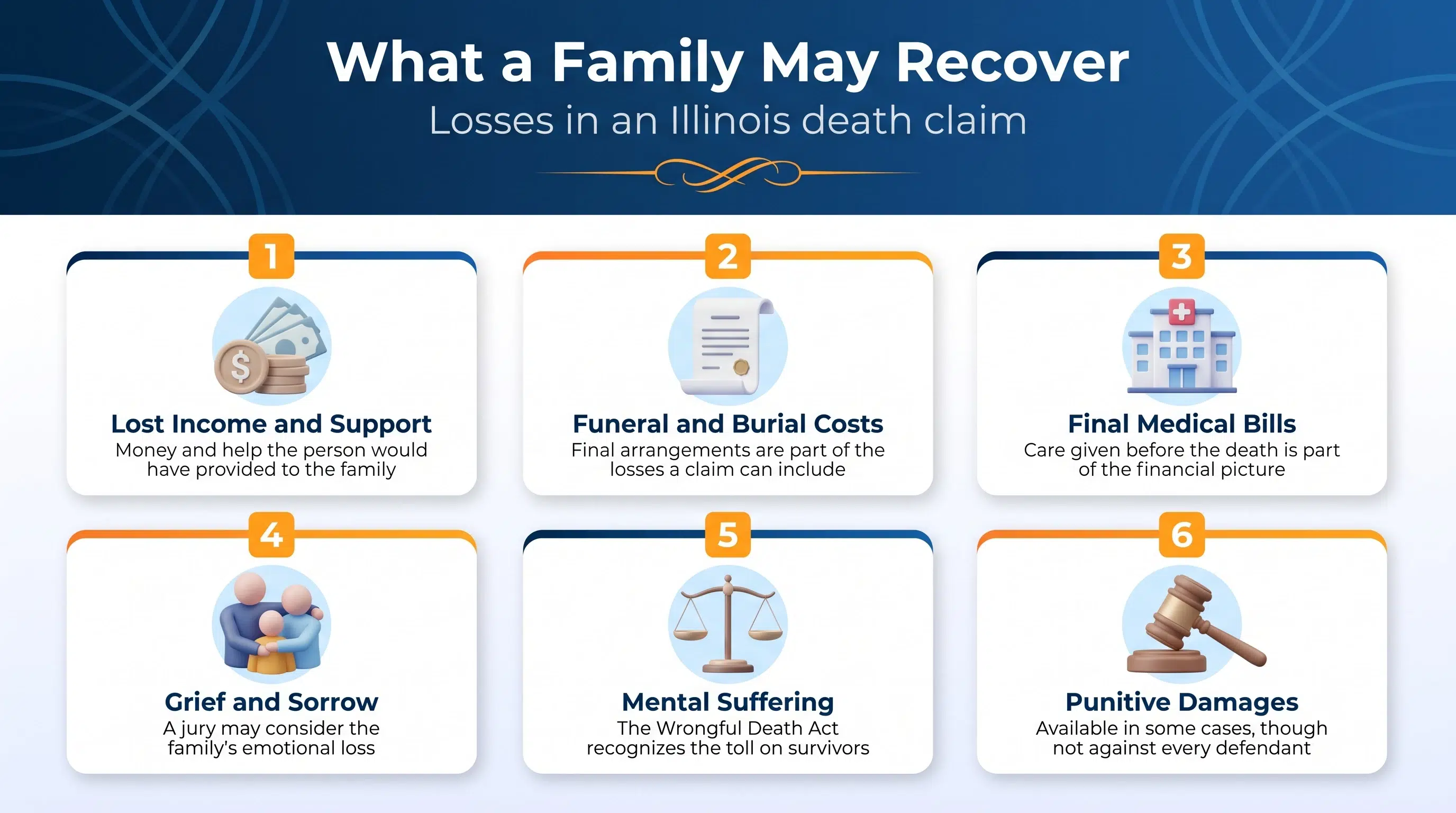
The Wrongful Death Act lets a jury award fair and just compensation for the losses survivors suffered. That includes financial losses, such as the income and support the person would have provided, and it can include grief, sorrow and mental suffering. Funeral and burial costs and final medical expenses are part of the picture. In cases that qualify, punitive damages may be available, though not against every kind of defendant.
The court divides a recovery among the spouse and next of kin by their dependency on the person who died. In an agreed settlement, the circuit court makes the distribution. Beyond pursuing the gross recovery from the responsible parties’ insurers, we negotiate with hospitals and other medical lien holders at settlement to reduce what comes out of the award. And Illinois allows prejudgment interest of 6 percent a year on certain wrongful death and injury judgments, running from the date of filing for up to five years, with limits tied to settlement offers (735 ILCS 5/2-1303).
How long does a family have?
The general period is two years from the date of death (740 ILCS 180/2). Exceptions exist. If the death resulted from violent intentional conduct, the period is five years, though only as against the person who committed the act. Where a person was charged with certain homicide offenses, a claim against that person may be brought within one year after the criminal case ends. A beneficiary who was under 18 when the claim arose may have until two years after turning 18. These extensions apply to specific defendants, not to everyone, so do not count on them.
The safe course is to talk to a lawyer well inside two years from the death. Evidence is fresher and the family is not pressed against a deadline.
What if the person who died shared some of the blame?
Fault still matters. If the person who died was more than 50 percent responsible, the claim is barred, and at 50 percent or less, damages are reduced by their share (735 ILCS 5/2-1116 and 740 ILCS 180/2). A defendant will often try to put some blame on someone who cannot answer back. That is why we gather independent proof: scene evidence, vehicle or equipment data and witnesses who have no stake.
Where fatal cases come from in and around Joliet
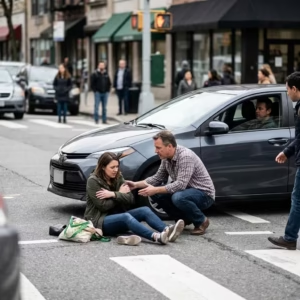
Highway collisions are the most familiar, particularly where trucks and passenger vehicles mix on I-80 and I-55 and on US 30 and the surface roads serving the warehouse district near the intermodal yards. Pedestrian deaths happen on busy streets. Other cases arise from workplace accidents on construction or industrial sites, from unsafe property conditions, and from defective products. Each case has its own defendants and its own insurance.
Medical records matter too. People injured in Joliet may be taken to Saint Joseph Medical Center on Madison Street or to Silver Cross Hospital in New Lenox. Those records show what treatment was given, how long the person lived and what they endured, which bears on both the wrongful death and survival claims.
What should families preserve?
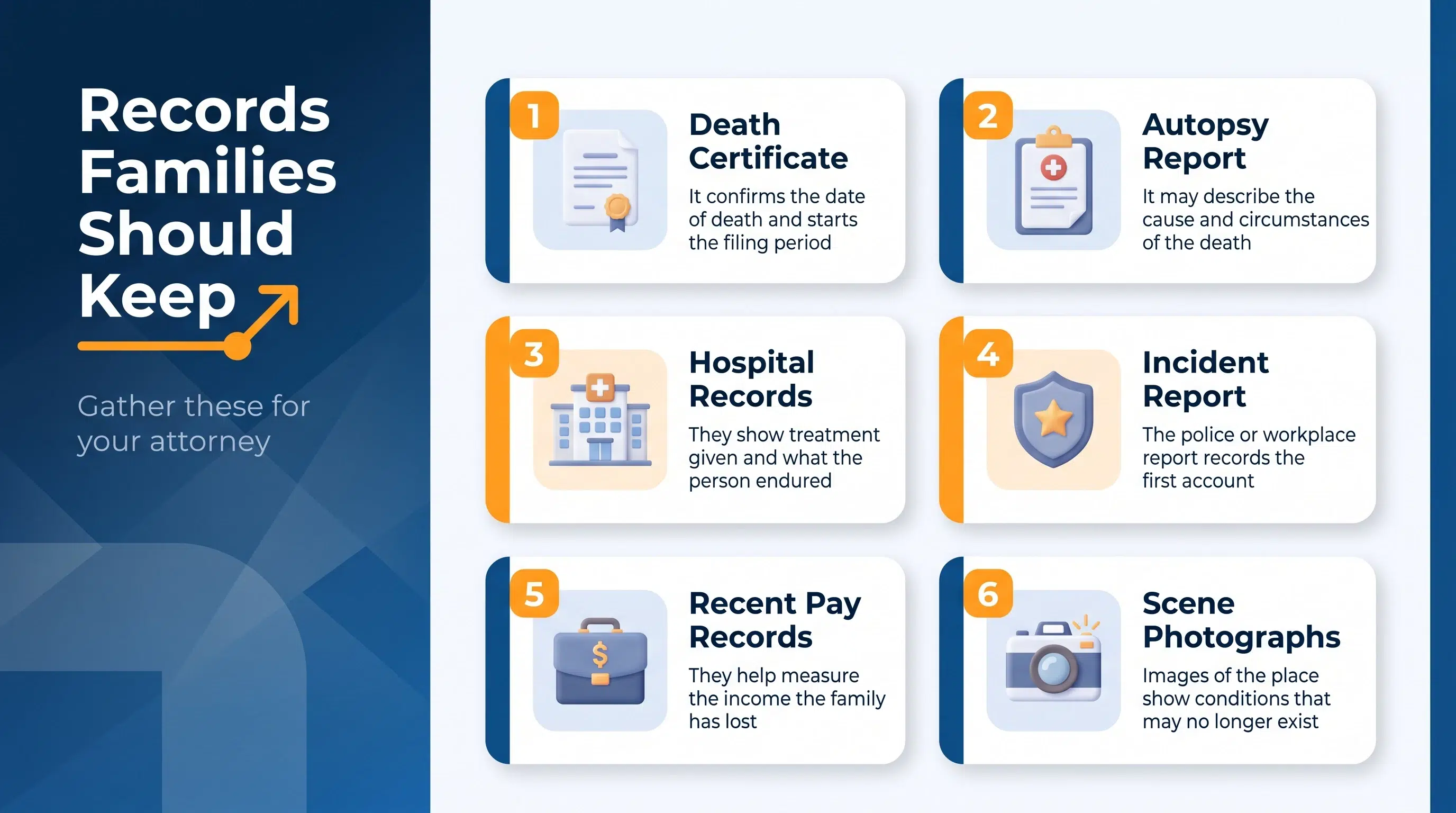
The death certificate and any autopsy report, hospital and emergency records, the crash or incident report, the person’s recent pay records, and photographs of the scene. Keep the vehicle, if there was one, where it is. Do not post about the incident on social media, since defense lawyers read those posts.
Tell us about any calls from an insurer. Adjusters sometimes reach out within days of a death with a condolence and a request for a statement or a signature. Hold off, and contact our team first.
Which relatives count as next of kin?
The statute sends the recovery to the surviving spouse and next of kin, generally understood to mean the people who would inherit if there were no will. A spouse and children are the usual group. When there is no spouse or child, parents, siblings and others may qualify, and adopted children and adoptive parents are treated as natural ones. Dependency drives the division. A spouse who relied on the income may receive more than an adult child who lived independently, and the judge holds a hearing on it when the family cannot agree. Families sometimes assume everyone shares equally, and that is not how it works.
How the loss looks for different family members
A spouse loses a partner and often the household’s main income, along with companionship and daily support. Young children lose a parent’s guidance and care for the rest of their childhood, and a court looks at what that parent would likely have given them. Parents who lose an adult child may have been relying on that child for help, or may simply have lost the person they raised. The Wrongful Death Act allows a jury to consider grief, sorrow and mental suffering alongside the financial loss.
We ask each family member to tell us about the person who died, in their own words. Those accounts, with photographs, work records and statements from friends and employers, are how a jury comes to see a life rather than a number. Some families find it hard. We go slowly, and we stop when someone needs to.
What if the person died days or weeks after the injury?
A death does not have to be immediate to support a claim. A person may spend days in intensive care or weeks in a rehabilitation unit before dying of complications. The medical records then document the suffering that the survival claim covers, and the wrongful death filing period runs from the date of death, not the date of the crash (740 ILCS 180/2). We check the survival claim’s deadline separately rather than assuming it matches, and we look at the whole timeline before telling a family how much time remains.
A death on a job site
When someone dies at work, the employer is generally shielded from a lawsuit by workers’ compensation, which pays benefits whatever the fault. That does not close every door. A wrongful death claim can often be brought against others whose negligence contributed: an equipment maker, a general contractor, a property owner, or a driver who hit the worker’s vehicle. The workers’ compensation insurer may also claim a share of any recovery, which complicates the settlement math.
When there is also a criminal case
A fatal crash caused by an impaired or reckless driver may bring criminal charges. The criminal case and the civil claim run on separate tracks with different standards of proof, and neither depends on the other. A conviction can help the family, and an acquittal does not end the civil claim. The Wrongful Death Act also allows one year after the criminal case ends for a claim against a person charged with certain homicide offenses, but only against that person (740 ILCS 180/2). We follow the criminal case so the family is not surprised by it, and we advise before anyone gives a statement that could matter in both.
Filing in Will County
A Joliet wrongful death suit is normally filed in the Circuit Court of the Twelfth Judicial Circuit in Will County. A small part of Joliet is in Kendall County, so the proper county can depend on where the death occurred and where the defendants reside or do business. Our personal injury attorneys serving Chicago and Joliet can walk your family through the choices.
Which Joliet wrongful death cases do we take?
We represent Joliet families after fatal crashes on I-80, I-55 and US 30, pedestrian deaths on busy streets, fatal workplace accidents on construction and industrial sites, and deaths caused by unsafe property or defective products. In Illinois the claim is brought by the personal representative of the estate for the surviving spouse and next of kin, and our Chicago-area wrongful death lawyers handle it together with the estate’s survival claim.
Wrongful death cases are handled through our Chicago personal injury office. When a semi or another commercial truck caused the death, our Chicago-area truck accident team works on the case from the start, because the carrier’s records are often the key evidence.