















What makes a truck crash in Joliet different from other crashes?
Scale, mostly, and the web of companies behind the wheel. The CenterPoint Intermodal Center Joliet/Elwood occupies about 6,400 acres by the I-55 and I-80 interchange, anchored by BNSF Logistics Park Chicago and the Union Pacific Joliet Intermodal Terminal. Containers arrive by rail and leave by truck. A driver hauling a container to a warehouse may be answerable to a trucking company, a broker who arranged the load and a shipper who set the delivery window.
That affects everything from where the case is filed to how much insurance is available. Federal rules apply as well as Illinois law, and the investigation looks very different from a fender-bender.
Who is actually liable when a freight truck causes a wreck?
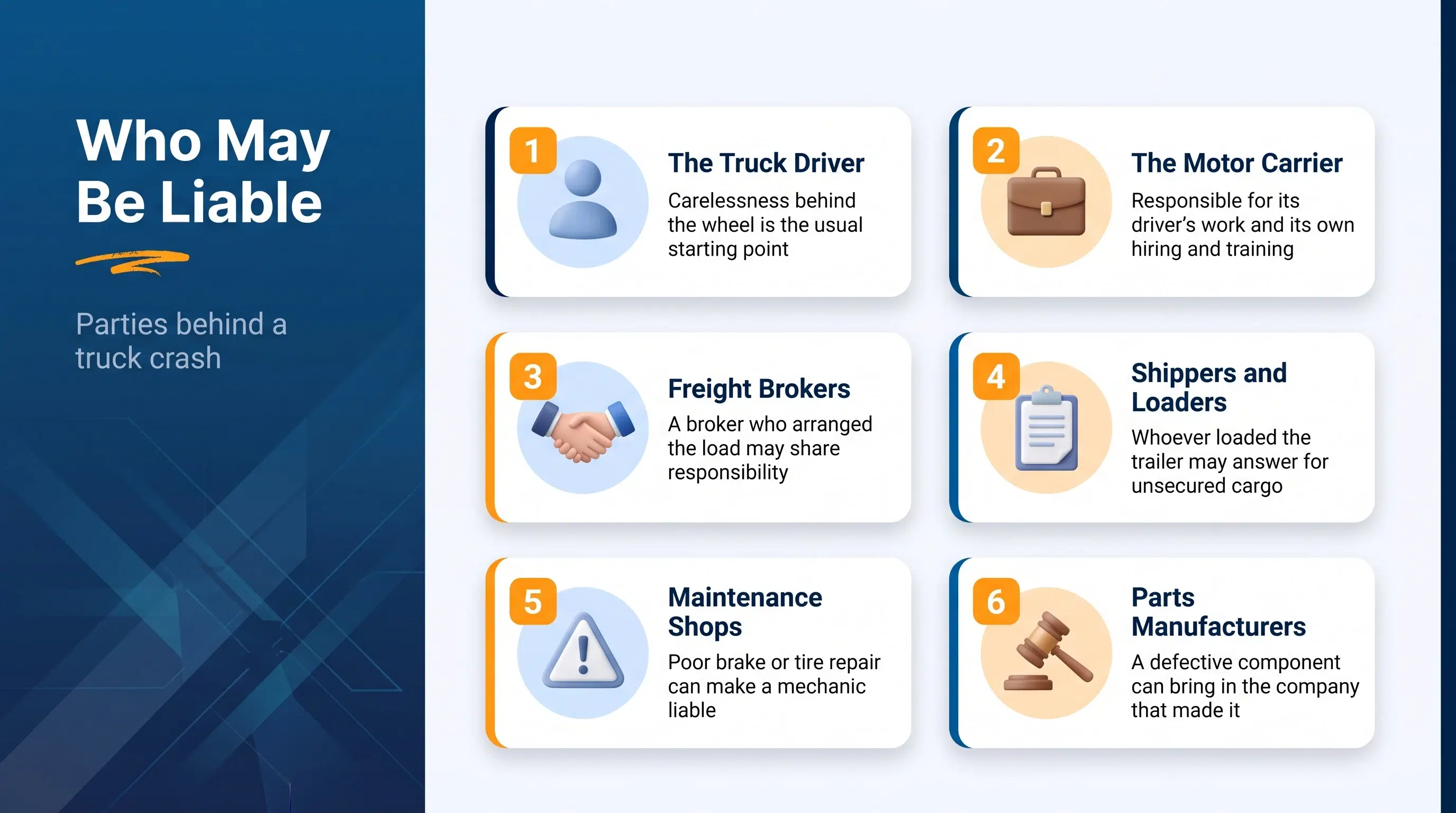
Start with the driver, whose carelessness is the usual cause. Next comes the motor carrier. A carrier can be responsible for what its driver did while working, and also for its own choices: hiring an unsafe driver, failing to train, pushing drivers past legal limits, or putting a truck with bad brakes on the road. Brokers, shippers who loaded the trailer, mechanics who repaired it and manufacturers of defective parts may also share responsibility.
Why does this matter? Because the driver alone often has little money and a modest policy, while a carrier carries more. Naming everyone who contributed is how families get to the coverage that actually matches their losses. You can read more in our article on CDL violations and negligence in Illinois truck crashes.
What do federal hours rules say, and how do we check them?
Federal regulations limit how long a property-carrying driver can be on the road. Under 49 CFR Part 395, a driver must take ten consecutive hours off duty before driving, may not drive beyond the 14th consecutive hour after coming on duty, and may drive no more than 11 hours within that window. A 30-minute break is required after eight cumulative hours of driving, and there are weekly caps of 60 hours in seven days or 70 hours in eight, depending on whether the carrier operates every day. Most carriers must record this on an electronic logging device.
The ELD record, along with fuel receipts, toll data, dispatch messages and delivery times, lets us see whether a driver was where the logs said. A crash at 4 a.m. after a driver has been awake since the previous afternoon looks very different when that data lines up. Short-haul and other exemptions exist, so we read the actual file before saying what applied.
Evidence that can vanish in days
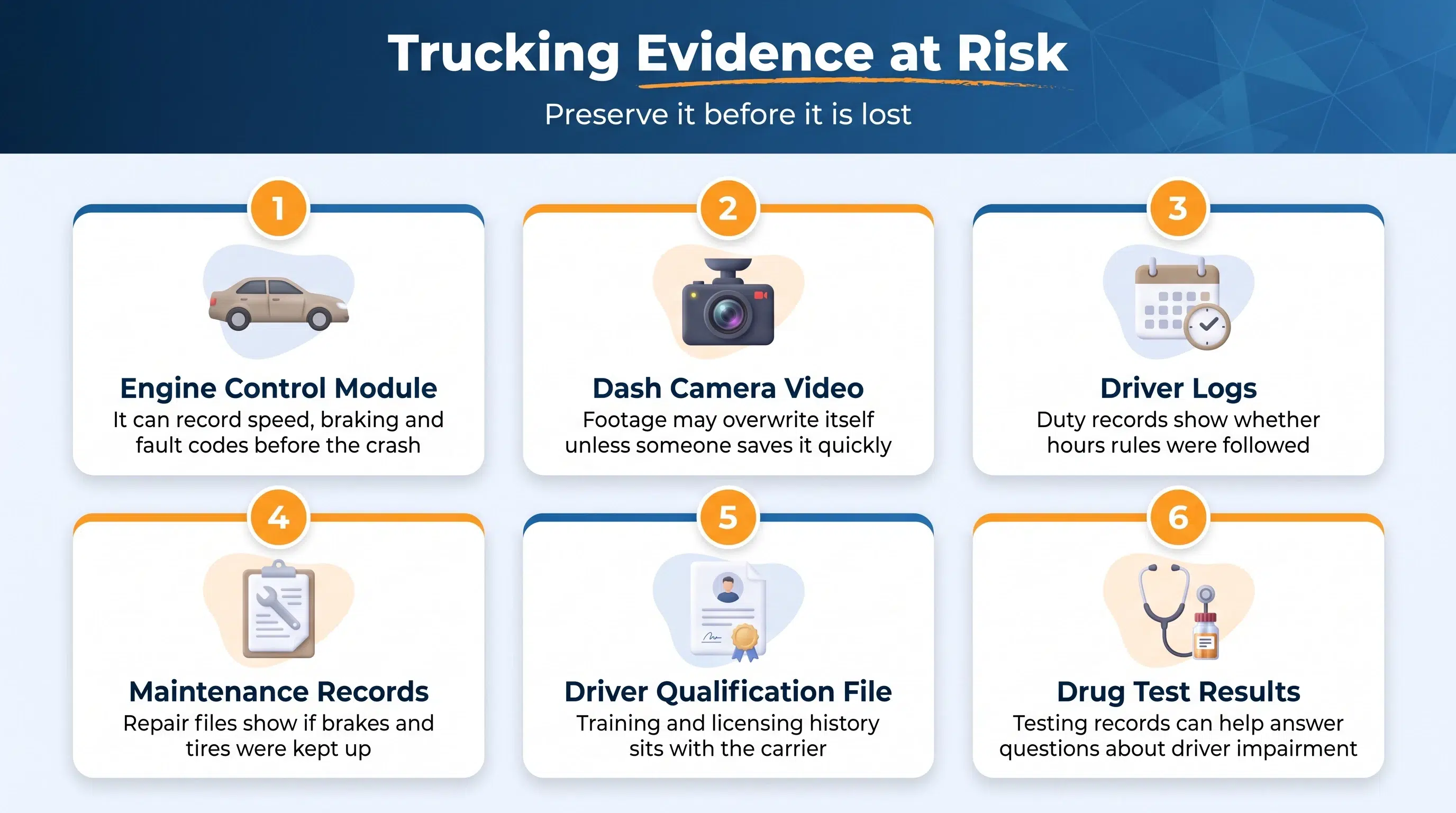
A truck’s engine control module can record speed, braking and fault codes. Dash cameras, if the truck has one, may overwrite. Drivers’ logs, maintenance records, driver qualification files and drug test results sit with the carrier, which has no reason to save them for you. We send preservation demands at the start and, where needed, ask a court to order the evidence kept.
We also photograph and measure the scene. Skid marks on an off-ramp, gouges in pavement and debris fields show where the truck went and how fast. On a rail-served corridor like this, we ask whether the truck was coming from or heading to a terminal, since gate records can show how long a driver had been waiting and working.
Which trucks, and which kinds of crash?
Not every truck case involves a tractor-trailer. Joliet traffic includes box trucks and delivery vans making stops, dump trucks and cement mixers heading to construction sites, flatbeds and tankers, and the container haulers coming off the rail terminals. Each has its own rules, its own insurance and its own ways of failing.
Crashes differ as well. A tractor-trailer can jackknife when it brakes hard on a wet road or a curve, sweeping across lanes. A loaded truck stops slowly, so a rear-end impact where traffic slows for a merge can be severe. Wide right turns and lane changes catch cars in blind spots on every side of the rig. Cargo that shifts, a tire that blows out and throws debris across a lane, and a trailer that comes loose all point back to whoever loaded, hitched or maintained the equipment.
What the carrier does in the first hours
Commercial carriers and their insurers often send investigators to a serious crash quickly, sometimes before the injured person has left the hospital. They photograph the truck, take statements and collect the driver’s paperwork. That is their right. It also means the carrier’s version of events may be well documented before yours exists, and the parts that help you, such as a damaged component or a delivery schedule, are held by the side with a reason to explain them away.
We level that out by moving just as fast: preservation demands go out, an inspection is scheduled, and the scene is documented before weather and traffic change it.
What if you were working when the truck hit you?
Some Joliet truck crash victims are on the job, a delivery driver, a tradesperson or a warehouse employee heading between sites. Workers’ compensation may pay for medical care and part of lost wages regardless of fault, but it generally does not pay for pain and suffering. A person hurt by someone else’s truck can often bring a separate injury claim against the trucking company and driver, while the compensation insurer may have a right to be repaid from the recovery. The two claims interact in technical ways, and a mistake can cost real money. Tell us at the start if the crash happened during work.
Your own insurance after a truck crash
A serious truck injury can exceed what the first policy pays, and your own coverage may become part of the picture. Look at your auto policy for underinsured motorist and medical payments coverage, and tell your insurer about the crash promptly, since these policies carry notice conditions. Do not give your own insurer a recorded account of fault before speaking with us. If the trucking company has layers of coverage, we need to know about all of them, and we ask for the policies early.
Why truck claims take longer
More parties, more records and bigger losses all slow things down. A carrier may have to produce years of driver qualification files and maintenance records in response to our requests, and it may fight over how much of that is relevant. Treatment can last long enough that the final medical cost is unknown for a year or more, and a settlement before your condition has stabilized often leaves out later care. We talk through that trade-off with clients instead of rushing toward an early number.
How does fault work when a truck driver blames you?
Carriers and their insurers often claim that the other driver cut in front or braked suddenly. Illinois uses modified comparative fault: a plaintiff more than 50 percent at fault recovers nothing, and one who is 50 percent or less has damages reduced by their share (735 ILCS 5/2-1116). A heavy truck needs far more room to stop than a car, and we use the truck’s own data to test those claims.
What injuries and costs follow a serious truck collision?
The forces in a truck crash can cause spinal cord injuries, traumatic brain injuries, crush injuries, amputations and major fractures. People from Joliet are often taken to Saint Joseph Medical Center on Madison Street or to Silver Cross Hospital in New Lenox, a state-designated Level II trauma center. Surgeries, long rehabilitation, home changes and the loss of earning ability make these claims large.
We work with treating physicians and, where appropriate, vocational and life-care professionals to document what the future holds. We also deal with hospital and ER-group bills. Beyond pursuing the gross recovery from the carrier’s insurers, we negotiate with medical lien holders at settlement to reduce what you owe out of the award, so more of it reaches you. Illinois law allows prejudgment interest of 6 percent a year on certain personal injury judgments, starting when the lawsuit is filed, subject to rules about settlement offers (735 ILCS 5/2-1303).
When families lose someone in a truck crash
A fatal truck collision involves the same investigation plus a wrongful death claim by the personal representative of the estate. The Illinois Wrongful Death Act sets a general two year filing period from the date of death (740 ILCS 180/2). We handle both sides of the claim so a family is not running two separate cases at once.
Deadline and venue
For injury claims, Illinois sets a two year limit from the date of injury (735 ILCS 5/13-202), so the clock is already running while you recover. Suits from Joliet crashes are generally filed in the Circuit Court of the Twelfth Judicial Circuit in Will County. A small part of Joliet is in Kendall County, so we confirm the right venue before filing, based on where the crash occurred and where the defendants do business.
To talk through your crash, schedule a free consultation with our personal injury lawyers serving Chicago and Joliet.
Which Joliet truck accident cases do we take?
We take Joliet crashes involving tractor-trailers on I-55 and I-80, container haulers coming off the intermodal terminals, box trucks and delivery vans, dump trucks, flatbeds and tankers. These cases can reach the driver, the motor carrier, a broker, a shipper or a repair shop, and our Chicago-area truck accident lawyers handle them from the first preservation demand through settlement or trial.
Truck cases are handled through our Chicago personal injury office. When a truck crash takes a life, an Illinois wrongful death claim is brought by the personal representative of the estate for the surviving spouse and next of kin, and our Chicago-area wrongful death lawyers handle those cases.