




















Who is allowed to bring a Greenville wrongful death claim?
Texas answers this by statute, and the list is shorter than many families expect. The surviving spouse, the children and the parents of the person who died may bring the claim, individually or together, and one or more of them can sue for the benefit of all (Texas Civil Practice and Remedies Code, section 71.004). Siblings, grandparents and other relatives are not on that list, however close they were.
The same statute adds a backstop. If none of those family members has filed within three calendar months of the death, the executor or administrator of the estate must bring the action, unless the eligible family members ask that it not be filed. That is why the first quarter after a death matters even though the general deadline is two years.
What is the difference between a wrongful death claim and a survival claim?
They are two claims from one death. The wrongful death claim belongs to the surviving family and covers what the family lost. The survival claim belongs to the estate and covers what the person who died could have recovered had they lived, such as medical bills before death, funeral costs and pain and mental anguish they went through between the injury and the death.
Both claims are often filed in one lawsuit. The split affects who receives what and what happens if the person who died left no will, which is why it deserves a full conversation. The survival action itself comes from section 71.021 of the Civil Practice and Remedies Code. We have a separate article on how survival actions work in Texas.
What can a family recover?
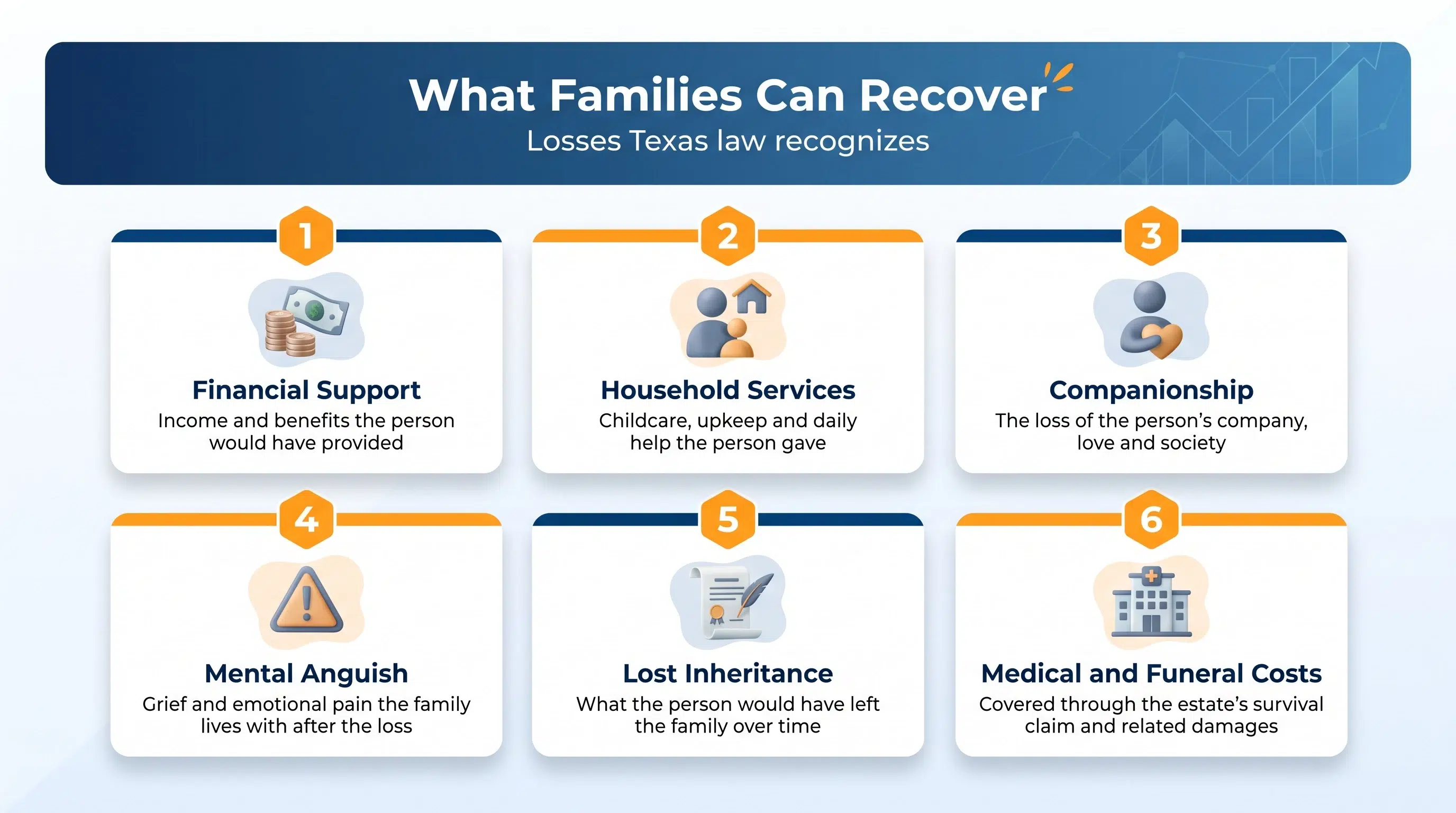
For the wrongful death claim, surviving family members can seek compensation for the financial support and household services the person would have provided, the loss of companionship and society, mental anguish, and in some cases the loss of the inheritance the person would have left. The estate’s survival claim adds medical and funeral expenses and the person’s own suffering before death.
When the death resulted from a willful act or gross negligence, Texas law also permits exemplary damages (section 71.009). Those are meant to punish the defendant, not to compensate the family, and they are available only in the narrow situations the statute describes.
The headline figure is not the whole story. Hospital bills from a final illness or injury, and claims by health plans, can take a bite out of a settlement, and we work to reduce those claims before the money is divided.
Which deaths lead to these claims in and around Greenville?
The most common cause is a vehicle crash. I-30, the Martin Luther King Jr. Freeway through town, carries high-speed and commercial traffic, and a collision there can be fatal in seconds. Joe Ramsey Boulevard, which carries US-69 and US-380, and Wesley Street (SH-34) bring heavy daily traffic and turning conflicts, and county roads around Hunt County, SH-224 among them, have their own risks at night and at speed.
Beyond the road, claims can follow a death at a workplace, a fall or fire on someone else’s property, or a defective product. Some families come to us after a loved one was hurt and died weeks later in the hospital, and those cases are claims too. Hunt Regional Medical Center is on Joe Ramsey Boulevard, and hospital records from there or from any facility that treated the person are often the starting point for proving how they died.
A wrongful death claim does not depend on a criminal case. A driver charged with intoxication manslaughter and a family suing in civil court are on separate tracks with different burdens of proof, and the civil claim can go forward even if the criminal case ends without a conviction.
What should a family do in the first weeks?
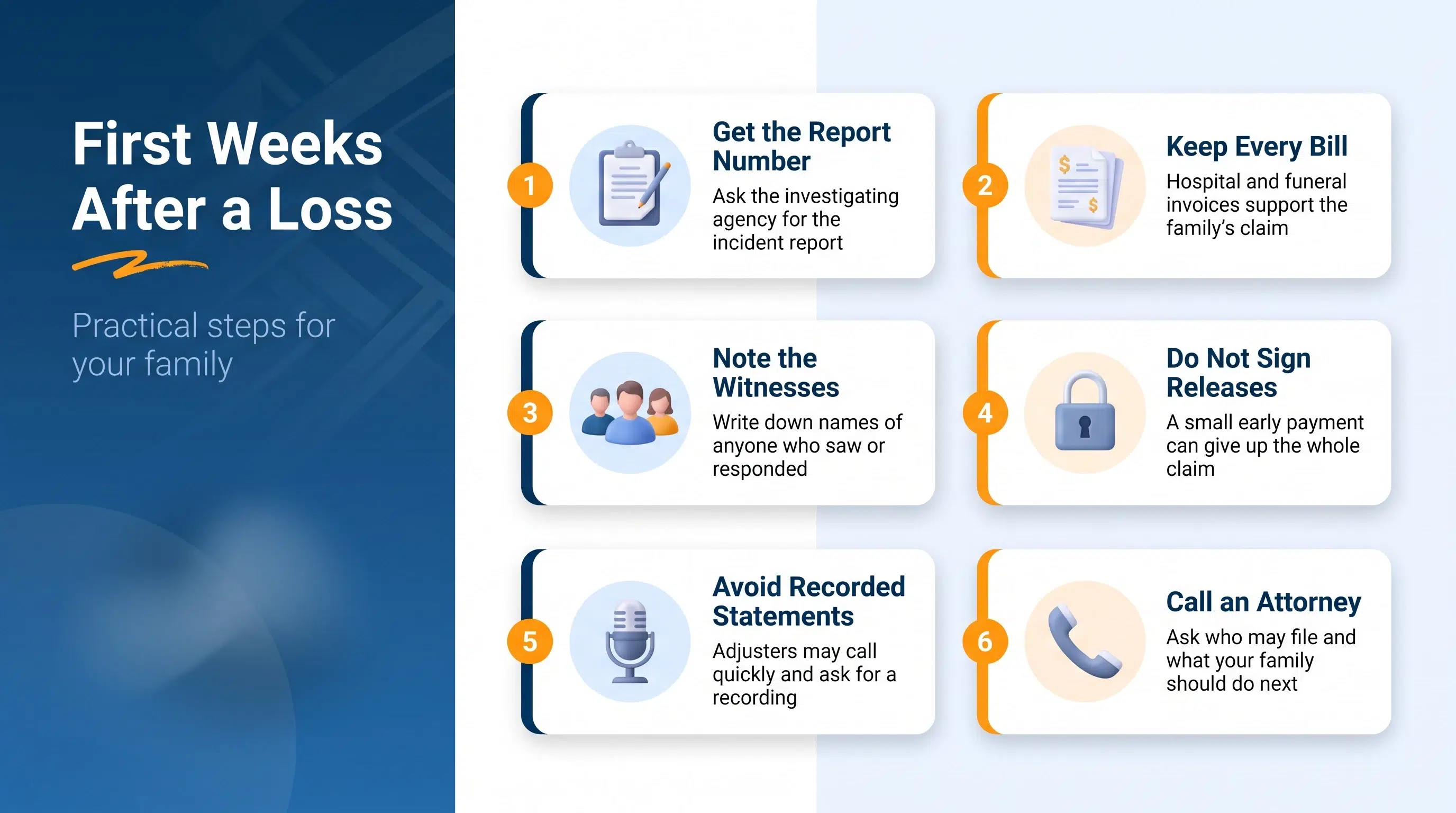
Take care of the immediate things first: arrangements, notifying relatives, and making sure someone is looking after the children if there are any. Then collect what you can. Ask the investigating agency for the report number, keep every bill, and write down the names of witnesses and responders.
Be careful with insurers. The other side’s adjuster may call quickly, sound kind and ask for a statement or offer a payment. A small early payment may come with a release that gives up the whole claim. Speak with an attorney before you sign or say anything recorded.
If the death was work related, the employer’s workers’ compensation coverage can affect the claim, and in Texas some employers do not carry it. That is a conversation to have early.
How long do families have?
Two years from the date of death for a wrongful death action in Texas (section 16.003 of the Civil Practice and Remedies Code). There are rare exceptions, and a minor’s rights are treated differently, but families should work from the two-year date and the three-month executor rule. If the cause of death was not clear at first, an attorney can look at whether anything changes the calculation.
Early action also protects evidence. Witnesses forget, surveillance recordings are overwritten and vehicles are repaired or sold. A family that waits can still have a claim, but a harder one to prove.
How does fault affect a wrongful death recovery?
Texas apportions responsibility among everyone involved (Chapter 33 of the Civil Practice and Remedies Code). If the person who died was partly responsible, the family’s recovery is reduced by that percentage, and if the person was more than 50 percent responsible, recovery is barred. Defense lawyers often make that argument because the person cannot speak for themselves. We answer it with physical evidence, data from the vehicle and independent witnesses.
Where is the case filed, and how long does it take?
A suit over a death in Hunt County is filed in Hunt County District Court in Greenville, where the 196th and 354th District Courts hear civil matters. Wrongful death cases take longer than ordinary injury claims because there are two claims, several possible beneficiaries and, often, a probate question to settle before money is paid.
Many resolve through settlement, sometimes after mediation. Some are tried. We prepare each one as though it will be, and when you want to talk, schedule a free consultation or reach our Dallas personal injury team.
What happens with the estate?
A death creates an estate, even a small one, and the estate matters to the case in several ways. The survival claim belongs to it. Someone has to be appointed to act for it if no one has been. If there is a will, it names an executor. If there is not, the court appoints an administrator, and Texas law sets a default order of heirs.
Probate runs on its own track in the county where the person lived. We coordinate with a family’s estate lawyer, or help find one, so the civil case and the estate paperwork do not collide. Money recovered on the wrongful death claim goes to the eligible family members, while money on the survival claim goes through the estate, which is why keeping them straight matters.
Why do insurers fight these claims?
The numbers are large and the facts are often disputed, because the one person who knows what happened cannot say. Insurers argue that the person caused the crash, that a different driver is to blame, that the death came from a prior illness and not the injury, or that the family’s losses are smaller than claimed.
A death that follows hospital treatment weeks after the injury draws the sharpest challenge. The defense asks whether the injury caused the death or an unrelated complication did. Medical records, treating physicians and sometimes the medical examiner’s findings answer that, and we assemble them early.
How is a person’s life described in a claim?
A claim has to say who the person was. A father who coached a team, a mother who ran the household and kept the books, a young adult who was about to start a career: the details are what a jury weighs, and what an adjuster must understand to value the loss. We ask families about daily routines, about what the person did for others, and about plans cut short.
That is not an easy conversation, and it does not have to happen in one sitting. We go at the family’s pace, and we use photographs, employment records and statements from friends and coworkers to fill in the picture so the family does not have to carry all of it.
What if the death happened at work or in a work vehicle?
Two systems can overlap. Workers’ compensation may pay death benefits and funeral costs when the employer carries coverage. A separate wrongful death claim may still be possible against someone other than the employer, such as a negligent driver, an equipment maker, a contractor on the same site or a property owner. Texas also allows some employers to opt out of workers’ compensation, which changes who can be sued.
The details turn on the employer’s coverage and the facts, so this is one of the first things we check when a family tells us the death happened on the job.
Which Greenville wrongful death cases do we take?
We represent surviving spouses, children and parents after deaths caused by crashes on I-30, US-69, SH-34 and the rural roads of Hunt County, and after fatal workplace incidents, falls, fires and defective products. Under chapter 71 of the Texas Civil Practice and Remedies Code, those family members bring the wrongful death claim, and the estate may bring a separate survival claim. These cases are handled by our Dallas-area wrongful death lawyers.
Many fatal crashes on I-30 involve a tractor-trailer, and our Dallas-area truck accident team works the carrier side of those claims. For any other question about your loss, our Dallas personal injury office is glad to talk it through with your family.