















Where do Greenville crashes actually happen?
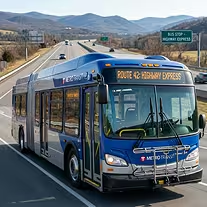
Greenville is built around a handful of roads that nearly everyone uses. I-30, also called the Martin Luther King Jr. Freeway, carries US-67 along the south side of town, and it meets Joe Ramsey Boulevard at an interchange where merging and exiting traffic overlap. Joe Ramsey Boulevard carries US-69 and US-380 and also runs to Hunt Regional Medical Center, so ambulances and ordinary commuters share the same lanes. Wesley Street, which is SH-34, is the main north-south commercial strip, with shoppers turning in and out of driveways all day.
Downtown runs on a one-way pair. Lee Street and Washington Street carry Spur 302 east and west past the Hunt County Courthouse, and the intersections along it mix local errands with through traffic.
The city sits northeast of Dallas, so a lot of the traffic is people commuting toward the metroplex on I-30. L3Harris, the city’s largest employer, is out at Majors Airport, which puts a large number of workers on the road at predictable hours. SH-224 and the farm roads around town feed all of it.
The crash patterns follow the roads. Rear-end collisions pile up where freeway speeds meet a stoplight, left-turn collisions are common on Wesley Street, and highway-speed wrecks on I-30 tend to produce the most serious injuries.
What should you do in the first week?
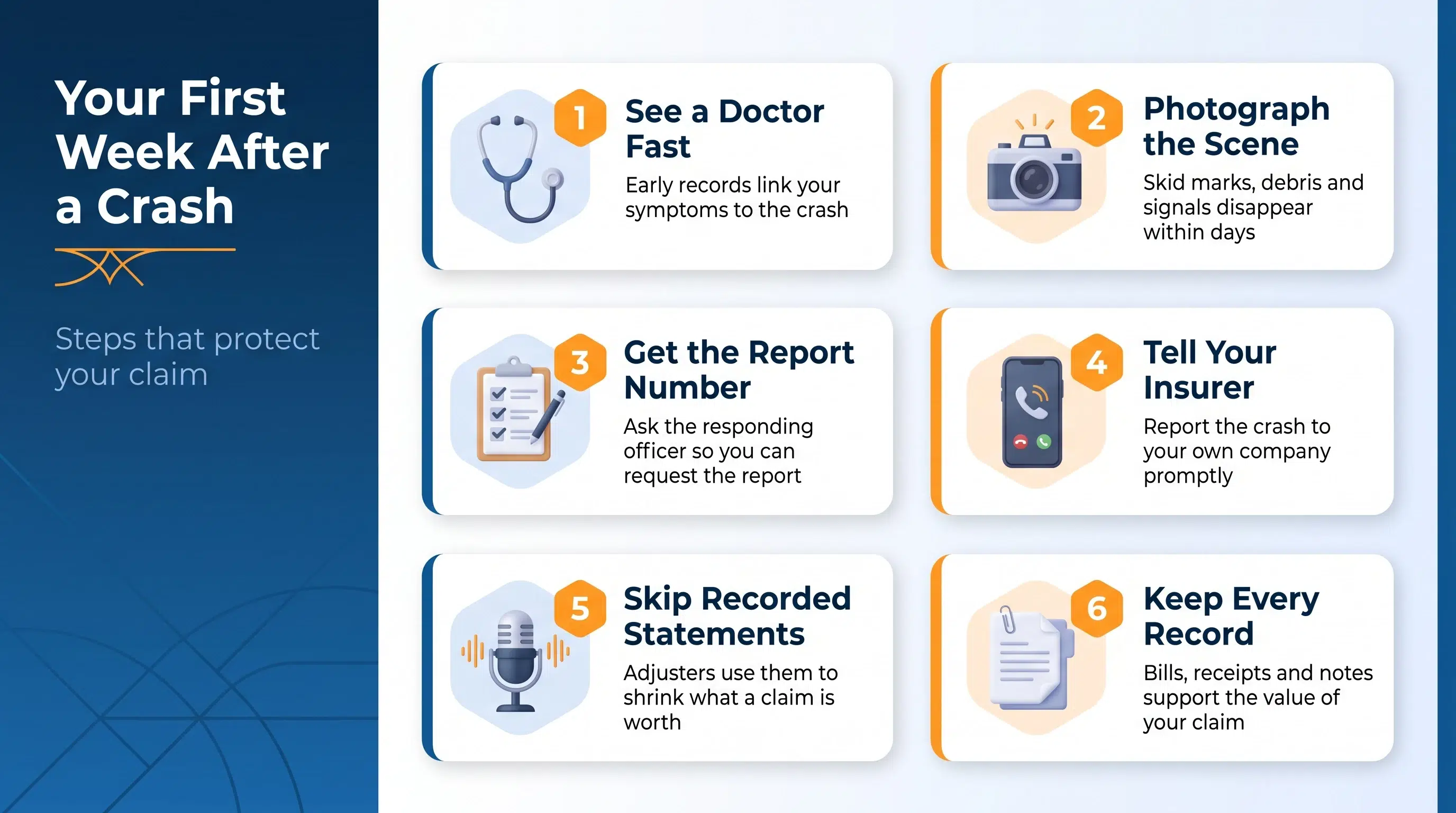
See a doctor the day of the crash or the next morning. Hunt Regional Medical Center has an emergency department at 4215 Joe Ramsey Boulevard. A neck that feels stiff on Tuesday can be a herniated disc by the end of the month, and a gap in treatment is something an adjuster will point to later.
Photograph everything while it is still there: skid marks, debris, damage, the view the driver had, the intersection signals. Ask a Greenville police officer or Hunt County deputy for the report number. If the crash happened on a state route, a Texas DPS trooper may have handled it instead, and the report is requested through the state’s crash records system.
Report the crash to your own insurer, but be careful with the other driver’s company. You are not required to give them a recorded statement, and anything you say can be used to shrink your claim. If you are not sure what to say, our guide to what to do right after a car accident in Texas walks through it.
How does fault work when both drivers share blame?
Fault is rarely all on one side, and the percentages decide what an insurer pays. Texas uses proportionate responsibility. A jury, or an adjuster, assigns each person a percentage of fault. Your recovery drops by your own share, and if your share is greater than 50 percent, Texas law bars recovery entirely (Texas Civil Practice and Remedies Code, Chapter 33). A driver found exactly 50 percent responsible can still recover half of the damages; a driver found 51 percent responsible recovers nothing.
That is why a few seconds of the crash can matter so much. Did the other driver brake before impact? Was your turn signal on? Did a light change early? Vehicle data and camera footage answer those questions better than memory does.
Who pays your bills when the other driver is at fault?
Usually the other driver’s liability insurer, up to its limits. Texas requires liability coverage, but the required minimums are modest, and a serious injury can exceed them quickly. That is the point where your own policy matters. Texas auto policies include personal injury protection and uninsured and underinsured motorist coverage unless the policyholder rejected them in writing, so check your declarations page before assuming you have none.
A crash with more than one vehicle or with a work vehicle involved can bring in several policies at once. A delivery driver may be covered by an employer, a rideshare driver by a platform policy, and a driver in a borrowed car by the owner’s insurer as well. Sorting out which policy applies first, and in what order, is the part people usually cannot do alone.
How long do you have to file?
Two years from the date of the accident, for most Texas personal injury claims (Texas Civil Practice and Remedies Code, section 16.003). Two years sounds generous until you add the months spent treating, waiting on records and negotiating. A claim against a city or other government body can carry much shorter notice requirements, so raise it early if a road defect played any part.
What can a car accident claim recover?
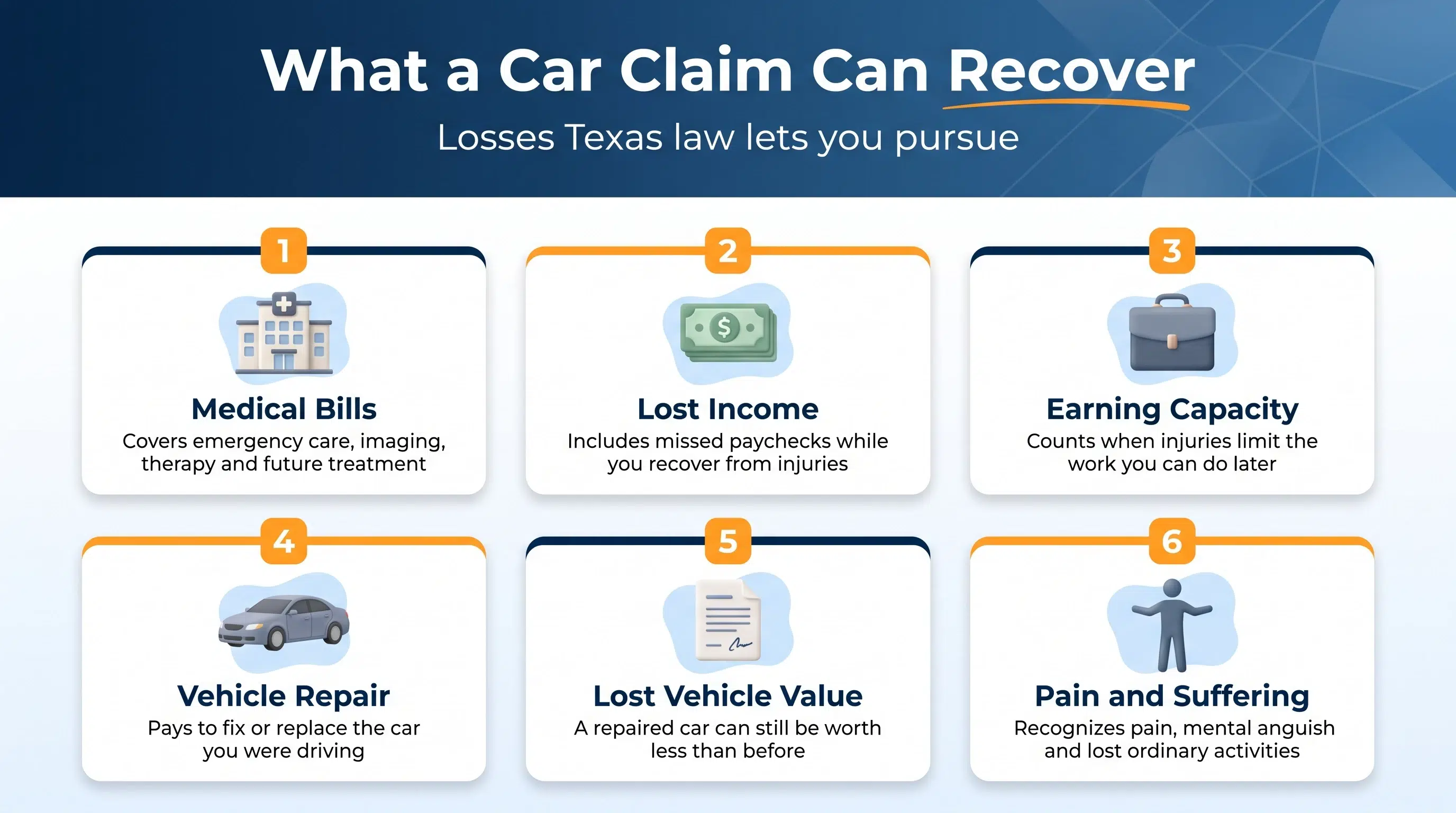
Medical bills come first: emergency care, imaging, surgery, physical therapy, and the cost of care you will need later. Lost income counts, as does reduced earning capacity if you cannot do the same work. Vehicle repair or replacement is part of the claim, and so is the loss of value that a repaired car carries afterward.
Non-economic damages cover pain, mental anguish, scarring and the loss of ordinary activities. Texas does not cap these in a standard car accident case, but a jury will want to see how your life changed, which is why a pain journal and treatment records carry weight.
The gross number is not what you keep. Hospitals, ER groups and health plans often claim a lien against a settlement. We negotiate those liens at settlement to reduce what you owe out of the award, so more of the money reaches you.
Why would a Greenville case end up in a courtroom?
Most claims settle. Some do not, usually because the insurer disputes fault or undervalues a long-term injury. In that case the suit is filed in Hunt County District Court, which sits in the courthouse on Lee Street in Greenville. Two district courts, the 196th and the 354th, hear Hunt County civil cases.
Filing a suit does not mean a trial is coming. It starts discovery, which forces the other side to produce its evidence, and it often changes how an insurer sees the case. If you want to talk through your options, you can schedule a free consultation with our team.
Is a Greenville car accident claim different from one in Dallas?
The law is the same. The practical side is different: the case is filed in Hunt County instead of Dallas County, the jury comes from a different pool, and the treating providers are often local. Hunt County cases are handled by our Dallas personal injury team, so you get a Hunt County filing with a larger firm’s resources behind it.
What if the other driver fled or had no insurance?
A hit-and-run or an uninsured driver does not end the claim. Your uninsured motorist coverage can respond, and most policies set reporting conditions for hit-and-run claims, so file a police report right away. Keep every receipt and every record, because your own insurer will treat the claim like an adversary would.
If a crash left someone you love dead, that is a different kind of claim with its own rules, and we handle those as well.
Which injuries show up after a Greenville crash?
Whiplash and other soft tissue injuries are the most common, and they are the ones insurers argue about most. Concussions and other head injuries can appear after a collision that did not feel violent. Herniated discs, rib and wrist fractures from bracing against the wheel, and knee injuries from striking the dash round out what we see after crashes at highway and in-town speeds alike.
Symptoms often arrive late. Adrenaline hides pain at the scene, and a headache or numbness in the hand can take days to develop. If you wait weeks to see a doctor, the insurer will say something else caused the pain. Seeing a provider early, following the treatment plan, and telling every provider about every symptom creates the record that backs your claim.
How do insurers approach these claims?
An adjuster for the at-fault driver’s company will usually call within a day or two, and the call is friendly. The goal is a recorded statement and, ideally, a quick settlement before you know how badly you are hurt. Common moves include asking whether you were “feeling okay” at the scene, pointing to a gap in treatment, calling the damage to the vehicle minor so the injury looks minor too, and blaming a pre-existing condition for pain that started after the crash.
Each has an answer. A person who says they feel fine at the scene may be in shock. A gap in treatment may come from a work schedule or a lack of insurance. A pre-existing back problem does not erase a new injury, because Texas law lets an injured person recover for aggravating a condition they already had. An attorney handles the adjuster so you do not have to relitigate each of these in a phone call.
What if a passenger, a pedestrian or a cyclist was hurt?
Passengers are rarely at fault, so their claims often run against both drivers’ insurers. Pedestrians and cyclists hit in Greenville face a different problem: no steel around them. Crossings along Lee Street and Washington Street downtown, and the driveways along Wesley Street, are places where a driver turning into traffic can miss someone on foot or on a bike.
The same fault rules apply. The difference is in the evidence, which usually depends on camera footage, witness statements and where the person was in relation to the crosswalk or the curb.
Which Greenville car accident cases do we take?
We take Greenville crash cases of every common kind: rear-end and left-turn collisions, highway crashes on I-30, hit and run and uninsured driver claims, and crashes that hurt passengers, pedestrians and cyclists on Joe Ramsey Boulevard, Wesley Street and SH-34. These cases are handled by our Dallas-area car accident lawyers.
Some crashes are bigger than a car case. If a tractor-trailer or another large truck was involved, our Dallas-area truck accident team handles the carrier and its records, and for injuries beyond the crash itself, our Dallas personal injury office can review the full claim with you.