- What a New Study Says About California’s Emergency Response Times
- Why Minutes Matter After a Crash
- Rural vs. Urban Delays and What They Mean for Communities
- Time of Day Patterns Across California Roads
- Economic and Insurance Impacts When Care Is Delayed
- Records to Secure and Who to Call in California
- How Slower Response Times Intersect With California Injury Law
- First 72 Hours After a Serious Crash in California
- Local Context: Coachella Valley, Inland Empire, and Ventura County
- Action Steps and Time Sensitivity
- Commentary from Gosuits Palm Desert, California Personal Injury Attorney
- References
What a New Study Says About California’s Emergency Response Times
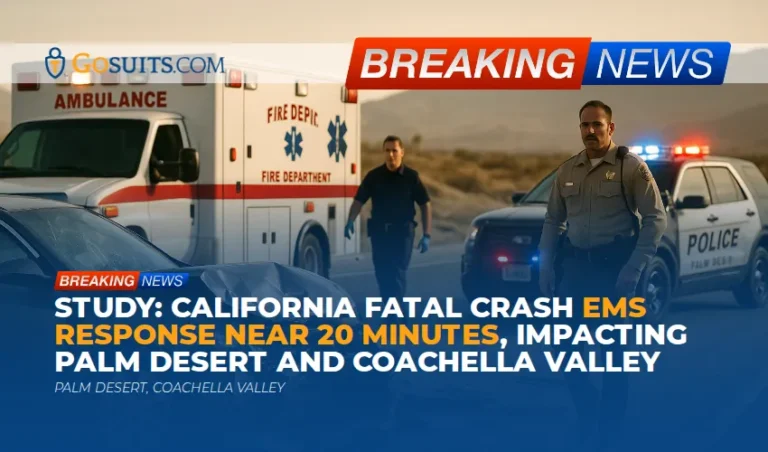
A recent private analysis reported that California’s emergency medical response to fatal crash scenes averages nearly 20 minutes, compared with about 10 minutes nationally. The difference is not just an abstract figure. For families traveling the I-10 through the San Gorgonio Pass, commuters on SR-111 between Palm Desert and Palm Springs, or early-morning drivers on US-101 near Moorpark, those extra minutes can change outcomes in life-altering ways. Federal public health guidance has long emphasized that timely field triage, transport, and treatment are key components of trauma survival, especially for hemorrhage and traumatic brain injuries [3].
National data also show a persistent rural-urban gap in injury outcomes and access to prompt emergency care. Rural residents often face longer distances to trauma centers, which correlates with higher injury mortality rates [4]. While response time is not the only factor shaping a crash outcome, it’s a meaningful one. California’s size, terrain, and resource allocation challenges all play a role in how fast help reaches people who need it most.
Why Minutes Matter After a Crash
When a severe crash happens, the clock immediately starts working against the injured. Emergency medicine relies on rapid assessment, hemorrhage control, airway management, spinal protection, and prompt transport to the right level of care. The more quickly those steps happen, the better the odds of preventing secondary injury from shock, low oxygen, or brain swelling. Current trauma field-triage recommendations stress expeditious identification of high-risk injuries and direct transport to appropriate trauma centers whenever feasible [3].
California’s trauma system is designed to sort patients to verified trauma centers. The California Emergency Medical Services Authority oversees local EMS agencies and trauma systems statewide, setting minimum standards that counties implement on the ground [5]. In practice, that means a patient in Palm Desert with suspected torso hemorrhage might be routed to a designated trauma center in Palm Springs or Moreno Valley if air or ground transport can get them there quickly. The principle is simple. Getting seriously injured patients to definitive care fast can reduce preventable deaths.
It is also important to remember that severe crashes often involve injuries that worsen over minutes, not hours. A person who looks “stable” on the roadside may be bleeding internally. Airway swelling can progress. Traumatic brain injuries can deteriorate without timely intervention. Federal agencies and public health researchers consistently highlight time-sensitive care as a pillar of trauma survival [3][4].
Rural vs. Urban Delays and What They Mean for Communities
California blends dense urban corridors and vast rural stretches. The Coachella Valley, the high desert, the agricultural Central Valley, the Eastern Sierra, and long rural segments of the North State all face different realities from Downtown Los Angeles or the Bay Area. In rural regions, two challenges commonly appear together. Response intervals can be longer due to distance and staffing, and the nearest trauma center may be far from the crash site. Both factors can push prehospital and total time-to-treatment upward, which research associates with higher injury mortality [4].
Urban areas generally see faster arrival times, but heavy congestion, complex multi-vehicle scenes, or crashes on interchanges like the 10 and 405 can still slow access. Even in cities, transport to an available trauma bay can take time, especially during simultaneous incidents. California’s statewide trauma network aims to cushion these differences, yet practical, on-the-ground conditions still create gaps that families feel most on the worst days of their lives [5].

Time of Day Patterns Across California Roads
Timing matters. Overnight and pre-dawn hours are a known risk window for fatigue-related driving. Federal safety materials note that drowsy driving crashes occur most frequently between midnight and 6 a.m., and again in the late afternoon, when circadian dips affect alertness [2]. In Southern California, that often lines up with long-haul trucking across the I-10 corridor, late returns from events in Indio or Palm Desert, and commuters starting pre-sunrise shifts from the High Desert into Inland Empire job centers.
When roads are emptier before dawn, average speeds rise. Higher-speed crashes create greater energy transfer to vehicle occupants and can lead to more severe injuries. If that injury severity is then compounded by longer EMS arrival or longer transport to the right trauma center, the risks add up. California’s OTS data and safety programs consistently urge planning trips around fatigue and using the many rest areas on highways like I-10 and I-5 to break up long drives [7].
Economic and Insurance Impacts When Care Is Delayed
Beyond the human toll, the financial cost of a severe or fatal crash is staggering. NHTSA’s comprehensive analysis of crash harm shows that fatal crashes and disabling injuries generate large economic costs, including medical care, lost work, emergency services, and property damage. These economic costs alone reach into the hundreds of billions annually nationwide [1]. For an individual family, a longer path to stabilization can mean more intensive hospital stays, more complex rehabilitation, and greater long-term needs.
From an insurance perspective, the first hours shape the entire claim trajectory. Medical records from those initial moments, the accuracy of field assessments, and the speed of transport to appropriate care all become part of the claim file. Adjusters analyze whether injuries were promptly treated, whether recommended trauma protocols were followed, and whether delays worsened outcomes. This is one reason many people seek guidance from car accident lawyers early on. Claims involving severe injuries are complex, documentation can be fragmented, and the stakes are high.
As cases grow more complex, medical timelines, operative reports, and rehabilitation plans take on outsized importance. The interplay between emergency response intervals and severity can also influence liability arguments, damage modeling, and life-care planning in catastrophic injury cases.
Records to Secure and Who to Call in California
Families often ask where to start. If a loved one was injured or killed after a crash anywhere from Palm Desert to Moorpark, these are the practical records and offices that typically matter. Processes vary by county and agency, so verify details with the specific office handling the incident.
- Collision report. If the California Highway Patrol investigated, you can request the crash report using the CHP 190 process through the appropriate Area Office. This report contains narrative details, involved parties, and diagrams that insurers and courts rely on [6]. If a city police department handled the scene, contact that department’s records division.
- Coroner or medical examiner records. Autopsy reports, cause and manner of death certifications, and toxicology are typically maintained by the county coroner or medical examiner. In Riverside County, the Sheriff’s Coroner handles these records. In Los Angeles County, the Medical Examiner is a separate office. Expect identification, next-of-kin verification, and possible fees. Time frames vary by county and by whether toxicology is pending.
- EMS run sheets and prehospital care reports. These document arrival times, vital signs, treatments, and transport decisions. They are generated by the responding EMS agency and can often be requested by the patient or legal representative. Local EMS agencies operate under oversight of the California EMS Authority and their county EMS office [5].
- Hospital records. Admission notes, imaging, operative reports, and discharge summaries will be central to any serious injury claim. Release requires HIPAA-compliant authorization by the patient or personal representative.
- Traffic signal and road maintenance records. For crashes at signaled intersections or on state routes like SR-111 or US-101, relevant agencies can include Caltrans district offices, counties, or cities. The California Public Records Act provides a process to request non-privileged records [8].
- 911 audio and CAD logs. Dispatch records can show call receipt time, unit dispatch, arrival, and transport timing. Retention schedules differ by agency. Request quickly.
- Video evidence. In some corridors, public cameras, bus cameras, or nearby businesses may have useful footage. Requests must be made fast, since many systems overwrite on short cycles. This is where a focused plan can make the difference between having clear proof and having gaps.
To understand how regional trauma systems function and where the closest higher-acuity centers are, see Level 1 trauma centers in Irvine California key information for personal injury victims. While this resource focuses on Orange County, it explains how trauma designation works across California and why routing matters.

How Slower Response Times Intersect With California Injury Law
Response intervals do not determine fault for a crash. Fault is about what caused the collision in the first place. But delays can affect the scope of damages in a civil case, because damages look at how severely someone was harmed and why. Here are ways timing can intersect with legal analysis in serious California crashes:
- Causation and damages. If a negligent driver caused a violent collision that resulted in severe injuries, the law allows recovery for the full extent of harm proximately caused by that negligence. Where the timing of care contributed to outcomes, defense teams sometimes try to argue that part of the injury was not caused by the crash. Proper medical testimony and documentation are key to explaining the chain from mechanism of injury through treatment and recovery.
- Public entity liability. Some crashes involve alleged dangerous conditions of public property, such as poor sight lines or malfunctioning signals. Claims against government entities in California carry shorter administrative deadlines compared with standard civil claims. Preserving notice and evidence early is critical.
- Comparative fault. California applies pure comparative negligence. Even if more than one party shares responsibility, an injured person can still seek compensation in proportion to others’ fault. Good documentation about speeds, lighting, signage, and roadway geometry can help counter efforts to shift blame unfairly.
- Wrongful death. In fatal cases, heirs may pursue a wrongful death claim and the estate may pursue a survival action for losses the person suffered before death. Medical chronology and emergency response intervals often figure into these analyses, alongside liability and insurance coverage issues.
Because insurance companies scrutinize every line of a claim file, many people choose to consult with Irvine car accident lawyers to map out a preservation strategy before any recorded statements occur. Insurers are trained to lock in narratives early. What someone says in the first few days can echo throughout the case.
First 72 Hours After a Serious Crash in California
These early steps help protect both health and legal rights. Adjust them to the specific facts of the crash, and when in doubt, ask a qualified attorney for guidance before dealing with insurers.
- Get a full medical evaluation. Even if you walked away, delayed-onset symptoms are common after high-energy impacts. Follow up with primary care and, if indicated, specialists in trauma, neurology, or orthopedics.
- Preserve evidence. Save damaged gear, child seats, and personal items. Take photos of vehicles, debris fields, skid marks, and any roadway defects. Document weather, lighting, and lane closures.
- Identify agencies. Determine whether CHP, a sheriff’s station, or a city police department handled the scene. Note responding fire and EMS agencies for later records requests.
- Request critical records. Ask the investigating agency how and when to request the collision report. If a death occurred, the coroner or medical examiner will advise on autopsy and toxicology timelines. Start hospital records requests once HIPAA releases are in place.
- Secure video. Quickly canvass nearby businesses and residences for cameras. Ask transit agencies about bus or rail cameras if relevant. Time is the enemy here; many systems overwrite quickly.
- Insurance caution. Before calling any insurer, consider speaking with car accident lawyers. Early statements can be used to narrow or dispute claims later. If you do speak with an insurer, avoid speculating about fault or injuries and do not sign blanket releases without understanding their scope.
California families navigating intensive care units or funeral arrangements deserve time to focus on loved ones. A clear plan to gather the essentials can prevent missing windows that are difficult to reopen later.
Local Context: Coachella Valley, Inland Empire, and Ventura County
Communities like Palm Desert, Palm Springs, Rancho Mirage, and Indio see seasonal traffic swings tied to festivals, tourism, and winter visitors. The I-10 through the San Gorgonio Pass can experience high winds that contribute to rollovers and multi-vehicle incidents. Coachella Valley communities also coordinate with trauma centers in Palm Springs and Moreno Valley, depending on injury severity and transport feasibility. That networked approach aims to cut time-to-treatment, but long distances still matter on overnight calls.
Farther west, Moorpark and its surrounding Ventura County neighborhoods connect to the 118 and 101 corridors. Early-morning commuter traffic and agricultural operations share the road with freight. Rural stretches between towns can mean longer distances to a trauma center compared with urban LA. Meanwhile, Riverside County’s unincorporated communities rely on the Sheriff’s Department for investigations and coroner functions, which can centralize records but also lengthen processing during busy periods. Each of these local realities helps explain why a statewide average might mask sharp differences between neighborhoods.
For families in these regions, knowing which agencies are most likely to have key records can save precious time:
- Investigations. CHP area offices, Riverside County Sheriff stations, Ventura County Sheriff, or local police departments, depending on jurisdiction.
- Prehospital care. County EMS providers listed under the local EMS agency’s directory, operating within California EMS Authority standards [5].
- Hospitals. Regional trauma centers and receiving hospitals, which document interventions that are foundational to claims and potential litigation.
As you organize requests, keep copies of everything. Create a simple timeline that plots the collision, 911 call, EMS arrival, hospital arrival, and major medical events. Having that at your fingertips will make later steps with insurers or courts more manageable.
When uncertainties arise, many people look for guidance from car accident lawyers to help prioritize which evidence is most at risk of being lost and how to approach agencies diplomatically and effectively.
Action Steps and Time Sensitivity
This section explains the urgency and the practical next steps people can take. The aim is to protect health, preserve evidence, and understand rights before making decisions that could affect a claim.
- Prioritize medical stability. Follow medical advice, attend follow-up visits, and document symptoms daily. Early continuity of care supports recovery and creates a reliable medical record.
- Preserve time-sensitive evidence now. 911 recordings, dispatch logs, intersection timing data, and private CCTV are often overwritten quickly. Act within days, not weeks.
- Organize agency requests. Start with the collision report, then EMS run sheets, then hospital records. If a fatality occurred, ask the coroner or medical examiner about expected timelines for autopsy and toxicology reports.
- Consult an attorney before speaking with insurers. A free consultation helps clarify your rights. Statements to insurers can be used later to dispute fault, minimize injury, or suggest preexisting conditions. Understanding what to say, and what not to say, matters.
- Calendar key deadlines. Some claims have short administrative claim windows, especially where a city, county, or state agency might bear responsibility. Missing these deadlines can limit legal options later.
- Consider long-term needs early. For severe injuries, think beyond discharge. Rehabilitation, adaptive equipment, home modifications, and lost earning capacity should be documented from the outset so they are not overlooked later.

Commentary from Gosuits Palm Desert, California Personal Injury Attorney
We are deeply sorry for the families and neighbors who feel the impact of delayed emergency response after serious crashes. This overview is intended for education and general information so community members can better understand how timing affects medical care, documentation, and ultimately the civil process that follows a collision.
In our view, the findings highlighting longer response times in parts of California reflect what people across the Coachella Valley and Inland Empire have experienced for years. Distance, traffic, staffing, and hospital capacity all influence how quickly help arrives. That does not determine who caused a crash, but it can change outcomes and the proof available to explain those outcomes. The more complete the record of when EMS arrived, what care was delivered, and how fast a patient reached a trauma bay, the more accurately a case can account for the harm a negligent driver set in motion.
Insurance companies and large corporations understand this dynamic well. They move fast to collect statements and records. They also know that when families are in shock or grief, details get missed. We frequently see recorded statements taken before people know the full scope of their injuries, broad medical releases signed without limits, and early offers presented before key evidence arrives. Those tactics take advantage of people’s lack of information in the moment. Slowing down, learning your rights, and controlling the flow of information can prevent avoidable harm to a claim.
A free consultation is important because it levels the playing field. It helps clarify what records to request now, how to avoid statements that can be used against you, and what timelines apply if a public entity or roadway issue is involved. Even a short conversation can prevent critical mistakes while you focus on healing or honoring a loved one.
References
- The Economic and Societal Impact of Motor Vehicle Crashes, 2019 – NHTSA
- Drowsy Driving – NHTSA
- 2023 Update to the Field Triage Guidelines for Injured Patients – CDC MMWR
- Vital Signs: Rural Residents at Higher Risk of Death From Unintentional Injury – CDC
- California Trauma System – California EMS Authority
- Collision Report CHP 190 – California Highway Patrol
- Traffic Safety Programs and Data – California Office of Traffic Safety
- California Public Records Act Guidance – California Attorney General
- Office of EMS – NHTSA
- U.S. Department of Transportation – Official Site