- What makes rear end crashes common in Irvine and how is fault determined?
- What does California law say about following too closely and negligence per se?
- When can the lead driver share fault in a rear end collision?
- How do you prove fault in an Irvine rear end crash step by step?
- What evidence should you preserve right away?
- How do police reports and Irvine PD records help your claim?
- How do insurance companies evaluate and challenge rear end claims in California?
- What damages can you claim after a rear end collision in Orange County?
- What are the deadlines to file in California and what if a government vehicle was involved?
- How do uninsured and underinsured motorist claims work in California?
- How do comparative negligence and jury instructions affect settlement value?
- How do crash reconstruction and vehicle data support your case?
- What if the crash involved rideshare, delivery, or a commercial vehicle?
- How do medical records help prove causation without overreach?
- What if the at fault driver was on the job or used a company car?
- How do you start a personal injury claim in Irvine and which courts may hear the case?
- How can GoSuits help you move forward?
- Where can you find the sources cited?
What makes rear end crashes common in Irvine and how is fault determined?
Rear end collisions are among the most frequent traffic crashes nationwide, and Irvine is no exception. National Highway Traffic Safety Administration research shows rear end crashes comprise a substantial share of police reported collisions, often tied to inattention, following too closely, and speed management issues [7]. In California, liability is a civil question that turns on whether a driver failed to use reasonable care and whether that failure caused harm. In many rear end scenarios, the trailing driver is presumed responsible because drivers must leave enough space to stop safely. California codifies this duty and allows plaintiffs to use statutory violations as evidence to prove negligence [1] [2].
That presumption is not absolute. Fault can be shared. California follows pure comparative negligence, which means a jury can allocate percentages of responsibility to each party based on the facts of the crash [3]. As a result, your strategy in an Irvine rear end crash should focus on gathering decisive evidence that shows how the crash happened and why the other driver’s choices, conduct, or vehicle condition were the primary cause.
What does California law say about following too closely and negligence per se?
California Vehicle Code section 21703 requires drivers to follow at a distance that is reasonable and prudent, considering speed, traffic, and roadway conditions [1]. If a trailing driver strikes the rear of a vehicle because they were tailgating or failed to keep a safe space cushion, that breach can support negligence per se under Evidence Code section 669. Negligence per se allows a court or jury to treat the violation of a safety statute as evidence of negligence if the violation proximately caused the harm and the injured person is part of the class the statute is intended to protect [2].
Related rules include the basic speed law, safe lane change and turning rules, and requirements not to suddenly decrease speed without signaling when there is an opportunity to do so. A sudden stop or sharp slowdown without a signal may itself be a statutory violation under Vehicle Code section 22109, depending on the circumstances, which can shift or share fault [15]. The overall analysis is context dependent, which is why detailed documentation of traffic flow, signals, and distances matters.
When can the lead driver share fault in a rear end collision?
While trailing drivers have a strong duty to avoid rear end crashes, lead drivers can share responsibility when they contribute to the risk. Examples include:
- Sudden stop without a signal When there was an opportunity to signal and traffic conditions allowed it, failing to signal a sudden decrease in speed can be a code violation [15].
- Unsafe lane change into a short gap Cutting in and braking immediately can collapse following distance to near zero.
- Disabled vehicle stopped in a travel lane without hazard lights Failing to move to the shoulder or warn others can contribute to fault.
- Vehicle defects Broken brake lights or failing lighting can reduce the trailing driver’s warning time.
California’s pure comparative negligence approach means even if you are the lead driver struck from behind, evidence that you stopped abruptly without signaling or that your brake lamps were nonfunctional could reduce your recovery. Conversely, if you were the trailing driver, you can still recover a portion of your losses if the lead driver’s conduct significantly contributed to the crash [3].
How do you prove fault in an Irvine rear end crash step by step?
Proving fault is a methodical process that pairs factual investigation with legal standards. A practical sequence looks like this:
- Document the scene immediately Photograph positions of vehicles, skid or yaw marks, debris fields, and traffic control devices. If safe, capture approach angles and the area you and the other driver were looking toward.
- Preserve dashcam and third party video Save your dashcam file, request footage from nearby homes or businesses, and ask rideshare or fleet operators for telematics if involved.
- Obtain the police report A police report can memorialize statements and diagrams that help reconstruct the crash and identify witnesses. For Irvine, traffic collision reports are requested through the Irvine Police Department portal [8].
- Identify code violations Assess safe following distance, signaling, speed relative to conditions, and sudden slowing behavior against the Vehicle Code. Evidence of a violation can support negligence per se [1] [2] [15].
- Secure vehicle data and inspections Event data recorders and post crash inspections can clarify speed, braking, and rear lamp function [13].
- Develop a medical timeline Align onset of symptoms, diagnostic findings, and treatment progression with the crash mechanics to show causation.
- Interview witnesses promptly Neutral witness statements can resolve disputes about whether a lead driver braked abruptly or a trailing driver was following too closely.
- Track losses meticulously Keep bills, wage records, and out of pocket expenses to support damages.
Many clients search for a car accident attorney near me because the process quickly becomes complex when liability is disputed or injuries evolve over weeks and months. A structured approach helps you stay in control of the evidence that will matter most.
What evidence should you preserve right away?
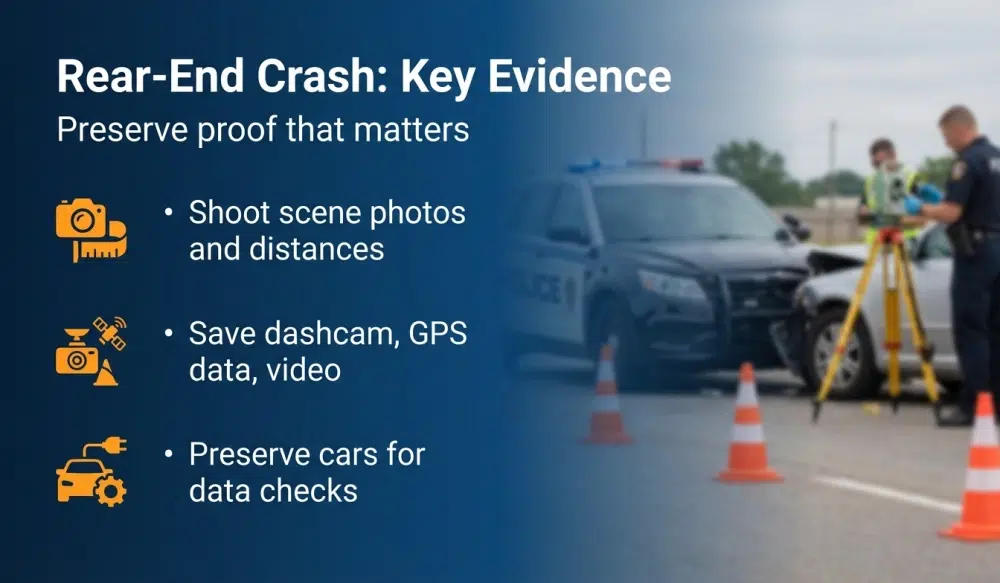
Rear end crash claims succeed or fail on the quality of proof. Prioritize these items from day one:
- Scene photos and measurements Distances between vehicles, skid marks, and lane widths help validate stopping distances and perception reaction timelines.
- Dashcam video and telematics Dashcam files, GPS speed traces, and telematics can be decisive in proving following distance and whether braking occurred.
- Witness contact information Third parties confirm traffic flow, sudden stops, and whether a vehicle cut in too closely.
- Vehicle data and inspections Preserve both vehicles for inspection to evaluate impact angles, brake lamp function, and event data recorder information consistent with California Vehicle Code section 9951 [13].
- Medical records and causation Keep emergency department notes, primary care follow ups, imaging reports, and therapy records. Update providers about evolving symptoms so the timeline is clear.
- Employment proof for wage loss Pay stubs, tax records, and employer letters document lost earnings and missed opportunities.
- Out of pocket expenses Receipts for prescriptions, medical mileage, and adaptive devices add up.
If the vehicles are towed, do not authorize disposal before photographs and inspections are complete. Consider a legal hold letter to the opposing insurer to preserve dashcam files, onboard data, and driver cell phone logs where appropriate. California law recognizes courts may admit qualifying public records such as certain official reports, but you still need independent documentation to prove the statutory elements and damages [9].
How do police reports and Irvine PD records help your claim?
A police report often captures diagrams, driver and witness statements, and preliminary fault observations. In Irvine, you can request the police report through the Irvine Police Department’s traffic collision reports portal [8]. California limits public disclosure of some collision report information under Vehicle Code section 20012, and police reports are not always admissible at trial except under specific evidence rules. Still, they are routinely used during insurance claims and settlement discussions to guide investigation and identify supporting proof [10] [9].
If the officer cites the following too closely rule or notes a sudden stop without signaling, that can help establish the theory of liability tied to California Vehicle Code sections and negligence per se principles [1] [2] [15]. When police do not respond, your own thorough documentation and prompt witness outreach become even more important.

How do insurance companies evaluate and challenge rear end claims in California?
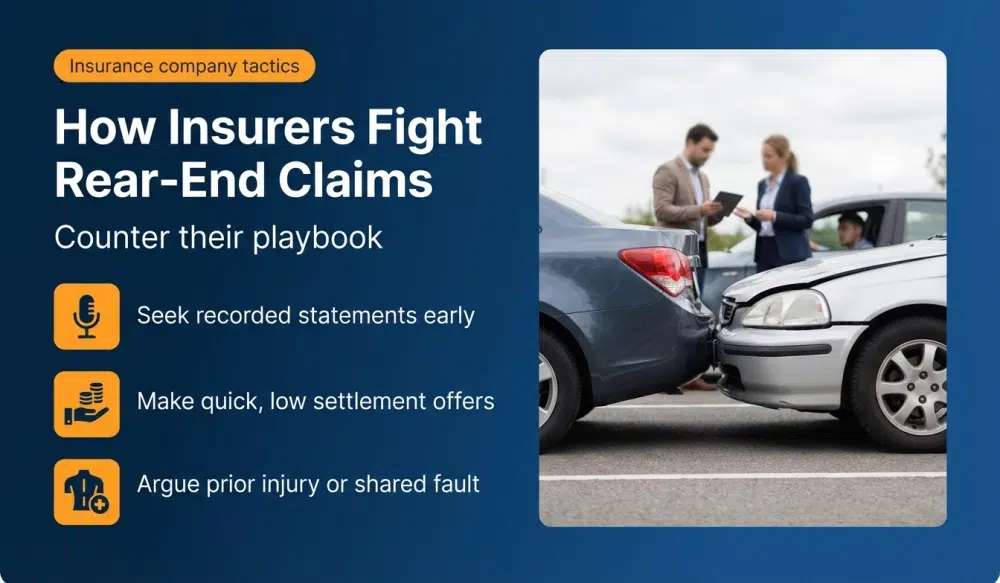
Insurers often start with a presumption the trailing driver is at fault, then test for exceptions. Common defense points include claims of a sudden unsignaled stop, a third vehicle cutting in and braking, or preexisting injuries. During claims handling, California’s Fair Claims Settlement Practices rules require insurers to communicate promptly and evaluate claims reasonably, but disputes often arise about fault, medical causation, and alleged overtreatment [11].
Expect these tactics:
- Requests for recorded statements Adjusters may seek detailed statements early. Keep responses factual and limited to avoid speculation about fault or injuries.
- Early low offers Quick offers sometimes precede complete medical evaluation. Waiting for a full diagnosis helps align settlement with actual needs.
- Broad medical record authorizations Limit releases to relevant providers and time frames to prevent fishing expeditions.
- Disputes over causation Insurers may attribute symptoms to degenerative changes rather than crash forces. Clear medical timelines and objective findings are key.
- Comparative negligence arguments Expect emphasis on sudden stop or unsafe lane change defenses to reduce payout [3] [15].
If the insurer for the at fault driver is uncooperative, your own policy’s uninsured or underinsured motorist coverage may become essential. California law sets out notice, cooperation, and arbitration procedures that apply to those claims [6].
What damages can you claim after a rear end collision in Orange County?
California civil law allows recovery of both economic and noneconomic damages when another driver’s negligence causes harm. In a typical Irvine rear end crash, compensable losses may include:
- Medical expenses Ambulance, emergency care, diagnostic imaging, specialist visits, therapy, and future care costs where supported.
- Lost earnings and reduced earning capacity Time off work and long term vocational effects tied to the injury.
- Property damage Vehicle repair or total loss valuation, diminished value, and personal items damaged in the crash.
- Out of pocket costs Transportation to medical visits and medically necessary devices.
- Pain, discomfort, and quality of life impacts Noneconomic harm documented by you, your family, and your providers.
Your damages presentation should connect the crash mechanics to injuries with consistent medical documentation. Photographs, vehicle repair estimates, and treating provider narratives combine to show how the collision affected day to day functioning. Keeping a recovery journal often helps communicate the nonfinancial impact clearly.
What are the deadlines to file in California and what if a government vehicle was involved?
Most California personal injury claims from vehicle crashes must be filed in court within two years of the injury under Code of Civil Procedure section 335.1 [4]. Property damage claims generally have a longer filing period. If the claim involves a public entity vehicle, you must file a government claim with the appropriate agency within a much shorter time frame, usually six months from the date of the incident, under the Government Claims Act [5].
Missing the applicable deadline can end a claim regardless of fault. Because exceptions and tolling rules are complex, it is important to track dates carefully and act early. Filing a timely government claim is a prerequisite before a lawsuit against a public entity can proceed, so do not wait to start that process if a city, county, or state vehicle was involved.
How do uninsured and underinsured motorist claims work in California?
When the at fault driver has no insurance or too little coverage to pay your losses, California uninsured or underinsured motorist provisions under Insurance Code section 11580.2 may allow recovery through your own policy [6]. These claims usually involve:
- Prompt notice Give written notice to your insurer as soon as practicable after the crash.
- Cooperation and documentation Provide police reports, photos, witness information, and medical records on request.
- Consent to settle and setoffs Obtain your insurer’s consent before settling with the at fault party to preserve benefits.
- Arbitration Many policies require binding arbitration if you and your insurer cannot agree on liability or damages [6].
UM and UIM claims follow many of the same proof rules as liability claims. Thorough evidence collection about fault and causation remains essential, and your damages presentation should be complete and well organized.
How do comparative negligence and jury instructions affect settlement value?
California’s pure comparative negligence rule lets a jury apportion fault between drivers in any percentages that fit the evidence, as established by the California Supreme Court in Li v. Yellow Cab [3]. In practice, that means a trailing driver may still recover if a lead driver cut in abruptly and braked, but recovery will be reduced by the trailing driver’s percentage of responsibility. Jury instructions used in California civil trials explain these principles and guide jurors in evaluating negligence and negligence per se, taking into account statutory duties and reasonable care under the circumstances [11].
For claims professionals and attorneys, these instructions inform negotiation. If discovery shows the trailing driver was traveling too fast for conditions and failed to maintain space, but the lead driver braked suddenly without signaling where there was an opportunity to signal, adjusters and counsel may converge toward a shared fault allocation grounded in these rules [1] [2] [15]. Comprehensive evidence and a clear narrative remain the best levers for a fair settlement.
How do crash reconstruction and vehicle data support your case?
In contested rear end collisions, technical analysis can answer key questions about speed, braking, visibility, and timing. California law recognizes ownership and privacy details for event data recorders in vehicles and sets rules for accessing and using that data [13]. Depending on vehicle make and model, stored data may show vehicle speed, brake application, throttle, and other pre impact factors for a brief period.
Beyond EDR data, reconstruction professionals analyze skid marks, crush profiles, lamp filament inspection, time distance calculations, and video frame analysis. For example:
- Skid and yaw analysis Confirms braking and steering inputs leading up to impact.
- Lamp analysis Evaluates whether rear brake lights were energized at impact, relevant to sudden stop and signaling disputes.
- Time distance modeling Tests whether a trailing driver could have stopped if following at a prudent distance.
- Video synchronization Aligns timestamps from dashcam or surveillance footage to reconstruct sequences precisely.
Real world traffic data from California mapping and collision databases can contextualize speed and congestion patterns on Irvine corridors. Tools like the Transportation Injury Mapping System at UC Berkeley help researchers and safety analysts examine crash distributions by corridor and time of day, which can support broader context in complex cases [14].
What if the crash involved rideshare, delivery, or a commercial vehicle?
Rear end collisions involving rideshare vehicles, delivery vans, or company cars raise questions about layered insurance coverage and potentially different driving behavior patterns. When a rideshare app is on, the rideshare policy may provide contingent or primary coverage depending on whether a passenger is matched or onboard. Delivery vehicles may have telematics and company policies that bear on liability assessments. Commercial fleets often preserve data and conduct internal investigations quickly, so acting promptly to request preservation of logs, dashcam files, and telematics can be crucial.
When a driver is acting within the course and scope of employment, the employer may be responsible for damages under vicarious liability principles. Identifying the employing entity and its insurer early helps streamline claims and clarifies available coverage limits.
How do medical records help prove causation without overreach?
Rear end collisions can produce a wide range of injuries, from short term soft tissue strain to more complex spinal or head injuries. To connect your injuries to the crash, build a consistent, practical medical narrative:
- Immediate complaints and diagnosis Report all symptoms at the first visit and request written discharge instructions.
- Follow up and imaging Follow provider recommendations and obtain imaging where clinically indicated to document objective findings.
- Therapy and progress notes Keep therapy attendance records and progress updates to demonstrate effort and trajectory.
- Functional limitations Document work restrictions, daily living changes, and adaptive measures you need.
Insurers frequently argue that symptoms reflect preexisting conditions rather than the crash. Detailed medical records that begin promptly after the collision and continue consistently rebut that claim. Aligning the medical story with the crash mechanics, including speed change and occupant movement, strengthens causation analysis.
What if the at fault driver was on the job or used a company car?
If the driver who struck you from behind was working at the time, both the driver and employer may be liable. Key steps include identifying the employer, confirming whether the trip was work related, and sending preservation requests for fleet telematics, dispatch logs, and dashcam files. In claims involving delivery or service vehicles, contracts may disclose additional layers of coverage or third party administrators. Naming all responsible parties in a timely lawsuit can be critical to preserving full recovery rights.
How do you start a personal injury claim in Irvine and which courts may hear the case?
Starting a personal injury claim in Irvine typically means notifying the at fault driver’s insurer, opening a claim with your own insurer for med pay or UM or UIM benefits if applicable, and requesting the police report Irvine PD prepared for the crash [8]. If settlement is not possible within the statute of limitations, lawsuits for Orange County crashes are generally filed in the Superior Court of California, County of Orange. The court’s Civil Division provides information about filing, case management, and local procedures [12].
If the crash involves a public entity vehicle, you must first submit a government claim to the agency within the statutory period before filing suit [5]. Keep copies of all filings and proof of service. Because California civil procedure has strict timelines after filing, early planning helps avoid avoidable delays or sanctions.
Which local facts matter most for Irvine rear end cases?
Irvine’s network of arterials, freeway connectors, and busy retail corridors create recurring patterns in rear end collisions. Congestion around campus areas, office parks, and shopping centers often leads to frequent slowing and stop and go traffic. In these conditions, California’s following distance rule and basic speed law apply strictly, and trailing drivers must anticipate abrupt slowdowns. A sudden stop defense carries less weight when traffic conditions make sudden stops foreseeable and when brake signaling was available and used [1] [15].
Video is abundant in the city environment. Many intersections and private businesses maintain cameras. In practice, the window to secure video is short. Prompt in person requests often succeed where emails do not. Document where you asked, who you spoke with, and the result. This record can matter later if the other side questions your diligence in gathering footage.
What strategy maximizes the strength of an Irvine rear end claim?
A practical, evidence first strategy is best. Build a precise timeline, highlight any code violations by the opposing driver, and connect medical documentation directly to the crash mechanics. Organize proof in a claims binder so an adjuster or mediator can follow the story without gaps. If the other side argues sudden stop or brake check, answer with signaling evidence, brake lamp function findings, and video showing traffic context [15].
- Lead with liability Begin settlement presentations with a concise fault analysis anchored to the Vehicle Code and case law.
- Clarify causation Use physician notes and imaging to show why this crash produced these injuries.
- Quantify losses Include a damages summary with references to bills, records, and wage documentation.
- Address defenses directly Preempt comparative negligence arguments with facts and visuals.
Strong cases are both well supported and easy to understand. If you are weighing whether to work with car accident lawyers, ask about their approach to early evidence preservation, witness outreach, and documentation. In many claims, preparation in the first 30 to 60 days sets the tone for the entire case.
Why can local counsel and resources matter in Irvine rear end cases?
Local knowledge helps with practical steps like requesting the police report Irvine PD prepared, understanding traffic signal timing at specific intersections, and identifying common congestion patterns. Knowing how the Orange County Superior Court schedules case management and prefers discovery issue resolution can also reduce delays [8] [12]. If you would like guidance from Irvine car accident lawyers, look for a team that communicates clearly, uses technology to accelerate evidence gathering, and prepares every case as if it could go to trial.
What myths about rear end crashes should you ignore?
- Rear end means automatic fault Fault is common but not automatic. Leading driver conduct still matters [1] [15].
- Minor property damage means minor injury Damage cost does not reliably reflect occupant forces, especially with modern bumper systems.
- Police report is the final word Reports guide claims but are not determinative at trial [9] [10].
- You must accept a quick offer There is no requirement to settle before your medical picture is clear.
What practical checklist should you follow after a rear end crash in Irvine?
- Call 911 and seek medical evaluation Health comes first.
- Photograph the scene thoroughly Vehicles, lanes, traffic controls, skid marks, and any visual obstructions.
- Exchange information and gather witnesses Names, contact details, and insurance information.
- Request or later obtain the police report Use the city portal to request the report when available [8].
- Notify insurers promptly Open claims with all applicable policies, including UM or UIM if necessary [6].
- Preserve vehicle and data Do not authorize disposal or repair before inspections and data retrieval [13].
- Track deadlines Note the two year personal injury filing deadline and any government claim timelines [4] [5].
Which statistics help frame rear end risk and arguments?
Across the United States, rear end crashes represent a large share of traffic collisions. NHTSA research highlights that driver inattention and inadequate following distance are leading critical reasons in these events, emphasizing the importance of prudent space management and speed control [7]. In California, researchers and agencies use statewide crash mapping tools to examine collisions by corridor and time of day, informing both safety initiatives and litigation context in dense areas like Orange County [14]. Citing objective national and state research during settlement talks counters anecdotal defenses and anchors your narrative in established safety principles.
How do you translate law and facts into a persuasive Irvine claim?
Start with the rules, then weave the facts. Tie following distance, signaling, and sudden stop issues directly to the Vehicle Code and negligence per se. Use photos, dashcam, and witness statements to establish a clear sequence. Bring in vehicle inspections and, where appropriate, event data recorder information to validate speed and braking [1] [2] [13] [15]. Finally, present a medical timeline that aligns logically with the crash mechanics. This approach answers the core questions a judge, jury, or adjuster must resolve and avoids distractions that do not move the needle.
How can GoSuits help you move forward?
You do not have to navigate an Irvine rear end collision claim alone. A free consultation with our personal injury team can help you understand timelines, evidence priorities, and coverage layers while you focus on recovery. We practice throughout California and handle cases across Orange County and the surrounding region.
GoSuits uses a technology driven approach supported by exclusive proprietary software that accelerates evidence gathering, organizes records, and flags legal deadlines for faster, better case progress. We combine innovation with dedicated attorney attention for every client. We do not hand cases off to case managers. Every client has direct, unfettered access to their attorney from start to finish.
Our trial ready posture and history of strong results reflect decades of courtroom and negotiation experience. You can review representative outcomes on our page of prior cases and learn more about who will stand with you on our attorneys. Explore our firm’s story at about us and see the breadth of matters we handle on our practice areas page.
Our practice covers personal injury, including vehicle collisions, as well as complex liability matters. With 30 years of combined experience and meaningful trial experience, we prepare every case for the possibility of court, which strengthens negotiation and keeps your claim on track. If you are comparing Irvine car accident lawyers, ask about our process, how we build proof in the first weeks, and how our software keeps your file moving without sacrificing personal attention.
Where can you find the sources cited?
- Vehicle Code 21703 Following Too Closely – California Legislature
- Evidence Code 669 Negligence Per Se – California Legislature
- Li v. Yellow Cab Co. of California – CourtListener
- Code of Civil Procedure 335.1 Personal Injury Limitations – California Legislature
- Government Code 911.2 Government Claims Act Deadline – California Legislature
- Insurance Code 11580.2 Uninsured and Underinsured Motorist – California Legislature
- Rear End Crashes Traffic Safety Facts – NHTSA
- Traffic Collision Reports – City of Irvine Police Department
- Evidence Code 1280 Public Records Exception – California Legislature
- Vehicle Code 20012 Collision Report Confidentiality – California Legislature
- California Civil Jury Instructions CACI – Judicial Council of California
- Civil Division – Superior Court of California County of Orange
- Vehicle Code 9951 Event Data Recorders – California Legislature
- Transportation Injury Mapping System TIMS – UC Berkeley
- Vehicle Code 22109 Sudden Decrease of Speed Signaling – California Legislature