- What makes left-turn motorcycle crashes so common in Dallas, TX?
- How does Texas law assign right-of-way when a vehicle turns left?
- Who is usually at fault when a car turns left across a motorcyclist’s path?
- How does Texas comparative negligence change fault and recovery?
- What evidence helps prove fault in a Dallas left-turn motorcycle crash?
- What damages are available in Texas civil cases after a left-turn crash?
- What deadlines and filing rules apply in Texas?
- How do Texas insurance rules and minimum limits affect your claim?
- What should you do right after a Dallas left-turn motorcycle collision?
- How do attorneys build a left-turn motorcycle case for trial?
- Who is GoSuits and how can our Dallas team help?
- References and resources
What makes left-turn motorcycle crashes so common in Dallas, TX?
Busy multilane arterials and high-speed connectors in Dallas increase the risk of drivers misjudging distance and speed when turning left across oncoming traffic. Motorcycles are smaller, which reduces conspicuity in a driver’s visual scan. Nationally, thousands of motorcyclists are killed each year; NHTSA reports that motorcyclists remain overrepresented in traffic fatalities and that drivers often fail to detect oncoming riders when turning left [4]. In Texas, state crash dashboards consistently show significant numbers of intersection and turning crashes each year, reflecting the same pattern seen nationally [5].
Dallas intersections funnel heavy volumes from I‑35E, I‑30, I‑45, US‑75, I‑635, and regional arterials. Complex signal phases, permissive left-turns, and rush-hour pressure can create split-second judgments. When a driver turns left across a through-moving motorcycle, the consequences can be severe due to the rider’s limited physical protection and the angle of impact.
How does Texas law assign right-of-way when a vehicle turns left?
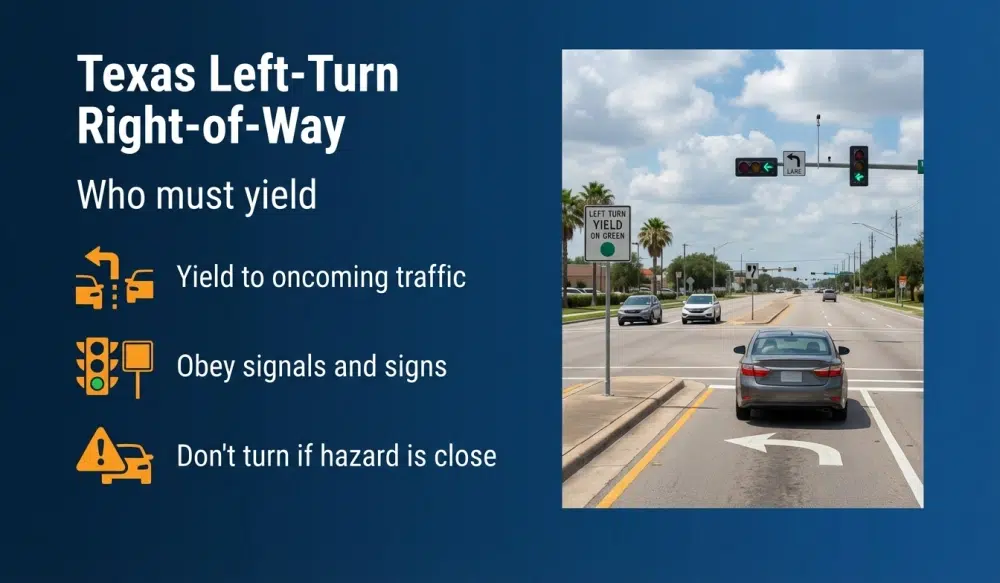
Texas law sets the basic rule: a driver turning left at an intersection or into a private drive must yield to a vehicle approaching from the opposite direction that is already in the intersection or so close as to be an immediate hazard [1]. Drivers must also approach intersections safely, obey control devices, and yield appropriately under general intersection rules [2].
In practical terms, if a Dallas driver initiates a left turn across a lane where an oncoming motorcycle is moving straight with the right-of-way, that driver has a statutory duty to yield. A violation can support a negligence finding in civil court, subject to defenses and comparative fault. Dallas motorcycle crash attorneys often start fault analysis with these Transportation Code sections and then test whether the facts show a failure to yield under the conditions at the time of impact [1] [2].
Who is usually at fault when a car turns left across a motorcyclist’s path?
There is no automatic fault assignment in Texas. However, the left-turning driver frequently bears a substantial share of fault when the evidence shows noncompliance with the yield requirement in the Transportation Code [1]. Courts may treat a proven statutory violation as negligence per se when the statute was designed to prevent the type of harm suffered and the injured person is within the class protected by the statute [13]. Whether negligence per se applies depends on the facts and the court’s rulings.
Important qualifiers affect the analysis:
- Visibility and conspicuity. Lighting, headlamp use, weather, and sight obstructions can be relevant. Even when visibility is poor, the duty to yield still applies if the oncoming vehicle posed an immediate hazard [1].
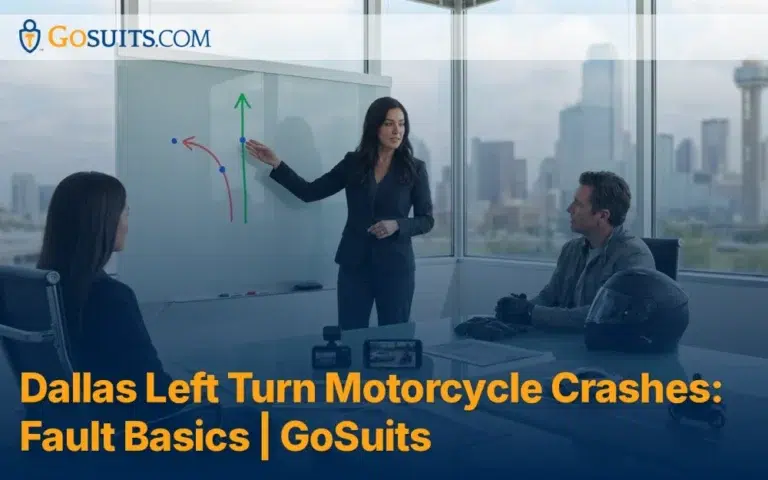
- Traffic control devices. Signals and protected vs. permissive left-turn phasing matter. A driver with a green arrow generally has the right-of-way, while a permissive green circle requires yielding to oncoming traffic [2].
- Oncoming speed. Excessive speed by the motorcycle can reduce or shift fault under comparative negligence rules if the speed rendered the hazard immediate in a way the turning driver could not reasonably anticipate [6].
For plaintiffs, the goal is to show the rider had the right-of-way, the driver failed to yield, and that failure caused the crash. For defendants, the focus is often on speed, lighting, positioning, or an intervening event that broke the causal chain.

How does Texas comparative negligence change fault and recovery?
Texas follows proportionate responsibility. A claimant who is more than 50 percent responsible for their injuries cannot recover damages. If a claimant is 50 percent or less responsible, the court reduces the award by the claimant’s percentage of responsibility [6]. In left-turn motorcycle cases, juries may apportion fault among the turning driver, the motorcyclist, and sometimes other parties.
Evidence that goes to comparative fault includes speed, lane position, compliance with signals, and use of safety equipment. Texas law now allows evidence about seat-belt nonuse to be considered in calculating damages and responsibility, overruling the old prohibition and aligning with comparative negligence principles [7]. The Texas Supreme Court extended this logic in related rulings, confirming that juries can hear evidence that bears on injury causation and damage mitigation under the comparative scheme [8].
This framework can be decisive. A rider found 10 percent responsible can still recover 90 percent of proven damages. A rider found 51 percent responsible recovers nothing. Calibrating fault through solid evidence is critical.
What evidence helps prove fault in a Dallas left-turn motorcycle crash?
Fault decisions often rise or fall on early scene work and complete documentation.
- Police crash report and supplements. The Texas CR‑3 crash report, diagrams, and any officer body-worn camera or dash video are foundational. Crash reports are available through the CRIS online system [11].
- Intersection timing and signal data. Signal phase logs and sequencing from the city can confirm whether a left turn was permissive or protected at the moment of impact [2].
- Event Data Recorder and infotainment data. Many vehicles record pre‑crash speed, throttle, and braking. These data can corroborate or contradict witness accounts.
- Scene forensics. Skid marks, yaw, gouge marks, scrape patterns, debris fields, and final rest positions inform time–distance analysis.
- Visibility study. Sun angle, headlamp condition, conspicuity gear, and sight-line measurements help address a driver’s claim that the rider was not visible.
- Third‑party video. Nearby businesses, transit buses, dashcams, and traffic cameras may capture the turn initiation and the oncoming rider’s approach.
- Medical records and biomechanics. Injury patterns and timing can support speed and angle estimates and connect mechanism to causation.
- TxDOT and city crash data. Background statistics on intersections and crash modes provide context for settlement discussions and expert testimony [5].
When we are contacted early, we can often secure videos before they overwrite, preserve vehicle modules, and document the scene while physical evidence is fresh. That work can close disputes about speed, signal status, and right-of-way.
What damages are available in Texas civil cases after a left-turn crash?
Texas law permits recovery of economic and non-economic losses caused by another’s negligence. Common categories in left-turn motorcycle collisions include:
- Medical expenses. Emergency care, hospitalization, surgery, rehabilitation, future treatment, and medical devices.
- Lost wages and earning capacity. Time off work and long-term changes to income.
- Property damage. Motorcycle repair or total loss, gear, and accessories.
- Physical pain and mental anguish. Human losses linked to injury and recovery.
- Physical impairment and disfigurement. Loss of function and scarring.
- Wrongful death and survival damages. If a death occurs, claims may include loss of companionship, funeral expenses, and estate survival claims under Texas statutes [12].
Texas comparative responsibility can reduce any award by the claimant’s percentage of responsibility, and the 51 percent bar applies [6]. Evidence that bears on injury causation and mitigation, including seat belt use in vehicles, may be admissible and can affect damage calculations under current Texas Supreme Court precedent [7] [8].

What deadlines and filing rules apply in Texas?
Most personal injury and wrongful death claims in Texas must be filed within two years of the date the cause of action accrues, subject to limited exceptions [9] [12]. Claims involving governmental units can require formal notice well before the statute of limitations runs. Missing a deadline can bar recovery entirely.
It is important to preserve evidence early, follow court rules for discovery and disclosure, and comply with Texas Rules of Evidence and Texas Rules of Civil Procedure in Dallas County and other Texas courts [10].
How do Texas insurance rules and minimum limits affect your claim?
Texas requires drivers to show financial responsibility, usually through auto liability insurance. State law sets minimum liability limits, often referenced as 30/60/25: $30,000 per injured person, $60,000 per crash for injuries, and $25,000 for property damage [14]. Motorcycle and auto claims in Dallas frequently exceed minimum limits, particularly when injuries involve hospitalization or surgery.
Practical points for Dallas riders:
- UM/UIM coverage. Uninsured and underinsured motorist coverage on your own policy can fill gaps when the at-fault driver has low limits or no coverage.
- PIP and MedPay. Personal Injury Protection and medical payments coverage can help with early bills regardless of fault, subject to policy terms.
- Third-party vs. first-party timelines. Different rules can apply to payment timing and bad faith in first-party claims. Documentation is key to both [10].
Negotiations often include liability limits tenders, UM/UIM demand sequencing, and hospital lien management. Accurate damage modeling and timing strategy can make a real difference.
What should you do right after a Dallas left-turn motorcycle collision?
Your safety comes first. If you can do so safely:
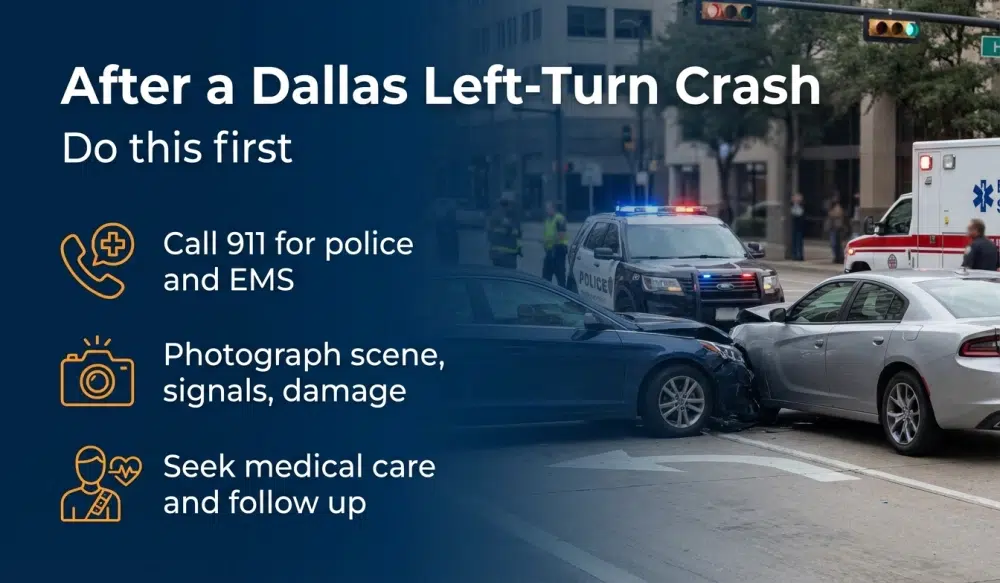
- Call 911 and request police and EMS.
- Photograph vehicles, the intersection, signal heads, skid marks, debris, and your motorcycle’s lights and controls.
- Identify witnesses and capture names, phone numbers, and any dashcam or phone video.
- Seek medical care and follow through. Gaps in treatment can be used to dispute causation.
- Preserve gear like your helmet, jacket, and boots. They can be evidence of impact forces and injury mechanisms.
- Avoid recorded statements to the other driver’s insurer until you have counsel.
- Order the crash report via TxDOT’s CRIS portal when available [11].
If you have questions, Dallas motorcycle accident lawyers can walk you through evidence preservation and insurance communications while you focus on recovery. Simple steps early on often prevent disputes later.
How do attorneys build a left-turn motorcycle case for trial?
We plan every case from day one as though a jury will decide it. That structure helps settlement because the evidence package is trial-ready.
- Scene and data. Download vehicle EDRs, secure videos, map sight-lines, and match physical evidence to time–distance models.
- Signal timing. Obtain and decode signal timing plans, phase logs, and detection placement to prove protected vs. permissive movement [2].
- Human factors. Address conspicuity, visual search patterns, and decision-making under Dallas traffic conditions.
- Medical causation. Tie injuries to mechanism with treating providers and, when necessary, independent experts.
- Comparative fault analysis. Present alternative scenarios and sensitivity analyses so jurors can see why the turning driver’s duty to yield was controlling.
- Damages presentation. Build clear economic models and day-in-the-life visuals anchored in the medical record and work history.
From the defense side, we expect challenges on speed, lighting, and timing. We directly test and address each with measurements, data, and reliable methodology. Texas comparative responsibility rules and evidence law shape that presentation [6] [7] [8] [10].

Who is GoSuits and how can our Dallas team help?
Our work fits the needs of riders and families facing serious injuries after left-turn collisions in Dallas, TX. A free consultation with a personal injury attorney can help you understand fault under Texas right-of-way statutes, the evidence needed for comparative negligence, and practical claim timelines. We practice across Texas state and federal courts, including cases in Dallas County and the DFW region.
- Technology-driven case handling. We use exclusive proprietary software to automate evidence intake, time–distance analysis, and document drafting, moving cases faster and with greater clarity for negotiations and trial.
- Designated attorney model. Even with advanced technology, every client works directly with a designated attorney. We do not rely on case managers. You have unfettered access to your attorney for strategy, updates, and preparation.
- Track record. Our past results reflect complex crash reconstructions, comparative negligence disputes, and significant recoveries. See a sample of outcomes here: prior cases.
- Leadership and innovation. We are committed to legal innovation that supports thorough investigations and clear presentations. Our tools support scene modeling, EDR decoding, and medical damages proof.
- Practice areas. We handle personal injury matters including motorcycle, car, and truck collisions; premises liability; wrongful death; construction and product cases. Explore our practice areas.
- Team. Meet the lawyers who lead our files, examine our methods, and try our cases: our attorneys.
- Experience. We bring 30 years of combined experience to investigation, negotiation, and trial. That depth helps frame fault and damages under Texas law.
- Trial-ready approach. We prepare every matter as though a jury will hear it. That mindset improves settlement quality and shortens timelines when trial is required.
- About. Learn more about our mission and tools on our about us page.
We understand how turning-left disputes hinge on statutes, timing diagrams, and visibility analysis. Bringing these pieces together early can shape both liability findings and the path to resolution.
References and resources
- Texas Transportation Code § 545.152 Vehicle Turning Left – Texas Statutes
- Texas Transportation Code § 545.151 Right-of-way at Intersections – Texas Statutes
- Texas Transportation Code § 541.201 Definitions, including Motorcycle and Intersection – Texas Statutes
- Motorcycles Safety Overview and Data – National Highway Traffic Safety Administration
- Texas Motor Vehicle Crash Statistics – Texas Department of Transportation
- Texas Civil Practice and Remedies Code § 33.001 Proportionate Responsibility – Texas Statutes
- Nabors Well Services, Ltd. v. Romero, 456 S.W.3d 553 (Tex. 2015) – Texas Supreme Court
- Nabors Well Services, Ltd. v. Loera, 457 S.W.3d 435 (Tex. 2015) – Texas Supreme Court
- Texas Civil Practice and Remedies Code § 16.003 Limitations for Personal Injury and Wrongful Death – Texas Statutes
- Texas Rules of Evidence and Rules of Civil Procedure – Supreme Court of Texas
- Crash Report Online Purchase System (CRIS) – Texas Department of Transportation
- Texas Civil Practice and Remedies Code Chapter 71 Wrongful Death and Survival – Texas Statutes
- Negligence Per Se Overview – Legal Information Institute, Cornell Law School
- Texas Transportation Code § 601.072 Minimum Liability Insurance Limits – Texas Statutes