
- What belongs in a Dallas wrongful death paperwork checklist?
- Who can bring a Texas wrongful death claim and who signs the paperwork?
- What is the difference between a Texas wrongful death claim and a survival action?
- What deadlines apply in Texas and how do exceptions work?
- How do you get a Dallas County death certificate and medical examiner records?
- How do you obtain police crash reports and other official records?
- How does probate intersect with wrongful death and survival claims in Dallas County?
- How should families and defendants handle evidence preservation and spoliation risks?
- What documents help prove damages in a Texas wrongful death case?
- How do insurance claims after a fatal accident work in Texas?
- How are settlements with minors handled and approved by the court?
- Are wrongful death recoveries taxable and what tax documents should you keep?
- What is the step by step Dallas wrongful death paperwork timeline?
- What are answers to common Dallas wrongful death paperwork questions?
- Why choose GoSuits for help with Dallas wrongful death paperwork?
- References and resources
What belongs in a Dallas wrongful death paperwork checklist?
After a tragic loss, it can feel overwhelming to figure out which documents to gather and which forms to file. A clear wrongful death paperwork checklist keeps everyone organized, reduces delays, and protects your rights under Texas law. Below is a practical, research backed roadmap for families in Dallas, TX. References appear as numbered links you can click to jump to the Resources section.
According to Texas law, a wrongful death claim belongs to the surviving spouse, children, and parents, or the executor if those family members do not file within three months [1]. A separate survival action belongs to the estate to recover the decedent’s own claims that would have survived had they lived [1]. Texas generally has a two year statute of limitations for wrongful death and survival actions [2].
Which identification and vital records should you obtain first?
- Certified death certificates: Order multiple certified copies to open claims, probate matters, insurance, and benefit changes. In Texas, vital records are maintained by the Department of State Health Services and local registrars [4].
- Proof of relationship: Marriage certificate, birth certificates of children, and in some cases adoption decrees. These documents help establish standing to file under Texas Civil Practice and Remedies Code Chapter 71 [1].
- Government identification: The decedent’s driver license or state ID and Social Security card if available. Keep secure.
What official investigative records should you request?
- Police and crash reports: For motor vehicle incidents, crash reports are governed by Texas Transportation Code Section 550.065 [5]. For incidents handled by Dallas Police Department or other local agencies, request the incident report and any supplemental narratives or diagrams.
- Dallas County medical examiner records: If an autopsy or inquest occurred, request the autopsy report, toxicology, and investigator notes. Authority for inquests and medical examiner functions is set by the Texas Code of Criminal Procedure Chapter 49 [3].
- Employer or property incident reports: If the death occurred at a workplace or on private property, request any incident reports, photographs, or maintenance logs maintained in the ordinary course of business.
What medical and financial documents help establish damages?
- Medical records and bills: Hospital records, emergency services records, physician notes, and itemized billing can be critical in survival actions and in proving medical expenses [6].
- Funeral and burial expenses: Keep contracts, itemized invoices, and receipts.
- Income and employment materials: Pay stubs, W 2 or 1099 forms, prior tax returns, benefits statements, and retirement plan documents to support loss of financial contributions.
- Household services and care data: Calendars, childcare invoices, and statements demonstrating the decedent’s contributions to childcare, elder care, and household tasks.
Which insurance documents do you need to gather?
- Liability and property policies: Automobile, homeowners, commercial general liability, and umbrella policies for all potentially responsible parties.
- Life insurance: Policies, beneficiary designations, and claim forms.
- Health and disability documents: Explanation of benefits and coverage notices to address any liens or subrogation.
What legal filings and authorizations should you prepare early?
- Preservation letter and notice: A written litigation hold directs recipients to preserve evidence. Texas courts have addressed spoliation and remedies when relevant evidence is destroyed [7].
- Wrongful death notices and claim letters: Pre suit claim notices may be required by contract or by specific statutes. Timely notice can also help with settlement negotiations.
- Application to open an estate: If a survival action or estate administration is needed, file an application for appointment of a personal representative in Dallas County Probate Court [8].
- HIPAA compliant authorizations: Signed releases allow lawful access to protected medical information, typically needed by counsel to collect records [6].
Most civil cases resolve before trial, but it is wise to build the record from day one. Federal judiciary data show trials are a small fraction of civil case dispositions, which makes careful documentation and early preparation especially important [6].
Who can bring a Texas wrongful death claim and who signs the paperwork?
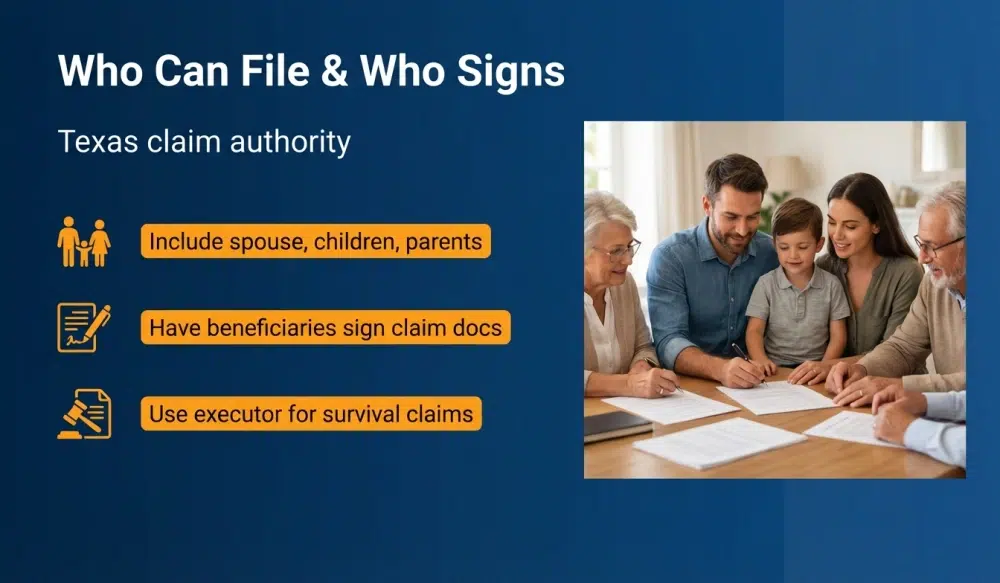
In Texas, the wrongful death cause of action exists for the benefit of the surviving spouse, children, and parents of the person who died [1]. One, several, or all eligible beneficiaries may bring the claim. If they do not bring it within three months, the executor or administrator may bring it unless all beneficiaries request otherwise [1].
How do beneficiaries prove they have standing to file?
- Spouse: Provide a certified marriage certificate and the death certificate.
- Child: Provide a certified birth certificate or adoption decree and the death certificate.
- Parent: Provide the decedent’s birth certificate naming the parent and the death certificate.
Who signs settlement paperwork and pleadings?
- Wrongful death claim: Beneficiaries who bring the claim sign pleadings and settlement documents, typically with counsel’s assistance [1].
- Survival action: The personal representative of the estate signs on behalf of the estate in a survival action [1].
You can begin organizing documents while you consult with a Dallas wrongful death lawyer about strategy and next steps. Families often benefit from early legal guidance to align paperwork with the legal requirements and deadlines that apply in Texas [2].
What is the difference between a Texas wrongful death claim and a survival action?
Texas law recognizes two related but distinct civil claims arising from a fatal injury.

How do damages differ between the two claims?
- Wrongful death claim: Brought by statutory beneficiaries to recover their own damages such as loss of companionship and society, mental anguish, loss of financial support, and loss of household services [1].
- Survival action: Brought by the decedent’s estate to recover the decedent’s own damages such as medical bills, conscious pain and suffering before death, and property damage. Any recovery becomes part of the estate and is distributed through probate [1], [8], [9].
Why does the difference matter for paperwork?
- Beneficiary proof: Wrongful death claimants must document their relationship.
- Estate authority: A survival action requires an appointed personal representative to sign on behalf of the estate and to handle estate accounting and distributions under the Estates Code [8], [9].
What deadlines apply in Texas and how do exceptions work?
Texas generally applies a two year statute of limitations for wrongful death and survival actions, measured from the date of death [2]. Missing this deadline can bar the claim entirely, which is why organizing paperwork promptly is critical.
Are there tolling rules or exceptions you should know?
- Minors: Limitations may be tolled for minor beneficiaries. Additional court procedures can apply when minors have an interest in settlement proceeds [10].
- Unknown defendants or fraud: Discovery rule and fraudulent concealment can affect deadlines in limited circumstances. Specific facts are necessary to evaluate these issues.
- Government units: Notice requirements and shortened timing may apply for claims against governmental entities. Preserve notice letters and proof of mailing.
Because timing is strict, many families choose to work with wrongful death attorneys to track filing deadlines, service of process, and related court dates. Experienced counsel can coordinate the litigation calendar with probate steps that affect authority to sign survival action documents.
How do you get a Dallas County death certificate and medical examiner records?
For death certificates, Texas families typically obtain certified copies through the Texas Department of State Health Services Vital Statistics Unit or local offices [4]. Order several copies because multiple agencies and insurers will require originals.
What if there was an autopsy or inquest in Dallas County?
- Autopsy and toxicology reports: Request from the county medical examiner if one was performed. Medical examiner functions and inquests are governed by the Texas Code of Criminal Procedure Chapter 49 [3].
- Investigator photographs and scene documentation: Ask for available materials that can assist with causation analysis and damages evaluation.
Which forms or information should you have ready when requesting records?
- Proof of identity and relationship: Government issued ID and documents showing your relationship to the decedent.
- Case number and date of death: If known, include agency case numbers, location, and date to speed up the request.
- Authorization: If required, provide a signed authorization from the next of kin or personal representative.
How do you obtain police crash reports and other official records?
Crash reports, sometimes called CR 3 reports, are regulated by Texas Transportation Code Section 550.065, which specifies who may obtain the report and what information may be redacted [5]. If the death involved a motor vehicle, you should request:
- Official crash report: Includes contributing factors, diagram, and involved parties.
- Officer body camera or dash camera footage: If available and releasable under Texas law.
- Supplemental narratives: Additional officer notes can provide useful context.
Other incidents may involve fire department responses, 911 audio, or code enforcement records. Requesting these items early preserves information while memories are fresh. A formal evidence preservation letter can help prevent loss of videos or logs that are subject to routine deletion cycles [7].
How does probate intersect with wrongful death and survival claims in Dallas County?
Wrongful death proceeds belong to beneficiaries directly and do not pass through the estate. By contrast, survival action proceeds become part of the estate and are distributed under the Estates Code [1], [8], [9].
When do you need to open an estate?
- Survival claim needed: If the decedent accrued medical bills or conscious pain and suffering before death, you likely need a personal representative to bring the survival claim [1], [8].
- Probate property to transfer: Real estate, bank accounts without payable on death designations, or other assets may require probate.

How do you request appointment of a personal representative in Dallas County?
- File an application: Submit an application in the appropriate Dallas County Probate Court requesting appointment of an independent administrator or executor if there is a will [8], [13].
- Prove up and oath: After the court hearing, the representative takes an oath and receives Letters Testamentary or Letters of Administration.
- Notice and inventory: Follow Estates Code requirements for notice to creditors and inventory, appraisement, and list of claims [8].
Families often coordinate probate filings and civil filings together to avoid delays in signing survival action pleadings and settlement documents. Electronic filing is standard in Texas courts and information is available through the judiciary’s electronic filing resources [12].
How should families and defendants handle evidence preservation and spoliation risks?
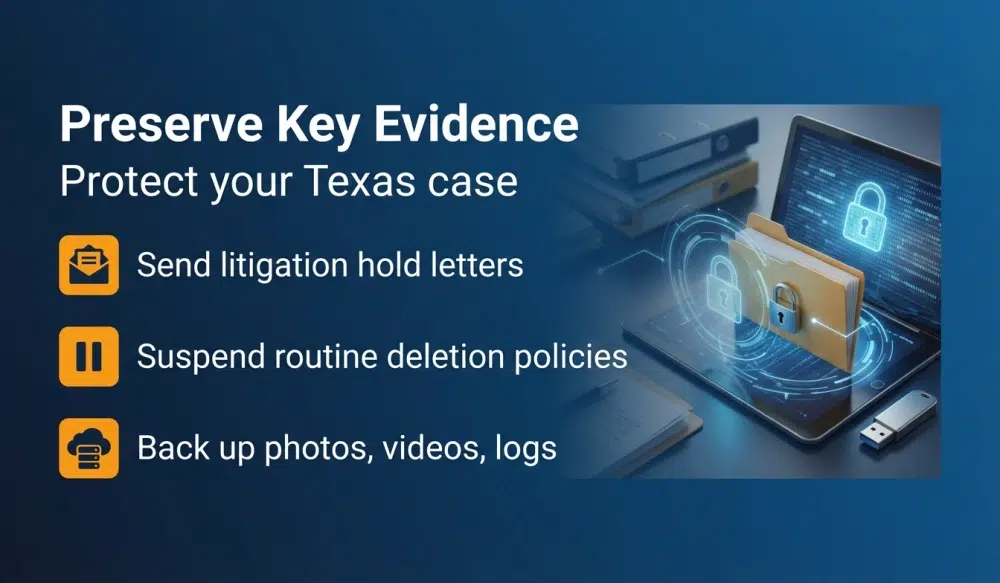
Texas law recognizes that destroying or failing to preserve relevant evidence can affect a case. The Supreme Court of Texas has discussed trial remedies when spoliation occurs, including limiting instructions and in rare cases sanctions [7]. A clear evidence preservation checklist helps both sides reduce risk and maintain a complete record.
What belongs in a preservation letter or litigation hold?
- Specific items and locations: Identify vehicles, electronic control modules, surveillance systems, phones, emails, and maintenance logs.
- Retention period: Request that routine deletion policies be suspended for all relevant data while the claim is pending [7].
- Chain of custody: Ask that parties document who has possession of key items and when transfers occur.
What should families do to preserve their own evidence?
- Keep a communications log: Track dates and details of calls with insurers, employers, and agencies.
- Save photographs and videos: Back up all digital media from the funeral, property damage, and memorial items that document the loss.
- Organize records: Use folders for medical bills, benefits letters, and receipts to support damages.
What documents help prove damages in a Texas wrongful death case?
Texas wrongful death damages focus on the financial and relational losses of the beneficiaries, while survival action damages focus on the decedent’s own losses before death [1].
Which documents support the beneficiaries’ wrongful death damages?
- Loss of financial support: Pay stubs, tax returns, job offer letters, employer benefits summaries, and retirement plan statements.
- Loss of household services: Calendars and receipts for childcare, meal preparation, home maintenance, transportation duties, and caregiving that the decedent handled.
- Loss of companionship and mental anguish: Journals, family photographs, and statements that describe the closeness of relationships and the impact of the loss.
Which documents support the estate’s survival damages?
- Medical bills and records: Emergency medical services, hospital records, physician notes, and itemized bills for treatment before death [6].
- Pain and suffering evidence: Nursing notes, witness statements, and timeline of treatment that show conscious pain and awareness prior to passing.
- Property losses: Vehicle damage estimates or other property repair bills.
Unintentional injury is a leading cause of death in the United States, which underscores the importance of careful documentation when sudden losses occur [14]. Collecting a complete record early can reduce disputes later.
How do insurance claims after a fatal accident work in Texas?
Insurance carriers typically open liability claims after receiving notice of the incident. Families may also need to open claims under life insurance and, where applicable, underinsured or uninsured motorist coverage.
What should your first insurance claim letter include?
- Policy and claim numbers: Reference all known policies and claim numbers.
- Preservation request: Ask the insurer and the insured to preserve evidence relevant to coverage and liability [7].
- Authorized contact: Identify a point of contact and provide signed authorizations where appropriate.
What laws apply to claim handling and timing?
- Prompt payment and fair handling rules: Texas law sets standards for timely claim acknowledgement, investigation, and payment in certain contexts. Contract terms and statutory provisions may apply depending on the policy [6].
- Reporting requirements: Some policies require prompt notice and cooperation. Keep copies of all letters and emails exchanged with the insurer.
How are settlements with minors handled and approved by the court?
When minor beneficiaries receive settlement funds, Texas courts frequently require approval to protect the minor’s interests. Courts may appoint a guardian ad litem and may order that funds be placed in restricted accounts, court registry, or structured arrangements managed under court supervision [10].
Which documents should you prepare for court approval of a minor’s settlement?
- Petition for approval: Describes the incident, allocation among beneficiaries, attorney fee request, and proposed plan for the minor’s funds [10].
- Evidence supporting allocation: Affidavits, medical bills, expert affidavits where appropriate, and structured settlement proposals.
- Order and receipts: Proposed order and bank letters confirming restricted accounts, if applicable.
Are wrongful death recoveries taxable and what tax documents should you keep?
Under federal law, damages for personal physical injuries or physical sickness are generally excluded from gross income, though certain categories such as interest may be taxable [11]. How a settlement is documented can affect tax reporting.
What should you keep for tax records?
- Final settlement agreement: Keep the full agreement and allocation among claims.
- Structured settlement contracts: If funds are structured, maintain the annuity documents.
- Forms issued by insurers: Retain any tax forms issued, including those related to interest.
What is the step by step Dallas wrongful death paperwork timeline?
What steps help in the first two weeks?
- Secure vital records: Obtain certified death certificates and gather identification and relationship documents [4].
- Open an investigation file: Create a folder for police reports, medical examiner case numbers, and insurance claim numbers [3], [5].
- Send preservation letters: Issue litigation hold letters to involved parties to protect evidence [7].
- Consult counsel: Early strategy can align wrongful death and survival action paperwork with probate needs [1], [8].

What steps help in the first one to three months?
- Request official records: Police crash reports, 911 audio, dispatch logs, and autopsy and toxicology if applicable [3], [5].
- Organize damages proof: Collect medical bills, funeral invoices, pay stubs, and tax returns.
- Open probate if needed: File to appoint a personal representative for a survival action or to manage estate assets [8], [13].
- File insurance claims: Provide prompt notice to all carriers and gather policy information.
What steps help from three months to filing suit?
- Complete the evidence preservation checklist: Confirm retrieval of videos, vehicle data, and electronic records [7].
- Evaluate damages and coverage: Review liability and damages theories and assess available coverage limits.
- Prepare pleadings: Draft petitions for wrongful death and survival claims in the appropriate Dallas County court. File electronically under Texas rules [6], [12].
What steps help post filing and at settlement?
- Monitor scheduling orders: Track discovery deadlines and mediation dates under the court’s scheduling order [6].
- Prepare for minor approvals: If any beneficiary is a minor, draft the approval petition and gather required attachments [10].
- Close the file carefully: Pay liens from settlement funds, finalize distributions, and keep a settlement notebook with releases, orders, and proof of payment.
Families searching for wrongful death paperwork checklist guidance in Dallas often ask for a simple summary. Two entries to keep in your notes are wrongful death attorneys for legal guidance and a list of the agencies likely to hold the official records you will need.
When you are ready to choose counsel, many families in Dallas look for compassionate wrongful death attorneys who will manage the paperwork and the court process while keeping the family informed and involved.
Why choose GoSuits for help with Dallas wrongful death paperwork?
We know you are looking for clear guidance, compassionate communication, and a steady hand through difficult steps. Our practice is focused on civil injury and wrongful death. A free consultation gives you a chance to ask questions about your Dallas wrongful death claims, timelines, and the paperwork you will need to gather. We walk you through filing a wrongful death claim in Texas, opening probate for wrongful death related survival actions when needed, and building an evidence preservation checklist that fits your situation.
We practice throughout Texas and regularly assist families in Dallas, TX. Our team uses a technology driven approach with exclusive proprietary software that streamlines record collection, timeline building, and court filing. That means faster organization, better case visibility, and fewer administrative delays while we prepare your case for negotiation or trial.
While we leverage advanced tools, every client has a designated attorney from day one. We do not use case managers. You have direct, unfettered access to your lawyer for updates, strategy discussions, and document review. Our attorneys have decades in court and are prepared to try cases when a fair resolution cannot be reached. That trial experience can influence how defendants and insurers evaluate your claim and can help frame a strong presentation for judge and jury.
We are proud of past results for clients and invite you to review a selection of our matters at prior cases. You can also learn more about the team at our attorneys and read about our values and process at about us. For a broader view of how we can help, visit our practice areas.
- How a consultation helps: We assess standing and venue, map deadlines, identify necessary documents, and plan both wrongful death and survival action filings.
- Where we practice: Statewide in Texas with frequent work in Dallas County trial and probate courts.
- Innovation: Our proprietary platform organizes discovery, records, and deadlines to support effective case building.
- Attorney access: You work directly with a lawyer, not a case manager.
- Experience: More than 30 years of combined experience in personal injury and wrongful death litigation.
- Trial readiness: We prepare every case as if it could go to trial, which helps drive focused discovery and meaningful negotiation.
If you are comparing legal representation, consider meeting with Dallas wrongful death attorneys who will take time to explain the paperwork and process, protect your deadlines, and coordinate probate and civil filings. With our approach, you get both modern tools and dedicated counsel to guide every step. We are available to talk when you are ready.
References and resources
- Texas Civil Practice and Remedies Code Chapter 71 Wrongful Death and Survival – Texas Statutes
- Texas Civil Practice and Remedies Code Chapter 16 Limitations including Section 16.003 – Texas Statutes
- Texas Code of Criminal Procedure Chapter 49 Inquests and Medical Examiner System – Texas Statutes
- Vital Statistics Unit Death Records Information – Texas Department of State Health Services
- Texas Transportation Code Section 550.065 Release of Accident Report – Texas Statutes
- Texas Rules of Civil Procedure and Texas Rules of Evidence – Texas Courts
- Brookshire Brothers Ltd. v. Aldridge 438 S.W.3d 9 Tex. 2014 – CourtListener
- Texas Estates Code Chapter 304 Appointment of Personal Representative – Texas Statutes
- Texas Estates Code Chapter 201 Descent and Distribution – Texas Statutes
- Texas Civil Practice and Remedies Code Chapter 142 Management of Funds to be Paid to a Minor – Texas Statutes
- 26 U.S.C. Section 104 Compensation for injuries and sickness – Legal Information Institute
- Electronic Filing Resources for Texas Courts – Texas Courts
- Dallas County Probate Courts Information – Dallas County
- Leading Causes of Death Data – Centers for Disease Control and Prevention