- What makes truck crashes so common on Dallas highways?
- What are the most common causes of Dallas highway truck crashes?
- Which federal and Texas rules govern truck safety and operations?
- Who can be liable in a Dallas truck crash claim?
- What evidence helps prove fault after a Dallas semi-truck collision?
- What damages can you seek in Texas, and how do key rules affect recovery?
- What steps should you take immediately after a truck crash in Dallas?
- How long do you have to file, and what does a typical timeline look like?
- How can a Dallas truck accident lawyer help you protect your case?
- How does GoSuits serve truck crash clients in Dallas, TX?
- References and Resources
What makes truck crashes so common on Dallas highways?
Dallas, TX sits at the crossroads of multiple interstates and freight corridors. I-35E, I-30, I-45, I-20, I-635, and US 75 move heavy freight daily through the Dallas Fort Worth metroplex. High speeds, lane merges, construction zones, and dense commuter traffic create frequent conflict points between large commercial trucks and smaller vehicles. National data reflect the scale of the risk. In recent years, the number of people killed in crashes involving large trucks has risen nationally, with thousands of fatalities documented by federal safety agencies each year [6]. Commercial motor vehicles also rack up hundreds of billions of vehicle miles traveled annually, which increases exposure to risk during both urban and long haul trips [15]. At the state level, Texas transportation authorities publish crash statistics showing that commercial vehicle crashes remain a persistent safety issue, including on the urban interstates that run through Dallas County [8].
Unlike typical car collisions, Dallas highway truck accidents often involve complex layers of responsibility. Federal safety rules set minimum standards for drivers, equipment, hours on duty, and cargo securement. Texas law supplements these standards with rules for road operation and civil responsibility for negligence. Understanding how these frameworks interact is crucial when evaluating fault and damages in I-35E truck crashes, I-30 truck accidents, or I-45 semi-truck collisions within Dallas.
What are the most common causes of Dallas highway truck crashes?
Most collisions in Dallas have multiple contributing factors. Below are frequent causes raised in Texas commercial vehicle accidents from both plaintiff and defense perspectives, with references to federal safety research and regulations.
Is driver fatigue a leading factor in I-35E truck crashes?
Fatigue reduces reaction time, impairs judgment, and can be as dangerous as alcohol in some circumstances. The Federal Motor Carrier Safety Administration regulates maximum driving hours and required off duty periods to combat fatigue [1]. Federal regulations also prohibit drivers from operating a commercial motor vehicle when they are ill or fatigued to the point that it is unsafe [2]. In federal research, fatigue has been identified as a contributing factor in a meaningful share of large truck crashes, especially on long interstate routes common around Dallas [7]. Plaintiffs may argue that hours of service violations or poor scheduling caused an unsafe duty cycle. Defendants may respond that logs and electronic records demonstrate compliance or that an unexpected event rather than fatigue was the crash trigger.
How often do distraction and inattention play a role?
Distraction includes in cab device use, eating, adjusting navigation, and visual attention diverted to roadside activity. Even a short glance away from traffic can be catastrophic at highway speeds. Studies of crash causation identify driver inattention as a frequent critical factor in large truck crashes [7]. Plaintiffs may examine phone records, in cab telematics, and dash video to identify distracted behavior. Defense teams often argue that the distraction of a noncommercial driver was the primary cause or that a sudden event outside the driver’s control made the crash unavoidable.
Do speeding and unsafe following distances cause Dallas highway truck accidents?
Speeding increases stopping distances and crash severity. Heavy truck braking distances are far longer than passenger cars, and following too closely reduces the time available to react. Federal safety studies repeatedly note that traveling too fast for conditions is a frequent crash factor for large trucks [7]. Plaintiffs may use ECM data, dashcam footage, and skid measurements to demonstrate unsafe speed. Defendants may counter that the commercial driver’s speed was appropriate for conditions or that the lead vehicle braked abruptly without reason.
Does improper truck maintenance contribute to collisions?
Brakes, tires, steering components, and lights must be in safe condition before a trip. Federal rules mandate regular inspection, repair, and maintenance, and carriers must keep records to show compliance [11]. Equipment failures such as worn brake components or underinflated tires can turn a near miss into a severe impact. Plaintiffs typically seek maintenance records, roadside inspection reports, and post crash examinations to identify defects. Defendants often present maintenance logs and recent inspections to show compliance with 49 CFR Part 396 requirements [11].
How does unsecured or shifting cargo spark jackknife accidents and rollovers?
Improperly loaded or secured cargo can shift, changing the truck’s center of gravity and causing loss of control. Federal cargo securement rules require carriers to prevent loads from leaking, spilling, falling, or shifting and to meet specific securement standards referenced in federal regulations [4][3]. Load shifts can trigger jackknife accidents on wet pavement or during emergency maneuvers. Plaintiffs may look to bills of lading, loading diagrams, and photographs to prove unsafe securement. Defendants may argue that the shipper or a third party loader controlled the securement process or that road hazards caused unavoidable instability.
Are weather and work zones frequent contributors on Dallas interstates?
Heavy rain, slick surfaces, and sudden slowdowns in construction zones complicate driving for both truckers and motorists. Defensive driving, safe speed selection, and hazard awareness are vital in these environments. Although weather and construction are external factors, a driver’s duty still includes adapting to conditions and complying with safe operation rules [1]. Plaintiffs may argue that the driver traveled too fast for the conditions, while defendants often emphasize that the crash was caused by an unexpected roadway condition or the actions of another driver.

Do mechanical failures like tire blowouts lead to multi vehicle collisions?
Tire failure at highway speed can cause lane departures and rollovers. Federal equipment standards and inspection rules require vehicles to be maintained in safe working order [3][11]. Plaintiffs often seek tread and casing evidence, maintenance intervals, and inspection documentation. Defendants may argue that debris on I-30 or I-45 caused sudden tire damage or that the failure was not foreseeable with reasonable maintenance.
Which federal and Texas rules govern truck safety and operations?
Truck crash cases in Dallas are shaped by both federal and state law. Federal motor carrier safety regulations create nationwide standards for driver qualifications, hours on duty, vehicle condition, and cargo securement. Texas law provides roadway rules and civil responsibility principles that courts apply in negligence cases.
Which hours of service rules limit driving time?
FMCSA rules limit driving time per day and week and require off duty rest periods. They also require carriers and drivers to keep duty status records, which are commonly collected from electronic logging devices and used in litigation to show compliance or violations [1]. Separate provisions prohibit operating when fatigued or ill in a way that makes driving unsafe [2].
What equipment and maintenance rules apply?
Federal rules require vehicles to be in safe condition and list specific equipment standards. Carriers must systematically inspect, repair, and maintain trucks and must keep records of those efforts [3][11]. Plaintiffs may compare records to the timeline of the crash, looking for missed inspections or deferred repairs. Defendants often rely on recent inspection reports and repair orders to show compliance.
How is cargo securement regulated?
Before driving, cargo must be properly positioned and secured to prevent movement that could affect the safe handling of the vehicle. The operator must also inspect securement at the start and during the trip and must comply with federal securement standards [4][3].
What Texas rules are relevant?
Texas adopts equipment requirements and sets roadway operation rules in the Transportation Code. Vehicle equipment must meet state standards to be lawful on Texas roads [12]. In civil cases, proportionate responsibility rules and time limits to file suit are set by the Texas Civil Practice and Remedies Code [9][10][11].
Who can be liable in a Dallas truck crash claim?
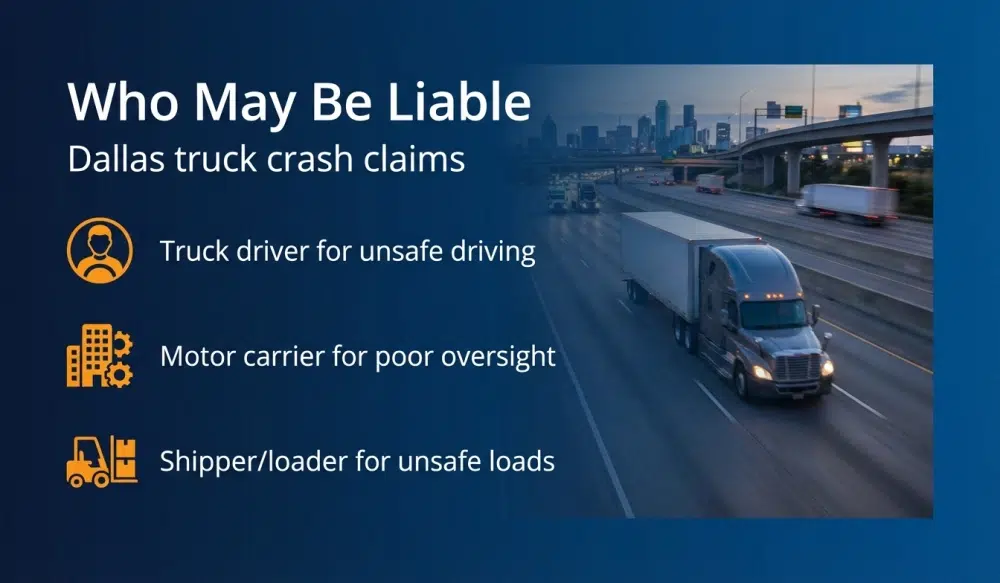
Responsibility in Dallas highway truck accidents is often shared across multiple parties. Texas law allows the jury to apportion fault among all responsible actors. Here are commonly involved parties and theories of liability, reflecting both sides of the case.
Can the truck driver be at fault?
Yes. Negligent operation such as speeding, distraction, unsafe lane change, or driving while fatigued may establish fault. Violations of FMCSA rules or Texas traffic laws can be evidence of breach of duty [1][2][12]. Defense counsel may focus on sudden emergencies or actions of other drivers to reduce or reallocate fault.
Can the motor carrier be liable separately from the driver?
Yes. A carrier may be vicariously liable for the driver’s negligence and may also face direct liability for negligent hiring, training, supervision, dispatch, or maintenance. Plaintiffs look to duty status records, driver qualification files, maintenance logs, and safety policies. Defendants often present policies, training records, and audits to demonstrate compliance with federal and state duties [11].

What about cargo loaders, shippers, or brokers?
Where cargo securement or loading balance is at issue, a shipper or loader may share responsibility. Federal cargo rules require proper securement, and bills of lading can show control and instructions [4][3]. Brokers and contractors may be implicated where their conduct influenced safety, though their legal exposure depends on the facts and contracts. Defendants may argue that the driver bears ultimate responsibility to inspect and refuse an unsafe load.
How does Texas proportionate responsibility work?
Texas uses a modified comparative fault system. A plaintiff may recover damages so long as the plaintiff’s percentage of responsibility is not greater than 50 percent. If the plaintiff is more than 50 percent at fault, recovery is barred. Any damages awarded are reduced by the plaintiff’s percentage of fault [9]. Defendants often raise comparative responsibility to limit damages, while plaintiffs focus on proof that commercial actors failed to meet safety duties.
What evidence helps prove fault after a Dallas semi-truck collision?
Evidence collection in Texas commercial vehicle accidents is critical and time sensitive. Below are categories of evidence that frequently matter on I-35E truck crashes, I-30 truck accidents, and I-45 semi-truck collisions in Dallas.
Which electronic records are most important?
Key data often include electronic logging device records for hours of service, engine control module speed and braking data, GPS and telematics, in cab camera video, and cell phone activity records. HOS records and ELD data can help show driver fatigue, compliance, and dispatch patterns [1]. ECM data may confirm speed, throttle, brake application, and fault codes around the time of impact, which can corroborate or contradict witness accounts.
What paper records should be preserved?
Preserve the driver qualification file, training records, drug and alcohol testing records if applicable, dispatch instructions, bills of lading, weight tickets, pre and post trip inspection reports, and maintenance and repair logs. Federal rules require carriers to systematically inspect, repair, and maintain vehicles and to retain related records [11]. Cargo securement documentation and photographs can be pivotal for unsecured cargo and load shift claims [4][3].
How do official reports and scene evidence help?
Investigating officers prepare a Texas CR 3 crash report that may include diagrams, contributing factors, and citations. Scene photographs, skid marks, gouge marks, debris fields, and final rest positions help reconstruct speed, angles, and avoidance opportunities. Weather data and work zone plans can clarify visibility and lane closures. Independent reconstruction and vehicle inspections are often pursued when liability is disputed.
Why is early preservation important?
Commercial carriers typically rotate equipment and overwrite electronic data in the ordinary course of business. Sending a prompt preservation letter and requesting immediate inspection can prevent the loss of relevant evidence. Discovery tools in civil cases allow parties to obtain records and testimony necessary to prove or defend claims [14][13].
What damages can you seek in Texas, and how do key rules affect recovery?
In a Dallas truck crash case, plaintiffs generally seek compensatory damages that cover economic and noneconomic losses. Defendants often dispute causation, the reasonableness of medical care, and the extent of claimed losses. Texas law and federal references provide the framework for what may be recoverable and how amounts can be limited.
What are common categories of damages?
- Medical expenses past and future treatment, rehabilitation, and related costs.
- Lost income and earning capacity time missed from work and diminished ability to work.
- Pain and suffering along with mental anguish and loss of enjoyment of life.
- Property damage vehicle repair or replacement and personal property loss.
- Household and caregiving services if injuries require ongoing support.
Are exemplary damages available?
Exemplary damages may be available in limited circumstances where a plaintiff proves certain higher levels of fault, but Texas law sets caps on exemplary damages. The caps are defined by statute and may limit recovery depending on the amounts of economic and noneconomic damages awarded [11].
How does comparative fault change a damages award?
If a plaintiff is 50 percent or less responsible, damages are reduced by the plaintiff’s percentage of responsibility. If the plaintiff is more than 50 percent responsible, recovery is barred. This proportionate responsibility framework is codified in Texas law and affects settlement evaluation and trial strategy [9].
What steps should you take immediately after a truck crash in Dallas?
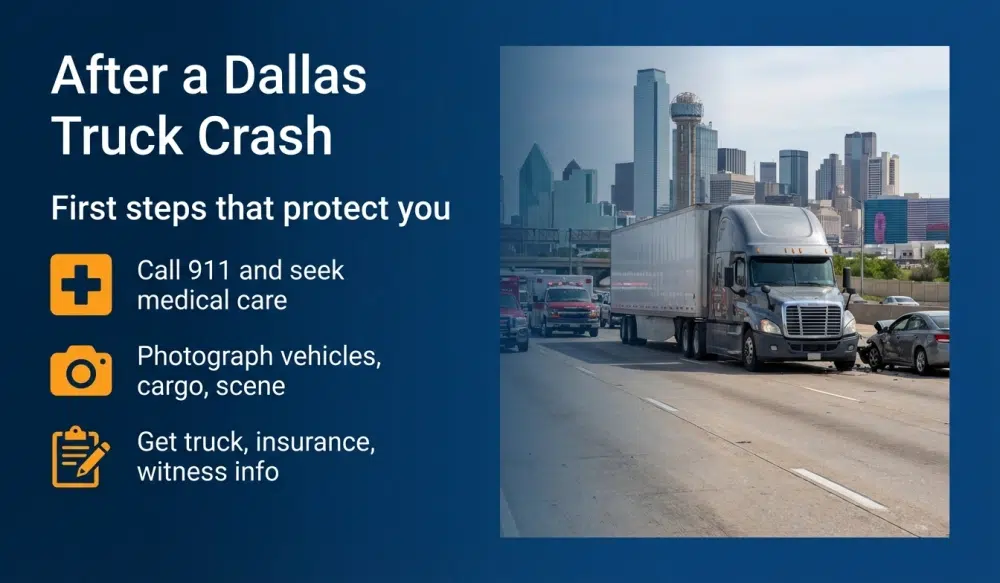
Your safety comes first. If you can, move to a safe area, call 911, and request medical help for anyone injured. Obtain the truck’s DOT number, carrier name, plate number, and insurance details. Take photographs and short videos of the vehicles, cargo, roadway, and your injuries. Collect witness names and contact details. Seek a full medical evaluation even if you believe injuries are minor, because symptoms from concussive or soft tissue injuries can appear later.
In the hours and days after the crash, consider the following actions that often help protect a civil claim:
- Report and document request the Texas crash report once available and keep a file of medical bills and repair estimates.
- Preserve evidence keep damaged items, do not allow vehicles to be repaired or destroyed before inspection when possible, and avoid deleting photos or messages related to the crash.
- Be careful with insurance communications provide only basic facts and do not speculate about fault or injuries before you understand the full picture.
- Consult qualified legal help promptly because key electronic data, camera footage, and maintenance records can be overwritten or lost without early preservation requests [13][14].
How long do you have to file, and what does a typical timeline look like?
In many Texas personal injury cases, the statute of limitations is two years from the date of the crash, though exceptions may apply in limited circumstances. Missing the deadline can bar the claim entirely, so calendar the date carefully and consider early investigation to preserve evidence and identify all responsible parties [10].
A typical civil case timeline includes investigation and preservation, filing the petition, service on defendants, written discovery, depositions, expert evaluations where appropriate, pretrial motions, mediation, and trial if the case does not resolve earlier. While each case is unique, federal court resources describe the stages of a civil case so you can understand what to expect in litigation [14].
How can a Dallas truck accident lawyer help you protect your case?
Complex truck crash claims often turn on details hidden in electronic logs, telematics, and maintenance files. Early legal help supports preservation of ELD and ECM data, cargo records, and in cab video before they are lost to routine overwriting. Investigation teams can inspect brakes and tires, gather witness statements, and retain reconstruction support when disputed speed and evasive maneuvers are central issues. When insurance companies raise comparative fault and sudden emergency, legal counsel can align evidence to the duty standards set by FMCSA and Texas law [1][11].
For many people, guidance from Dallas truck accident lawyers provides a path to organize medical care documentation, wage records, and property damage proof while the case unfolds. Clear communication also helps you navigate requests for recorded statements and medical authorizations that may affect your claim.
In addition to local knowledge of Dallas County courts and roadway conditions, truck accident lawyers coordinate experts in inspection, human factors, and load securement when needed. They also manage discovery requests and protective orders to balance privacy with the exchange of information required in civil cases [13][14].

What if the insurer calls right away offering a quick settlement?
Early offers can be tempting, but they may not reflect the full cost of future medical needs, lost income, or the impact of long term injuries. Waiting for a full medical evaluation and understanding the durability of recovery can prevent undervaluation of your case. Legal help can evaluate whether an offer accounts for the strength of fault evidence and Texas comparative responsibility implications [9].
Does federal safety data really matter to my Dallas claim?
Yes. Federal crash research and safety rules provide recognized standards for safe operation. When facts show a departure from those standards, jurors and insurers can better understand how the collision occurred and what could have prevented it. For example, hours of service compliance, cargo securement procedures, and inspection intervals can connect directly to why a jackknife accident or rollover occurred on I-20 during rush hour [1][4][11].
How does GoSuits serve truck crash clients in Dallas, TX?
We help people after serious Dallas highway truck accidents by pairing attentive client service with a technology driven case process. Our proprietary software platform centralizes records, accelerates document review, and helps teams keep decisive timelines. This approach supports faster, clearer case development while maintaining hands on advocacy at every step.
- Free consultation for personal injury Speak with a lawyer about your Dallas truck crash, your goals, and the next steps that can protect your claim.
- Texas based practice We serve clients across Texas, including Dallas, Fort Worth, and the surrounding counties.
- Exclusive proprietary software Our in house system is built to streamline investigations, track medical records, and organize evidence for depositions and trial.
- Leadership in innovation We invest in solutions that cut administrative waste so legal teams can spend more time on strategy and client communication.
- Direct access to your attorney Although we use technology to expedite the case, you will have a designated attorney and not a case manager. Clients have unfettered access to their attorney for questions and updates.
- Past results for clients See a sample of outcomes on our page for prior cases. Results depend on facts and law in each matter.
- Trial readiness Our lawyers have tried cases and understand how thorough preparation influences negotiation and courtroom presentation.
- 30 years of combined experience Our team has decades of combined work handling injury matters, from investigation through trial.
- Full service personal injury practice Explore our practice areas and meet our attorneys. Learn more about us.
When your case involves I-35E truck crashes, I-30 truck accidents, I-45 semi-truck collisions, or other Dallas highway incidents, a focused strategy on duty, breach, causation, and damages is essential. Careful attention to FMCSA hours-of-service violations, distracted truck driver conduct, fatigued truck driver logs, improper truck maintenance records, and unsecured cargo documentation helps build a clearer picture of what happened and why. For those evaluating legal options, Dallas truck accident lawyers can help organize the investigation and protect your timeline to file a civil claim.
If you are comparing options for representation after a Dallas highway crash with a commercial vehicle, thoughtful questions about process, communication, and courtroom experience can help you decide what is right for you. Many people find it useful to discuss how commercial vehicle accident lawyers structure early preservation, reconstruction, and damages analysis to support the evaluation of fault and recovery choices.
References and Resources
- Summary of Hours of Service Regulations – FMCSA
- 49 CFR 392.3 Ill or Fatigued Operator – LII
- 49 CFR Part 393 Parts and Accessories Necessary for Safe Operation – LII
- 49 CFR 392.9 Safe Loading and Cargo Securement – LII
- 49 CFR Part 396 Inspection, Repair, and Maintenance – LII
- Traffic Safety Facts 2021 Data Large Trucks – NHTSA
- Large Truck Crash Causation Study – FMCSA
- Crash Reports and Statistics – TxDOT
- Texas Civil Practice and Remedies Code Chapter 33 Proportionate Responsibility – Texas Statutes
- Texas Civil Practice and Remedies Code Section 16.003 Limitations – Texas Statutes
- Texas Civil Practice and Remedies Code Section 41.008 Exemplary Damages – Texas Statutes
- Texas Transportation Code Chapter 547 Vehicle Equipment – Texas Statutes
- Texas Rules and Standards Resources – Texas Judicial Branch
- Understanding Civil Cases – U.S. Courts
- Pocket Guide to Large Truck and Bus Statistics – FMCSA