- What we know about the Point Loma Heights collision
- Where it happened and local context on West Point Loma Boulevard
- What San Diego authorities typically do after a fatal crash
- How families can obtain official records and information
- California pedestrian and driver laws that often matter in these cases
- Potential civil liability questions raised by this crash
- Insurance considerations after a fatal pedestrian collision
- Safety reflections and community prevention in Point Loma Heights
- How evidence is preserved around West Point Loma Boulevard
- Practical next steps checklist for loved ones
- Why timely action matters
- Commentary from Gosuits San Diego, California Personal Injury Attorney
- References and resources
What we know about the Point Loma Heights collision
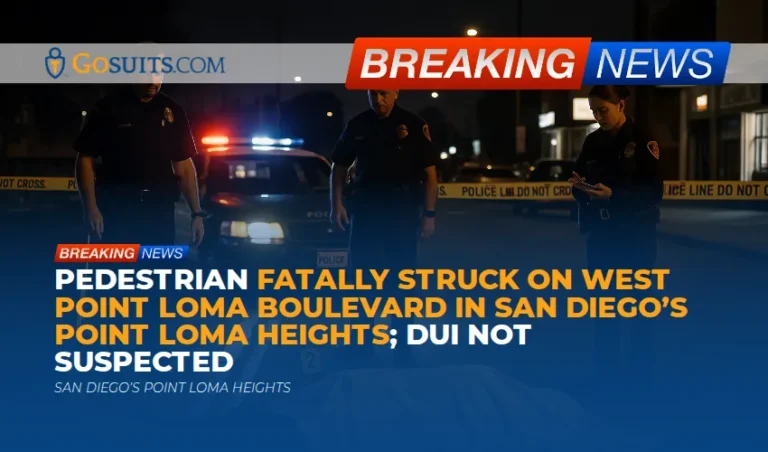
In the early hours of Thursday morning, around 2 a.m., a male pedestrian was struck and killed in the Number 1 eastbound lane of the 4300 block of West Point Loma Boulevard in San Diego’s Point Loma Heights neighborhood. According to initial details attributed to the San Diego Police Department, the driver was a 40-year-old man operating an eastbound 2009 Toyota Yaris. The pedestrian sustained fatal injuries and was pronounced deceased at the scene. The Toyota driver was not injured, and investigators stated driving under the influence was not a factor at this time.
At this stage, the pedestrian had not yet been publicly identified. When next of kin notifications are complete, the San Diego County Medical Examiner typically provides identification details in a public report, including cause and manner of death.
Where it happened and local context on West Point Loma Boulevard
Point Loma Heights sits between the Ocean Beach area and the Midway District, with West Point Loma Boulevard serving as a key corridor that connects homes, small businesses, and commuter routes. Traffic volume varies significantly by time of day, and at 2 a.m. lighting, speed, and visibility can all play a role in how drivers and people walking see and react to each other. Even familiar stretches of West Point Loma Boulevard can feel different in low light or when traffic is lighter and vehicles travel closer to the posted speed.
Community members know that crossing patterns in this area can be unpredictable at night, especially near driveways, bus stops, and mid-block destinations. Whether someone was in a marked crosswalk or between intersections often becomes a key fact in investigations, but California law assigns duties to both drivers and people walking in either situation. We discuss those general rules in a later section.
What San Diego authorities typically do after a fatal crash
After a fatal traffic collision on a city street in San Diego, multiple agencies and teams coordinate to document the scene thoroughly. Understanding this process can help families anticipate what records may exist later.
At-scene response and investigation
San Diego Police Department officers typically secure the scene, render aid, and preserve evidence. The Traffic Division or a specialized collision investigation unit may respond, particularly for fatal or serious injury incidents. Investigators document roadway conditions, lighting, weather, vehicle positions, and damage patterns; capture photographs and measurements; and identify potential witnesses. If available, they note camera locations that might have recorded the event.
Medical examination and identification
The San Diego County Medical Examiner’s Office is responsible for determining cause and manner of death and for official identification. The Medical Examiner may conduct an autopsy, gather toxicology, and issue a report that later becomes a key official record in a wrongful death investigation or claim.
Crash report, supplements, and public records
SDPD prepares a collision report and may issue later supplements if new evidence emerges. Parties of interest can usually obtain the report, while some sensitive information may be redacted. In the weeks following, families may also request certain records under the California Public Records Act, subject to exemptions.
How families can obtain official records and information
In the first days and weeks after a fatal pedestrian crash, several official records can help loved ones understand what happened and start necessary administrative steps.
San Diego Police Department traffic collision report
Parties of interest can request the collision report through SDPD’s Records Division. Having the report number, date and time, and location will help. Families can ask how to request the narrative, diagrams, and any available supplements. Note that certain personal identifiers, juvenile information, and ongoing investigative details may be redacted under California law. SDPD outlines report request procedures on its official website [1].
San Diego County Medical Examiner autopsy report
The Medical Examiner maintains the autopsy, toxicology, and identification documents connected to a decedent. Depending on case status and applicable law, these records can often be requested by next of kin. The Medical Examiner’s public-facing portal provides case status updates and request procedures [2].
Death certificate
Certified death certificates are issued by the County’s Assessor/Recorder/County Clerk. These are essential for probate, insurance, and other administrative needs. The County provides application instructions, eligibility details, and mailing or in-person options on its official site [3].
911 audio and dispatch logs
Families sometimes request 911 audio or Computer Aided Dispatch (CAD) logs for timeline clarity. These can be requested under the California Public Records Act, with some exemptions for privacy and investigative integrity [9]. In fatal traffic investigations, response timing and caller descriptions can be informative.
Traffic signal timing, streetlight maintenance, and roadway records
Depending on the location, traffic control devices and lighting may be under City of San Diego or Caltrans oversight. In many neighborhood corridors like West Point Loma Boulevard, the City manages signal timing, visibility standards, and street lighting. Public agencies may have maintenance records, complaints, or prior incident data that sometimes become relevant to a civil claim.
Video evidence
Nearby city traffic cameras, if present, business security systems, and transit-related cameras can sometimes capture portions of a collision. Although city traffic camera recordings are not always archived for long, prompt requests can make a difference. When footage is privately owned by a local business, a timely preservation letter can help ensure it is not overwritten. The process for requesting CCTV and related footage after a California crash is summarized in statewide guidance [10].
California pedestrian and driver laws that often matter in these cases
Every collision is unique, and these general laws may or may not apply to the specific facts of this case. Still, they are frequently examined by investigators and insurers in fatal pedestrian collisions across San Diego.
Driver duties to pedestrians
California Vehicle Code section 21950 requires drivers to yield the right of way to pedestrians within marked crosswalks and within unmarked crosswalks at intersections. The law also expects pedestrians to use due care, and it makes clear that a driver’s duty to exercise care does not disappear even when a pedestrian acts unsafely [4].
Pedestrians outside crosswalks
When pedestrians are crossing outside a crosswalk, different rules can apply, including duties set out in California Vehicle Code section 21954. Liability in civil cases is not all or nothing, though. California applies pure comparative negligence principles, which means fault can be divided among the involved parties in proportion to each person’s contribution to the event.
Basic speed law and nighttime visibility
California’s basic speed law, Vehicle Code section 22350, requires drivers to travel at a speed that is reasonable and prudent for conditions. That takes into account visibility, traffic, and the roadway environment, not just the posted speed limit [5]. Investigators often look at headlight illumination, sight lines, stopping distances, and whether a driver could have avoided a collision with reasonable care. Research from federal safety agencies has consistently linked higher speeds to increased risk and severity of pedestrian injuries and fatalities [6] [7].
California’s Freedom to Walk Act and what “jaywalking” means now
California’s Freedom to Walk Act, AB 2147, adjusted how officers address pedestrian crossings outside of crosswalks. As of 2023, an officer generally should not stop a pedestrian for crossing outside a crosswalk unless a reasonably careful person would realize there is an immediate danger of a collision [8]. The change does not remove a pedestrian’s duty of care or a driver’s obligation to avoid collisions. For a plain-language overview of how this plays out in everyday situations, see our guide on the jaywalking legal california freedom act.
Wrongful death basics and key deadlines
When a life is lost in a traffic crash, close family members may bring a civil wrongful death claim seeking damages for losses such as financial support and companionship. In California, most wrongful death claims must be filed within two years under Code of Civil Procedure section 335.1 [11]. If a public entity is a potential defendant, a Government Claims Act claim can be due within six months in many situations [12]. Because deadlines can be complex, many families consult seasoned counsel early to understand which time limits apply.
Potential civil liability questions raised by this crash
We do not speculate about fault in this specific collision. These are general questions that commonly arise in fatal pedestrian cases in San Diego.
Driver conduct and avoidability
Investigations typically assess the driver’s speed for conditions, attentiveness, headlight use, and lane position. Even on a familiar corridor like West Point Loma Boulevard, sight distance can vary based on lighting, parked vehicles, and roadway curvature. The central question is often whether a reasonably careful driver could have detected and avoided the pedestrian under the circumstances.
Pedestrian location and movement
Where the person was walking matters. Was it a marked crosswalk, an unmarked crosswalk at an intersection, or mid-block? Investigators also consider clothing reflectivity, direction of travel, and whether the pedestrian’s movement pattern was predictable. None of these factors automatically resolve civil liability; they are pieces of a larger analysis.
Vehicle factors
Even a smaller car like a compact sedan can present significant risk to a person on foot. Investigations sometimes include a look at headlight aim, braking components, tire condition, and any driver-assistance features that might log alerts or speed. If a vehicle maintenance defect or component failure contributed, separate claims may be considered, depending on the evidence.
Roadway design and lighting environment
Nighttime pedestrian visibility hinges on lighting quality. If streetlights were inoperative or if contrast conditions were unusually poor, families sometimes explore whether the roadway environment met applicable standards. This can be sensitive when a city department is involved and may require a timely claim under the Government Claims Act if evidence suggests a dangerous condition of public property.
Third-party and employer liability
If a driver was working at the time, an employer could be responsible under respondeat superior. If a rideshare, delivery, or commercial policy is implicated, insurance layers can change. Determining whether a driver was on the job and what coverage applies is an early priority in many wrongful death reviews.
Evidence preservation letters
Critical evidence can disappear quickly, including business CCTV that overwrites every few days. Families often send preservation letters to the driver’s insurer, nearby businesses, and public agencies as appropriate. This is one area where experienced guidance can be particularly valuable to ensure that time-sensitive materials are not lost. Many families turn to wrongful death attorneys to coordinate and send these notices promptly and correctly.
Insurance considerations after a fatal pedestrian collision
Insurance coverage paths can be confusing, especially after a tragedy. In California, a pedestrian’s family typically looks first to the at-fault driver’s auto liability coverage. If that coverage is inadequate or if fault is disputed, other sources may come into play.
Potential coverage sources
- At-fault driver’s liability policy. This is the primary coverage in many pedestrian crashes. Policy limits vary widely in California.
- Uninsured and underinsured motorist coverage. If the decedent carried UM or UIM coverage on a household auto policy, it may apply to a pedestrian crash, depending on policy terms. California allows residents to file SR-1 accident reports in certain circumstances, and policyholders can explore UM or UIM claims when the at-fault coverage is missing or insufficient [13].
- Medical payments coverage. Some policies include limited no-fault medical payments benefits that may help with immediate costs.
- Employer or commercial policies. If the driver was in the course and scope of employment, a commercial policy could apply. Determining this early can significantly affect the resources available.
Why families should speak with counsel before engaging insurers
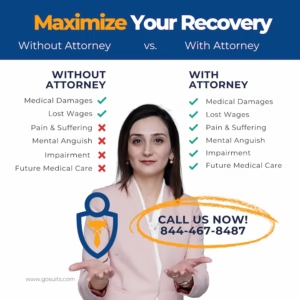
Insurance adjusters record calls and may ask questions that seem routine but later get used to deny or reduce claims. Before giving recorded statements or signing medical or records releases, families often choose to consult with an attorney to understand their rights and potential pitfalls. What is said to an insurer can be used against the claim later. For cases involving a fatality, the stakes are high and the paperwork can be overwhelming.
When multiple policies, public-entity issues, or employer liability may be involved, families often benefit from guidance by wrongful death attorneys who can coordinate claims in the proper order and protect against avoidable mistakes.
Local families also commonly rely on San Diego wrongful death attorneys to manage evidence, filings, and communications so they can focus on arrangements and grieving while deadlines are met.
Safety reflections and community prevention in Point Loma Heights
No summary can capture the loss felt after a neighbor dies on our streets. Still, San Diego’s Vision Zero initiative reminds us that fatal and severe crashes are preventable through design, enforcement, education, and community participation [14].
Pedestrian risk patterns
Statewide and national agencies have documented concerning trends: pedestrian fatalities have increased over the past decade in many regions. The California Office of Traffic Safety reports ongoing challenges in urban corridors, particularly at night and in areas with higher vehicle speeds [6]. Nationally, NHTSA highlights the disproportionate severity of pedestrian injuries when vehicle speeds increase even modestly [7].
Local strategies that can help
- Speed management. Traffic calming and setting appropriate speeds for conditions can reduce both crash likelihood and injury severity [6].
- Lighting and visibility. Maintaining streetlights and improving crosswalk illumination can increase detection distance at night.
- Crossing enhancements. High-visibility markings, refuge islands, and pedestrian signals often reduce conflicts.
- Community reporting. Residents noticing near-miss patterns can report them to City traffic engineering so problem spots are prioritized.
How evidence is preserved around West Point Loma Boulevard
On commercial corridors like West Point Loma Boulevard, a mix of public and private cameras may exist. Grocery stores, gas stations, and restaurants often have outward-facing CCTV that captures the roadway and sidewalks. These systems sometimes overwrite recordings within 48 to 72 hours. That is why a prompt canvass and preservation letters can make the difference between having video and losing it forever.
In addition, investigators may look for vehicle event data recorder information, roadway skid marks or scrape patterns, and nearby property damage that indicates vehicle trajectory. Even small details like broken plastic lens fragments can help reconstruct a collision. Families who act quickly often have a better chance of assembling the full picture of what happened.
Practical next steps checklist for loved ones
Every family’s situation is different, and none of these steps are mandatory. They are presented as general information that often helps after a fatal pedestrian crash in San Diego.
- Request the SDPD collision report. Note the date and location: around 2 a.m., 4300 block of West Point Loma Boulevard, Point Loma Heights. Ask for any supplements when available [1].
- Check the Medical Examiner’s case status. When ready, request the autopsy and toxicology reports if you are eligible next of kin [2].
- Order certified death certificates. These are usually needed for insurance, banking, and other administrative steps [3].
- Preserve potential video evidence. Identify nearby businesses and ask them to preserve footage from the time of the collision before it is overwritten. A written preservation letter is helpful.
- Collect photos and witness information. If any bystanders took pictures, videos, or saw the collision, ask them to write down what they observed and keep original files.
- Secure personal belongings. Ask SDPD where personal effects were logged and how they can be released.
- Pause before speaking to insurers. Consider consulting an attorney first. Recorded statements can influence liability assessments later.
- Track expenses and documents. Keep all funeral invoices, memorial expenses, and related receipts in one folder.
- Calendar important dates. Note potential legal deadlines, including general two-year periods for wrongful death and any shorter timelines that could apply if a public entity is implicated [11] [12].

Why timely action matters
Taking timely steps protects access to evidence and preserves options. Here is why acting sooner rather than later can make a tangible difference.
- Video is fragile. Many security systems overwrite footage within days. Early preservation can capture a fuller record of what occurred.
- Witness memory fades. People forget details quickly. Short conversations held soon after an event are more accurate than those weeks later.
- Deadlines can be strict. California has firm statutes of limitations, and claims against public entities can have even shorter notice requirements [11] [12]. Missing them can end a claim regardless of its merits.
- Insurance moves fast. Adjusters start building a case immediately. Understanding your rights before speaking with them helps avoid missteps.
- Records take time. Collision reports, autopsies, and certificates have processing timelines. Starting early avoids last-minute scrambles.
What to do next
- Document and preserve. Gather documents, save digital files, and send preservation notices to likely video sources.
- Clarify coverage. Identify potential insurance policies and do not provide recorded statements until you understand the implications.
- Learn your options. Schedule a free initial consultation with a qualified attorney to understand timelines and next steps before you approach insurers.
Preserve Evidence Today Understand Your Deadlines Request Official Records Explore Free Consultation Options
Commentary from Gosuits San Diego, California Personal Injury Attorney
Our hearts go out to the family, friends, and neighbors affected by the fatal pedestrian crash reported along West Point Loma Boulevard. Losing someone on a neighborhood street is devastating. This commentary is offered for educational purposes and general information only.
From the limited details available, investigators indicated DUI was not a factor and that the pedestrian was in the Number 1 lane at the time of impact. In our experience with nighttime pedestrian cases, the analysis often focuses on speed for conditions, sight distance, lighting, and driver response time. At the same time, the pedestrian’s location and visibility are examined carefully. Civil fault assessments in California rely on the totality of the evidence and can apportion responsibility between involved parties. That is why early evidence preservation matters so much.
Insurance companies and corporations know how to move quickly after a serious crash. Adjusters gather statements, frame the narrative, and look for reasons to minimize or deny claims. Families, overwhelmed by grief, may not realize that a well-intended comment on a recorded call can be taken out of context later. Before giving any recorded statement or signing releases, it is wise to talk with a qualified attorney about rights and risks.
A free consultation is important because it helps families understand deadlines, insurance coverage layers, and the preservation steps that protect their options. No one should have to navigate complex rules alone while grieving. Speaking with a skilled advocate early can reduce uncertainty, help secure critical evidence, and provide a plan for what comes next.
References and resources
- Request Police Records and Collision Reports – City of San Diego
- San Diego County Medical Examiner – Official Site
- Assessor/Recorder/County Clerk – County of San Diego
- California Vehicle Code § 21950 – Pedestrians’ Right-of-Way
- California Vehicle Code § 22350 – Basic Speed Law
- Pedestrian Safety Facts – California Office of Traffic Safety
- Pedestrian Safety – National Highway Traffic Safety Administration
- AB 2147 Freedom to Walk Act – California Legislature
- California Public Records Act – Office of the Attorney General
- Request CCTV Footage After a California Car Accident – GoSuits
- Code of Civil Procedure § 335.1 – Statute of Limitations
- Government Code § 911.2 – Government Claims Act Deadlines
- Traffic Accidents and SR-1 Reporting – California DMV
- Vision Zero San Diego – City of San Diego