- What We Know About the Smith County 18‑Wheeler Underride Crash
- Where This Happened and Why This Stretch Can Be Risky
- How a DPS Truck Crash Investigation Typically Unfolds
- Understanding Underride Crashes With Tractor‑Trailers
- Potential Civil Liability Considerations in Texas
- Preserving Evidence After a Fatal Truck Crash
- How to Obtain Official Records: Crash Report, Autopsy, and More
- Insurance Issues Unique to 18‑Wheeler Collisions
- Wrongful Death and Survival Claims in Texas
- Community Safety Notes for the U.S. 271 and I‑20 Corridor
- Practical Steps in the First 10 Days
- Why Taking Action Now Matters
- Commentary from Gosuits Smith County, Texas Personal Injury Attorney
What We Know About the Smith County 18‑Wheeler Underride Crash
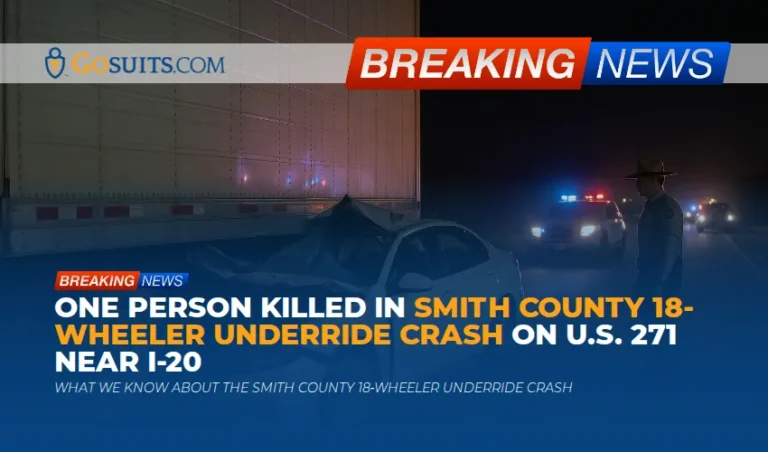
Late Friday night, just before midnight, a passenger car became stuck underneath an 18‑wheeler in the westbound lanes of U.S. Highway 271 near the I‑20 interchange in Smith County. According to Smith County Emergency Services District 2, the crash was called in around 11:55 p.m. One person, the driver of the car, died. Authorities reported no additional injuries. U.S. 271 was shut down while first responders worked the scene and later reopened after 4 a.m. The Texas Department of Public Safety (DPS) is leading the investigation. The name of the driver has not been released publicly at this time.
That’s the confirmed information shared by local officials. Beyond that, it’s appropriate to refrain from guessing how it occurred until investigators release their findings. Nighttime lighting, truck visibility, vehicle speeds, lane changes, and trailer position are all factors DPS often analyzes in crashes of this nature.
Where This Happened and Why This Stretch Can Be Risky
The area where U.S. 271 meets I‑20 carries heavy commercial traffic, especially late evenings and overnight when long‑haul rigs move through East Texas between Dallas and the Shreveport corridor. Closer to Tyler, traffic patterns can shift quickly as drivers merge to or from I‑20, and lighting can vary by segment. Locals know that the interchanges north of Tyler can feel different after dark: fewer cues, more glare from oncoming headlights, and frequent trucks entering and exiting at speed.
Add in seasonal challenges. In December, sunset comes early. That means more miles are driven in darkness, and cooler temperatures can affect tire traction and visibility. Even familiar roads can feel different at 11:55 p.m. than they do at lunch hour. If you live in Lindale, Chapel Hill, Winona, or along the outskirts near the county line, you’ve likely felt how the pace changes on this corridor after dark.
How a DPS Truck Crash Investigation Typically Unfolds
When DPS responds to a fatal crash, troopers secure the scene, attend to any injured people, and coordinate with local fire and EMS. They document vehicle positions, roadway evidence, lighting conditions, and the state of the vehicles. With an 18‑wheeler involved, investigators often review the truck’s lighting and reflective markings, trailer type, brake condition, and any signs of maintenance issues. If available, troopers may preserve event data recorder (EDR) information from the passenger car and electronic logging device (ELD) or engine control module (ECM) data from the commercial vehicle.
From there, DPS completes the official Texas Peace Officer’s Crash Report (CR‑3), typically within days or weeks depending on complexity. In underride situations, they may evaluate the trailer’s rear impact guard, the presence and condition of required reflective tape, and whether line-of-sight or driver perception issues existed. Toxicology testing can be part of the process, and chain-of-custody documentation is maintained for official records.
Understanding Underride Crashes With Tractor‑Trailers
In an underride crash, a passenger vehicle travels under the rear or side of a trailer or truck body. These events are particularly dangerous because the point of impact can bypass standard crumple zones and airbags. Many rear underride crashes are influenced by visibility and conspicuity. Federal standards require trailers to carry reflective markings and lamps, and most trailers must have rear impact guards designed to prevent passenger vehicles from traveling beneath the trailer in a rear impact.
Key federal requirements relevant to visibility and impact protection include:
- Rear impact guards on most trailers: Federal Motor Vehicle Safety Standards (FMVSS) 223 and 224 set performance and equipment requirements for rear underride guards on applicable trailers. See 49 CFR 571.223 and 49 CFR 571.224.
- Lamps and reflective devices: Commercial vehicles must meet conspicuity and lighting requirements, including red-and-white retroreflective tape on trailers. See 49 CFR 393.11 and lighting provisions in FMVSS No. 108 (49 CFR 571.108).
- Inspection attention to rear guards: Federal regulators have increased focus on rear guard condition and inspection regimes in recent years. NHTSA and related agencies monitor underride risks and countermeasures; see the Fatality Analysis Reporting System for national crash data at NHTSA FARS.
Side underride guards are not widely required under current U.S. regulations. That means nighttime side impacts with a crossing or turning trailer can be especially unforgiving if reflectors or lights are degraded, obscured, or unlit. None of this assigns blame in this Smith County crash, but it helps explain why investigators pay close attention to trailer conspicuity and guard condition after an underride.

Potential Civil Liability Considerations in Texas
Liability assessments in fatal truck cases depend on verified facts, not assumptions. In general, civil responsibility can involve multiple parties. Common areas lawyers examine include:
- Truck driver actions and training: Was the driver properly qualified and trained for nighttime and highway interchanges? Carriers must maintain driver qualification files and ensure drivers meet federal standards. See 49 CFR 391.51.
- Motor carrier safety programs: Carriers must systematically inspect, repair, and maintain equipment and keep records. See 49 CFR 396.3.
- Pre‑trip and post‑trip inspections: Drivers have duties to inspect equipment, including lighting and conspicuity elements, and note defects. See 49 CFR 396.13 and 49 CFR 396.11.
- Trailer visibility and compliant guards: Were the reflective tapes, lamps, and rear impact guards present and functional as required by federal rules? See 49 CFR 393.11, 49 CFR 571.223, and 49 CFR 571.224.
- Route, speed, and maneuvering: Was the truck stopped, turning, backing, or crossing lanes near the interchange? Were there markings or temporary conditions that limited visibility?
- Third parties: Depending on the evidence, liability can sometimes involve a shipper, broker, maintenance contractor, or trailer owner if their actions contributed to unsafe conditions.
- Roadway conditions and design: Some crashes involve questions about signage, lighting, or road design. Those claims have specific notice and timing requirements in Texas and require careful review of the facts and applicable immunities.
None of these points suggests a conclusion in this case. They simply outline what civil investigators and seasoned attorneys typically evaluate in an underride scenario.
Preserving Evidence After a Fatal Truck Crash
Evidence can disappear quickly after a highway fatality. Trailers are repaired, trucks return to service, electronic data overwrites, and scene markings fade. That’s why preservation is so important. Consider these steps, which families often pursue through counsel:
- Send a written preservation notice: A formal letter asks the trucking company and its insurer to preserve ECM/EDR data, ELD logs, dashcam footage, driver qualification and training files, dispatch communications, repair records, and the trailer’s rear guard and reflective tape condition.
- Secure vehicle inspections: Prompt expert inspections can document conspicuity, lighting, guard dimensions, underride geometry, and post‑crash damage patterns. Photogrammetry and 3D scans help reconstruct night visibility and angles.
- Obtain driver logs and hours‑of‑service data: Logs may show fatigue risks or duty‑status history. See 49 CFR Part 395 for hours‑of‑service rules and retention provisions.
- Request maintenance documentation: Carriers must keep inspection, repair, and maintenance records. See 49 CFR 396.3.
- Identify all potential defendants and insurers: The tractor, trailer, and load may each be owned or insured separately, meaning multiple policies and claim paths.
Families rarely want to handle these technical steps alone, especially during grief. It’s common to have a skilled legal team handle the communications and evidence requests so loved ones can focus on arrangements and support.
How to Obtain Official Records: Crash Report, Autopsy, and More
Texas Peace Officer’s Crash Report (CR‑3)
In Texas, the official crash report is generally available to eligible requestors and can be purchased online through TxDOT’s CRIS system. You can search and purchase the CR‑3 at TxDOT CRIS Crash Report Purchase. Texas Transportation Code 550.065 governs crash report release to certain parties, including those involved and their representatives; see the statute at Texas Transportation Code 550.065.
Reports often appear within a few days to several weeks. Supplemental reports may follow if new information develops.
Incident reports, 911 audio, and scene photos
Public records like dispatch logs, certain incident reports, and some scene photographs may be requested under the Texas Public Information Act. Agencies can withhold or redact portions by law. Learn about the Public Information Act process at the Texas Attorney General’s website: Texas Open Government: What Information Is Public.
For this incident, requests may be directed to DPS as the investigating agency. If Smith County ESD 2 or other local responders created records, those entities may also receive requests. Be precise about dates, times, and locations to help custodians locate records.

Autopsy and death investigation records
Texas handles death investigations through a medical examiner if the county has one, or through a Justice of the Peace (JP) acting as coroner in counties without a medical examiner. State law identifies deaths requiring an inquest and when autopsies may be ordered. See the Texas Code of Criminal Procedure provisions for inquests and autopsies at Texas Code of Criminal Procedure Chapter 49, including Articles 49.04 and 49.10.
Autopsy reports are often released to next of kin and certain requestors. There can be exceptions during ongoing investigations. Toxicology results typically arrive later than the initial report. If you’re unsure whether the local JP or a medical examiner handled the case, the funeral home or DPS investigator can usually tell you which office to contact.
Certified death certificates
Death certificates are obtained through the county clerk or vital records office. The State’s vital records information is available through Texas government channels, and funeral homes often assist with the request process for next of kin.
Insurance Issues Unique to 18‑Wheeler Collisions
Trucking claims are not like typical auto claims. There are more players and more data, and insurers usually deploy rapid response teams. Common insurance considerations include:
- Multiple policies: The tractor, trailer, and motor carrier may each carry separate coverage. There can also be excess or umbrella policies.
- Recorded statements: Statements to any insurer can be used later and sometimes taken out of context. It’s generally best to speak with an attorney first, then decide how to proceed with insurers.
- Cargo and broker issues: The load, shipper, or broker arrangements can influence which policy addresses which loss.
- Rapid scene teams: Commercial insurers often send investigators quickly. That’s another reason evidence preservation letters are time‑sensitive.
If a claim is contemplated, contact a qualified attorney for a free consultation before calling any insurance company. What’s said to an adjuster can affect how a case is evaluated later.
Wrongful Death and Survival Claims in Texas
Texas law recognizes two related civil claims in fatal incidents: wrongful death and survival. Wrongful death compensates certain family members for their own losses resulting from a loved one’s death. The survival claim belongs to the decedent’s estate and addresses the decedent’s own damages that accrued before death.
- Who may bring a wrongful death action: The spouse, children, and parents of the deceased may bring the claim. See Texas Civil Practice and Remedies Code Chapter 71, including Section 71.004.
- Survival claim authority: The decedent’s estate may pursue the survival action. See Texas CPRC 71.021.
- Statute of limitations: Many wrongful death and survival claims in Texas are subject to a two‑year limitations period. See Texas CPRC 16.003. Certain exceptions may apply, but the general rule is that time matters.
There are additional Texas rules concerning apportionment among beneficiaries, representative authority, and probate considerations. Those specifics depend on individual facts and are typically discussed in a confidential consultation.
Community Safety Notes for the U.S. 271 and I‑20 Corridor
Locals in Smith County know how quickly road dynamics can change north of Tyler and near I‑20. Here are practical, community‑minded safety points relevant to this corridor:
- Expect high truck volumes at night: Long‑haul and regional rigs often move at off‑peak hours. Give extra space, especially when you see a trailer glinting with reflective tape ahead.
- Watch for merging and slow‑moving vehicles near ramps: Westbound U.S. 271 traffic approaching I‑20 can compress as drivers jockey to enter or exit. Anticipate speed variance.
- Mind night visibility: Glare, headlight height differences between cars and trucks, and fatigue can narrow what you perceive. Slow down, use clean windshields, and scan well ahead.
- Report dark or damaged trailer lights: If you notice a semi‑trailer with non‑functioning lights or missing reflective tape, keep your distance and report hazardous conditions when safe to do so.
- Remember stopping distances: A fully loaded tractor‑trailer can weigh up to 80,000 pounds. It takes considerably longer to stop and maneuver.
These reminders don’t place fault on anyone involved in this crash. They’re part of how our community looks out for one another on roads we all share.
Practical Steps in the First 10 Days
After a fatal crash, families can feel inundated with to‑dos. Here’s a practical, fact‑based checklist that respects that reality while highlighting what matters for safety and documentation:
- Identify the investigating trooper or unit: Keep the report number if it’s available. Ask when the CR‑3 is expected to be ready and how supplemental findings will be handled.
- Coordinate with the funeral home: Confirm whether an autopsy was ordered and which office handled the inquest. Ask about timing for death certificates.
- Preserve phones and vehicles: The decedent’s phone can contain vital trip data, location history, and communications. The involved vehicles may hold EDR/ECM data. Avoid altering or disposing of anything until counsel evaluates it.
- Avoid social media discussions: Public posts can be misinterpreted by insurers. Keep communications private and factual.
- Hold off on insurer statements: Before speaking to any adjuster, consult with an attorney. Recorded statements can affect later proceedings.
- Collect practical records: Gather photos, phone logs, work schedules, vehicle maintenance records, and any witness contact information you may already have.
- Consider a preservation letter: A timely spoliation/preservation request to the motor carrier and trailer owner can help secure critical electronic and physical evidence.
Why Taking Action Now Matters
Several important deadlines and risks begin immediately after a serious truck crash, and waiting can limit options:
- Electronic data overwrites quickly: ELDs, ECMs, and dashcams may cycle and overwrite. Early preservation requests help protect this evidence window.
- Vehicles are repaired or salvaged: Once a trailer is repaired, it becomes far harder to document guard condition, lighting issues, or reflective tape status.
- Witnesses’ memories fade: Recollections change rapidly in the first weeks. Capturing statements sooner tends to produce clearer narratives.
- Public records have timelines: Crash reports, inquest findings, and some dispatch records post in stages. Tracking them early prevents missed updates.
- Insurance strategies start fast: Commercial insurers often move quickly to shape the record. Balanced, informed steps early can level the field.
What should be done right away? Ensure a preservation letter is sent, identify all potential policyholders and corporate entities tied to the tractor, trailer, and load, and map out a plan for official record requests. Acting within days instead of months can make a meaningful difference in what can be proven later.

Commentary from Gosuits Smith County, Texas Personal Injury Attorney
Our hearts are with the family and friends grieving this loss in Smith County. This write‑up is intended for education and general information as our community processes what happened near U.S. 271 and I‑20. Crashes involving an 18‑wheeler and a passenger car beneath a trailer are among the most devastating events we see on East Texas roads.
From a civil perspective, underride cases call for careful, methodical fact‑finding. Investigators typically look closely at trailer lighting and reflective materials, rear impact guard condition, driver maneuvers near interchanges, and the surrounding visibility environment at the time of night the collision occurred. It’s not about jumping to conclusions. It’s about collecting the facts the right way so the truth is clear.
In our experience, commercial insurers and corporate defendants often move first. They know the value of early control over information. They may request recorded statements or suggest quick resolutions before a full picture is developed. That’s why it’s so important for families to understand their rights and options before engaging with insurers. What someone says to an adjuster can be used against them later, even when the person is simply trying to be helpful and honest.
A free consultation with a seasoned attorney can help people understand the process, the documents that matter (like the CR‑3, inquest findings, and electronic vehicle data), and the importance of preservation steps. No one should feel rushed into decisions before the evidence is secured and reviewed. While nothing can undo a loss like this, informed choices and timely action can protect a family’s rights while they focus on honoring their loved one.
Helpful Government Resources Cited
- TxDOT CRIS Crash Report Purchase
- Texas Transportation Code 550.065 (Crash Reports)
- Texas Public Information Act Overview
- Texas Code of Criminal Procedure Chapter 49 (Inquests and Autopsies)
- Texas CPRC Chapter 71 (Wrongful Death and Survival)
- Texas CPRC 16.003 (Limitations)
- 49 CFR 571.223 (Rear Impact Guards) and 49 CFR 571.224
- 49 CFR 393.11 (Lamps and Reflective Devices) and 49 CFR 571.108
- 49 CFR 396.3 (Inspection, Repair, and Maintenance) and 49 CFR Part 395 (Hours of Service)
- 49 CFR 391.51 (Driver Qualification Files)
- NHTSA FARS (National Fatal Crash Data)