- What the renewed federal focus on CDLs means for families after a serious truck crash
- How truck crash investigations typically unfold in Los Angeles County
- Common liability pathways after a catastrophic truck collision
- Evidence that proves fault and how to preserve it quickly
- Where to obtain official records and immediate help in Los Angeles County
- Insurance dynamics and early claim pitfalls after a large truck crash
- First 7 to 14 days checklist
- For grieving families: wrongful death and survival action basics in California
- Community safety context on LA freeways and freight corridors
- Practical next steps: why acting now matters
- Commentary from Gosuits Los Angeles, California Personal Injury Attorney
- References and resources
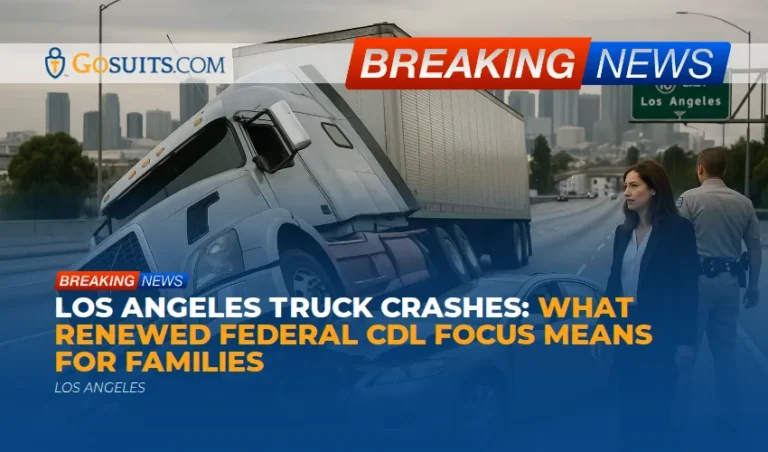
What the renewed federal focus on CDLs means for families after a serious truck crash
Angelenos know the daily reality of big rigs moving between the Ports of Los Angeles and Long Beach, the East LA Interchange, and the Inland Empire. When a large truck collides with a family car on the I‑10 through Boyle Heights or along the 710 corridor, the consequences can be life altering. Recent federal attention on how states vet commercial drivers licensing for non‑domiciled applicants has amplified a simple question many families ask after a tragedy: how do licensing rules and safety oversight affect civil claims when a crash happens?
Under long‑standing federal regulations, states issue Commercial Driver’s Licenses (CDLs) using baseline standards set by the Federal Motor Carrier Safety Administration (FMCSA). The rules address knowledge and skills testing, driver qualification, and identity and lawful status verification for non‑U.S. citizens seeking to operate commercial motor vehicles in interstate commerce [1] [2] [3]. These safeguards exist because large trucks present elevated risk on urban freeways. National data show thousands of lives lost each year in crashes involving large trucks, with complex factors like driver fatigue, inadequate training, or poor maintenance often in the mix [4].
Why does this matter in a Los Angeles claim? If a serious collision occurs, the driver’s licensing status, training background, and the motor carrier’s vetting and supervision can become central to civil liability. Plaintiffs commonly investigate whether a motor carrier followed federal and state requirements on driver qualification, ongoing monitoring of records, hours‑of‑service compliance, and drug and alcohol testing programs [5] [6]. Gaps in any of these areas can help explain how and why a crash occurred.
How truck crash investigations typically unfold in Los Angeles County
In Los Angeles County, freeway crashes are commonly investigated by the California Highway Patrol (CHP) while municipal police departments handle incidents on city streets. A catastrophic crash on I‑5 near the East LA Interchange, for example, would usually bring CHP investigators, and in severe cases their Multidisciplinary Accident Investigation Team. Within the city, LAPD Traffic divisions respond to major injury collisions on arterials like Cesar E. Chavez Avenue or Figueroa Street.
Investigations tend to follow a well‑worn path:
- Scene documentation that captures roadway evidence such as gouge marks, tire friction marks, vehicle rest positions, debris fields, and lane geometry. In urban settings like the 110 and 10 interchange, this often includes overhead ramp and ramp‑merge complexities.
- Vehicle inspections that assess brake condition, lighting, conspicuity tape, cargo securement, underride guards, and electronic control module data (sometimes called the truck’s “black box”).
- Driver and carrier records gathering, including hours‑of‑service logs or ELD data, dispatch records, bills of lading, weigh station receipts, and the driver qualification file.
- Supplemental digital evidence from dashcams, nearby traffic cameras, ring‑style home cameras facing the street, and 911 call audio.
Because freeways and major surface streets in Los Angeles are dotted with public and private cameras, time is critical. Some public agencies do not archive traffic camera video absent a prompt records request, and many private systems overwrite within days. Prompt preservation requests can make the difference between having a clear sequence of events and relying on memory.
Common liability pathways after a catastrophic truck collision
Every collision is different, but in metropolitan Los Angeles we see several recurring legal theories that may be investigated:
- Driver negligence such as speeding on downhill grades like the Grapevine, unsafe lane changes on the 405 through the Sepulveda Pass, or driving while fatigued in violation of hours‑of‑service limits [5].
- Motor carrier negligence including negligent hiring, retention, training, or supervision, and failure to maintain vehicles in safe operating condition required by federal regulations [2].
- Cargo loading errors by shippers or loaders that result in shifting cargo, high center‑of‑gravity rollovers on the 710, or hazardous materials incidents.
- Broker or third‑party logistics liability in limited scenarios, often fact‑intensive, involving control or negligent selection.
- Roadway design or maintenance issues in rare situations, such as defective signage, obscured sight lines, or malfunctioning signals. Claims against public entities like Caltrans carry strict notice deadlines under California’s Government Claims Act.
These theories are not mutually exclusive. A single crash near Union Station could implicate the driver, the carrier’s safety culture, a maintenance provider, and even a shipper if loading contributed to instability.
Evidence that proves fault and how to preserve it quickly
In the first days after a serious collision, key evidence can vanish. Urban corridors like the East LA Interchange, the 710, and the 105 move quickly to remove disabled vehicles, and businesses routinely overwrite security footage. Consider the following categories:
- Electronic data: ELD hours‑of‑service records, GPS pings, dispatch messaging, telematics, speed governor settings, and ECM downloads can reveal speed, throttle, brake application, and fault codes before impact.
- Driver qualification file: Application, prior employer checks, drug and alcohol testing history, road test or CDL skills verification, medical examiner’s certificate, and record of violations review, all mandated for motor carriers by FMCSA rules [2].
- Cameras: The truck’s front‑facing and driver‑facing dashcams, city street cameras, Caltrans traffic management cameras, private business cameras along the route, and residential systems.
- Cargo documentation: Bills of lading, weight tickets from the ports or inland terminals, and seal logs may show overloads or unsecured freight.
- Physical inspection: Early expert inspection of the tractor and trailer can lock down brake performance, tire condition, lighting, and underride guard configuration before repairs or salvage disposal.
Many families rely on seasoned investigators working with truck accident lawyers to send immediate preservation letters and put the carrier and its insurer on notice not to destroy evidence. A practical, step‑by‑step aid for LA‑area cases is the Los Angeles Truck Crash Evidence Checklist for Victims, which aligns with how local agencies and carriers store key information.

Where to obtain official records and immediate help in Los Angeles County
Collecting official documents helps answer what happened and can support an insurance claim or civil case. Below are common sources and how they fit together in Los Angeles County and surrounding corridors.
Traffic collision reports
For freeway crashes in LA County (I‑5, I‑10, I‑110, I‑405, SR‑60, SR‑710), CHP typically investigates. Families can request the Traffic Collision Report using CHP’s process and form, usually the CHP 190. Eligibility generally requires involvement in the crash, a representative, or legal interest [7].
Crashes on city streets in Los Angeles are handled by the Los Angeles Police Department. For collisions in unincorporated LA County, the Los Angeles County Sheriff’s Department may be the agency of record. While those departments provide their own request procedures, CHP resources are a good starting point for freeway incidents.
Medical examiner records
When a collision causes a fatality in Los Angeles County, the Department of Medical Examiner manages decedent examinations and records. Next of kin can request autopsy and examination records, death certificates, and investigator notes through the agency’s records unit. The department’s site describes eligibility, costs, and typical processing timelines [8].
Traffic and infrastructure records
Caltrans District 7 oversees many of the freeways in Los Angeles County. Families or representatives can submit California Public Records Act requests for items like signal timing records, lane closure logs, or traffic management center logs. Some live camera feeds are not archived, which makes rapid requests critical after a major collision [9].

Licensing and carrier oversight
Carrier registration status, USDOT numbers, and certain safety metrics fall under FMCSA. While investigative files are not always public early on, federal sites explain the standards carriers must meet on driver qualification, drug and alcohol testing, and hours‑of‑service limits [2] [5] [6]. Non‑U.S. citizen applicants for CDLs are subject to identity and lawful status checks that rely on DHS’s SAVE system, which states use to confirm immigration or lawful presence information [3].
Insurance dynamics and early claim pitfalls after a large truck crash
Serious truck crashes often involve multiple insurance layers: the driver, the motor carrier, and sometimes the tractor and trailer each have separate policies. Depending on contracts, there can also be coverage through a freight broker or shipper. Interpreting which policy applies, and when, can be challenging in Southern California’s intermodal freight environment.
Insurers usually move quickly. Adjusters may call within days seeking recorded statements, medical authorizations, or early releases. Before any recorded statement to a trucking insurer, it is prudent to speak with an attorney. What is said early on can be used later to narrow or dispute claims. Many families in Greater LA choose to consult with truck accident lawyers to coordinate communications and preserve leverage without missing notice obligations.
Common early traps include accepting a quick property damage settlement that contains broad language waiving bodily injury claims, or providing unrestricted medical authorizations that allow data mining of years of records unrelated to the crash.
First 7 to 14 days checklist
Here is a practical, LA‑focused checklist that reflects how evidence moves in our region. Tailor to the facts of any incident.
- Secure vehicles and components at a reputable storage yard. Avoid releasing a totaled car for disposal until all necessary inspections are completed.
- Preservation letters to the motor carrier, its insurer, the truck’s telematics vendor, the shipper, and any known brokers. Demand retention of ELD data, ECM, dashcam video, bills of lading, dispatch notes, and driver qualification materials.
- Canvas for video along the route. In Los Angeles, corner businesses on corridors like Alameda Street, Mission Road, and Olympic Boulevard often have external cameras aimed at traffic lanes.
- Request official records promptly. For freeway crashes, submit the CHP collision report request early. If a fatality occurred, review Los Angeles County Department of Medical Examiner procedures for record requests.
- Document injuries and care. Follow medical guidance, keep discharge instructions, maintain a symptom journal, and save receipts and out‑of‑pocket expenses.
- Identify witnesses. Obtain names and contact details of all eyewitnesses and first responders when possible.
- Do not post details publicly. Social media content is routinely captured by opposing insurers.
- Coordinate insurance notifications carefully. If an insurance claim must be opened, consult an attorney first to protect rights and control the flow of information.
For grieving families: wrongful death and survival action basics in California
When a collision takes a life, California law provides two related civil paths. A wrongful death claim compensates eligible heirs for their own losses associated with the death, such as loss of financial support and companionship. A related survival action belongs to the decedent’s estate for harms the person suffered between injury and death, such as medical bills or conscious pain and suffering. Strict deadlines apply, and if any public entity could be implicated for roadway issues, a Government Claims Act notice must generally be filed far earlier than the standard civil statute.
Families often face multiple investigative tracks at once. CHP or a city police department may be finalizing a collision report while the Department of Medical Examiner completes its examination. Insurance companies begin their analysis in parallel. Coordinated requests and careful communication can help ensure that critical documents are preserved and obtained as they become available.
Community safety context on LA freeways and freight corridors
Greater Los Angeles blends some of the nation’s busiest freight arteries with dense commuter patterns and varied topography. The East LA Interchange is a well‑known chokepoint where abrupt merges and heavy truck volumes compound risk. The I‑710 corridor serves port drayage operations, with trucks frequently entering and exiting industrial access roads. Seasonal rains, glare during winter sunsets on westbound I‑10, and high‑wind days in the San Gabriel Valley can heighten the danger of jackknifes or lost‑load events. Data from national highway safety sources consistently show the disproportionate severity of crashes involving large trucks due to vehicle mass and stopping distances [4].
Stakeholders across the region continue to push safety measures, from enhanced enforcement of hours‑of‑service to infrastructure projects that separate freight movements from local traffic. But when a crash occurs, families deserve clear guidance on how the rules apply, what evidence must be preserved, and which agencies hold the records that can answer their questions.
In corridor‑heavy settings like the 710 and 60, Los Angeles truck accident lawyers frequently retain accident reconstructionists and trucking safety consultants within days to secure ECM data and perform scene re‑inspections before roadway evidence fades.
Practical next steps: why acting now matters
Time affects evidence, leverage, and outcomes. The exact steps to take will depend on whether an incident caused injuries or a fatality, and where it happened. Consider the following general actions and why speed counts in Los Angeles County:
- Initiate targeted records requests. CHP collision reports, Caltrans logs, and Medical Examiner records each open specific doors. Delays can push back the entire fact‑finding timeline.
- Issue comprehensive preservation notices. The goal is to freeze ELD, ECM, dashcam, and dispatch materials before routine retention cycles or repair activities erase them.
- Coordinate expert inspections. In a metro area with rapid salvage workflows, locking down vehicle inspections early protects key mechanical evidence like brake adjustment and tire condition.
- Plan communications with insurers. Recorded statements taken too soon can limit the ability to present the full medical picture later. Speaking with counsel first helps avoid missteps and protects legal rights.
- Track medical trajectory. Early documentation of symptoms, referrals, and functional limitations helps demonstrate the progression from the crash to current limitations.
Acting promptly can protect options. Many physical and digital records are time sensitive, and several agencies and private companies in Los Angeles operate on short retention cycles.

Commentary from Gosuits Los Angeles, California Personal Injury Attorney
Our hearts are with anyone in Greater Los Angeles reeling from a devastating truck crash on our freeways. This overview is intended for general information and education during a difficult moment.
From our perspective, continued federal attention to commercial driver vetting underscores something families learn the hard way after a catastrophic collision: licensing, training, and carrier safety culture are not academic details. They are often central to how preventable crashes occur on the I‑10, 5, and 710. Thorough, early investigation is essential to uncover what really happened and why.
In the immediate aftermath, insurers and large transportation companies tend to move fast. They organize adjusters and experts, collect their driver’s statements, and work to shape the narrative. Without guidance, people can feel pressured into recorded statements or broad medical authorizations that are later used to undercut claims. Corporations understand how to leverage gaps in knowledge about hours‑of‑service rules, driver qualification files, and electronic data.
A free consultation can help level the field. It provides a chance to understand rights, set a plan to preserve ECM and dashcam data, and decide how to handle insurance communications. No one should have to piece this together alone, especially while managing medical care or grief.
References and resources
- Commercial Driver’s License Standards, Requirements for States, and CDL Learner’s Permit Standards – eCFR
- Commercial Driver’s License Program – FMCSA
- Systematic Alien Verification for Entitlements (SAVE) – USCIS
- Large Trucks: Risks and Data Highlights – NHTSA
- Hours of Service Regulations – FMCSA
- Overview of Drug and Alcohol Rules – FMCSA
- How to Obtain a Traffic Collision Report – California Highway Patrol
- Records Request – Los Angeles County Department of Medical Examiner
- Public Records Act Requests – Caltrans
- Commercial Driver Licenses (CDL) – California DMV