
- What makes Uber and Lyft accident claims different from other car crashes?
- Do any law firms focus on Uber and Lyft accident claims nationwide?
- How does liability work in rideshare crashes and who can be responsible?
- How do Uber and Lyft insurance rules work across federal, California, Texas, and Illinois law?
- What is the statute of limitations for Uber or Lyft accident lawsuits?
- How is fault decided when more than one driver shares blame?
- What damages can you claim after an Uber or Lyft crash?
- How do claims and settlements usually progress in rideshare cases?
- Should you talk to the insurer or a rideshare company after a crash?
- What steps should you take right after a rideshare crash?
- What evidence helps most in an Uber or Lyft accident claim?
- How does jurisdiction work for nationwide rideshare claims?
- How does GoSuits help with Uber and Lyft accident claims across the United States?
- References and resources
What makes Uber and Lyft accident claims different from other car crashes?
Rideshare cases involve overlapping layers of insurance and contracts that do not appear in a typical two vehicle collision. When a driver uses a transportation network app, coverage can change based on whether the driver is logged into the app, waiting for a trip, en route to pick up a passenger, or carrying a passenger. States set distinct minimum coverage levels for each of these time periods. That means your available coverage can shift minute by minute, which is why careful documentation of the trip status is important.
You are also dealing with multiple potential parties. In a single event, possible parties include the rideshare driver, another driver, a commercial vehicle operator, a municipality responsible for a hazardous roadway, and sometimes a vehicle manufacturer if a defect contributed to the crash. Each of those parties may have a separate insurer with different reporting timelines and defenses. Understanding those moving pieces is essential to protecting your claim.
Context matters. Motor vehicle crashes remain a leading cause of injury in the United States. Federal data show that tens of thousands of people die in traffic crashes annually, and millions are injured. In 2022, national reports documented a high number of fatalities and serious injuries, underscoring the importance of prompt medical care and careful claims handling [1]. The lifetime economic cost of crash injuries is substantial, including medical bills and lost productivity, which can weigh heavily on families if claims are undervalued or delayed [2].
Do any law firms focus on Uber and Lyft accident claims nationwide?
Yes. Across the country, many personal injury firms focus their practice on rideshare collisions. Because these cases involve unique questions about app status, layered insurance, and modern data sources such as trip logs and telematics, it can be helpful to work with a team that regularly handles Uber and Lyft accident claims. Look for clear explanations of how the law applies in your state, familiarity with the insurance periods that apply to rideshare drivers, and a track record of negotiating or litigating disputes with large insurers.
When you consider a rideshare injury lawyer, ask how the firm investigates app status and trip data, whether it preserves evidence promptly, and how it approaches comparative fault where multiple drivers share blame. Ask for plain language about fees and costs, regular communication, and readiness to file suit if an insurer does not make a fair offer. Because defendants and insurers vary by state, a nationwide rideshare accident lawyer should be able to explain how your state’s rules will affect your claim strategy.
Both sides must weigh risks. Plaintiffs want timely care, lost income replacement, and fair compensation for pain and limitations. Defendants and insurers evaluate liability, causation, pre existing conditions, and policy limits. A methodical process that uses objective evidence and medical documentation can narrow disputes and often leads to a clearer path to resolution.
How does liability work in rideshare crashes and who can be responsible?
Liability turns on negligence. In most states, a plaintiff must show duty, breach, causation, and damages. Drivers have a duty to use reasonable care. If a driver fails to yield, speeds, or drives distracted, that breach can cause a crash that injures you. You then document damages with medical records, wage loss proof, and other evidence [3].
What about the rideshare company itself. Traditional employer liability, sometimes called respondeat superior, holds employers responsible for employees acting within the scope of their job [4]. Rideshare companies generally classify drivers as independent contractors. Many state statutes discuss insurance responsibilities for transportation network companies without addressing employer status, which means most claims first proceed against the driver and the insurer according to the periods set by state law. Whether the company bears direct responsibility can depend on the facts and applicable statutes in your state.
Other parties may share fault. If another motorist causes or contributes to the crash, that driver and insurer are typically in the case. If a road defect, malfunctioning signal, or dangerous construction zone contributed, a city, county, state agency, or contractor might be involved. In some situations, a vehicle or component defect may bring in a manufacturer. These multi party cases require disciplined investigation and claim management.
How do Uber and Lyft insurance rules work across federal, California, Texas, and Illinois law?
What does federal law say about rideshare insurance?
There is no single federal statute that sets specific insurance limits for rideshare operations. Instead, states regulate transportation network companies and set coverage levels and responsibilities. Federal law and procedure still matter for things like civil case filings, especially if a claim involves parties from different states and the amount in controversy meets federal thresholds for diversity cases [14].
How does California define insurance periods and limits for rideshare drivers?
California established clear insurance periods tied to app status. When a driver is logged into the app but has not yet accepted a ride, there must be liability coverage of at least 50,000 dollars for death or bodily injury per person, 100,000 dollars per incident, and 30,000 dollars for property damage, plus additional coverage for excess liability during that waiting period [5]. When the driver has accepted a ride or is transporting a passenger, the law requires at least 1,000,000 dollars in coverage for death, personal injury, and property damage [6]. These rules are designed to protect passengers and the public and to reduce coverage gaps between personal auto policies and commercial policies.

What are the Texas insurance requirements for rideshare drivers?
Texas law similarly sets distinct coverage levels. When a driver is logged into a transportation network app and available for rides but not yet carrying a passenger, Texas requires at least 50,000 dollars for death or bodily injury per person, 100,000 dollars per incident, and 25,000 dollars for property damage. When a driver is engaged in a prearranged ride, the required coverage rises to at least 1,000,000 dollars for death, bodily injury, and property damage per incident [7].
How does Illinois handle insurance for Uber and Lyft trips?
Illinois requires transportation network providers and drivers to maintain coverage during app use. State law sets liability minimums for periods when a driver is logged in and available, and higher minimums once a ride is accepted. Illinois statutes outline these requirements and coordination between personal and TNP policies [8]. This structure helps passengers and third parties understand which policy should respond based on the driver’s app status at the time of the crash.
Why do these state by state differences matter to your claim?
The coverage available to you depends on where the crash happened and what the driver’s app status was at that moment. If you were a passenger in California during an active trip, there is typically at least one million dollars in third party liability coverage. If you were another motorist hit by a rideshare vehicle while the driver was only waiting for a request, lower limits may apply unless other coverages are triggered. Plaintiffs and defendants both benefit from early confirmation of app data and insurer policy language so the claim proceeds under the correct coverage tier.
What is the statute of limitations for Uber or Lyft accident lawsuits?
Time limits control when you can file a lawsuit. Missing a deadline can end your claim even if liability is clear. The time limit for most personal injury suits in California is two years from the date of injury [9]. Texas provides two years for most personal injury claims [10]. Illinois also provides two years for actions for damages for injury to the person [11]. Certain exceptions may extend or shorten deadlines, such as claims against government entities that require a written notice within a shorter period. Because facts differ, getting timely guidance is important to preserve your rights.
How is fault decided when more than one driver shares blame?
Many states use comparative negligence, which allows recovery even if you shared some fault, with damages reduced by your percentage of responsibility [12]. For example, if a jury finds the rideshare driver 70 percent at fault and another driver 30 percent at fault, your recovery may be apportioned accordingly. Some states bar recovery if a plaintiff’s fault reaches a certain threshold. Understanding your state’s approach helps both sides evaluate settlement value and trial risk.
Insurers will look closely at speed, distraction, impairment, lane position, and pre impact behavior. They will analyze scene photos, vehicle damage patterns, black box data when available, and witness statements. Your own consistency, documentation, and medical follow through influence how adjusters and juries view causation and damages.
What damages can you claim after an Uber or Lyft crash?
In civil cases, compensatory damages often include medical expenses, lost income, reduced earning capacity, and non economic harms such as pain, limitations, and loss of enjoyment of life. Property damage, rental car costs, and out of pocket expenses may also be recoverable. Where permitted by law and supported by the evidence, punitive damages may be available in cases involving egregious conduct. To support your claim, keep detailed records, save all bills and receipts, and follow your medical plan. The more objective your proof, the stronger your negotiations will be.
If you were a rideshare passenger, your medical records, trip receipt, and correspondence confirming the driver and route help tie injuries to the incident. If you were a rideshare driver hit by another motorist, photographs, dash camera video, and your app logs can support your liability position and economic losses. Plaintiffs strengthen their case by showing complete medical histories and a clear timeline. Defendants may focus on pre existing conditions, gaps in treatment, or alternate causes.

How do claims and settlements usually progress in rideshare cases?
Claims often begin with notifying the correct insurers and confirming app status. Adjusters will request statements, medical records, and proof of wage loss. After investigation and treatment progression, parties may exchange settlement demands and offers. If negotiations stall, filing a lawsuit can preserve deadlines and allow formal discovery. Each step has timing and documentation requirements that can affect leverage and outcomes.
It is common for at least two insurers to be involved, and sometimes more. For example, a rideshare passenger injured by a third party may have claims against the third party’s liability insurer, the rideshare insurer for underinsured motorist coverage if available by state law, and possibly a government entity if a dangerous road condition contributed. A Lyft accident attorney or Uber accident lawyer can help map these avenues and coordinate benefits such as medical payments or personal injury protection where applicable.
Negotiations often weight objective indicators like diagnostic imaging, physician impairment ratings, and consistent symptom reporting over subjective descriptions. Settlement value also depends on policy limits and comparative fault. Plaintiffs should be prepared for defense arguments about biomechanics and causation. Defendants should be prepared for plaintiffs to demonstrate day to day limitations through testimony and treatment notes.
Should you talk to the insurer or a rideshare company after a crash?
You should promptly report the incident and cooperate with reasonable requests, but be cautious about recorded statements or broad medical authorizations without understanding the scope. Anything you say can be used to challenge liability or causation. When you have a rideshare injury lawyer guiding your communications, you reduce the risk of incomplete or confusing statements that may be taken out of context. Your attorney can coordinate written submissions and evidence, and can move the claim forward if an adjuster is unresponsive or undervalues your injuries.
Defendants and insurers benefit from early notice and complete information too. Prompt access to photographs, scene diagrams, and medical records allows earlier liability evaluations and reserves. Clear communication from both sides can shorten the timeline to a fair settlement when facts are not disputed.
What steps should you take right after a rideshare crash?
Safety comes first. Call 911 if anyone is hurt. Move to a safe location if possible. Seek medical care and follow up even if symptoms seem minor, because some injuries present hours or days later.
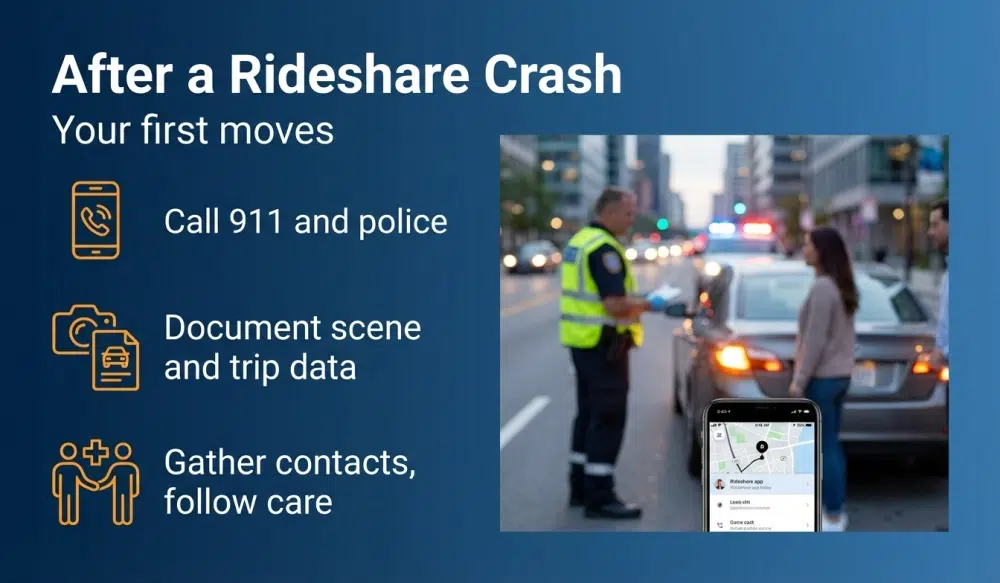
- Call law enforcement to create an official report. Request the report number and later obtain a copy.
- Gather information including driver names, contact details, license plates, and insurance information for every involved vehicle.
- Document the scene with photos and video of vehicle positions, debris, skid marks, traffic controls, and visible injuries.
- Save the trip data by taking screenshots of the rideshare app showing the driver, route, time, and trip status.
- Identify witnesses and politely ask for names, phone numbers, and short written statements if they are willing.
- Follow medical advice and keep all bills and records together to support your claim.
Federal safety guidance offers a helpful checklist for what to do after a crash, including documentation and next steps that can protect your health and claim [13].
What evidence helps most in an Uber or Lyft accident claim?
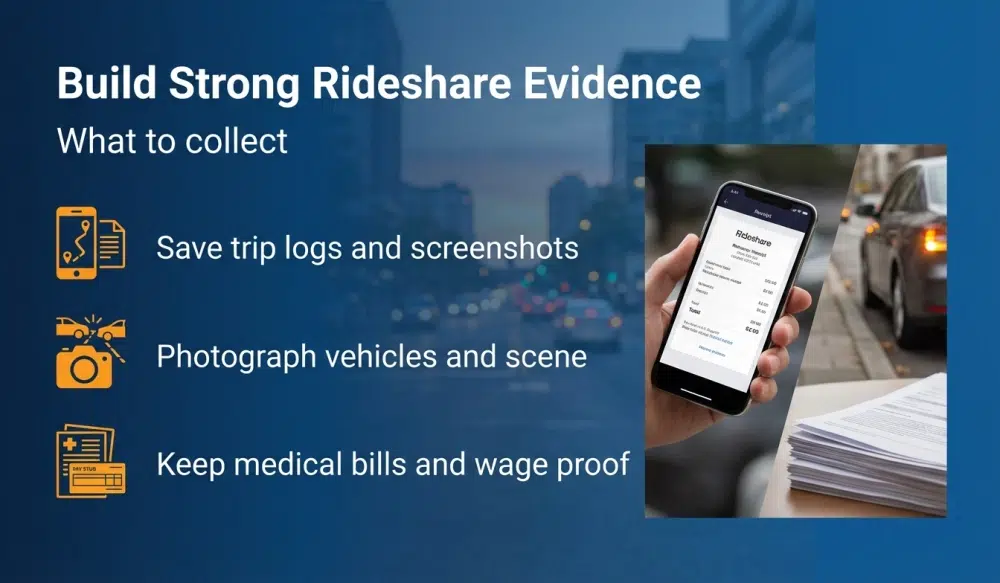
Evidence wins cases. In rideshare claims, consider building a file with the following:
- Trip data such as app screenshots, email receipts, and any in app communications confirming pickup and drop off points.
- Vehicle and scene photos showing angles, impact points, traffic lights or signs, and road conditions.
- Vehicle damage estimates and repair invoices that correlate with the mechanics of injury.
- Medical records from the emergency department, primary care, specialists, and physical therapy, including imaging and lab results.
- Employment and wage proof including pay stubs, employer letters, and tax documents to support lost income claims.
- Witness statements with contact information for later verification.
On the defense side, counsel often seeks pre incident medical histories, prior claims, and social media posts to test credibility and causation. Both sides should act promptly to preserve relevant records. Timely preservation by all parties supports fair adjudication and can reduce disputes about what happened.
How does jurisdiction work for nationwide rideshare claims?
Most rideshare injury suits are filed in state courts where the crash happened. However, if the plaintiff and defendant are citizens of different states and the amount in controversy meets federal thresholds, the case may be filed in or removed to federal court under diversity jurisdiction. Federal courts handle a substantial share of civil cases with parties from different states and claims exceeding the jurisdictional requirement, but state substantive law on negligence and damages typically still applies in those diversity cases [14].
Practical considerations also affect filing decisions. Convenience to witnesses, the availability of treating physicians to testify, and the applicable jury pool are real world factors both plaintiffs and defendants consider when choosing or contesting a forum.
Which related practice areas and issues often overlap with rideshare cases?
Because rideshare crashes occur on public roads, many issues mirror those in other motor vehicle cases. If your injury also involves a multi vehicle pileup with a commercial tractor trailer, principles from trucking cases may apply. If a defective component contributed to the injury, product liability concepts may be relevant. For many injured passengers or drivers, guidance from car accident lawyers is highly relevant to evaluating liability, proving damages, and organizing a strategy that fits the state rules that apply to your case.
When injuries are significant or involve long term treatment, many people consider working with accident lawyers who regularly coordinate with medical providers, economists, and where appropriate, rehabilitation specialists. This coordinated approach can help align documentation with the forms and standards insurers use to evaluate claims, which can make your presentation clearer and more persuasive.
How do Uber insurance coverage and Lyft insurance policy limits affect your recovery?
Insurance limits set the ceiling for most recoveries. If a negligent driver carries only the minimum limits that apply when they are logged into the app but have not accepted a ride, the available coverage may be lower than the limits that apply when a passenger is in the vehicle. In California, for example, the difference between the waiting period and the active trip period is large and can change the entire valuation of a claim [5] [6]. Texas and Illinois set similar period based structures with their own numbers and definitions [7] [8].
If you are a rideshare passenger injured by another driver, that driver’s liability coverage usually applies first. If the other driver is uninsured or underinsured and your state allows it, rideshare policies may include uninsured or underinsured motorist coverage that can come into play. Coordinating primary and secondary coverage can be complex, so it is common for both sides to exchange insurer information early and confirm coverage letters in writing.
Who is liable in Uber accidents and how do passenger or driver claims differ?
Passenger claims often focus on the conduct of the rideshare driver and any third party drivers. Because passengers rarely share fault, their claims often turn on the severity of injury, medical causation, and available coverage. Rideshare driver claims often look like traditional motor vehicle claims unless the driver’s own negligence contributed. If you are a driver for a rideshare platform and another motorist hits you during a trip, your claim against that third party proceeds like any other crash, but you may also have access to additional coverages tied to your app status as defined by state law [5] [7] [8].
Can you sue the rideshare company after an accident, or do you only sue the driver?
In many cases, claims are pursued against the at fault driver and the insurer that covers the relevant period. Whether a rideshare company is named as a defendant depends on the facts and state law. Some claims also include negligent hiring or retention theories or focus on how a platform handled safety flags. Because rideshare drivers are generally treated as independent contractors rather than employees, the doctrine of respondeat superior does not automatically apply in the same way it would for a traditional employer employee relationship, though your state’s statutes and case law will control [4].
What factors most affect settlement value in Uber and Lyft claims?
- Liability clarity supported by photos, video, crash report, and witness statements.
- Medical proof including imaging, diagnosis, prognosis, and consistent treatment.
- Economic losses such as documented wage loss and future earning impact.
- Policy limits for the at fault party and any additional coverage available.
- Comparative fault in states where shared blame reduces recovery [12].
- Venue including local jury tendencies and scheduling conditions.
Negotiations usually improve when both sides exchange the essential documentation early and address any disputes about medical causation with objective references to records and imaging. If settlement does not occur, filing suit keeps the claim moving and allows depositions and expert discovery.
What statistics put rideshare injury risks in perspective?
Nationwide motor vehicle data provide useful context. Recent federal reports estimate high levels of fatalities and injuries on United States roadways. While causes vary, common factors include impaired driving, distraction, and speed. This backdrop shows why even seemingly low speed collisions can have serious consequences, particularly for vulnerable passengers or those with pre existing conditions that can be aggravated by a crash [1]. The public health impact is large, with billions in costs from medical care and lost productivity each year [2].
How does GoSuits help with Uber and Lyft accident claims across the United States?
GoSuits is a personal injury firm that represents injured people and families in rideshare and other motor vehicle cases nationwide. If you were hurt in an Uber or Lyft crash, a free consultation can help you understand your rights, deadlines, and what evidence to gather. Our team explains how your state’s rules work, which insurers to notify, and how to organize medical records and wage proof for a clear presentation.
We practice nationwide and handle cases across the United States from intake through resolution. We built an exclusive proprietary software platform that organizes claims data, medical records, images, and timelines so we can move cases forward faster and with greater clarity. This technology driven approach reflects our leadership in innovation, yet every client has a designated attorney and unfettered access to that attorney. We do not use case managers to stand between you and your lawyer. You will always be able to reach the attorney responsible for your case.
Our trial experience matters when negotiations stall. We prepare each case as if it may be tried, which helps us identify strengths and address weaknesses early. Over the years, we have secured meaningful results for clients in a range of injury cases. You can review a selection of our past outcomes here: prior cases.
To learn about who will represent you and how we approach strategy and communication, meet the team here: our attorneys. For more about our values, client service, and technology platform, visit about us. To see the full scope of what we do, including rideshare, car, truck, motorcycle, construction, premises, product, and property damage matters, explore our practice areas. We bring 30 years of combined experience to negotiating with insurers, preparing for litigation, and presenting evidence in court when necessary.
If your case involves a Lyft accident attorney or an Uber accident lawyer, we coordinate claim notices, gather and preserve app data, and build the record with your treating providers. Our nationwide rideshare accident lawyer team uses our platform to keep you informed in real time, and we stay trial ready when that is the best path to a fair result.
References and resources
- Traffic Safety Facts 2022 Overview – NHTSA
- Costs of Motor Vehicle Crash Injuries – CDC
- Negligence – Legal Information Institute
- Respondeat superior – Legal Information Institute
- California Public Utilities Code section 5433 – California Legislature
- California Public Utilities Code section 5434 – California Legislature
- Texas Insurance Code Chapter 1954 Transportation Network Companies – Texas Legislature
- 625 ILCS 57/25 Insurance – Illinois General Assembly
- California Code of Civil Procedure section 335.1 – California Legislature
- Texas Civil Practice and Remedies Code section 16.003 – Texas Legislature
- 735 ILCS 5/13-202 Personal injury actions – Illinois General Assembly
- Comparative negligence – Legal Information Institute
- What To Do After a Crash – NHTSA
- Civil Cases Overview – United States Courts