- Which law firms handle scooter and e-bike accident claims in U.S. cities?
- How should you choose an electric scooter accident lawyer or e-bike accident lawyer?
- How do civil scooter and e-bike claims work and who can be liable?
- What laws and deadlines apply at the federal level and in California, Texas, and Illinois?
- How do insurance and uninsured or underinsured motorist scooter claims work?
- What evidence helps win urban scooter accident claims?
- How are damages calculated in micromobility accident claims?
- How do product defect claims differ from driver negligence claims?
- What if a family member died after a scooter or e-bike crash?
- How long do scooter accident cases take and what are the typical steps?
- What are quick answers to common city micromobility questions?
- How can GoSuits help with your urban scooter or e-bike case?
- References and resources
Which law firms handle scooter and e-bike accident claims in U.S. cities?
In most U.S. cities, scooter and e-bike crash cases are handled by firms that focus on personal injury, traffic collisions, and product liability. The right fit depends on the facts. If you were hit by a car while riding a scooter or e-bike, a firm that regularly handles urban roadway collisions can handle driver negligence, insurance coverage, and municipal rules. If a defective scooter part or battery contributed to the incident, product-focused teams with experience in design, manufacturing, or warnings claims can evaluate a potential product case.
Because micromobility devices operate in traffic, sidewalks, and bike lanes, your lawyer should be comfortable with local ordinances, state vehicle codes for scooters and e-bikes, and insurance policies that may include auto, commercial, rideshare, or homeowners coverage. Many potential clients search for an electric scooter accident lawyer, e-bike accident lawyer, or scooter accident attorney with urban experience, and firms that litigate crosswalk collisions, delivery rider crashes, and bike lane incidents often handle these cases.
Urban caseloads vary by city, but the demand is clear. Public safety agencies have documented rising micromobility usage and injuries over recent years, and major metropolitan areas have expanded bike lanes and pilot programs that interact with scooters and e-bikes every day [1]. In Austin’s multi-agency study, researchers found roughly 20 injuries per 100,000 e-scooter trips during the study period, highlighting the real risks users face in dense urban corridors [2].
Firms that handle these matters typically coordinate with investigators and consult publicly available crash data. They also navigate claims against drivers, businesses, property owners, and sometimes manufacturers, depending on what went wrong. You will often see city-focused teams position themselves as a micromobility injury lawyer that handles urban scooter accident claims, including Bird or Lime incidents where third-party negligence may be involved.
How should you choose an electric scooter accident lawyer or e-bike accident lawyer?
Your choice can affect investigation speed and claim value. Use a structured checklist that fits your case and city.
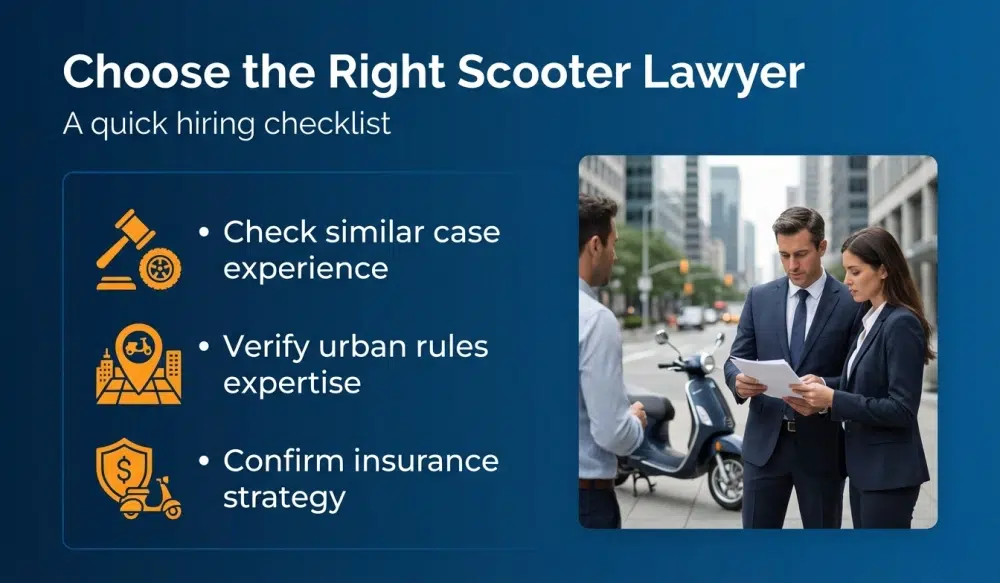
- Case focus and similar fact patterns: Ask whether the firm regularly handles scooter-pedestrian collisions, bike lane sideswipes, intersection crashes, or delivery rider e-bike accidents. Similar fact patterns usually mean quicker issue spotting.
- Urban rules and state statutes: City programs and state codes govern helmets, sidewalks, bike lanes, lighting, and device classes. A team that cites the applicable sections and can explain how they apply to your facts adds clarity [3] [4] [6] [10] [11].
- Insurance strategy: Urban cases often involve multiple insurers. Look for a plan that accounts for auto liability, UM or UIM, rideshare or commercial policies, and property coverage, with a litigation track if negotiations stall [9] [14].
- Product defect screening: If a brake, fork, throttle, tire, or battery malfunctioned, ask how the firm screens for design or manufacturing defects and preserves the device for testing [15].
- Client communication: Urban cases evolve quickly due to city notices, camera footage retention windows, and medical scheduling. Ask about frequent updates and direct access to the attorney handling your file.
- Trial readiness: Timelines, motions, and expert workups move differently in busy dockets. Trial experience can influence insurers’ risk calculations.
- Fee clarity: Many personal injury firms offer contingency fee arrangements. Ask how costs are advanced and reimbursed, and how lien negotiations for medical bills are handled.
For roadway collisions involving devices, some people first contact car accident lawyers because those teams routinely litigate intersection and crosswalk claims. If your crash involved a turning driver or road hazard in a bike lane, that experience often translates to scooter and e-bike cases.
How do civil scooter and e-bike claims work and who can be liable?
Most cases are civil negligence or product liability claims. Liability depends on who failed to act with reasonable care and whether a defect contributed to the injury.
- Drivers and vehicle owners: A driver who runs a red light, fails to yield in a crosswalk, opens a door into a bike lane, or passes too closely may be liable for injuries to a scooter or e-bike rider. Vicarious liability may apply to owners or employers when the driver was in the course of employment.
- Commercial entities: Delivery companies, contractors blocking bike lanes, or property owners who create dangerous sidewalk conditions can share fault. City permits and right-of-way rules can be relevant evidence.
- Municipalities: Some claims involve dangerous roadway designs or defective signals. Notice requirements and immunities may apply. Deadlines are often shorter, so early notice is crucial.
- Manufacturers and distributors: Defects in brakes, steering, frames, tires, throttles, batteries, or software can support product claims, including design, manufacturing, or failure-to-warn theories [15].
- Comparative fault: If a rider or pedestrian shares responsibility, states apply different comparative negligence rules that affect recovery. California, Texas, and Illinois rules are discussed below [8] [11].
Claims generally proceed through investigation, insurance notice, medical documentation, settlement negotiations, and if needed, filing suit. City cases often involve multiple data sources, including municipal camera requests, 311 records, scooter GPS data when available, and business footage from nearby storefronts.
Because scooters and e-bikes share roadways with cars and trucks, many injured riders look to car accident lawyers for roadway negligence litigation, while product issues are commonly evaluated by product liability lawyers for potential defect claims. Coordinating these two tracks early preserves important evidence and can improve leverage if multiple defendants share responsibility.
What laws and deadlines apply at the federal level and in California, Texas, and Illinois?
There is no single federal scooter statute governing everyday operation in cities. States and cities set most rules on where and how you can ride. Federal sources are still useful for safety trends and engineering guidance. For example, the U.S. Consumer Product Safety Commission has tracked micromobility injuries and issued safety resources for e-scooters and e-bikes [1].
What California rules matter for scooters and e-bikes?
- Motorized scooters: California Vehicle Code section 21235 includes operation rules for scooters, such as lane positioning, carrying items, and device requirements like lighting, with important exceptions and local control possibilities [3].
- E-bike classes: California’s three-class system for e-bikes appears in Vehicle Code section 312.5, which defines low-speed electric bicycles and their classes. Classes 1 and 2 assist up to 20 mph, Class 3 up to 28 mph, with rules varying by class and location [4].
- Deadline: Most personal injury claims must be filed within two years under Code of Civil Procedure section 335.1, subject to exceptions, including government claims that can have shorter notice requirements [5].
Helmet use, sidewalk riding, and bike lane rules can vary by city. A case-specific review of local ordinances is often necessary. California riders and pedestrians who are injured frequently consult motorcycle accident lawyers when crashes involve two-wheel stability and driver visibility issues at intersections and in bike lanes, even if the device is not a motorcycle.
What Texas rules matter for scooters and e-bikes?
- General operation: The Texas Transportation Code includes Chapter 551, which governs the operation of bicycles and certain low-speed devices. Local ordinances may supplement these rules for sidewalk use and speed zones in specific corridors [6].
- Deadline: Most personal injury claims must be filed within two years under the Texas Civil Practice and Remedies Code section 16.003, with different notice rules for claims against governmental units [7].
- Comparative responsibility: Texas proportionate responsibility rules reduce or bar recovery depending on a claimant’s percentage of fault. Recovery is barred at greater than 50 percent responsibility under Chapter 33 [8].
For roadway crashes involving scooters or e-bikes and motor vehicles, many Texans reach out to car accident lawyers in Texas to navigate driver negligence, insurance coverage, and proportionate responsibility issues that are common in intersection and crosswalk cases.
What Illinois rules matter for scooters and e-bikes?
- E-bike classes: Illinois adopted a three-class e-bike framework that defines low-speed electric bicycles at 625 ILCS 5/1-140.10 and sets operation rules in 625 ILCS 5/11-1516 [10] [11].
- Deadline: Most personal injury claims must be filed within two years under 735 ILCS 5/13-202, with special notice rules for certain public entities [12].
- Comparative negligence: Illinois follows modified comparative negligence under 735 ILCS 5/2-1116. Damages are reduced by the plaintiff’s percentage of fault, and recovery is barred if the plaintiff’s fault exceeds 50 percent [13].
Local ordinances, pilot programs, and bike network plans in cities like Chicago influence where and how scooters operate, including slow zones and restricted areas. After a collision in a bike lane or crosswalk, riders sometimes speak with motorcycle accident lawyers in Illinois to leverage two-wheel roadway litigation experience in similar visibility, duty, and speed-control disputes.
How do insurance and uninsured or underinsured motorist scooter claims work?
Insurance coverage is often the most complex part of urban scooter and e-bike claims. Several policies can apply.
- At-fault driver liability: If a driver causes a crash, their auto liability coverage is the first target. Evidence of fault and injury documentation drive settlement value.
- Uninsured and underinsured motorist coverage: If the at-fault driver lacks adequate coverage, UM or UIM benefits under your auto policy can apply in many scenarios. State-specific rules and definitions matter. In Texas, UM and UIM coverages are addressed by the Department of Insurance’s consumer materials and state law, and claims must satisfy policy conditions like prompt notice and cooperation [9]. In California, Insurance Code section 11580.2 governs uninsured motorist coverage, including procedures for arbitration and limits [14].
- Rideshare and delivery insurance: If the at-fault driver was driving for a platform, there may be third-party liability policies that apply depending on whether the driver was en route, online but waiting, or offline.
- Commercial and property coverage: If a business vehicle, construction site, or unsafe premises contributed, commercial general liability or premises coverage can factor into recovery.
- Homeowners or renters coverage: In pedestrian collisions caused by non-vehicle negligence, personal liability coverage can be relevant.
Policy definitions for covered vehicles and exclusions can be nuanced for scooters and e-bikes. Where facts implicate both driver negligence and potential mechanical failure, it is prudent to pursue both tracks. Product defect investigations proceed separately from third-party liability coverage and may be litigated in different venues.
Because these cases cross automobile and product issues, many clients consult car accident lawyers for driver fault claims and product liability lawyers for equipment defects, coordinating both efforts to protect all sources of recovery.
What evidence helps win urban scooter accident claims?
You can strengthen your case by documenting hazards, injuries, and device condition quickly. City infrastructure and the device itself are both crucial.
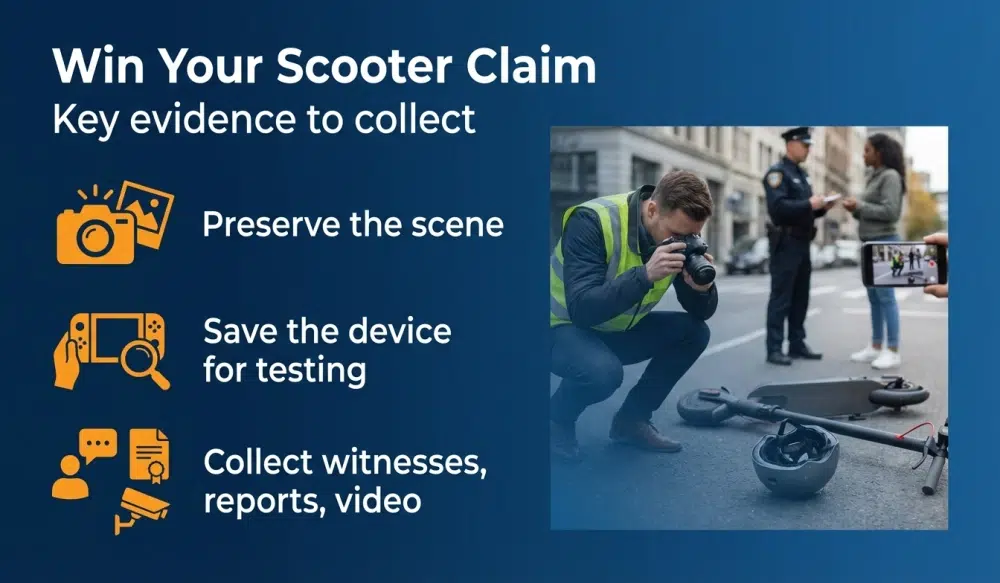
- Scene preservation: Photograph lanes, debris, potholes, signage, construction barriers, and skid or scrape marks. Request nearby store or transit camera footage promptly, since recordings can be overwritten within days.
- Device retention: Preserve the scooter or e-bike. Do not repair or dispose of it. Secure the battery, controller, tires, frame, and any broken components for inspection. This is vital for potential product claims [15].
- Witnesses and reports: Collect names and contact details of witnesses. Obtain incident numbers from local law enforcement or transit police. For delivery rider collisions, keep dispatch or platform logs.
- Medical documentation: Seek evaluation and follow treatment plans. Link symptoms to the incident. The CDC’s urban study highlights head injuries and the importance of early care in scooter incidents [2].
- Helmet and visibility: If you wore a helmet or had lights and reflectors, document that. Jurors consider visibility and reasonable safety steps, even when not legally mandated in every location.
- Trip, GPS, and telematics: Preserve app trip data and screenshots. Some platforms record route and time stamps that can support liability and timing disputes.
How are damages calculated in micromobility accident claims?
Compensation in civil cases typically includes economic and non-economic losses supported by records and testimony. The framework is similar to other roadway injury cases but must be tailored to micromobility contexts.
- Medical expenses: Emergency care, imaging, surgery, rehabilitation, therapy, prescription costs, and future care. Urban scooter and e-bike injuries often involve fractures and head injuries that require follow-up care, as seen in city public health data [2].
- Lost income: Time off work, reduced hours, missed gigs, delivery platform downtime, and diminished earning capacity when injuries limit riding or standing for prolonged periods.
- Property damage: The scooter or e-bike itself, safety gear, phone mounts, and clothing.
- Pain and suffering: Physical pain and emotional distress. Proof can include journals, family testimony, and therapist notes.
- Loss of consortium and wrongful death damages: Where applicable, spouse and family claims are considered under state law. See the wrongful death section below for state-specific rules.
Most settlements reflect liability strength, comparative fault, medical documentation, and insurance limits. City-specific speed limits, signage, and lane markings can influence how fact-finders allocate fault. In disputes about rider conduct, firms sometimes draw on the courtroom experience of motorcycle accident lawyers to explain two-wheel dynamics such as visibility, stopping distance, and door-zone hazards to adjusters or juries.
How do product defect claims differ from driver negligence claims?
Product liability claims involve allegations that the scooter or e-bike had a design, manufacturing, or warnings defect that made it unreasonably dangerous. The proof and defendants differ from driver cases.
- Defect theories: Design claims allege a safer feasible alternative design existed. Manufacturing claims allege a deviation from specifications in a particular unit or batch. Failure-to-warn claims allege inadequate instructions or warnings about foreseeable uses and risks [15].
- Proof: Preservation of the device is essential. Engineers may test brakes, forks, stems, throttles, controllers, and batteries. Photographs and maintenance records matter, including for shared devices.
- Causation: Plaintiffs must link the defect to the crash. If a brake cable snapped or the throttle stuck before impact, that supports defect causation. If a driver ran a red light, defect causation is less likely unless a separate defect worsened the injury.
- Defendants: Manufacturers, suppliers, distributors, and sometimes software vendors. Retailers can be defendants under some state laws.
- Overlap with negligence: Many cases include both driver negligence and product claims. Coordination helps avoid inconsistent positions and preserves all defendants’ data.
When equipment failure is suspected, people often consult product liability lawyers for testing and defect theories while another team presses the roadway negligence claim. This dual approach is common for e-bike fork failures, throttle malfunctions, and battery thermal events.
What if a family member died after a scooter or e-bike crash?
Wrongful death claims allow eligible family members to seek compensation for losses after a fatal incident. States differ on who may file and which damages are available.
- Eligibility and damages: Spouses, children, and sometimes parents can recover damages like loss of companionship, support, and funeral expenses, depending on state statutes.
- Deadline: Filing deadlines often match or are related to general injury limitations periods. California sets a two-year deadline for wrongful death in most cases, with earlier notice requirements when the claim involves a public entity [5]. Texas and Illinois generally follow two years, subject to exceptions [7] [12].
- Fault allocation: Comparative negligence rules still apply and may reduce recovery in proportion to the decedent’s fault, subject to state thresholds [8] [13].
Families typically reach out to wrongful death lawyers to manage notice requirements, probate considerations, and high-stakes litigation. In California, survivors sometimes work with wrongful death lawyers in California who are familiar with municipal claims procedures when a city vehicle or roadway condition is involved.
How long do scooter accident cases take and what are the typical steps?
Timelines vary with injuries, liability disputes, and the number of insurers or defendants. A straightforward driver negligence claim can resolve in months, while defect or multi-defendant cases often take longer.
- Immediate safety and notice: Get medical care, preserve the device, and notify insurers. If a government entity may be involved, calendar early notice deadlines.
- Investigation: Collect photos, witness statements, police reports, and camera footage. Download trip data. Request city records such as traffic signal timing charts or maintenance logs when relevant.
- Medical documentation: Continue treatment and collect records and bills. Document activity limitations and time away from work.
- Evaluation: Assess liability and damages, including economic and non-economic losses. Consider whether comparative fault may apply under state law [8] [11] [13].
- Demand and negotiation: Present a demand with supporting evidence to all implicated insurers. Address UM or UIM when applicable [9] [14].
- Filing suit: If settlement is not reasonable within the limitations period, file suit against responsible parties. Discovery, motions, mediation, and trial dates will follow local court schedules.
- Product testing and experts: In defect cases, coordinate inspections and retain qualified experts early to preserve the chain of custody and test protocols [15].
The CDC and city-level data show that head injuries and fractures are common in scooter incidents, which can extend medical timelines and influence case duration [2]. Open communication with your legal team about treatment milestones and functional recovery helps with realistic scheduling and settlement timing.
How can GoSuits help with your urban scooter or e-bike case?
GoSuits handles civil roadway and product claims arising from urban micromobility crashes in U.S. cities. If you were injured on an electric scooter or e-bike, a free consultation can help you understand timelines, insurance paths, and whether your facts support driver negligence, product defect, or both. We practice throughout the United States and coordinate with local counsel where required by state rules.
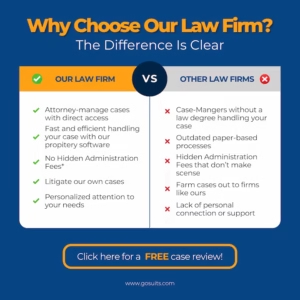
- Technology-driven case building: We use exclusive proprietary software that accelerates evidence collection, organizes medical and damages proof, and flags comparative fault issues early for stronger negotiations.
- Attorney access: Although we leverage technology to move cases faster, every client has a designated attorney with direct access. We do not use case managers, and your lawyer remains your point of contact.
- Proven results: Our litigation teams have secured meaningful recoveries across roadway and product cases. See our prior cases for examples of outcomes and approaches.
- Leadership in innovation: Our software and process automation shorten the distance from intake to demand, while preserving litigation readiness if trial becomes necessary.
- Trial experience: We prepare every claim as if it will be tried. This approach can influence insurer risk assessments and supports better discovery positioning.
- Practice areas: Urban roadway collisions, scooter and e-bike crashes, product defects, premises liability, and serious injury claims. Explore our practice areas for details.
- Team and background: Learn about our attorneys and our firm’s story on the about us page. We bring 30 years of combined experience to complex urban cases.
We commonly represent injured riders, pedestrians, and families in crosswalk scooter crashes, bike lane sideswipes, and equipment failure incidents. For roadway claims involving cars, some clients also consult car accident lawyers for driver-focused litigation. Where equipment malfunction is suspected, our teams coordinate with product liability lawyers to preserve devices, retain experts, and pursue defect theories in parallel. If the crash resulted in a death, our attorneys approach these cases with care and trial readiness.
If you want to discuss your case, reach out for a free consultation. We can review the facts, identify deadlines, and map an evidence plan that fits your city’s rules and the state law that applies.
In addition to scooter and e-bike matters, we frequently litigate multi-vehicle crashes. Some clients also search for truck accident lawyers when heavy vehicles are involved in urban corridors. Coordination across related claims may improve results by aligning discovery and insurer negotiations.
Because urban collisions often involve two-wheel dynamics, some riders also consider working with motorcycle accident lawyers for courtroom explanations of visibility and lane positioning, especially in intersection and dooring disputes.
In the product defect space, complex cases often benefit from product liability lawyers who can analyze design alternatives, manufacturing records, and warnings for devices and components. Where tragedies occur, families often seek guidance from wrongful death lawyers to address eligibility and damages under state law. For Texas cases, coordination with car accident lawyers in Texas and proportionate responsibility rules can be particularly important when insurers raise comparative fault.
References and resources
- Micromobility Products, Injuries, and Safety Information – U.S. Consumer Product Safety Commission
- Dockless Electric Scooter-Related Injuries Study in Austin, TX – Austin Public Health and CDC
- California Vehicle Code § 21235 Motorized Scooters – California Legislative Information
- California Vehicle Code § 312.5 Electric Bicycles – California Legislative Information
- California Code of Civil Procedure § 335.1 Two-Year Limitation – California Legislative Information
- Texas Transportation Code Chapter 551 Operation of Bicycles and Devices – Texas Legislature Online
- Texas Civil Practice and Remedies Code § 16.003 Limitations – Texas Legislature Online
- Texas Civil Practice and Remedies Code Chapter 33 Proportionate Responsibility – Texas Legislature Online
- Auto Insurance Coverages, Including UM/UIM – Texas Department of Insurance
- 625 ILCS 5/1-140.10 Low-speed Electric Bicycle – Illinois General Assembly
- 625 ILCS 5/11-1516 Bicycles, Low-speed Electric Bicycles – Illinois General Assembly
- 735 ILCS 5/13-202 Limitations for Personal Injury – Illinois General Assembly
- 735 ILCS 5/2-1116 Comparative Negligence – Illinois General Assembly
- California Insurance Code § 11580.2 Uninsured Motorist Coverage – California Legislative Information
- Strict Products Liability Overview – Cornell Law School Legal Information Institute