- What should you do immediately after a CTA bus accident in Chicago?
- When do you need a Chicago personal injury lawyer for a CTA crash?
- What laws govern claims against the Chicago Transit Authority?
- How long do you have to file a claim against the CTA in Illinois?
- What evidence helps prove a CTA bus accident injury claim?
- How is fault decided in a CTA bus crash under Illinois law?
- What damages can you seek after a public transportation accident in Chicago?
- How do insurance negotiations work with public transit cases?
- How are claims different for pedestrians, cyclists, or other drivers hit by a CTA bus?
- What if a loved one died in a CTA bus collision?
- What if the bus driver says sudden stop or medical emergency?
- What if roadway design or a third party contributed to the crash?
- Where do you file a CTA lawsuit in Chicago and what happens next?
- What are common mistakes that can hurt your claim?
- How do attorney fees work and can you get a free consultation?
- How does GoSuits approach CTA bus accident cases in Chicago?
- References and Resources
What should you do immediately after a CTA bus accident in Chicago?
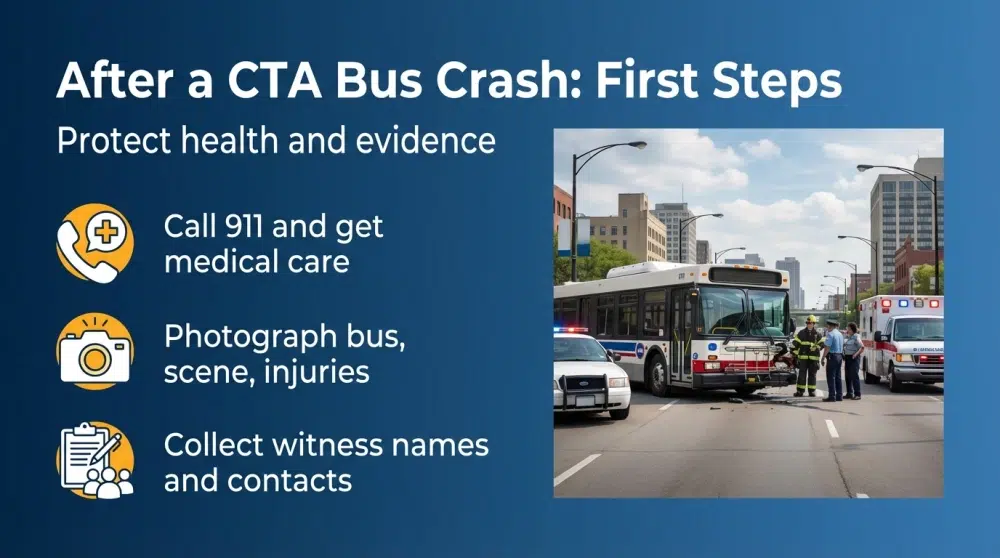
If you were hurt on a CTA bus, or struck by one as a pedestrian, cyclist, or driver, your first priority is your health. Call 911 and request medical care. Many serious injuries are not obvious at the scene, including head injuries and internal injuries. If you can safely do so, take photos of the bus number, location, street signs, damage to vehicles, skid marks, debris, and visible injuries. Ask witnesses for their names and contact information. If you were a passenger, note whether you were seated or standing, whether handrails were available, and whether the driver announced any hazards.
Preserving evidence early protects your rights. Surveillance video, onboard data, and incident reports can be crucial, and these records may be overwritten with time. A prompt written preservation request can help reduce the risk of lost evidence, and Illinois law recognizes claims when parties negligently fail to preserve key evidence under certain circumstances [4]. You can also request public records and footage through the Illinois Freedom of Information Act, which generally requires a response within five business days unless a lawful extension is taken [5].
Even if you feel okay, get evaluated by a doctor as soon as possible. Medical documentation connects your injuries to the incident and helps you track medical bills and lost wages for any future claim. Keep all receipts, discharge papers, and follow-up instructions. Do not provide recorded statements to any insurer before you understand your rights. An early conversation with a Chicago personal injury lawyer can help you avoid missteps that affect fault or damages.
When do you need a Chicago personal injury lawyer for a CTA crash?
You should consider speaking with a lawyer quickly in any case involving injuries, disputed fault, or complex damage questions. Public transportation claims can involve additional rules and shorter timelines compared to claims against private parties. A Chicago bus accident attorney can help you identify all responsible parties, protect evidence, and navigate deadlines that apply to local public entities [1].
Situations that often benefit from legal help include:
- Multiple injured people on the bus or on the street, where evidence and witness accounts need careful coordination.
- Questions about driver conduct such as excessive speed, hard braking, distracted driving, or failure to yield.
- Complex injuries like head trauma or spinal injuries that require specialists and long term care planning.
- Disputed causation where a bus operator claims a sudden stop or unavoidable medical event.
- Potential roadway or vehicle issues such as defective equipment, signal timing, or hazardous work zones that may involve other public or private defendants.
If you are comparing options for broader traffic cases, firms that handle related matters such as Chicago car accident lawyers, Chicago truck accident lawyers, and Chicago motorcycle accident lawyers are often familiar with overlapping rules, medical proof, and negotiation strategies in serious roadway cases. For injuries that are profound, you may also look for Chicago brain injury lawyers, and if a crash leads to a fatality, Chicago wrongful death lawyers. Those teams often coordinate with medical and economic professionals to address long term needs and loss calculations.
What laws govern claims against the Chicago Transit Authority?
Two points of law frame most CTA bus crash cases.
- Common carrier duty in Illinois. Illinois courts have long recognized that common carriers owe their passengers a high degree of care consistent with the practical operation of the service [3]. That standard affects how juries evaluate driver conduct such as acceleration, lane changes, and passenger loading.
- Illinois Tort Immunity Act. Lawsuits against local public entities, including many transit-related claims, follow special timing and liability rules. Most personal injury actions against a local public entity must be commenced within one year [1]. This shorter deadline is a central issue in many CTA bus accident cases.
Illinois also applies standard negligence principles. To recover, you must generally show duty, breach, causation, and damages [12]. In practice, that means proving the operator or another responsible party failed to use reasonable care and that the failure caused your injuries.
The Federal Transit Administration requires each transit agency to maintain a Public Transportation Agency Safety Plan and to track and manage safety risk. These federal safety rules do not set civil liability standards, but they can inform evidence and industry expectations [8]. In addition, transit agencies report safety and security events to the National Transit Database, which helps quantify how many collisions and injuries occur by mode and year across the country [9].
How long do you have to file a claim against the CTA in Illinois?
For most injury claims against a local public entity, Illinois sets a one year statute of limitations measured from the date of the injury [1]. That time limit is significantly shorter than the general two year deadline that often applies to claims against private parties. Missing the one year deadline typically bars the claim, so time is crucial in a CTA bus accident.
You may see references online to a notice of claim CTA. Historically, some public entity claims included pre suit notice requirements. Illinois rules have changed over time and can depend on the specific statute governing the agency. The safest approach is to treat the one year limit under the Illinois Tort Immunity Act as a hard deadline for filing a lawsuit, while also reviewing current statute text for any additional requirements that may apply to a particular defendant [1].
Wrongful death claims and claims involving minors or persons with certain disabilities may follow different accrual or tolling rules under Illinois law. If a family member died in a bus crash, the claim is generally brought by the personal representative under the Illinois Wrongful Death Act, and additional related claims can be brought under the Survival Act [6] [7]. Prompt legal guidance helps confirm the correct deadlines for the specific claim type in Chicago, IL.

What evidence helps prove a CTA bus accident injury claim?
Public transportation accident evidence can be robust, but it must be preserved and obtained correctly. Useful evidence often includes:
- Onboard video and external camera footage. Many buses capture multiple camera angles that show driver inputs, passenger movement, and surrounding traffic. Early preservation demands are important to avoid deletion cycles [4].
- Incident and operator reports. The transit operator often completes a report with time, route, bus number, and basic facts.
- Vehicle data. Some fleets record speed, braking, and acceleration. Data can clarify whether a hard brake or lane change caused a fall or collision.
- Dispatch and radio communications. These can confirm alerts, delays, or reported hazards.
- Third party videos. Nearby businesses or traffic cameras may capture critical seconds before impact. FOIA requests can be used to request certain public records in Illinois, and the statute sets response timelines and exemptions [5].
- Medical documentation. Emergency records, imaging, specialist notes, and therapy records trace the full scope of injury and recovery. This is essential for medical bills and lost wages.
- Employment records. Payroll, time off, and HR documents support wage loss and reduced earning capacity claims.
Illinois recognizes claims based on negligent spoliation in certain circumstances when key evidence is lost or destroyed in breach of a duty to preserve it, which can alter how courts handle proof and remedies [4]. Sending timely preservation letters and coordinating requests with FOIA and discovery can help maintain a complete evidentiary record.
How is fault decided in a CTA bus crash under Illinois law?
Illinois uses modified comparative negligence. A plaintiff can recover damages reduced by their share of fault as long as that share does not exceed 50 percent. If a plaintiff is more than 50 percent at fault, recovery is barred [2]. In practice, juries assign percentages of responsibility to the bus operator, other drivers, pedestrians, cyclists, and occasionally the injured passenger.
Key fault questions in CTA accidents include:
- Driver conduct. Did the driver keep a proper lookout, yield to pedestrians in crosswalks, and adjust speed to traffic and weather conditions?
- Passenger handling. Did the driver wait for passengers with mobility challenges to be seated, and were handholds available for standing riders?
- Traffic control and signals. Were signals functioning, and was the operator obeying them?
- Third party drivers. Did a cut off or sudden lane change by another vehicle force the bus into a hard brake?
- Injury causation. Can medical evidence connect the mechanism of the crash to the injury complaints?
For passengers, Illinois case law on common carrier negligence highlights the high care standard carriers owe to riders consistent with the practical operation of the service [3]. For people outside the bus, standard negligence principles apply, and juries compare fault across every party involved.
What damages can you seek after a public transportation accident in Chicago?
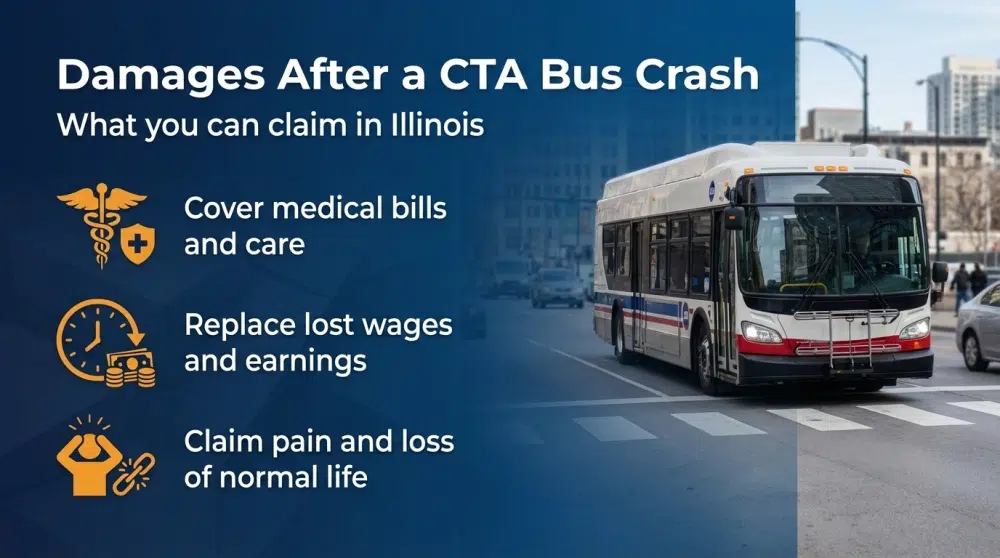
Illinois law allows injured people to claim economic and non economic damages where liability is proven. In a CTA bus accident, recoverable damages can include:
- Medical bills for emergency care, hospital stays, specialists, surgery, therapy, and medical equipment.
- Future medical needs for continuing treatment, home modifications, or assistive devices for long term injuries.
- Lost wages and reduced earning capacity if injuries limit work or require job changes.
- Pain and suffering, loss of normal life, and other non economic harms recognized by Illinois law.
- Property damage for personal items and vehicles.
If the crash resulted in a fatality, the Illinois Wrongful Death Act permits recovery of pecuniary injuries for surviving next of kin and related damages, and the Survival Act allows certain claims the decedent could have brought to continue through the estate [6] [7]. Tax questions may arise for certain categories of compensation. Under federal law, compensatory damages for personal physical injuries or sickness are generally excluded from gross income, while other categories can be treated differently. You can review Internal Revenue Code section 104 for the baseline rule [15].
How do insurance negotiations work with public transit cases?
Claims against a public transit agency often involve risk management departments and third party administrators rather than a standard consumer auto insurer. Process and timelines can differ from private claims. Early documentation helps support your position in negotiations, and complete medical records, wage evidence, and clear proof of fault are especially important where comparative negligence arguments may reduce recovery [2].
Many cases resolve through direct negotiation or mediation. Others require filing in court, engaging in discovery, and preparing for trial. Transit operators also track and analyze safety performance under federal safety planning rules, which can influence internal procedures and training [8]. If settlement talks stall, a seasoned Chicago Transit Authority injury lawyer can develop a litigation plan while continuing to evaluate fair resolution options.
How are claims different for pedestrians, cyclists, or other drivers hit by a CTA bus?
People outside the bus often suffer direct impact injuries. For these cases, liability can be shared among the bus operator and other drivers, especially at busy intersections, during turns, or near bus stops. Useful proof includes intersection videos, vehicle damage patterns, bicycle damage, helmet damage, and pedestrian right of way rules at the location.
Cyclists should document visibility gear, lane position, and hand signals as applicable. Pedestrians should note crosswalk status and any signals or walk indicators. Other drivers should preserve dashcam video and vehicle event data where available. Because Illinois comparative negligence reduces damages in proportion to your share of fault and bars recovery above 50 percent, careful evidence development is essential [2].
If you or a family member suffered severe injuries, consider contacting Chicago personal injury lawyers who routinely handle roadway claims. For cross over issues involving heavy vehicles and commercial policies, Chicago truck accident lawyers can be helpful when a collision involves both a bus and a commercial truck in Chicago, IL.
What if a loved one died in a CTA bus collision?
Family members face a difficult time after a fatal crash. Under the Illinois Wrongful Death Act, a personal representative brings the claim for the benefit of surviving next of kin, and damages can include loss of financial support, services, and society [6]. The Survival Act allows recovery for certain conscious pain and suffering and other claims that accrued before death [7]. The one year deadline for local public entities requires quick action to preserve the case [1].
In these cases, working with Chicago wrongful death lawyers can help families coordinate probate filings, identify all defendants, and prepare a full damages presentation with economic and grief evidence in compliance with Illinois law.
What if the bus driver says sudden stop or medical emergency?
Two defenses that appear frequently in bus cases are the sudden stop defense and the medical emergency defense.
- Sudden stop. Transit buses must brake and maneuver in traffic, and not every abrupt movement is negligence. However, a stop that is unnecessarily hard or caused by inattention may support a claim. Onboard video, braking data, and witness testimony usually decide these disputes. For passengers, the high degree of care carriers owe under Illinois law is part of the analysis [3].
- Medical emergency. If a driver experiences an unforeseeable medical event that causes loss of control, liability may be limited. Medical records, driver history, and pre trip fitness questions can be important where this defense is raised.
When defenses are asserted, technical evidence often becomes central. Preservation of vehicle data and prompt requests for video can be decisive. Negligent spoliation principles may also be implicated if vital records are lost in breach of a preservation duty [4].
What if roadway design or a third party contributed to the crash?
Some CTA bus accidents involve overlapping fault among multiple parties.
- Roadway design or maintenance. Timing of signals, signage, work zones, and road surface defects can contribute to a collision. Claims may involve contractors or other governmental entities that designed or maintained the location.
- Vehicle or equipment issues. Defective doors, brakes, or tires may involve product manufacturers. These claims often require engineering experts and detailed maintenance records.
- Other drivers. A private driver may cut off a bus or run a red light, shifting part of the blame. Comparative negligence allows fault to be divided among all responsible parties [2].
When multiple defendants are involved, filing a complete complaint that names every responsible party is important to preserve your right to full recovery within the one year deadline for local public entities [1]. Discovery can then sort out relative fault and financial responsibility.
Where do you file a CTA lawsuit in Chicago and what happens next?
Most CTA injury lawsuits are filed in the Circuit Court of Cook County, which serves Chicago and nearby municipalities. The court provides public information about divisions, locations, and procedures [11]. Illinois uses statewide e filing for civil cases, including personal injury matters, with procedures and guidance available from the Illinois Courts website [10].
After filing, the typical steps are:
- Service of the complaint and summons on defendants.
- Responsive pleadings, where defendants may answer or raise defenses.
- Discovery, including written questions, document requests, subpoenas, and depositions. Preservation and production of bus video and data are key issues during this phase.
- Motions, such as summary judgment, contesting liability or damages.
- Mediation or settlement conferences to evaluate resolution.
- Trial if no agreement is reached. Trial preparation includes exhibits, medical testimony, and private or public records produced through discovery or FOIA [5].
Federal courts publish general resources on civil litigation stages that can be helpful for orientation even though your claim proceeds in Illinois state court [13]. Your Chicago Transit Authority injury lawyer can explain local rules, timelines, and strategic options in detail.
What are common mistakes that can hurt your claim?
We see several avoidable errors in CTA bus injury cases:
- Waiting too long and missing the one year lawsuit deadline for claims against a local public entity in Illinois [1].
- Not preserving evidence, especially bus video and vehicle data, or failing to request nearby camera footage before it is overwritten. Spoliation issues can complicate proof [4].
- Giving recorded statements to an insurer or risk management office without understanding comparative negligence and how statements can be used against you [2].
- Stopping medical care early, creating gaps in treatment that undermine causation.
- Overlooking third party fault, which can reduce your recovery if not properly pled within the deadline.
Coordinated legal help can reduce these risks. For collisions that also involve automobiles, Chicago car accident lawyers and Chicago personal injury lawyers frequently work together on overlapping issues like medical proof, wage loss, and settlement planning.
How do attorney fees work and can you get a free consultation?
In most injury cases, lawyers use a contingency fee. You pay no upfront attorney fee. The fee is a percentage of the recovery, and you and the lawyer agree on the percentage and case costs in writing at the start. A free consultation lets you ask questions about deadlines, evidence, and strategy, and helps you decide your next steps with clarity.
When you interview a CTA bus accident lawyer or CTA accident lawyer, consider asking:
- What is the plan to preserve bus video and other records and when will preservation letters go out?
- How will fault be analyzed given Illinois comparative negligence? [2]
- What deadlines apply for filing against the CTA or other public entities? [1]
- How will medical bills and lost wages be documented and presented to a claims administrator or jury?
- What are the next steps if negotiations stall and trial becomes necessary?
In more complex roadway collisions, you may also speak with Chicago truck accident lawyers or Chicago motorcycle accident lawyers if the crash involved multiple vehicle types or policies.
How does GoSuits approach CTA bus accident cases in Chicago?
GoSuits focuses on helping people injured in Chicago, IL navigate the path after a CTA bus accident. A free consultation gives you a chance to share what happened, learn about critical timelines, and understand how your claim can move forward. Our practice is centered in Illinois, and we regularly help clients in Cook County and the surrounding area with civil injury matters.
We use a technology driven approach built around our exclusive proprietary software that streamlines case intake, evidence collection, and litigation milestones for faster, better results. While we rely on advanced tools to save time and reduce friction, every client has a designated attorney and unfettered access to that attorney. We do not use case managers in place of lawyers. You can meet the people who will work on your case at our attorneys page and learn more about our values at the about us page. See our prior cases to review past results for clients and the kinds of disputes we have handled. Past results do not predict future outcomes, but they show how we prepare and present cases with care and diligence.
We bring 30 years of combined experience to personal injury litigation. Our team tries cases when necessary, and trial readiness often improves outcomes during negotiation. We handle a wide range of practice areas, including roadway crashes, premises incidents, product liability, and wrongful death. You can explore our full practice areas to see how we can help across different situations.
If you were hurt as a passenger on a CTA bus or as a pedestrian, cyclist, or driver in Chicago, a CTA bus accident lawyer can guide you through preservation of video, claims against public entities, and preparation for negotiation or trial. We are here to listen, explain the process in clear language, and move your claim forward with urgency.
References and Resources
- 745 ILCS 10/8-101 Statute of Limitations for Local Public Entities – Illinois General Assembly
- 735 ILCS 5/2-1116 Modified Comparative Negligence – Illinois General Assembly
- Rotheli v. Chicago Transit Authority, 7 Ill. 2d 172 – CourtListener
- Boyd v. Travelers Insurance Company, 166 Ill. 2d 188 – CourtListener
- Illinois Freedom of Information Act 5 ILCS 140 – Illinois General Assembly
- Illinois Wrongful Death Act 740 ILCS 180 – Illinois General Assembly
- Illinois Survival Act 755 ILCS 5/27-6 – Illinois General Assembly
- 49 CFR Part 673 Public Transportation Agency Safety Plan – eCFR
- National Transit Database Safety and Security Time Series – Federal Transit Administration
- Illinois Courts eFiling Program – Illinois Courts
- Circuit Court of Cook County – Official Court Website
- Negligence Overview – Cornell Law School Legal Information Institute
- Civil Cases Overview – United States Courts
- Illinois Roadway Crash Data – Illinois Department of Transportation
- 26 U.S.C. 104 Compensation for injuries and sickness – Cornell Law School LII