- What is the Los Angeles car crash photo checklist and why does it matter?
- What should you photograph first to stay safe in Los Angeles traffic?
- Which vehicle and property damage photos help most for insurance and court?
- How do you capture the accident scene, road conditions, and traffic controls?
- Should you photograph injuries and how should you do it respectfully?
- What witness and officer information should you document with photos?
- Which documents should you photograph after a crash in Los Angeles?
- How do California and federal evidence rules treat accident photos?
- What file formats, metadata, and backup steps preserve your photos?
- What if you could not take photos at the scene in Los Angeles?
- How soon must you report a crash and request the police report in California?
- What common mistakes should you avoid when taking crash pictures?
- How can photos affect liability in rear-end, intersection, and sideswipe cases?
- How do photos support property damage appraisals and diminished value claims?
- How do California, Texas, and Illinois treat crash photo evidence differently?
- What is a printable Los Angeles car crash photo checklist you can save?
- Who can help you use your images effectively in a civil claim?
- Why choose GoSuits for a technology-driven approach to your Los Angeles collision?
- References and Resources
What is the Los Angeles car crash photo checklist and why does it matter?
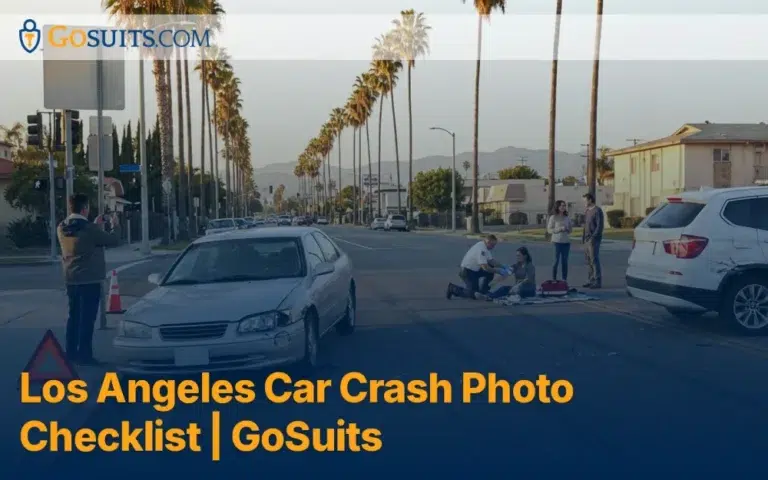
Crashes in Los Angeles happen on freeways, canyon roads, and busy neighborhood streets. Clear, methodical photos can make the difference between an insurance dispute and a documented claim. Photos freeze the position of vehicles, the crush patterns, skid marks, debris, traffic signals, and injuries. Insurers and courts rely on objective images to evaluate fault and damages, and national data confirms that roadway crashes remain a major public safety issue [1]. In California, images can support or rebut a police report’s findings, help reconstruct the collision, and show how road conditions or signal timing contributed [10]. This checklist walks you step by step through the images to capture so you can document the accident scene, protect your rights, and support a civil insurance claim or lawsuit if necessary.
How does this checklist help both plaintiffs and defendants?
Accurate photos help injured people demonstrate liability and damages, and they help drivers accused of fault present context such as evasive maneuvers, sudden hazards, or obscured signs. Under rules of evidence, photos are generally admissible if a witness can authenticate that they fairly and accurately depict what the scene looked like when taken [6] [7]. Because civil claims rely on proof, complete images reduce disputes about what actually happened.
What should you photograph first to stay safe in Los Angeles traffic?
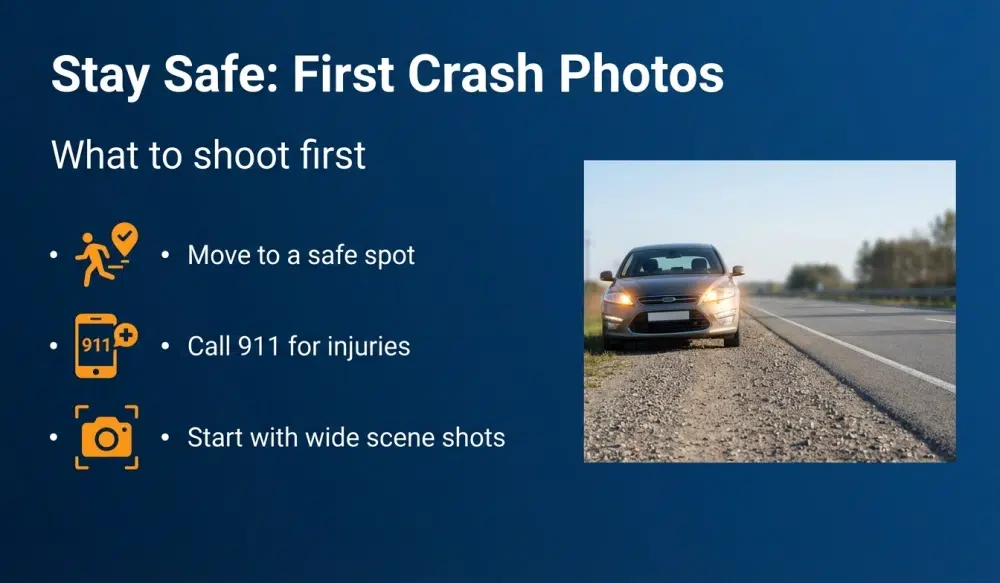
Your safety is the priority. If vehicles can move, get to a safe shoulder or turnout before photographing. If traffic is heavy or visibility is poor, stay out of lanes and wait for officers or flares when needed. Once safe, focus on essentials.
- Call 911 and check for injuries: Health comes first. Photos can wait until it is safe. If injuries exist, medical response takes priority [1].
- Turn on hazard lights: Make your vehicle more visible to approaching drivers.
- Place triangles if available: Only if safe to do so.
- Start with wide shots: Capture the overall scene from several angles before anything changes.
California law requires reporting certain crashes to law enforcement and to the DMV, which means that after safety is addressed, documenting the scene will help complete those reports and answer follow-up questions [3] [4].
Which vehicle and property damage photos help most for insurance and court?
These images show forces, angles, and impact points that are central to liability and damage evaluations.
- Each vehicle’s license plate and VIN: Photograph plates and the driver-side door jamb VIN sticker to identify the vehicles.
- Four corners and sides of each vehicle: Take front, rear, left, and right side shots to show pre-existing damage versus fresh damage.
- Close-ups of primary impact points: Focus on crushed metal, bumper deformation, headlight damage, wheel and suspension hits, and undercarriage scuffs.
- Secondary contacts: Photograph mirror scrapes, quarter panel creases, roof dents, and glass spray patterns that indicate directionality.
- Airbags and interior damage: Show deployed airbags, seatbelt condition, steering wheel damage, shattered windows, and displaced interior panels.
- Property damage beyond vehicles: Photograph guardrails, signs, landscaping, or structures impacted by the crash for property damage photos.
Insurers analyze crush profiles and angles using adjuster guidelines and collision industry methods. Thorough photos allow a fair estimate and may support diminished value claims where appropriate.
How do you capture the accident scene, road conditions, and traffic controls?
The setting often explains why a crash happened. Traffic controls, surface conditions, and sight lines can support or refute negligence arguments.
- Wide scene from multiple corners: Stand at four different corners of the scene for wide shots that show vehicle positions and lane markings.
- Skid marks and yaw marks: Photograph start and end points of tire marks, including measurement references if possible, to suggest speed or braking behavior.
- Debris fields and fluid trails: Capture debris distribution and fluid spill direction to indicate point of impact and post-impact movement.
- Traffic signals and signs: Photograph signal heads, pedestrian signals, stop signs, yield signs, and lane-use signs. Include the signal phase if visible. National standards govern device design and placement, which can matter when signage or visibility is at issue [10].
- Lane markings and road geometry: Show double yellow lines, turn pockets, crosswalks, bike lanes, merge zones, and curvature.
- Obstructions and sight lines: Document overgrown vegetation, parked vehicles, sun glare, and construction barriers that affect visibility.
- Weather and lighting: Capture wet pavement, puddles, fog, and nighttime lighting conditions.
- Work zones: If a work zone exists, photograph signs, cones, taper lengths, and flaggers to preserve the layout.
California investigations often rely on consistent documentation. In many collisions, officers use standard reporting forms and diagrams. Your photos can complement official reports and translate roadway details into visual evidence [11].
Should you photograph injuries and how should you do it respectfully?
Injury photos are sensitive but important for civil claims. Take them only with consent and with care for privacy.
- Obtain permission: If photographing another person, ask first. Focus on the injury and avoid faces when possible.
- Immediate and follow-up images: Photograph bruises, cuts, swelling, abrasions, and immobilization devices promptly and again over days as injuries evolve.
- Use consistent lighting and scale: Include a common object for scale if helpful and avoid harsh shadows.
- Medical devices and restrictions: Document crutches, braces, slings, and wound dressings as indicators of functional impact.
Injury documentation supports medical records and damages evaluation. While photos can be admitted when properly authenticated, medical records and testimony remain crucial pieces of proof [6] [7].
What witness and officer information should you document with photos?
Information often disappears quickly after a crash. Photographing contact and scene details helps avoid transcription errors.
- Driver’s license and insurance cards: Take clear photos of both sides, then verify spelling of names and addresses.
- License plates and vehicle registrations: Photograph plates and any registration documents offered.
- Witness information: With permission, photograph a witness’s business card or a handwritten note showing name, phone, and email.
- Officer information: Photograph the officer’s business card or note their name, badge number, and agency. Ask for the incident or report number for follow-up with the police report.
Later, you may need to request the official collision report from the investigating agency. In Los Angeles, collisions within city limits are typically handled by LAPD, and instructions exist for obtaining a copy of the report after it is processed [5].

Which documents should you photograph after a crash in Los Angeles?
Documenting paperwork supports claims and helps you comply with post-crash reporting duties.
- Exchange information form: Photograph the completed exchange form or handwritten details collected at the scene.
- Traffic citations: If any driver receives a citation, photograph it. A citation is not a civil admission of liability but can be relevant to fault discussions.
- Tow records and invoices: Photograph tow slips and receipts for immediate expenses.
- Medical discharge papers: Photograph emergency room or urgent care discharge instructions as part of your damages file.
- Work absence notes: Photograph employer notes documenting missed time.
How do California and federal evidence rules treat accident photos?
Courts in California and federal court generally require that photos be authenticated and relevant to issues in the case. Relevance is usually straightforward for crash images, and authentication is often done through witness testimony or metadata.
- Authentication: Under the Federal Rules of Evidence 901, a witness with knowledge can testify that a photo is a fair and accurate depiction of the scene when taken. Distinctive characteristics and metadata can also help authenticate [6]. California’s Evidence Code similarly requires authentication before admission [7].
- Public records and police reports: Police reports may be considered hearsay but can fall under public records exceptions in some contexts. Insurers often use them in claim evaluations, though trial admissibility can be limited. California recognizes a public records exception in its Evidence Code [7].
- Spoliation concerns: Destroying or materially altering relevant photos can lead to adverse inference jury instructions in California civil cases, making preservation important [8].
To avoid admissibility disputes, keep original files, preserve metadata, and maintain a simple chain of custody that records how you transferred and stored your images [9].
What file formats, metadata, and backup steps preserve your photos?
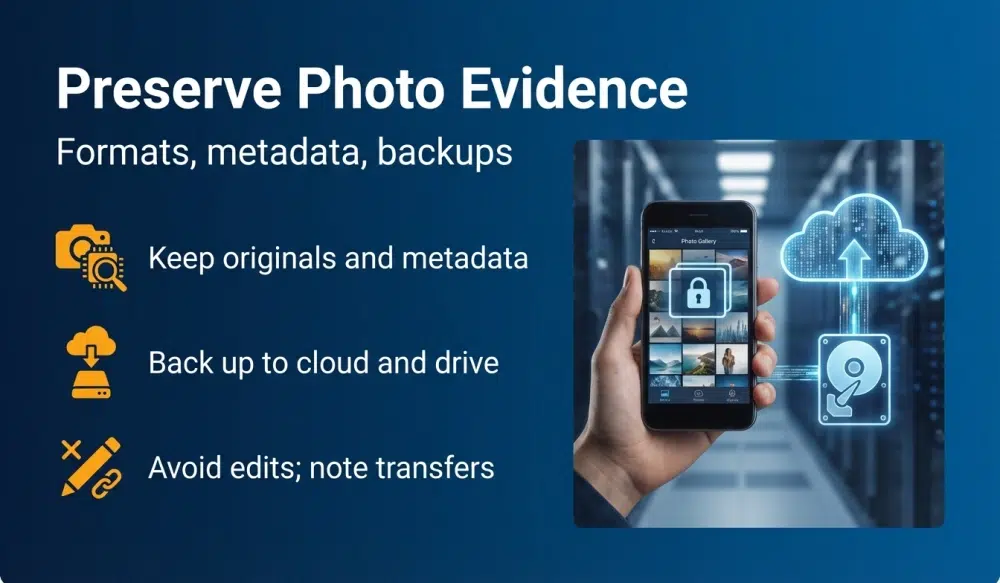
Smartphones create powerful evidence, but only if you preserve the original data.
- Capture settings: Keep your camera timestamp and location services on if safe and legal. These metadata fields can corroborate where and when images were taken [9].
- Use original files: Save the original HEIC or JPEG files. Avoid screenshots or edits that strip metadata.
- Immediate backup: Make at least two backups: a cloud copy and a local copy on a secure drive. Label folders by date and event.
- Do not alter content: Avoid filters, annotations, or cropping on your originals. If you need to mark up copies for your own notes, keep those separately and retain the originals untouched.
- Document transfer: If you send files to an insurer or attorney, note the date, method, and recipient to maintain a clear chain of custody [9].
What if you could not take photos at the scene in Los Angeles?
It happens. Medical emergencies, severe traffic, or lack of daylight can make on-scene photography impossible. You still have options:
- Return promptly: If safe and feasible, return within 24 to 48 hours to photograph the area, traffic signals, sight lines, and any residual marks.
- Photograph the vehicles later: Take comprehensive damage photos at the tow yard or repair facility before repairs begin.
- Request surveillance: Identify nearby businesses or residences that may have exterior cameras. Save timestamps and send prompt preservation requests.
- Request the police report: Obtain the official report and any scene diagrams. In Los Angeles, follow the LAPD request process or, for state-handled collisions, the CHP process [5] [11].
- Avoid social media: Do not post about the collision; public posts are routinely reviewed in civil cases.
How soon must you report a crash and request the police report in California?
California imposes several reporting duties when a crash involves injury, death, or qualifying property damage.
- Law enforcement report: If someone is injured or killed, drivers must report the crash to local police or the California Highway Patrol within 24 hours [3].
- DMV report: You must file a DMV Form SR-1 within 10 days when a crash involves injury, death, or property damage that meets the statutory threshold. The DMV provides instructions for filing and what qualifies [4].
- Obtaining the police report: For collisions investigated by LAPD, you can request the Traffic Collision Report following department procedures after the report is approved and available [5]. For CHP-investigated crashes, the CHP provides forms and guidance tied to its Traffic Collision Report format [11].
These reports often contain officer narratives, diagrams, and involved parties’ statements that insurers consider during liability assessments.
What common mistakes should you avoid when taking crash pictures?
- Standing in traffic lanes: Never risk injury for a photo. Safety first.
- Too few angles: Take wide, medium, and close-up shots from multiple viewpoints to avoid gaps.
- Editing originals: Altered files can raise authenticity questions. Keep originals intact.
- No context: Capture landmarks, street signs, and directional references so reviewers understand the layout.
- Missing time progression: If lighting or traffic patterns matter, revisit at the same time and day of week for comparison shots.
- Delayed backups: Back up immediately to prevent loss.
How can photos affect liability in rear-end, intersection, and sideswipe cases?
Liability often turns on angles, distances, and traffic control devices. Photos can clarify contested facts in common collision types.

How do photos help in a rear-end crash?
Rear-end photos should show bumper heights, hitch presence, crush patterns, and any underride or override indications. Skid length, brake light function, and lane congestion provide context about following distance and reaction time. While traffic citations may be issued, civil fault still depends on the totality of circumstances supported by evidence including images and official records [11].
What matters most in intersection collisions?
At intersections, focus on signal phases, stop line locations, crosswalk placement, and sight obstructions. Photos that capture the sun’s position, tree shadows, or billboard placements at the approximate time of day can help recreate visibility. Traffic control standards help explain device placement and meaning [10].
How do photos clarify lane-change and sideswipe disputes?
Sideswipe cases benefit from linear scrape patterns along panels, mirror damage consistency, and wheel scuffing that indicates encroachment. Document lane markers, merge arrows, and any missing reflectors or faded paint that could contribute to confusion.
How do photos support property damage appraisals and diminished value claims?
Insurers rely on pictures to determine whether to repair or declare a total loss and to estimate parts and labor. Thorough documentation also supports diminished value arguments where a repaired vehicle is worth less than before the crash.
- Pre-accident condition: Include any recent maintenance receipts or photos showing the vehicle’s prior condition to separate old from new damage.
- Hidden structural areas: Photos of frame rails, crumple zones, and suspension mounts help assess severity.
- Airbag deployment: Deployed airbags often correlate with higher repair costs and may trigger specific replacement protocols.
- After-repair inspections: Photograph repairs and alignment printouts to document final condition and any remaining issues.
When accompanied by repair estimates and appraisals, photos make it easier to negotiate fair property damage settlements.
How do California, Texas, and Illinois treat crash photo evidence differently?
Across jurisdictions, the basic approach to photo evidence is similar: relevance, authentication, and reliability. Still, it helps to know the rules language where your case may be filed.
- California: Photos must be authenticated under the Evidence Code before admission. A witness familiar with the scene can testify that the image fairly and accurately represents the scene at the time, or metadata can support authentication [7]. California also recognizes adverse inference instructions for spoliation in appropriate cases [8].
- Federal: The Federal Rules of Evidence outline common methods of authentication and often apply in diversity jurisdiction or federal-question cases. Rule 901 provides examples including testimony by a witness with knowledge and distinctive characteristics of the item [6].
- Texas: Texas courts apply authentication requirements similar to the federal approach, and the Texas Rules of Evidence include Rule 901 on authenticating evidence [13].
- Illinois: Illinois likewise follows Rule 901-type standards for photographic evidence under its Rules of Evidence [14].
Most civil cases pertaining to Los Angeles collisions will proceed under California law in state court, but understanding these cross-jurisdictional similarities helps when insurers operate nationally.
What is a printable Los Angeles car crash photo checklist you can save?
Use this condensed checklist to document the accident scene. Save it in your phone notes so you can follow it under stress.
What should you capture in the first five minutes?
- Safety first: Move to a safe location if possible and call 911 for injuries [1].
- Wide scene shots: Four corners of the scene and overall traffic flow.
- Vehicle positions: Each vehicle’s resting place relative to lane markings.
- License plates and VINs: Plate of every vehicle and door jamb VIN stickers.
What vehicle details should you include?
- Impact zones: Close-ups of primary and secondary damage.
- Airbags and restraints: Deployed airbags, seatbelt condition, broken glass.
- Undercarriage and wheels: Suspension components, wheel scuffs, leaks.
What scene elements are most often overlooked?
- Skid or yaw marks: Start and end points with context.
- Debris and fluids: Distribution that suggests impact direction.
- Traffic controls: Signals, stop signs, lane-use signs, and stop lines [10].
- Sight lines and obstructions: Vegetation, parked cars, glare, and construction.
What personal and witness documentation should you collect?
- IDs and insurance: Both sides of licenses and insurance cards.
- Witness contacts: Photo a business card or handwritten contact info.
- Officer details: Officer name, badge number, agency, and report number.
How should you handle injury photos?
- Consent and privacy: Photograph your injuries and others only with permission.
- Progression: Take follow-up photos over days as bruising or swelling develops.
What preservation steps keep your photos usable?
- Original files: Keep unedited originals with metadata intact.
- Backups: Cloud plus local storage, labeled by date and event [9].
- No social posting: Avoid public sharing during an active claim.

Who can help you use your images effectively in a civil claim?
Insurance carriers and courts evaluate facts, not assumptions. Thoughtful images make your account verifiable and help resolve disputes over speed, distance, and right of way. Many people prefer to have car accident lawyers organize photos, obtain the police report, and present the strongest possible narrative supported by evidence and law [5] [6] [7].
If your collision occurred in Los Angeles, speaking with Los Angeles car accident lawyers can help you decide which photos and records to gather next, how to request the correct agency report, and how to preserve originals for admissibility [5] [11].
Why choose GoSuits for a technology-driven approach to your Los Angeles collision?
Our practice focuses on civil cases involving injuries and property damage. If you were hurt in a crash, a free consultation can help you understand how photos, dashcam video, and official records fit together to build a civil claim under California law. We practice across California and handle cases throughout Los Angeles, CA, and surrounding counties.
- Technology-driven representation: We use exclusive proprietary software to collect, analyze, and timeline your photos, phone metadata, and repair estimates quickly, helping move claims forward without delay.
- Leadership in innovation: Our workflows prioritize secure evidence intake, automated backups, and chain-of-custody tracking that aligns with modern evidentiary standards.
- Attorney access: Although technology expedites the case, every client has a designated attorney from start to finish. We do not use case managers. Clients have direct, unfettered access to their attorney for questions and strategy.
- Proven results: We have secured meaningful outcomes for clients in a range of collision scenarios. See our track record in prior cases. Results vary by facts and law, and past outcomes do not predict future results.
- Trial readiness: When negotiations stall, trial experience helps frame evidence for judges and juries. We build cases with litigation in mind so your photos, reports, and testimony are ready if needed.
- Experience and coverage: With 30 years of combined experience, our team handles auto collisions, pedestrian and bicycle injuries, rideshare incidents, uninsured motorist claims, and serious injury litigation. Learn more about our attorneys, our firm on the about us page, and our full practice areas.
Photos are powerful when paired with careful legal strategy. We help you organize your images, request the correct police report, and preserve digital evidence for negotiations and trial.
References and Resources
- Fatality Analysis Reporting System and Traffic Safety Facts – NHTSA
- City Collision Ranking Results – California Office of Traffic Safety
- California Vehicle Code section 20008 – Leginfo
- DMV SR-1 Accident Reporting Requirements – California DMV
- Traffic Collision Reports – Los Angeles Police Department
- Rule 901 Authentication – Federal Rules of Evidence – LII Cornell
- California Evidence Code Articles on Authentication and Hearsay – Leginfo
- CACI 204 Willful Suppression of Evidence (Spoliation) – Judicial Council of California
- NIST SP 800-86 Digital Evidence Guidance – NIST
- Manual on Uniform Traffic Control Devices – FHWA
- How to Obtain a Traffic Collision Report – California Highway Patrol
- California Code of Civil Procedure section 335.1 – Leginfo
- Texas Rules of Evidence and Court Rules – Texas Judicial Branch
- Illinois Rules of Evidence – Illinois Courts