- What is a left turn motorcycle accident in Los Angeles and why are intersections so risky?
- Who has the right of way during a left turn under California Vehicle Code 21801?
- How is fault determined in a Los Angeles left turn motorcycle crash?
- What evidence best proves fault in an intersection motorcycle accident in Los Angeles?
- What defenses do drivers and insurers raise in left turn motorcycle collisions?
- How does comparative negligence in California affect your recovery?
- What if the at fault driver was uninsured or underinsured in California?
- What is the statute of limitations for a motorcycle accident claim in California?
- Do police reports and citations decide civil fault in Los Angeles left turn cases?
- How do insurance investigations evaluate left turn motorcycle claims?
- What damages can you seek in a civil motorcycle accident case?
- What should you do after a left turn motorcycle crash in Los Angeles?
- How can a lawyer help with a left turn motorcycle crash claim?
- About GoSuits
- References
What is a left turn motorcycle accident in Los Angeles and why are intersections so risky?
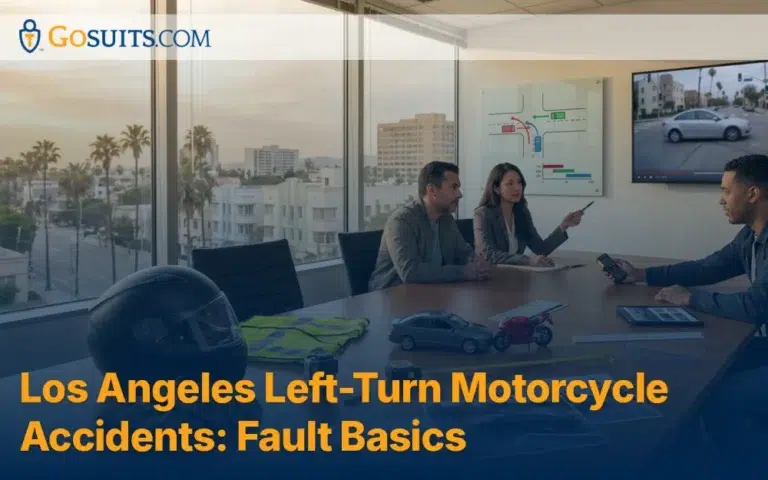
A left turn motorcycle accident happens when a vehicle turns left across the path of a motorcyclist who is proceeding straight through an intersection, approaching from the opposite direction, or in some cases overtaking traffic in an adjacent lane. In Los Angeles, these crashes are common at busy junctions like Hollywood and Highland, La Brea and Sunset, and along Ventura Boulevard, where complex signal timing and heavy traffic create visual clutter, short decision windows, and multiple conflict points.
Nationally and in California, intersections present elevated risk for all road users. Federal safety agencies highlight that a large share of serious crashes occur at or near intersections, where drivers must judge speed and distance while scanning for smaller road users like motorcycles that are easier to overlook [12]. Motorcyclists are also more vulnerable to severe injury because they lack a vehicle frame and restraints, which is why federal highway safety materials stress extra caution at intersections and the need for drivers to scan carefully for bikes [11].
In Los Angeles, Vision Zero initiatives identify a High Injury Network of streets that account for a disproportionate number of severe and fatal traffic injuries, many of which cluster at complex intersections. Understanding these patterns helps us focus investigation and prevention on intersection approaches, signal compliance, and turning movements where risk concentrates [14].
Who has the right of way during a left turn under California Vehicle Code 21801?
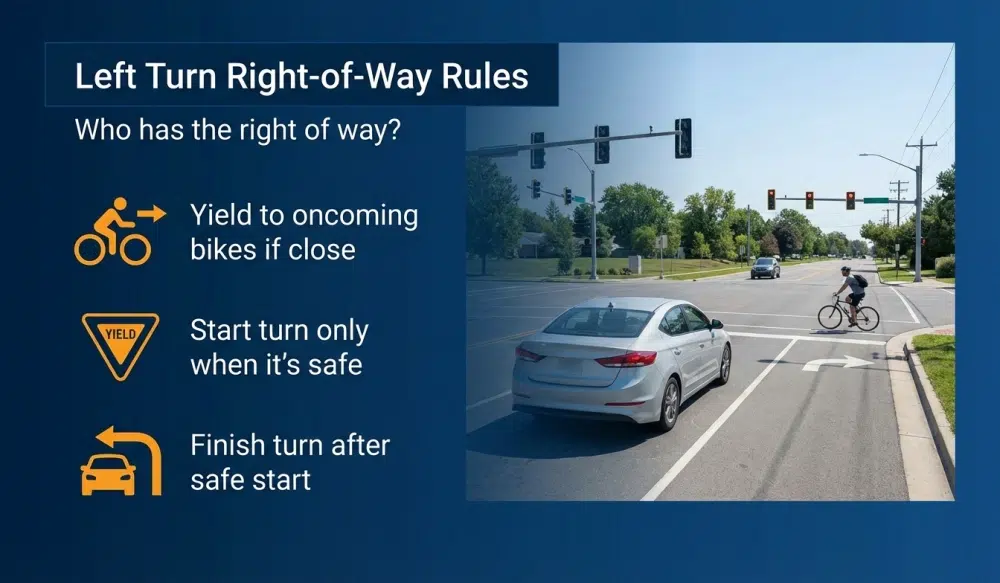
California Vehicle Code section 21801 governs left turns. A driver intending to turn left or make a U turn at an intersection must yield the right of way to any oncoming vehicle that is close enough to pose an immediate hazard. Only when it is safe may the turning driver proceed, and once the turn has been initiated safely, oncoming traffic must yield to the turning vehicle completing its maneuver [1].
Other provisions of state law reinforce safe turning. California Vehicle Code section 22107 requires that a turn or lane change be made only when it can be done with reasonable safety and after giving an appropriate signal [2]. California’s basic speed law at section 22350 prohibits driving at a speed greater than is reasonable or prudent under the conditions, which can apply to both the turning driver and the motorcyclist approaching the intersection [3]. The California Driver Handbook echoes these rules in plain language, explaining that drivers turning left must yield to oncoming traffic and pedestrians before proceeding [4].
How is fault determined in a Los Angeles left turn motorcycle crash?
Fault in a civil case is based on whether someone breached a duty of care and caused harm. In left turn motorcycle collisions, fact finders consider whether the turning driver failed to yield to an oncoming motorcycle that was an immediate hazard under section 21801 [1], whether the driver failed to signal or execute the maneuver safely under section 22107 [2], and whether either party violated the basic speed law at section 22350 [3]. A proven violation of a safety statute can support a finding of negligence per se under Evidence Code section 669 when the law was designed to prevent the type of harm suffered and the injured person was in the protected class [6].
Investigators also look at visibility, line of sight, and timing. Was the motorcycle conspicuous and within a reasonable distance when the turn began, considering lighting, weather, and traffic? Did signal phasing permit the turn, and was there a protected arrow or permissive green? Did either party accelerate or brake unexpectedly? The California Driver Handbook guidance on right of way, combined with the statutory framework, provides a baseline for analyzing whether each person used reasonable care under the circumstances [4].
What evidence best proves fault in an intersection motorcycle accident in Los Angeles?
Evidence is often strongest when it ties timing, distance, and visibility to the exact moment the turn started. Useful sources include:
- Traffic signal data and timing plans. Signal timing from Los Angeles Department of Transportation can show whether a left turn arrow was active and how long permissive lefts run. This helps establish if a driver had enough time to clear before oncoming traffic arrived. Local Vision Zero resources map corridors with frequent intersection injury patterns, aiding context [14].
- Dashcam, intersection, or storefront video. Video can confirm approach speeds, lane positions, and when a turn commenced relative to the motorcyclist’s approach.
- Event data recorder and infotainment logs. Many newer vehicles store limited pre impact speed and brake data. Where available, this can corroborate eyewitness accounts.
- Scene forensics. Skid marks, gouge marks, debris fields, impact points, and final rest positions allow reconstructionists to estimate speed and path of travel.
- Vehicle damage profiles. Crush patterns and paint transfers help confirm angle of impact and lane use during the turn.
- Witness statements. Independent witnesses can clarify whether the motorcycle had a stale green, whether the left turning driver waited, and whether either party hesitated, accelerated, or deviated unexpectedly.
- Police collision report and diagram. The report documents scene observations, driver statements, diagrams, and any citations. While not dispositive of civil fault, it provides foundational facts and often references the relevant code sections, such as section 21801 [1].
Increasingly, Los Angeles riders use helmet or handlebar cameras. Clear, time stamped video that captures the approach through the intersection is powerful proof of right of way and speed. Cell tower data, rideshare telematics, and smartphone motion logs may also support timing and movement analysis when properly preserved.
What defenses do drivers and insurers raise in left turn motorcycle collisions?
Insurers frequently assert comparative fault. Common arguments include:
- Approach speed. The driver claims the motorcyclist was traveling faster than was reasonable or prudent under the conditions, invoking the basic speed law at section 22350 [3].
- Signal and distance judgment. The driver contends the motorcycle was far enough away that a reasonable person could complete the turn safely, so the motorcycle’s later acceleration created the hazard.
- Lane position and lane sharing. In California, lane splitting can be lawful when done safely. Section 21658.1 recognizes the practice and authorizes safety guidance, and the California Highway Patrol publishes lane splitting safety tips. Insurers may still argue that lane sharing near an intersection made the rider less visible or created a surprise movement that contributed to the collision [10] [9].
- Conspicuity. The driver alleges the motorcycle lacked adequate lighting or the rider wore low contrast gear, reducing visibility at dawn, dusk, or night.
- Signal non compliance. The defense asserts the motorcyclist entered on a red or late yellow or failed to obey a traffic control device, undermining right of way.
These defenses are fact intensive. They can be addressed through time distance analysis, lighting and visibility studies, and expert testimony. The California Driver Handbook and relevant vehicle code provisions provide objective standards on yielding, signaling, and safe turns that anchor the analysis [4] [1] [2].
How does comparative negligence in California affect your recovery?
California follows pure comparative negligence. In plain terms, if both parties bear some share of fault, a plaintiff’s damages are reduced by their percentage of fault rather than eliminated. The California Supreme Court recognized this rule in a leading decision, replacing the older rule that any contributory negligence would bar recovery entirely [5].
For example, if a jury finds the left turning driver 80 percent at fault for failing to yield under section 21801 [1] and the motorcyclist 20 percent at fault due to unsafe speed under section 22350 [3], the rider may still recover 80 percent of proven damages. This proportional approach accounts for the realities of traffic interactions at complex Los Angeles intersections and allocates financial responsibility accordingly.
What if the at fault driver was uninsured or underinsured in California?
If the person who cut across your path has no coverage or too little coverage, California Insurance Code section 11580.2 allows you to seek benefits under your own uninsured motorist and underinsured motorist coverage if you purchased it. UM applies when the other driver has no liability insurance, and UIM applies when the other driver’s policy limits are lower than your damages. These claims typically require prompt notice to your insurer and careful documentation of liability, injuries, and damages [8].
Even in UM or UIM claims, evidence of fault still matters. Your insurer may dispute liability or the degree of comparative negligence. Thorough preservation of scene evidence, video, witness accounts, and medical documentation will support your claim and improve claim valuation.
What is the statute of limitations for a motorcycle accident claim in California?
Most personal injury claims in California must be filed within two years of the date of injury under Code of Civil Procedure section 335.1 [7]. Property damage claims often have a different timeline. Claims against government entities, such as when a public vehicle is involved or roadway design is implicated, have additional administrative claim deadlines that are shorter than two years. It is important to evaluate all potential defendants and deadlines early to preserve your rights.
Do police reports and citations decide civil fault in Los Angeles left turn cases?
No. A traffic citation is not the final word on civil liability. The civil standard looks at the totality of evidence and applies the preponderance of the evidence standard to determine negligence. A citation can be evidence of a statutory violation, but civil courts still assess whether any party breached a duty and whether that breach caused the harm, including consideration of comparative negligence principles recognized by California courts [5]. The collision report remains useful for facts, diagrams, and code references, especially to section 21801 on left turns and section 22107 on signaling [1] [2].
How do insurance investigations evaluate left turn motorcycle claims?
Insurance adjusters commonly:
- Map approach times and distances using speed estimates, sight lines, and signal timing to test whether each party had a reasonable opportunity to avoid the crash.
- Analyze lane positions to determine if the turn encroached into the motorcyclist’s right of way or if the motorcycle changed lanes near the intersection in a way that created a new hazard.
- Assess compliance with sections 21801, 22107, and 22350, and review Driver Handbook principles on right of way [1] [2] [3] [4].
- Consider lane sharing in light of section 21658.1 and CHP safety guidance. While lane splitting can be lawful when done safely, unsafe lane sharing near intersections may be argued as comparative negligence if it contributed to the inability of a turning driver to judge distance or see the rider [10] [9].
- Request recorded statements and inspect physical damage to compare with reported versions of events.
To protect your interests, be careful with recorded statements before your injuries and the facts are fully documented. Focus early on medical care, preserving evidence, and documenting losses. If you have questions, Los Angeles motorcycle accident lawyers can help you navigate insurer requests and keep the investigation focused on objective evidence rather than speculation.
What damages can you seek in a civil motorcycle accident case?
Depending on the evidence, you may seek compensation for:
- Medical expenses for emergency care, hospitalization, surgery, rehabilitation, and future treatment related to crash injuries.
- Lost income and loss of earning capacity if injuries reduce your ability to work or advance in your career.
- Out of pocket costs for transportation to treatment, home assistance, and medical devices.
- Pain and suffering including physical pain, emotional distress, and loss of enjoyment of life.
- Property damage for motorcycle repair or replacement and gear.
The amount and type of recoverable damages depend on medical documentation, expert opinions, employment records, and how California comparative negligence principles apply in your case [5].
What should you do after a left turn motorcycle crash in Los Angeles?
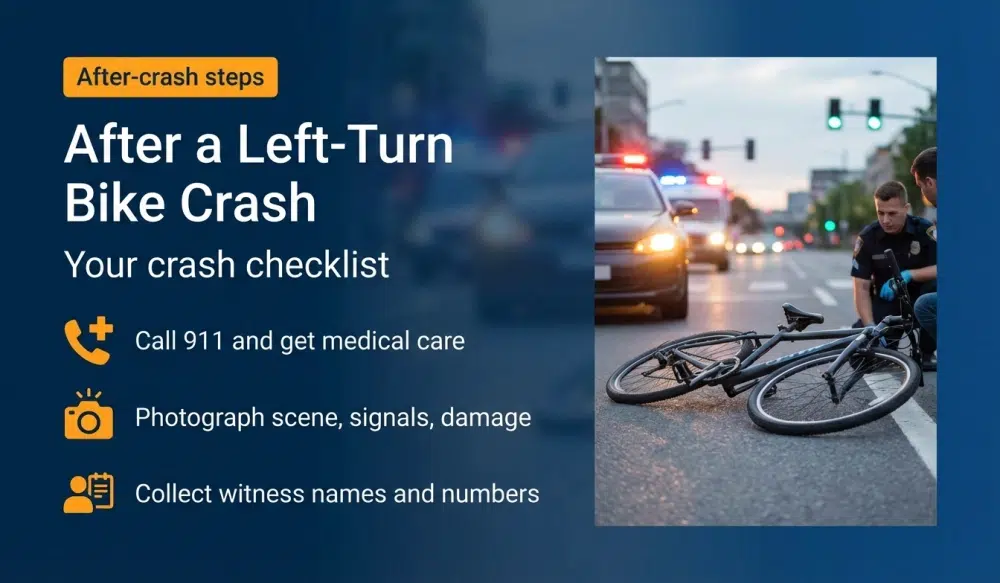
Your safety comes first. If you can do so safely:
- Call 911 and request medical evaluation. Some injuries are not immediately obvious.
- Wait for police to document the scene. Ask for the report number and the investigating agency. For state roadways, the California Highway Patrol collision report process is published online [13].
- Document the scene with photos or video of vehicle positions, damage, skid marks, signals, and signage. Capture vantage points from the turning driver and from your approach.
- Identify witnesses and request contact information. Independent witnesses often make the difference in intersection disputes.
- Preserve your gear including helmet, jacket, and damaged equipment. These can support impact and injury mechanism analysis.
- Seek follow up care and follow medical recommendations. Keep all records and receipts.
In the days that follow, avoid posting about the crash on social media, do not repair or dispose of the motorcycle until it is thoroughly photographed and inspected, and keep a journal of symptoms and limitations. If an insurer contacts you for a recorded statement, you can request time to review the police report and consult with counsel first. In many cases, motorcycle accident lawyers in Los Angeles can coordinate evidence preservation quickly, including requests for nearby video before it is overwritten.
How can a lawyer help with a left turn motorcycle crash claim?
A lawyer can investigate promptly, gather video and signal timing data, retain accident reconstruction and human factors experts when appropriate, and analyze how sections 21801, 22107, and 22350 apply to the facts [1] [2] [3]. Counsel can also frame negligence per se arguments under Evidence Code section 669 if a safety statute violation contributed to the crash [6], while preparing to counter comparative negligence claims with objective time distance analysis and visibility studies. In a serious injury case, early expert input often strengthens claim valuation and settlement leverage.
When liability is disputed, counsel can obtain sworn testimony, subpoenas for data, and expert reports that explain how a reasonable driver should have yielded based on the motorcycle’s proximity and speed. In UM or UIM cases, counsel can navigate policy language, coverage triggers, and valuation with your own insurer under Insurance Code section 11580.2 [8]. If settlement is not fair, a trial ready approach can motivate resolution and, if needed, present the case to a jury with clear, evidence based explanations of right of way and safe turning rules.
Many riders appreciate working with Los Angeles motorcycle accident lawyers who understand local intersections, typical traffic patterns, and the way Los Angeles juries evaluate left turn right of way disputes. Experienced teams can translate technical reconstruction into clear, human centered narratives that honor your story and the law.
If you prefer to learn more before you decide, motorcycle accident lawyers can offer a no cost case review to help you understand timelines, evidence, and options without pressure.
About GoSuits
We focus on helping people injured in traffic crashes throughout California, including Los Angeles, Orange County, and the Bay Area. Our team offers free consultations so you can understand how California law applies to your situation, the evidence that will matter most in a left turn motorcycle case, and how timelines like the two year statute apply to you [7].
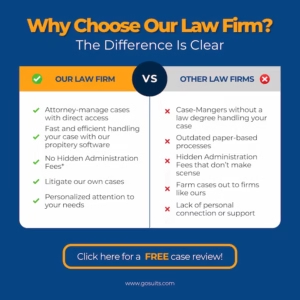
We use a technology driven approach anchored by exclusive proprietary software that organizes investigation, medical records, and litigation tasks in one workflow to move cases faster while maintaining quality. Even with strong technology, your case is personal. Every client has a designated attorney from start to finish, not a case manager. You have direct, unfettered access to your attorney for updates, strategy, and questions.
- Innovation leadership. Our proprietary case engine surfaces time sensitive tasks, video preservation windows, and expert needs early, which can be decisive in intersection cases with short video retention cycles.
- Proven results. We have obtained meaningful outcomes for clients in serious injury cases. For examples, see our prior cases.
- Trial experience. We prepare every claim as if it will be tried. A trial focused posture strengthens negotiation and keeps insurers accountable when fault is disputed in left turn right of way crashes.
- Thirty years of combined experience. Our attorneys bring decades of courtroom and negotiation experience to claims involving motorcycles, cars, trucks, and complex injury litigation.
- Practice areas. We handle motorcycle, car, and truck collisions, premises injuries, product claims, and wrongful death. Explore our practice areas.
Learn who we are on the about us page and meet our attorneys. If you want to talk through a left turn motorcycle claim, we are ready to help.
Which local Los Angeles resources help with evidence and safety context?
Two public resources are especially useful. First, LADOT’s Vision Zero program maps corridors with high concentrations of severe injuries, providing valuable context for intersection design and expected driver behavior [14]. Second, California OTS publishes collision data and trends that can support broader safety analyses and policy discussions for intersection approaches across California [13].
Does lane splitting affect fault in a left turn motorcycle crash?
Lane splitting can be lawful in California when done safely. Vehicle Code section 21658.1 recognizes motorcycle lane sharing and authorizes safety guidance, and the California Highway Patrol publishes practical tips for safer lane sharing. In civil cases, the question remains whether either party used reasonable care. If the rider was lane sharing prudently and was close enough to be an immediate hazard, the left turning driver must still yield under section 21801. If lane sharing was unsafe under the conditions, an insurer may argue comparative negligence and seek a percentage reduction of damages [10] [9] [1].
What statistics help explain left turn motorcycle crash risk?
National and state agencies report that motorcyclists are overrepresented in serious crashes, and that intersection conflicts are a frequent scenario for severe injuries. Federal highway safety materials emphasize the need for extra vigilance at intersections and awareness of smaller road users that can be hidden by traffic and roadside features [11] [12]. California OTS provides collision data tools to review county and city level trends, including motorcycle involvement in intersection crashes, which can inform safety planning and litigation strategy [13].
How do plaintiffs and defendants each frame the case?
From the rider’s perspective, the focus is on right of way, visibility, and the duty of a turning driver to wait until the motorcycle is no longer an immediate hazard. Time distance studies and sight line photos from the driver’s vantage point can powerfully demonstrate that the rider was plainly visible and close. From the defense perspective, the narrative often emphasizes approach speed, signal timing, or a sudden maneuver by the motorcyclist. Both sides rely on the same statutes and driving rules, different interpretations of human perception and response time, and objective reconstructions grounded in physics and roadway design. California’s comparative negligence framework allocates responsibility proportionally if both made errors [5] [1] [3].
If you are weighing next steps after a crash, motorcycle accident lawyers can help you prioritize medical recovery, preserve critical intersection evidence, and prepare a clear timeline and technical analysis that addresses common defenses. Los Angeles motorcycle accident lawyers understand how local signal timing, protected versus permissive lefts, and urban sight lines affect liability and claim value across the city’s busiest corridors.
References
- California Vehicle Code section 21801 Left Turns and U Turns Yielding – California Legislative Information
- California Vehicle Code section 22107 Turning Movements and Required Signal – California Legislative Information
- California Vehicle Code section 22350 Basic Speed Law – California Legislative Information
- Right of Way Chapter – California Driver Handbook – California DMV
- Li v. Yellow Cab Co. 13 Cal. 3d 804 1975 – CourtListener
- California Evidence Code section 669 Presumption of Negligence – California Legislative Information
- California Code of Civil Procedure section 335.1 Two Year Limitation for Injury – California Legislative Information
- California Insurance Code section 11580.2 Uninsured and Underinsured Motorist Coverage – California Legislative Information
- Lane Splitting General Safety Tips – California Highway Patrol
- California Vehicle Code section 21658.1 Lane Splitting Guidance – California Legislative Information
- Motorcycle Safety Overview – National Highway Traffic Safety Administration
- Intersection Safety Overview – Federal Highway Administration
- Collision Data and Research – California Office of Traffic Safety
- Vision Zero Program – Los Angeles Department of Transportation